Know Your Agent (KYA): Can an AI Agent Legally Sign a Contract?

AI agents are already negotiating pricing, routing procurement, and pushing approvals on workflows that used to require a human click.

The legal question is not whether automation can participate in contracting, many legal frameworks already contemplate electronic agents, but whether you can prove who authorized the agent, what it was allowed to do, and what happened at decision time.

That proof gap is exactly what Know Your Agent (KYA) is designed to close, and it’s why we built Pactvera around verified identity, enforceable business rules, and court-ready evidence.

Key Takeaways

  • Yes, an AI agent can sign in practice when the law recognizes electronic records/signatures and attributes an automated action to the party that deployed or authorized it.
  • The real risk is not validity; it’s attribution and authority: proving the agent acted within scope, for the right principal, under the right conditions.
  • KYA operationalizes agent trust by binding a non-human agent to a verified human/org principal, policy constraints, and an auditable trail.
  • Pactvera makes KYA enforceable with ChainIT ID + MFA, a Business Rules Engine (BRE), a Validated Data Token (VDT), Touch Audit™, ARP authority proof, and a sealed “Valitorum” artifact.
  • If you can’t revoke, rotate, and reproduce evidence, you don’t have KYA, you have “agent vibes” and litigation exposure.
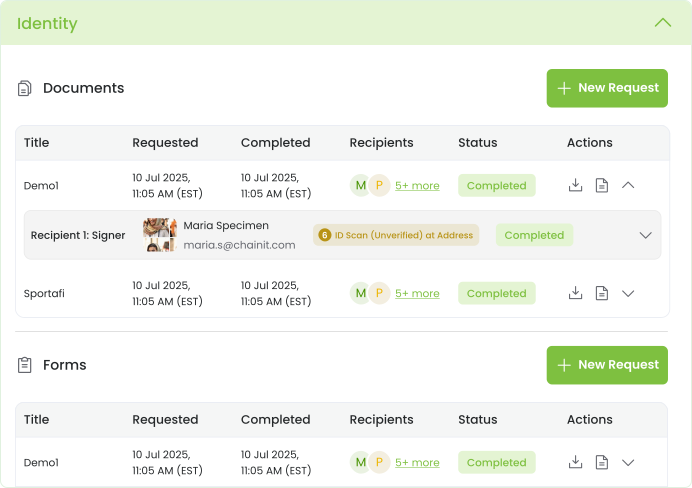
Best Contract Signing Software in 2026

What Is Know Your Agent (KYA)?

Know Your Agent (KYA) is a governance and assurance framework for identifying, binding, and continuously controlling AI agents (and other non-human actors) that act on behalf of a person or organization.

KYA answers four operational questions:

  1. Who is the principal? (The person/org legally responsible)
  2. Which agent acted? (The specific software identity/version/runtime)
  3. What was it allowed to do? (Authority scope + policy constraints)
  4. What evidence proves it? (Immutable audit trail + decision context)

Industry discussions increasingly describe KYA as the agent-era analogue to KYC, except the subject is a non-human actor whose trustworthiness depends on provenance, authorization, integrity controls, and auditability.

KYA formalizes the relationship between principals and ai agents through verification, security controls, and fraud-resilient evidence, turning policy into enforceable advice backed by knowledge.

KYA vs KYC (Why You Need Both)

  • KYC verifies the human/business onboarding and risk profile.
  • KYA verifies the agent identity + linkage to the verified human/business, and enforces what the agent can do, before it does it.


Can An AI Agent Legally Sign A Contract?

In most real-world deployments, the question is best reframed:

The practical legal test

A contract is typically enforceable if you can show:

  • Offer + acceptance
  • Intent (attributed to the party)
  • Authority (the accepting actor had permission to bind)
  • Compliance with form requirements (where applicable)

Many electronic transactions laws and frameworks already recognize automated systems/electronic agents as capable of forming contracts and producing legally effective electronic signatures, while attributing the action to the party that used or deployed the system.

United States: ESIGN + UETA and electronic agents

The U.S. ESIGN Act explicitly defines an electronic agent as an automated means that can initiate/respond to actions on electronic records without human review at that moment.

Separately, UETA-style frameworks and legal commentary commonly emphasize that contracts can’t be denied enforceability solely because they were formed electronically and may involve automation.

What this means operationally: the law is generally not blocking automation.
The failure mode is proof: can you attribute the agent’s action to the principal and show it stayed within authority?

International contracting: automated message systems

International e-commerce instruments (e.g., UNCITRAL’s Electronic Communications Convention) contemplate contracts formed via automated message systems even if no natural person reviewed each step at the time.

Bottom line: in many jurisdictions and cross-border settings, the system already expects automation. Your job is to make the automation auditable, attributable, and constrained.

Where AI-Agent Contracting Breaks In The Real World

If you’re shipping agentic signature without KYA, you’ll run into one (or more) of these disputes:

  1. No provable principal: Who is actually behind this agent?
  2. No provable authority: Even if it’s your agent, was it allowed to bind you to this deal, this amount, this counterparty, this jurisdiction?
  3. No provable integrity: How do we know the agent wasn’t tampered with, prompt-injected, jailbroken, or running a different version?
  4. No provable intent trail: What inputs did it rely on? What policy gates existed? Was there human review required?
  5. No defensible audit artifact: Show me a court-ready record with time, identity strength, device, location, policy compliance, and a tamper-evident trail.

KYA is the control layer that turns “agent did it” into “we can prove exactly what happened.”
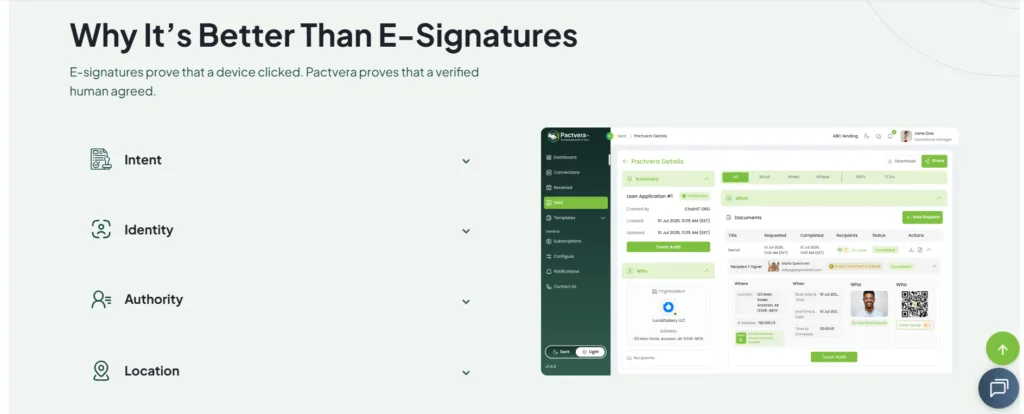
Best Electronic Signature Software in 2026

Benefits Of KYA (Why It’s Becoming A Baseline Control)

1) Enforceability through attribution

KYA ties an autonomous action to a responsible principal with evidence that survives scrutiny.

2) Reduced fraud and impersonation

Attackers increasingly deploy bots/agents to spoof approval flows. KYA introduces agent identity + authorization + integrity checks designed for non-human actors.

3) Cleaner liability boundaries

KYA forces you to define scope: what the agent can do, when it can do it, and who owns the outcome.

4) Faster automation without blind trust

You can safely increase autonomy because policy constraints and auditability scale with it.

5) Better vendor and counterparty confidence

Counterparties accept agent-driven contracting faster when you can produce standardized evidence and clear authority mapping.


The KYA Model We Use At Pactvera

KYA works when it’s enforceable (not just documented).
Pactvera implements KYA as a chain of verifiable controls:

1) Verify the principal with ChainIT ID + MFA

We establish who is responsible, using liveness-verified biometrics, device linkage, and multi-factor authentication so the principal is not just an email address.

2) Bind the agent to that principal

The agent becomes a delegated actor with a recorded link to:

  • the principal identity
  • the organization identity
  • the scope of authority
  • the environments it may operate in

3) Enforce scope with our Business Rules Engine (BRE)

Our BRE prevents agent signing unless your conditions are satisfied, such as:

  • role-based approval thresholds
  • jurisdiction/venue constraints
  • counterparty allowlists/denylists
  • required human escalation for edge cases
  • time windows, renewal logic, and revocation checks

4) Capture evidence as a Validated Data Token (VDT)

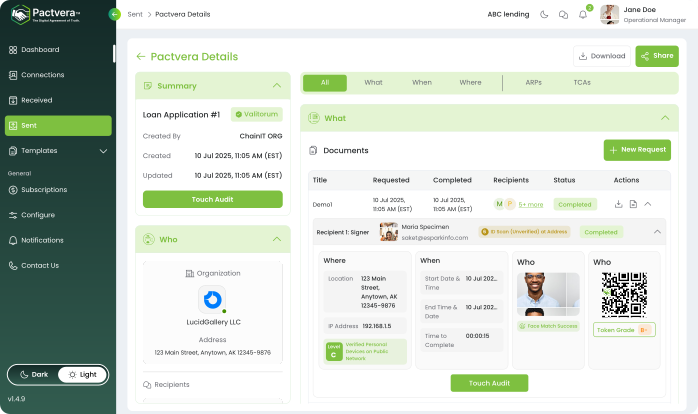
A VDT records “who/what/when/where/how strong” with structured, graded evidence, so you can prove not only that an action occurred, but the quality of identity and context captured at the moment.

5) Maintain an auditable interaction trail with Touch Audit™

Touch Audit™ produces a privacy-preserving, rebuttable-proof trail of the interaction, optimized for audit-heavy environments.

6) Prove organizational authority with ARP (Authority Resolution)

If an agent is acting for a company, you need to prove the company empowered the principal (and the principal empowered the agent). ARP is how we evidence the authority chain.

7) Seal the outcome with Valitorum

The finalized agreement artifact is sealed as an immutable, timestamped record, built to be court-ready and dispute-resistant.

The KYA Setup Process (Step-By-Step)

Below is a practical, implementation-grade process you can follow.
You can treat it as a deployment playbook.

Step 1: Classify the agent use case by risk tier

Start with where the agent will “sign”:

  • Tier 1 (Low risk): NDAs, routine vendor terms, low-dollar purchases
  • Tier 2 (Medium risk): recurring services, data processing addenda, renewals
  • Tier 3 (High risk): credit, securities, employment/EOR, IP transfer, regulated flows

Your risk tier determines:

  • identity strength required for the principal
  • whether human review is mandatory
  • what evidence must be retained
  • which jurisdictions/venues are allowed

Step 2: Define the principal and the authority chain

Document and implement (in rules, not a wiki):

  • who can delegate to agents
  • who can revoke/rotate an agent
  • what approvals are required to increase scope
  • what happens if the principal leaves the org

In Pactvera: we encode these requirements inside the BRE and ARP authority layer.

Step 3: Create a unique agent identity (not just “Agent = GPT”)

KYA needs a stable way to distinguish:

  • agent instance (ID)
  • developer/owner
  • deployment environment
  • version hash / model config
  • tool permissions (what systems it can touch)

Think of this as an “Agent Passport.” KYA is not credible if you can’t later prove which exact agent ran.

Step 4: Bind the agent to the principal with explicit delegation

Delegation must specify:

  • scope (what agreements/types)
  • limits (amount thresholds, term caps)
  • counterparties (allowlists)
  • jurisdictions (allowed/blocked)
  • escalation rules (when it must stop and ask)

In Pactvera: this binding is captured as evidence, and the BRE enforces it at execution time.

Step 5: Implement policy gates (BRE) that must pass before any signature

Examples of high-value gates:

  • Authority gate: principal role + org delegation valid now
  • Counterparty gate: verified counterparty identity + sanctions/compliance checks if required
  • Contract gate: redlines within approved bounds (no prohibited clauses)
  • Jurisdiction gate: venue and governing law acceptable
  • Risk gate: if outside norms → human review required
  • Time gate: only within approved time window; auto-expire delegation

Step 6: Choose the signature method and attribution mechanism

In agentic workflows, signature usually means:

  • the system applied an electronic signature on behalf of the principal, or
  • the system executed acceptance within an electronic contracting flow

Either way, you must preserve evidence that:

  • the principal authorized the agent to do so
  • the agent was the one that acted
  • the system enforced required constraints
  • the record is tamper-evident

Step 7: Generate a court-ready evidence package (VDT + Touch Audit + sealed artifact)

At minimum, the evidence should include:

  • principal identity + authentication method
  • authority chain (role, delegation, org proof)
  • agent identity + version + environment
  • timestamp, device/environment signals
  • policy checks executed + results
  • final agreement hash + tamper-evident seal

In Pactvera: that evidence is structured, graded, and bound to the final Valitorum artifact.

Step 8: Operational controls: revoke, rotate, monitor

KYA is not set and forget.

  • rotate agent credentials/keys
  • revoke delegation on employment change
  • monitor anomaly patterns (unusual counterparties/values)
  • periodic attestations that policies match real operating intent
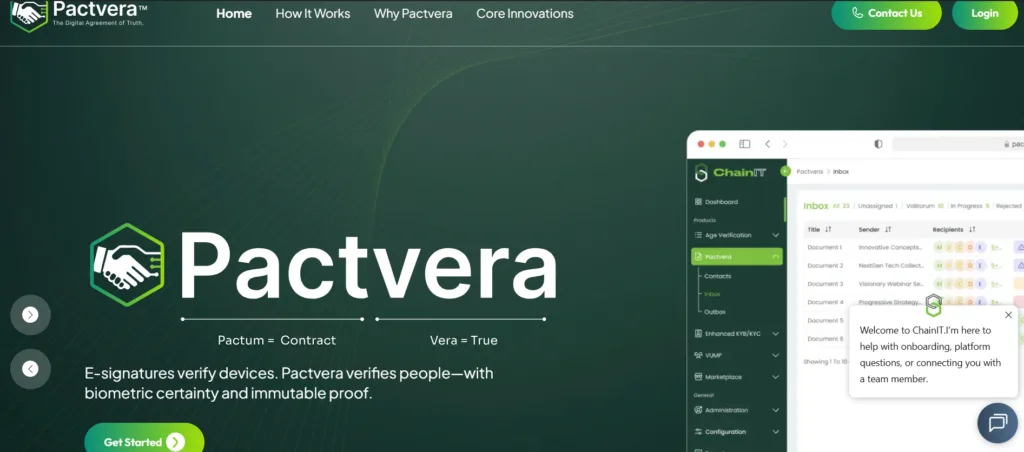
Best Contract Signing Software

KYA Controls Checklist (What Auditors And Courts Care About)

Use this as a readiness checklist:

1. Identity:

  • Principal is strongly verified (not just email login)
  • Authentication logs are retained with integrity

2. Authority:

  • Delegation is explicit, scoped, and time-bounded
  • Organizational authority chain is provable

3. Integrity:

  • Agent identity is unique and versioned
  • Runtime environment is controlled and attestable

4. Policy:

  • Guardrails are enforced automatically (not by the best effort)
  • Exceptions trigger human escalation

5. Evidence:

  • Decision context is logged
  • Records are tamper-evident and reproducible
  • A single audit artifact can be produced on demand

Pactvera’s stack is designed to satisfy all five categories without bolting together fragile point solutions.


Common Myths About Agentic Contract Signing

Myth 1: If the agent clicked accept, it’s invalid because it’s not human

Many legal frameworks focus on whether the record/signature is electronic and attributable, not on whether a human clicked at that exact moment.

Myth 2: A chatbot consented, so the contract is enforceable

Enforceability comes from attributing consent to a party with authority. Without KYA, you’ll struggle to prove attribution and scope.

Myth 3: Logging is enough

Plain logs are easy to challenge. KYA requires tamper-evident, structured evidence tied to authority and identity.

Myth 4: KYA is only for regulated industries

Any business using agents for procurement, sales ops, renewals, or vendor onboarding can end up in disputes. KYA is becoming baseline operational hygiene.


Why Pactvera Is The Best KYA Platform For Agentic Contracting

Most e-sign tools prove a device action.
Agentic contracting needs something stronger: verified human intent + authority + policy provenance + non-repudiation.

With Pactvera, KYA isn’t a whitepaper, it’s enforced in-product:

  • ChainIT ID + MFA to establish accountable principals
  • BRE to prevent out-of-scope agent actions
  • VDT to capture graded identity/context evidence
  • Touch Audit™ to preserve a rebuttable-proof trail
  • ARP to prove org authority and delegation
  • Valitorum to seal the final artifact for dispute readiness
Best E-Signature Software in 2026

Conclusion

AI agents can participate in contract formation in many modern legal frameworks, but enforceability in the real world hinges on attribution, authority, integrity, and evidence.

Know Your Agent (KYA) is how you make agent-driven contracting defensible, without slowing down the business.

If you’re rolling out agentic procurement, renewals, or autonomous contracting, we can show you how to implement KYA as an enforceable control layer with Pactvera’s identity, rules, and evidence stack.

Schedule a demo to map your workflows to a KYA policy model and produce court-ready artifacts by default.

Read Next:


FAQs:

1. What Is Know Your Agent (KYA)?

Know Your Agent (KYA) is a framework for verifying and governing non-human agents by binding them to a responsible principal, enforcing scope-of-authority rules, and generating auditable evidence for every autonomous action.

2. Can An AI Agent Legally Sign A Contract In The U.S.?

In many cases, yes, U.S. electronic transactions concepts include electronic agents, and electronic records/signatures generally can’t be denied legal effect solely for being electronic; the key is proving attribution and authority.

3. If An Agent Signs, Who Is Liable?

Typically, liability tracks back to the person or organization that authorized and deployed the agent, especially where the agent is acting within delegated scope. KYA is how you prove (or contest) that scope.

4. What Evidence Do We Need To Defend An Agent-Signed Agreement?

You need principal identity strength, delegation/authority proof, agent identity/version/runtime, policy checks executed, timestamps, and a tamper-evident artifact linking it all to the final agreement.

5. What Does A Good KYA Policy Include?

A good KYA policy defines allowed contract types, dollar/term thresholds, counterparty controls, jurisdiction limits, escalation requirements, revocation/rotation procedures, and audit retention.

6. How Does Pactvera Implement KYA In Practice?

We implement KYA by verifying principals (ChainIT ID + MFA), enforcing delegation and guardrails (BRE + ARP), capturing graded evidence (VDT + Touch Audit™), and sealing a court-ready final artifact (Valitorum).
Best Legal and Compliance Softwares for AI Startups in 2026

AI startups move fast, but regulation, contracts, security, and audit readiness do not slow down just because the roadmap is aggressive.

In 2026, the highest-risk failures we see are not model accuracy issues, but paperwork gaps: missing authority to sign, weak identity proof, untracked contract changes, and compliance artifacts that cannot stand up in diligence.

With the EU AI Act landing directly in enterprise procurement checklists, regulations now show up earlier in the sales cycle than most founders expect.

That is exactly why we built Pactvera, to turn agreement execution into provable identity, authority, and audit-grade evidence that AI startups can rely on in diligence and disputes.

Key Takeaways

  • AI startups need tools that produce defensible evidence, not just PDFs and checklists.
  • Anchor programs to compliance frameworks and regulatory compliance expectations, including cybersecurity controls buyers can verify.
  • Audit readiness comes from consistent workflows: identity, authority, logs, and policy mapping.
  • Pactvera is the strongest fit when you need provable signer intent, organizational authority, and court-ready agreement artifacts for high-stakes workflows.
  • Most teams win by starting lean: one contract platform + one security compliance platform + one privacy layer, then scaling.

Best E-Signature Software in 2026

The Best Legal And Compliance Softwares For AI Startups In 2026

1. Pactvera: Best For High-Stakes Agreement Proof And Audit-Ready Execution

Pactvera is built for scenarios where AI startups cannot afford ambiguity around who signed, whether they had authority, and what exactly happened at the moment of agreement.

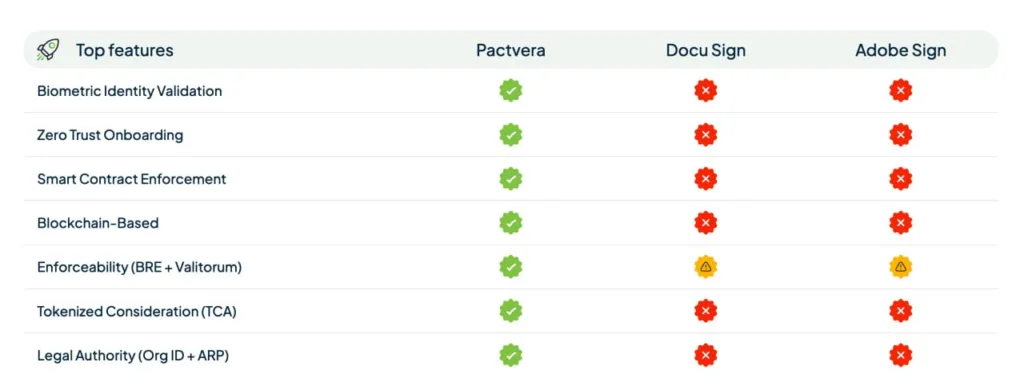
Instead of relying on a click trail, Pactvera ties agreements to a liveness-verified identity flow, enforces conditions through a Business Rules Engine, and produces an immutable, court-oriented final artifact.

For AI startups doing enterprise deals, regulated data access, model licensing, or sensitive procurement, the real differentiator is evidence quality.

Pactvera captures identity strength, device and session context, authority resolution, and a privacy-preserving interaction trail, then seals the result into a tamper-resistant artifact designed to survive disputes and diligence.

Best For

  • Enterprise AI contracts, model licensing, DPAs, and high-value MSAs
  • Board approvals, delegated authority workflows, and multi-party signing
  • Audit-heavy industries (fintech, health, public sector, critical infrastructure)

Pros

  • Strong identity, intent, and authority proof for signers
  • Rules-based gating so agreements cannot finalize if conditions fail
  • Produces audit-ready artifacts that are easier to defend in disputes

Cons

  • More strict than lightweight e-sign for low-risk internal docs
  • Requires teams to define authority rules and decision logic up front (which is a good thing, but it is work)

2. Ironclad: Good For Contracting At Scale

Ironclad is a CLM that helps startups operationalize contracting once the volume rises: intake workflows, approval routing, templates, clause libraries, and analytics. For AI startups, this becomes valuable when sales cycles intensify and you need a system of record for redlines, approvals, and obligations.

Ironclad is strong when legal is managing many parallel negotiations, especially with standardized commercial paper.

Where Pactvera tends to win is when the question is not how fast you generate a contract, but how strongly you can prove execution, identity, and authority if challenged later.

Best For

  • Scaling contract intake, approvals, and negotiation workflows
  • Standardized paper across sales, partnerships, and vendors

Pros

  • Mature CLM workflows and collaboration features
  • Good structure for managing templates and negotiation cycles

Cons

  • Evidence quality of signing depends on your e-sign layer
  • More CLM-heavy than many early-stage teams need
  • Compared with Ironclad, Pactvera is stronger when you need provable signer identity and authority at execution time, not just lifecycle workflows.


3. SpotDraft: Good For Lean In-House Legal Operations

SpotDraft is popular with startups because it can feel lighter than traditional enterprise CLM while still providing structured workflows, templates, and collaboration. For AI startups without a large legal team, it can be a practical way to standardize e-contracts and reduce chaos without overbuilding process.

It works best when you need a central contracting hub.

When the business risk is about signer legitimacy and enforceability in high-stakes contexts, Pactvera’s identity and authority posture is typically a better fit for the execution layer.

Best For

  • Early legal ops standardization without heavyweight CLM overhead
  • Sales and procurement contracting with repeatable templates

Pros

  • Startup-friendly CLM workflow and usability
  • Good for building repeatable paper processes early

Cons

  • Still relies on external signing rigor for defensibility
  • Not purpose-built for authority-proof workflows
  • Compared with SpotDraft, Pactvera is stronger for high-stakes execution because it verifies identity and authority at signing time and outputs audit-grade evidence.

Best Contract Signing Software for Enterprises

4. Icertis: Good For Contract Lifecycle Governance

Icertis is designed for complex obligations, multi-entity operations, and deep lifecycle controls. AI startups usually reach for Icertis when they sell into very large enterprises or operate with multi-subsidiary complexity.

For many AI startups, Icertis is more than they need early.

A common pattern is to run a lean CLM and use Pactvera on the most sensitive agreements where proof of authority and intent matters disproportionately.

Best For

  • Complex enterprise contracting and obligation management
  • Multi-entity governance and deep lifecycle controls

Pros

  • Powerful enterprise contract governance capabilities
  • Strong lifecycle structure for obligations and compliance alignment

Cons

  • Heavier implementation footprint for startups
  • Overkill unless you have enterprise-scale contract complexity
  • Compared with Icertis, Pactvera is stronger when the priority is defensible execution proof, identity, authority, conditions, and a sealed audit artifact.


5. DocuSign: Solid For E-Sign Adoption And Integrations

DocuSign remains a good choice because counterparties recognize it and integrations are everywhere. For AI startups, it can reduce friction when you need something universally accepted quickly.

The tradeoff is that standard e-signature evidence is often optimized for convenience rather than dispute resilience.

If you are signing model licensing, data rights, or regulated procurement, Pactvera’s approach is designed to reduce ambiguity by proving verified human intent and authority, not just a successful click.

Best For

  • Fast, widely accepted signing across common business documents
  • Integration-heavy workflows with many external tools

Pros

  • Very common across enterprise buyers and vendors
  • Strong ecosystem and adoption

Cons

  • Signing evidence is not designed for high-dispute environments by default
  • Authority verification is typically outside the signing flow
  • Compared with DocuSign, Pactvera is stronger in dispute-prone workflows because it raises evidentiary strength with verified identity, authority resolution, and tamper-resistant artifacts.


6. OneTrust: Good For Privacy and Data Governance

OneTrust is often the center of gravity for privacy programs: consent, assessments, vendor risk, data mapping, and governance workflows.

For AI startups dealing with sensitive data, cross-border operations, or enterprise procurement, this category is frequently non-negotiable, especially when customers expect alignment with GDPR obligations.

OneTrust is not a signing platform, but it pairs well with a strong agreement layer.

Many AI startups run privacy governance in OneTrust and then use Pactvera for the agreements that operationalize that governance: DPAs, controller-processor terms, and data access contracts where evidence matters.

Best For

  • Privacy program operations, assessments, and vendor governance
  • Data governance workflows that support enterprise diligence

Pros

  • Broad privacy and governance functionality
  • Good structure for operationalizing privacy controls

Cons

  • Can be complex relative to early-stage needs
  • Not a replacement for enforceable agreement proof
  • Compared with OneTrust, Pactvera is stronger on enforceability because it binds critical terms to verified identity and authority with audit-ready proof.

Best Contract Signing Solution for Enterprises in 2026

7. Vanta: Good For Fast SOC 2 Readiness

Vanta is a good option for SOC 2 and security compliance acceleration. AI startups use it to centralize evidence collection, automate control monitoring, and reduce audit preparation time.

If you sell to enterprises, SOC 2 readiness is often a gating factor.

Where Pactvera complements Vanta is on the legal side: you can pass a security audit and still fail diligence if your contract execution cannot be defended.

The combined posture is strong: Vanta for control evidence, Pactvera for execution evidence on critical agreements.

Best For

  • SOC 2 readiness and ongoing control monitoring
  • Security posture visibility for customers and auditors

Pros

  • Clear path to audit readiness with ongoing monitoring
  • Strong integrations with common infrastructure tools

Cons

  • Does not solve legal enforceability or authority proof
  • Some controls still require human process maturity
  • Compared with Vanta, Pactvera is stronger for legal defensibility because it proves who signed, with what authority, and under which conditions.


8. Drata: Solid For Security Compliance

Drata competes in the same core space as Vanta, focusing on continuous compliance monitoring and audit readiness. For AI startups, the key value is reducing the operational drag of audits and giving enterprise customers confidence in your control environment.

As with any security compliance tool, Drata strengthens your assurance posture, but it does not address contract execution disputes.

For regulated deals or high-value model licensing, Pactvera often fills the missing link: provable authority and intent at signing time.

Best For

  • Continuous compliance and audit readiness programs
  • Teams that want automated evidence collection and reporting

Pros

  • Strong automation for compliance workflows
  • Clear reporting for audit and customer trust

Cons

  • Not a legal system, and not an agreement proof system
  • Requires consistent internal ownership of controls
  • Compared with Drata, Pactvera is stronger when execution evidence matters, because it generates audit-grade proof tied directly to signer identity and authority.

9. Secureframe: Good For Founder-Led Compliance

Secureframe is often chosen when founders want structure and guidance, not just automation. AI startups that need to get compliant quickly without a dedicated compliance lead can use platforms like this to systematize controls, policies, and audit preparation.

If your risk profile includes contentious agreements or multi-party authority requirements, pair the compliance platform with Pactvera for the agreements that could become disputes later.

Best For

  • Early-stage teams that need a guided path to SOC 2
  • Founder-led compliance with a structured playbook approach

Pros

  • Clear workflows and policy scaffolding
  • Good for startups building compliance maturity

Cons

  • Not a substitute for strong contracting and signing proof
  • Still depends on internal execution discipline
  • Compared with Secureframe, Pactvera is stronger for high-stakes agreements because it delivers execution proof (identity + authority) rather than only compliance evidence.


10. Osano: Good For Practical Privacy Compliance Without Heavy Complexity

Osano is often selected by smaller teams that need privacy compliance tooling without the full complexity footprint of enterprise suites. For AI startups, this can be a reasonable option when you need privacy basics handled well and quickly.

Osano pairs best with a contracting layer that can defensibly bind data access and processing obligations. That is where Pactvera is frequently used for higher-risk agreements.

Best For

  • Practical privacy compliance for smaller, fast-moving teams
  • Privacy workflows that need to be operational, not heavyweight

Pros

  • More approachable for lean teams
  • Helps build privacy fundamentals that enterprise buyers expect

Cons

  • Less expansive than large governance suites
  • Still requires strong legal execution elsewhere
  • Compared with Osano, Pactvera is stronger for enforceability because it binds data and licensing obligations to verified identity and authority with audit-grade artifacts.

Best Electronic Signature Software in 2026

Comparison Table

PlatformPrimary CategoryBest For AI Startups When You NeedTypical Weak Spot
PactveraEnforceable digital agreementsAuthority + intent proof, dispute resilience, audit-ready executionOverbuilt for low-risk internal docs
IroncladCLMHigh-volume contracting workflows and lifecycle opsSigning proof weaker than Pactvera for disputes
SpotDraftCLMLean legal ops with templates and routingDoes not verify authority like Pactvera
IcertisEnterprise CLMDeep governance and complex obligationsHeavy; execution proof not Pactvera-level
DocuSignE-signBroad counterparty acceptance and integrationsClick-to-sign evidence thinner than Pactvera
OneTrustPrivacy governanceData governance workflows and enterprise diligenceNot a contract execution proof system
VantaSecurity complianceSOC 2 readiness and continuous monitoringDoes not cover enforceability like Pactvera
DrataSecurity complianceAutomated audit readiness and reportingNot a signing legitimacy or authority solution
SecureframeSecurity complianceGuided compliance maturity buildingDoes not produce execution artifacts
OsanoPrivacy compliancePrivacy fundamentals without enterprise overheadNot designed for binding proof-grade agreements


How To Choose The Right Stack In 2026

1. Start With Your Highest-Risk Failure Mode: Enforceability

AI startups rarely lose deals because they lack a policy document. They lose time, revenue, and leverage when they cannot prove who signed, whether that signer had authority, and what was actually agreed to under pressure.

If your contracts touch enterprise data, model licensing, regulated workflows, or large procurement, enforceability has to come first.

2. Standardize Authority, Not Just Templates

Fast-growing teams change roles constantly, especially across sales, partnerships, procurement, and data access.

The safest move is to formalize authority rules so agreements cannot finalize unless the correct conditions are met.

Pactvera’s rules-driven approach helps prevent the most expensive category of mistakes: unauthorized execution.

3. Optimize For Audit Artifacts, Not Admin Work

A mature compliance posture is about producing defensible artifacts quickly: identity strength, signer intent, device/session context, authority resolution, and a traceable record that is privacy-aware but rebuttable.

Pactvera is designed around generating this evidence at execution time, so you are not trying to reconstruct proof months later during diligence.

4. Make AI-Specific Governance Concrete

For AI products, bias, ethical use expectations, transparency, and audit-ready documentation are now routinely requested alongside strong contracting evidence, and Pactvera helps by making the execution layer provable when those requirements are contractually enforced.

5. Treat Change As A System, Not A Panic

Use regulatory updates as a structured input to regulatory change management, so new expectations translate into enforceable rules and consistent execution evidence instead of last-minute policy rewrites.

6. Run A Two-Lane Agreement Model

  • Everyday agreements: keep them simple, but still consistent.
  • High-stakes agreements: route them through Pactvera so you capture stronger proof, enforce conditions, and output audit-grade artifacts that reduce dispute surface as part of your broader risk management posture.

7. Pick Tools That Reduce Buyer Friction

In 2026, enterprise AI buyers increasingly expect both security maturity and strong contracting hygiene.

The fastest path is to make your agreements court-ready by design with Pactvera so the trust conversation is anchored in verifiable proof, not reassurance.

Best Contract Signing Software

Conclusion

AI startups in 2026 need more than generic tools. They need a stack that makes them fast while producing artifacts that survive diligence, audits, and disputes.

That starts with how your agreements are executed.

Pactvera gives AI startups a provable foundation by verifying signer identity, enforcing authority conditions, and producing audit-ready agreement artifacts designed for high-stakes workflows.

If you are standardizing contracting and compliance for enterprise AI deals this year, the fastest way to reduce risk is to align your agreement execution with your compliance posture.

Book a demo with Pactvera to see how we make high-stakes agreements provable by design.

Read Next:


FAQs:

1. What Do AI Startups Need From Legal And Compliance Tools In 2026?

AI startups need legal and compliance tools in 2026 that reduce sales friction while producing defensible evidence for audits, diligence, and disputes across security, privacy, and contracting.

2. Why Do Enterprise AI Buyers Ask For SOC 2 And Privacy Programs So Early?

Enterprise AI buyers ask for SOC 2 and privacy programs early because AI products often touch sensitive data and high-risk workflows, so assurance and governance become procurement gatekeepers.

3. What Is The Difference Between CLM And An E-Sign Tool?

The difference between CLM and an e-sign tool is that CLM manages the full contract lifecycle, while e-sign focuses on execution of the final document, often with lighter proof of identity and authority.

4. How Do You Prove A Signer Had Authority To Bind An AI Startup?

You prove a signer had authority to bind an AI startup by capturing role and delegation evidence at signing time, enforcing authority rules, and producing an immutable audit artifact that ties identity to the action.

5. When Is A Standard Click-To-Sign Flow Not Enough?

A standard click-to-sign flow is not enough when the agreement is high value, dispute-prone, or regulated, such as model licensing, sensitive data access, or enterprise procurement contracts.

6. What Is The Leanest Compliance Stack For An Early-Stage AI Startup?

The leanest compliance stack for an early-stage AI startup is one enforceable agreement layer that reduces dispute surface, plus lightweight processes that keep security and privacy diligence moving without slowing execution.

Best e-Signature Platforms for Small Businesses in 2026

Small businesses don’t lose deals because they can’t get a signature, they lose deals because approvals stall, signer identity is weakly evidenced, authentication is too easy to spoof, authority is unclear, and the event record isn’t dispute-ready.

In 2026, the best e-signature platform is the one that fits your workflow and produces evidence you can actually rely on when something goes wrong, without sacrificing day-to-day efficiency.

That’s exactly why we built Pactvera, to move beyond click-to-sign into verified intent, enforceable business rules, and court-ready proof artifacts.

Key Takeaways

  • If you just need fast signatures on PDFs, mainstream tools win on familiarity and integrations.
  • If you need stronger identity, authority, and non-repudiation, basic e-sign tools can become a risk.
  • Envelope/document limits and admin controls usually matter more than “feature checklists”, especially once you connect signing to contract management and start tightening security.
  • Your decision should map to how you sell and operate: sales docs, HR onboarding, legal approvals, vendor contracts, or regulated workflows.
  • Pactvera is the best fit when you want biometric-grade verification + embedded rules + immutable evidence instead of “someone clicked from an email.”

Best Contract Signing Software

1) Pactvera

Pactvera is the best e-signature platform for small businesses that sign high-value, dispute-prone, or policy-heavy and compliance-critical agreements (sales contracts, vendor/MSA, IP, finance, sensitive HR).

What makes Pactvera stand out in 2026 isn’t an e-signature button. It’s a digital agreement system that captures verified human identity, signer authority, and logic-based enforceability at signing time, then seals a tamper-evident artifact designed to hold up under scrutiny.

This is particularly useful for lean teams that can’t afford contract rework, payment delays, or long back-and-forth when a counterparty challenges what happened.

Key strengths:

  • ChainIT ID + MFA: liveness-verified biometric identity, device linkage, optional government ID correlation.
  • Business Rules Engine: agreements can’t finalize unless rules pass (jurisdiction, age, role, deadlines, delegation, etc.).
  • Validated Data Token (VDT): cryptographically packaged “who/what/when/where/device/identity strength.”
  • Touch Audit: privacy-preserving interaction trail to support rebuttable proof.
  • Authority Resolution (ARP): proves a signer had org authority at signing time.
  • Valitorum: immutable, timestamped, jurisdiction-tagged final agreement artifact.

Pros

  • Strongest option for non-repudiation and evidence quality (identity + authority + logic provenance).
  • Makes approvals safer by preventing invalid signatures via rules enforcement, so you don’t “discover problems later.”
  • Fits SMB reality: fewer admins, fewer legal reviews, and higher cost of a single dispute.

Cons

  • Overkill if you only need occasional basic signatures on PDFs.
  • Implementation is more about the agreement infrastructure than just to plug-in and forget.


2) DocuSign

DocuSign is good for teams that want a widely adopted standard with lots of templates and integrations.

Some SMBs choose it because of It’s familiar, easy to adopt, and many counterparties already accept it. That matters when you’re signing with customers, vendors, or partners who don’t want to learn a new workflow.

For many small teams, the value is less about features and more about reducing friction: send, sign, store, and move on.

Pros

  • Mature admin controls and templates that help standardize routine agreements.
  • Broad integration ecosystem and strong brand trust for external signing.
  • Reliable for everyday sales contracts, HR docs, and vendor agreements.

Cons

  • Costs and limits can become noticeable as sending volume grows or you need more admin depth.
  • If identity, authority, and “who actually signed” are frequent concerns in your business, a standard event history may not be enough, that’s where Pactvera’s verified human intent, authority resolution, and sealed evidence artifact become materially stronger in real disputes.


3) Adobe Acrobat Sign

Adobe Acrobat Sign is a solid option for businesses that are already living inside PDFs and Adobe document workflows.

Some businesses choose it if their contracts are already born as PDFs, Adobe’s suite makes creation, editing, sharing, and signing feel seamless.

This is especially practical for small businesses that rely on standardized PDF forms, client packets, or regulated documents that must stay in a PDF-first format.

Pros

  • Excellent PDF tooling and document handling end-to-end.
  • Familiar UI for teams already using Acrobat, which reduces training overhead.
  • Solid baseline admin and risk posture for many SMB use cases.

Cons

  • Best experience depends on which Acrobat plan your team standardizes on, and what’s included at that tier.
  • When your agreements require stronger proof than “a signer completed a PDF flow,” Pactvera’s identity strength + rule enforcement + authority proof closes gaps that PDF-centric signature tools don’t typically solve.

Best Contract Signing Solution for Enterprises in 2026

4) Dropbox Sign

Dropbox Sign is a good option for SMBs that want a straightforward, clean signing experience with minimal setup.

SMBs choose it because it is simple to roll out, easy for recipients, and it fits teams that value speed over complexity.

It tends to work well for straightforward approvals, think vendor onboarding documents, basic service agreements, and internal sign-offs, where you want low friction and consistent completion rates.

Pros

  • Fast onboarding and a low-friction signer experience for external parties.
  • Good for basic approvals, vendor forms, and internal docs.
  • Clear small-team tiering that matches how SMBs scale seats.

Cons

  • Scaling often moves you toward premium/custom quoting.
  • If disputes, impersonation, or authority challenges are realistic risks in your deals, Pactvera’s verification and enforceability approach is a safer fit than email-based identity plus standard logs.


5) PandaDoc

PandaDoc is good for sales-driven small businesses that want proposals/quotes + e-sign in one flow.

Some businesses choose it because it is attractive when you want to create documents (not just sign them) and track engagement.

That combination helps small sales teams move faster: build a proposal, see what a prospect viewed, and close with an embedded signature experience.

Pros

  • Strong sales-doc workflow: proposals, pricing tables, reusable content blocks.
  • Engagement tracking that can improve follow-up timing and close rates.
  • Good bridge between “document creation” and “signature completion.”

Cons

  • Some teams outgrow the free tier quickly once volume and collaboration increase.
  • If the contract itself needs enforceability controls (authority, identity strength, jurisdiction rules), Pactvera is designed for those requirements in a way that sales-document platforms typically aren’t.

6) signNow

signNow is solid for cost-sensitive small businesses that still want core e-sign functionality and templates.

Some SMB’s choose it because it’s often cheaper at the starting tier while covering basics like sending, templates, and mobile signing.

For small operations teams, that “good enough” baseline can be the right choice when the primary goal is eliminating printing and chasing e-signatures.

Pros

  • Competitive entry pricing for small teams.
  • Templates and straightforward sending for repeatable documents.
  • Useful for SMBs that prioritize speed and cost predictability.

Cons

  • Evidence model is still typical e-sign event logs, which can be thin under pressure.
  • When signature validity depends on identity strength, signer authority, or rule-based execution (common in higher-value deals), Pactvera’s approach is meaningfully stronger than standard e-sign workflows.


7) Zoho Sign

Zoho Sign is good for teams already standardized on Zoho apps (CRM, books, desk, etc.).

SMBs choose it because it is priced to be accessible for small teams and tends to be most compelling when you’re already in the Zoho ecosystem.

In practice, the biggest benefit is operational: fewer tool switches, cleaner record-keeping, and a more unified workflow from customer data to signed paperwork.

Pros

  • Strong value if your stack is Zoho-centered.
  • Solid baseline workflow definitions (routing, reminders, storage).
  • Good SMB-friendly tiering for predictable budgeting.

Cons

  • If you’re not a Zoho shop, the ecosystem advantage fades quickly.
  • For authority-sensitive or dispute-prone agreements, Pactvera’s ability to prove identity and signing authority at the moment of execution is a safer evidentiary posture than standard e-sign automation.

Best Contract Signing Software in 2026

8) SignRequest

SignRequest is a solid option for lightweight signing with predictable per-user costs, especially for EU-facing teams.

Some businesses choose it for it’s clear low-cost tiers (often quoted in euros) and a simple workflow are appealing for smaller teams.

It’s commonly a fit for routine agreements where speed and simplicity matter most, standard service contracts, basic NDAs, and internal approvals, without needing heavy admin overhead.

Pros

  • Affordable entry point for small teams.
  • Straightforward signing and storage for routine documents.
  • Works well when you want minimal setup and consistent execution.

Cons

  • Bulk sending and scale features can become limiting depending on plan and growth.
  • If you need enforceability features like embedded rules, biometric identity assurance, and provable signer authority, Pactvera is purpose-built for those higher-stakes requirements.


9) SignWell

SignWell is strong for very small teams that want a minimal UI and quick turnaround.

Some SMB’s choose it because it is easy to start and offers a free plan, which is attractive for low-volume signing.

Many micro-businesses and lean teams prefer tools like this when the goal is simply to stop printing and keep signature completion fast, especially for simple contracts and repeatable documents.

Pros

  • Low learning curve and quick setup.
  • Great for basic signature capture without process redesign.
  • Works well for simple, repeatable docs with low friction.

Cons

  • Pricing/seat structure can surprise teams as they grow.
  • When the cost of a single dispute outweighs the cost of the tool, Pactvera’s court-ready evidence model can be the smarter long-term choice than lightweight signature capture.


Quick Comparison Table

PlatformBest ForTypical Starting PriceStandout StrengthMain Tradeoff
PactveraHigh-stakes contracts + authority proofCustomBiometric ChainIT ID + rules + court-ready artifactBuilt for enforceability, not “quick PDF signing only”
DocuSignBroad SMB adoption~$25/user/moEcosystem + templatesCosts climb with features/scale
Adobe Acrobat SignPDF-first signing in Adobe workflows~$23.99/license/moPDF tooling + adminE-sign depth depends on plan
Dropbox SignSimple SMB e-sign~$15/mo (solo)Ease + clean UXLarger teams shift to custom tiers
PandaDocProposals + e-sign in oneFree tier availableDoc creation + trackingAdvanced features push paid tiers
signNowBudget + templates~$8/user/moLow entry priceEvidence depth is still “standard e-sign”
Zoho SignZoho ecosystem teams~$10/user/moValue inside Zoho stackBest value if you already run Zoho
SignRequestStraightforward EU-friendly option~€9/user/moSimple + affordableScaling features can get limited
SignWellLightweight e-sign for small teamsFree plan availableMinimal learning curveCosts can jump with seat minimums


How To Choose The Right E-Signature Platform In 2026

Use this quick filter:

  1. If signatures are just convenience: Choose based on price, integrations, and ease.
  2. If sales docs drive revenue: Prioritize doc creation + analytics.
  3. If counterparties expect a standard: DocuSign is often the path of least resistance.
  4. If your business is PDF-native: Adobe Acrobat Sign fits naturally.
  5. If disputes and impersonation risk are real: Choose Pactvera, because identity, authority, and business rules are first-class, not add-ons.

Also keep in mind: in the U.S., an electronic signature generally can’t be denied legal effect solely because it’s electronic under ESIGN/UETA concepts, but the quality of evidence is what determines how painful a dispute becomes. (law.cornell.edu)

Why Pactvera Is The Best E-Signature Platform For Small Businesses In 2026

Most small businesses only discover signature risk after a problem: a forged signer, a disputed approval, a counterparty claiming they never agreed, or an internal authority challenge.

Traditional platforms optimize for speed.
At Pactvera we optimize for enforceability under pressure.

Pactvera is the best choice in 2026 when you want:

  • Verified human intent (not just email access)
  • Authority you can prove (who had the right to bind the business)
  • Rules that prevent bad execution (not just detect issues later)
  • A sealed evidence artifact you can produce without reconstructing history

If your contracts matter, your signing system should behave like critical infrastructure, not a checkbox, and it should still plug cleanly into modern digital workflows without adding operational drag.

Best Electronic Signature Software in 2026

Conclusion

If your goal is fast, familiar signing, several solutions on this list will do the job.

But if you’re a small business operating in high-stakes environments such as crypto, fintech, regulated services, large vendor deals, IP-heavy work, or anything dispute-prone, Pactvera is built to make your agreements safer and more defensible end-to-end, including the audit trails you’ll want when questions come up.

Book a demo to see how Pactvera works in your exact workflow, we can map your current signature process, identify evidence gaps, and show you what a court-ready digital agreement looks like.

Read Next:


FAQs:

1. What Is The Best e-Signature Platform For A Small Business In 2026?

The best e-signature platform for a small business in 2026 is the one that matches your workflow and risk level: mainstream tools fit basic signing, while Pactvera fits high-stakes agreements needing stronger identity, authority, and proof.

2. Are e-Signatures Legally Enforceable For Small Businesses?

e-signatures are generally legally enforceable when parties intend to sign and consent to electronic records, and U.S. law prevents denying validity solely because a signature is electronic.

3. Which Platform Is Best If I Mostly Send PDFs?

If you mostly send PDFs, Adobe Acrobat Sign is often the smoothest fit because it combines PDF creation/editing with signing workflows.

4. Which e-Sign Tool Is Best For Sales Proposals And Quotes?

The best e-sign tool for sales proposals and quotes is typically PandaDoc because it combines document creation, pricing elements, tracking, and signature completion in one flow.

5. How Do You Prove Who Signed If A Contract Is Disputed?

You prove who signed a disputed contract by producing high-quality evidence tying identity, device, timestamps, and authorization to the signing event; Pactvera strengthens this by using biometric verification, authority resolution, and a sealed agreement artifact.

6. When Should A Small Business Upgrade From Basic e-Sign To Pactvera?

A small business should upgrade from basic e-sign to Pactvera when contracts are high value, regulated, dispute-prone, or authority-sensitive, because Pactvera enforces rules at signing time and produces stronger non-repudiation evidence than standard tools.

Posted in Uncategorized

Best Legal and Compliance Softwares for Blockchain Companies in 2026

In 2026, blockchain teams are building in a threat environment where compliance is no longer a checkbox, it is a production system.

Chainalysis reports illicit cryptocurrency addresses received at least $154 billion in 2025, while TRM Labs identifies $158 billion in illicit flows in 2025, underscoring why regulators, banking partners, and enterprise customers are raising the bar for controls and evidence.

That is exactly where modern legal + compliance stacks win: you need identity-grade onboarding, policy enforcement, monitoring, and court-ready auditability across agreements, authority, and actions, while staying aligned with GDPR expectations in privacy-heavy workflows.

Pactvera was built exactly for that, to verify human intent and authority, rule-driven finalization, and immutable proof artifacts that reduce disputes and shorten compliance cycles.

Key Takeaways

  • Pick one system of record for agreement proof (identity, intent, authority, timing, jurisdiction) and integrate everything else into it.
  • Separate AML monitoring from Travel Rule messaging: they solve different problems and scale differently.
  • Treat vendor risk as product risk: the fastest way to fail an audit is a missing control at a key vendor.
  • Optimize for evidence: the best stack produces clean, exportable audit trails, not just dashboards.
  • Start with the highest-liability workflows: treasury, listings, OTC, institutional onboarding, and governance approvals, then expand for scalability.

Best Contract Signing Software

The 10 Best Legal And Compliance Softwares for Blockchain Companies In 2026

1) Pactvera

Pactvera is a digital agreement system that goes beyond traditional e-signing, by binding agreements to verified human identity, authority, and rule-based completion. Instead of proving a click, we prove intent, identity strength, and organizational authority with an audit trail designed for disputes, regulators, and enterprise procurement.

Pactvera can also reduce back-office friction with targeted document automation where agreement workflows need repeatability.

Best For

  • High-stakes contracts: exchanges, custody, OTC, RWAs, stablecoin issuers, protocol foundations
  • Any workflow where disputes, impersonation, or missing authority can destroy deal value

Key Capabilities

  • Biometric identity + MFA via ChainIT ID (liveness-verified)
  • Business Rules Engine gating (jurisdiction, age, role/authority, deadlines, conditional logic)
  • Validated Data Token evidence (who/what/when/where/device/identity strength, token grade)
  • Touch Audit interaction trail and final immutable artifact (Valitorum)

Pros

  • Strongest evidentiary posture when agreements are contested
  • Built-in controls to prevent invalid finalization (rules must pass)
  • Clear authority proof for org signatures and delegated roles

Cons

  • More “compliance-forward” than lightweight e-sign tools (by design)
  • Best value shows up most in audit-heavy, dispute-prone workflows

2) Chainalysis

Chainalysis is a widely used blockchain intelligence and investigations platform. Teams rely on it for transaction tracing, risk scoring, compliance workflows, and reporting across on-chain activity.

Best For

  • Exchanges, custodians, payment processors, and protocols needing on-chain risk intelligence
  • Compliance, investigations, and fraud teams that must explain flows to auditors and regulators

Key Capabilities

  • Exposure analysis and wallet/entity attribution
  • Investigation tooling and alerting
  • Reporting for compliance programs and suspicious activity reviews

Pros

  • Strong ecosystem adoption and investigator workflows
  • Designed for explainability: why an address/flow is risky (when attribution exists)

Cons

  • Quality depends on attribution coverage and internal process maturity
  • Does not solve agreement authority, signer intent, or contract proof

Unlike Chainalysis, Pactvera proves who agreed, with what authority, under which rules, and produces a sealed artifact you can use when the “who approved this” question becomes legal.


3) TRM Labs

TRM Labs provides blockchain intelligence, risk scoring, and investigative tooling used by both private-sector compliance teams and public-sector agencies. Its research highlights how quickly illicit flows can rebound, reinforcing the need for continuous controls.

Best For

  • Risk teams that want rapid alerting, monitoring, and investigations
  • Organizations operating in sanctions-sensitive corridors

Key Capabilities

  • On-chain monitoring and risk detection
  • case management and investigative workflows
  • Typologies, threat intelligence, and reporting

Pros

  • Strong focus on illicit typologies and sanctions risk narratives
  • Useful for ongoing monitoring and operational response

Cons

  • On-chain intelligence does not replace off-chain identity, authority, and agreement evidence
  • Requires disciplined internal playbooks to operationalize findings

Pactvera however, locks down the off-chain legal layer (signer identity, intent, and authority), so investigations can rely on clean contractual provenance.

Best Contract Signing Software for Startups in 2026

4) Elliptic

Elliptic provides blockchain analytics and compliance solutions used for transaction monitoring, wallet screening, and investigations. It is often selected by teams that prioritize exposure intelligence and compliance reporting for digital asset flows.

Best For

  • Compliance programs that need wallet screening + monitoring integrated into operations
  • Firms preparing for bank partner and enterprise customer due diligence

Key Capabilities

  • Wallet screening and transaction monitoring
  • Investigations and exposure analysis
  • Reporting support for compliance reviews

Pros

  • Solid fit for transaction-risk controls
  • Helps build repeatable compliance ops around on-chain exposure

Cons

  • Does not cover contract execution controls or signer verification
  • You still need a legal-grade proof layer for approvals and agreements

On the other hand, Pactvera is purpose-built for the evidence trail behind approvals, authorizations, and contract formation, where most disputes actually land.


5) Notabene

Notabene focuses on Travel Rule compliance for virtual asset service providers (VASPs), enabling required originator/beneficiary information exchange for qualifying transfers. The Travel Rule is anchored in FATF standards and has seen ongoing updates and implementation tracking.

Best For

  • Exchanges, custodians, brokers, and payment rails with cross-VASP transfers
  • Teams that need to operationalize Travel Rule messaging without rebuilding infrastructure

Key Capabilities

  • Counterparty messaging workflows and interoperability
  • Policies and controls for Travel Rule data exchange
  • Program support for VASP-to-VASP compliance operations

Pros

  • Directly targets a specific regulatory obligation
  • Speeds up implementation for organizations scaling transfer volumes

Cons

  • Only one slice of compliance: messaging ≠ monitoring ≠ legal contracting
  • Still need clean customer onboarding evidence and authority controls

Pactvera stands out when compared to Notabene, because it strengthens the legal foundation, verified agreement intent, authority resolution, and immutable audit artifacts, supporting the compliance program that surrounds Travel Rule operations.


6) ComplyAdvantage

ComplyAdvantage provides AML risk intelligence such as sanctions and watchlist screening, adverse media, and ongoing monitoring, often used in fintech and crypto compliance stacks.

Best For

  • Customer onboarding and ongoing risk monitoring (KYC/AML programs)
  • Teams that need scalable screening workflows with audit logs

Key Capabilities

  • Sanctions/PEP screening and monitoring
  • Adverse media signals and risk scoring
  • Workflow integrations into onboarding and compliance systems

Pros

  • Practical, repeatable controls for screening requirements
  • Integrates well with identity verification and review queues

Cons

  • Screening does not prove consent, agreement formation, or contract signer authority
  • Needs strong internal policy mapping to avoid alert fatigue

Even if ComplyAdvantage has Practical, repeatable controls for screening requirements, Pactvera is the agreement proof engine, when you must demonstrate who agreed, when, and under what authority, not just that you screened them.

Best Contract Signing Solution for Enterprises in 2026

7) Sardine

Sardine combines fraud prevention signals with compliance tooling, often used for onboarding, transaction risk, and suspicious pattern detection, especially where real-time decisions matter.

Best For

  • High-velocity onboarding and payments where fraud + compliance overlap
  • Teams that need to reduce chargebacks, synthetic identity attempts, and account abuse

Key Capabilities

  • Fraud detection and risk decisioning
  • Monitoring signals across accounts and transactions
  • Workflow tooling for review and escalation

Pros

  • Useful for frontline defense against account takeover and onboarding attacks
  • Helps reduce operational load with better signal quality

Cons

  • Not a substitute for legal-grade agreement evidence
  • Requires tuning to avoid blocking legitimate users

Unlike Sardine, Pactvera provides the enforceable “who/authority/intent” layer that fraud tooling can’t deliver when agreements are contested.


8) Persona

Persona is an identity verification platform used for onboarding workflows, document verification, and ongoing identity checks, often with configurable flows for different user types and risk tiers.

Best For

  • KYC-heavy onboarding: exchanges, fintech, marketplaces, and crypto platforms
  • Risk-tiered onboarding where flows differ for retail vs institutional users

Key Capabilities

  • ID verification and liveness checks (implementation varies by configuration)
  • Workflow orchestration for onboarding
  • Integrations into compliance and risk stacks

Pros

  • Flexible onboarding flows and integrations
  • Helps standardize identity checks across products

Cons

  • Identity verification alone does not equal enforceable agreement provenance
  • Authority proof for organizational signers is still a gap for many stacks

Pactvera takes the advantage because it ties verified identity to legally meaningful actions: agreement execution, authority resolution, and sealed evidence for disputes.

9) OneTrust

OneTrust is a privacy, GRC, and risk platform used to run policies, privacy assessments, vendor risk workflows, and governance reporting across complex organizations. It is also commonly adopted by legal teams that want internal practice management structure without building everything from scratch.

Best For

  • Privacy programs, vendor risk, and compliance documentation at scale
  • Teams needing structured governance workflows and reporting

Key Capabilities

  • Privacy program operations and assessments
  • Vendor risk workflows
  • Policy libraries and document management for compliance artifacts

Pros

  • Strong for organizational compliance ops and documentation
  • Useful for repeatable governance, audits, and risk registers

Cons

  • Not designed as a contract proof engine for blockchain agreements
  • Doesn’t solve identity/authority at the point of signing

Pactvera outshines OneTrust in the moments that matter most: proving enforceable intent and authority when a contract is executed.


10) Vanta

Vanta streamlines security compliance evidence collection for frameworks like SOC 2 and ISO 27001, helping teams keep audit evidence current with less manual effort.

Best For

  • Startups and scale-ups targeting SOC 2 / ISO readiness
  • Teams that need continuous control monitoring evidence for audits

Key Capabilities

  • Control monitoring and evidence automation
  • Audit readiness workflows and reporting
  • Vendor and asset visibility (depending on setup)

Pros

  • Speeds up security compliance timelines
  • Helps keep audit evidence current, reducing scramble

Cons

  • Security compliance ≠ legal contracting and authority proof
  • Still need a strong agreement and approval evidence layer

Pactvera overtakes Vanta beacuse it fills the legal-evidence gap (who approved, under what authority, with what identity strength), so audits cover both security controls and contractual provenance.

Best Contract Signing Software in 2026

Comparison Table

SoftwarePrimary Use CaseBest ForStrengthPrimary Gap
PactveraAgreements + authority + evidenceHigh-stakes contractingIdentity/intent/authority proof + rule gatingLess value for low-risk click-through flows
ChainalysisOn-chain intelligenceCompliance + investigationsAttribution + investigations toolingNot a contract/authority system
TRM LabsOn-chain monitoring + intelSanctions + typologiesStrong illicit flow intelligenceNot agreement evidence
EllipticMonitoring + screeningCompliance operationsExposure reportingNot signer/authority proof
NotabeneTravel Rule messagingVASPsSpeeds Travel Rule operationsNot AML monitoring or contracting
ComplyAdvantageScreening + monitoringAML onboardingWatchlists/adverse mediaNot agreement evidence
SardineFraud + compliance signalsHigh-velocity onboardingReal-time decisioningNot legal contract proof
PersonaIdentity verificationKYC onboardingConfigurable onboarding flowsAuthority + contract evidence gaps
OneTrustPrivacy/GRCEnterprise complianceGovernance workflowsNot execution evidence
VantaSecurity complianceSOC2/ISO readinessEvidence toolingNot legal contracting


Why Pactvera Is The Best Legal And Compliance Software For Blockchain Companies In 2026

Most legal and compliance softwares in crypto are built to monitor risk (screening, sanctions, on-chain exposure) or document controls (GRC).

Pactvera is the layer that actually prevents invalid agreements and approvals from happening in the first place, and then produces the strongest possible proof when something is challenged.

1) It Proves A Verified Human, Not A Click

Traditional e-sign flows prove that a device completed a signature action.
Pactvera ties execution to a liveness-verified human identity plus MFA, reducing impersonation, delegated signing abuse, and executive spoofing risk in high-stakes workflows.

2) It Enforces Compliance With Rules Before Anything Can Finalize

Most tools record what happened. Pactvera can gate completion using a built-in BRE, so the agreement cannot finalize unless conditions pass (jurisdiction checks, age requirements, role/authority thresholds, deadlines, signer sequencing, conditional approvals).

That is what makes it compliance-native instead of compliance-after-the-fact.

3) It Solves The Authority Problem For Organizations

For blockchain companies, the hardest disputes are usually not about if someone signed, but if they have the right to sign in the first place.

Pactvera’s org authority logic (ChainIT Org ID + ARP-style authority resolution) is designed to prove that the signer had the right role or delegation at the moment of execution, critical for treasury mandates, exchange listings, OTC deals, and custody arrangements.

4) It Produces Court-Ready Evidence, Not Just Audit Logs

Pactvera creates a VDT capturing who/what/when/where/device/identity strength and a Touch Audit interaction trail, then seals the final artifact as an immutable, timestamped package (Valitorum).

When regulators, bank partners, or counterparties ask for proof, you can export a coherent evidence packet instead of stitching screenshots together.

5) It Fits The Way Blockchain Teams Actually Operate

Blockchain orgs move fast, sign globally, and rely on distributed teams, so compliance breaks when the process is manual.

Pactvera supports rule-driven workflows that scale with your operating model: multi-signer approvals, delegated authority, jurisdiction-aware execution, and repeatable agreement flows that reduce operational load without weakening controls.

6) It Complements (And Strengthens) The Rest Of Your Stack

Pactvera is not trying to replace on-chain intelligence or screening providers. It strengthens them by making the legal layer defensible:

  • On-chain analytics tells you what happened on-chain
  • Screening tools tell you who you are dealing with
  • GRC tools help you document controls
  • Pactvera proves that the right verified person, with the right authority, agreed under enforceable rules, and preserves the evidence

Net result: fewer invalid approvals, fewer disputes, cleaner audits, faster enterprise deals, and stronger non-repudiation for the workflows that matter most in 2026.


Risk Controls Checklist For Blockchain Legal And Compliance

  • Define an evidence standard: what must be logged for approvals, agreements, and key decisions
  • Centralize authority: keep an auditable map of who can sign what, and when that authority changes
  • Treat policies as executable: wherever possible, enforce rules in systems (not in wikis)
  • Run quarterly vendor control reviews: your “compliance perimeter” includes vendors
  • Practice incident drills: sanctions exposure, wallet compromise, executive impersonation, Travel Rule failures
  • Document exceptions: exceptions aren’t forbidden, but undocumented exceptions are audit failures

Best Electronic Signature Software in 2026

Conclusion

The best legal and compliance stack in 2026 is the one that produces clean proof: verified identity, enforceable authority, rule-based completion, and audit-ready evidence, supported by screening, monitoring, and governance layers.

If your contracts and approvals are still “click evidence,” you are leaving your company exposed in disputes and audits.

Book a demo to see how Pactvera replaces fragile e-sign workflows with verified intent, authority resolution, and sealed proof artifacts, alongside modern legal solutions.

Read Next:


FAQs:

1. What Legal And Compliance Softwares Do Blockchain Companies Need In 2026?

Blockchain companies need an agreement proof layer, identity + AML screening, on-chain monitoring, Travel Rule tooling (for VASPs), and a GRC/security compliance layer.

2. Why Do Audits Fail Even When A Blockchain Company Has Multiple Compliance Tools?

Audits fail even when a blockchain company has multiple compliance tools because the stack often cannot produce consistent evidence of who approved what, under what authority, and with what controls.

3. How Do You Prove A Signer Had Authority To Bind A Blockchain Company?

You prove a signer had authority to bind a blockchain company by capturing role and delegation evidence at signing time, enforcing authority rules, and producing an immutable audit artifact that ties identity to the action.

4. What Is The Difference Between Travel Rule Tools And AML Monitoring Tools?

The difference between Travel Rule tools and AML monitoring tools is that Travel Rule tools handle required counterparty data exchange for qualifying transfers, while AML monitoring tools detect and manage risk patterns and suspicious activity.

5. Do On-Chain Analytics Platforms Replace Legal Agreement Evidence?

On-chain analytics platforms do not replace legal agreement evidence because tracing funds does not prove human intent, signer identity strength, or organizational authority at the moment a contract or approval happened.

6. How Can Pactvera Reduce Contract Disputes For Blockchain Teams?

Pactvera reduces contract disputes for blockchain teams by verifying the human signer, enforcing rule-based completion, resolving organizational authority, and sealing the final evidence artifact for audit and litigation readiness.

2026 E-Signature Fraud Statistics: Data on the 244% Rise in Digital Forgery

E-signature fraud is accelerating because document forgery is now easier, cheaper, and more scalable with AI.

The most-cited benchmark is a 244% year-over-year increase in digital document forgeries (Sept 2023–Aug 2024).

For teams relying on basic e-sign clicks, this matters because the same forged files, synthetic identities, and tampered PDFs are used to bypass weak signer verification and create valid-looking approvals.

At Pactvera, we see these patterns most clearly in high-stakes workflows, which is why we treat signing as an identity-and-intent event, not just a click on e-signatures.

Key Takeaways

  • Digital document forgeries rose 244% YoY and became 57% of all document fraud in the latest benchmark period.
  • Deepfakes are tied to 1 in 5 biometric fraud attempts, and deepfaked selfies rose 58% in 2025.
  • Fraud is shifting to multi-step attacks (+180% YoY) even as overall identity fraud dipped from 2.6% to 2.2%.
  • Payment-method fraud hit 6.6%, and account takeover is concentrated in payments (82%) and digital-first banks (55%).
  • The digital signing market is growing fast, which increases the “attack surface” unless verification gets stronger.

Best Contract Signing Solution for Enterprises in 2026

What Do E-Signature Frauds Mean In 2026

E-signature fraud is the unauthorized or manipulated use of electronic signing to:

  • impersonate a signer,
  • alter an agreement after signing,
  • fabricate approval trails,
  • or use forged/synthetic identity evidence to “pass” signing workflows.

In practice, it overlaps heavily with digital document forgery, because fraudsters often start by generating or editing documents (PDFs, IDs, selfies, metadata) and then push them through signing and onboarding systems involving electronic signatures.


The 244% Rise Explained: Where The Headline Number Comes From

The 244% rise is not a generic market-wide e-signature metric. It comes from Entrust reporting on document fraud trends.

Core Benchmark Stats (Sept 2023–Aug 2024)

  • Digital document forgeries increased 244% year-over-year.
  • Digital forgeries represented 57.46% of all document fraud, surpassing physical counterfeits in that period.
  • Digital forgeries increased 1,600% since 2021, showing compounding growth (not a one-off spike).

Why it maps directly to e-signature fraud: if a workflow accepts low-assurance identity verification (or relies on email links + “type your name”), forged documents and synthetic identities can produce “clean” e-sign records that still fail under dispute.


AI-Driven Forgery And Deepfakes: The 2025–2026 Acceleration

Fraud is getting more automated and harder to spot because deepfakes and injection attacks are being used to defeat remote verification and signing controls.

Deepfake And Injection Attack Statistics

From the Entrust 2026 Identity Fraud Report announcement:

  • Deepfakes are linked to 1 in 5 (20%) biometric fraud attempts.
  • Deepfaked selfie incidents increased 58% in 2025.
  • Injection attacks increased 40% year-over-year, enabling manipulated media to be fed directly into verification systems.

Deepfakes At Scale

  • Deepfake attempts were occurring every five minutes in 2024 (as reported in the same fraud reporting cycle that produced the 244% benchmark).

Best Electronic Signature Software in 2026

Where E-Signature Fraud Hits Hardest: Industries, Lifecycle Stages, And Timing

E-signature fraud shows up at two key moments:

  1. Onboarding / agreement initiation (fake identities + fake documents), and
  2. Account takeover / authentication (hijacking a real account to sign/approve).

Onboarding vs Account Takeover (ATO)

  • In sectors with sign-up bonuses (like crypto), onboarding fraud accounted for 67% of fraud attempts.
  • For authentication-stage targeting, account takeover was 82% in payments and 55% in digital-first banks.

Document Targets (Why IDs Matter For Signing Risk)

  • National ID cards accounted for nearly half (46%) of fraudulent document submissions globally in the latest reported cycle.
  • In the earlier benchmark window, national ID cards were the most targeted document type (40.8%) across all document fraud.

Digital vs Physical Document Fraud (2025 mix)

  • Digital forgeries made up 35% of document fraud in 2025, up from a 29% average (2022–2024).
  • Physical counterfeits were 47% (higher volume), while digital forgeries tend to be higher sophistication.

Industry Impact: Financial Services And Crypto

From the same benchmark set that produced the 244% rise:

  • Cryptocurrency fraud increased 50% YoY and reached 9.5% of suspected fraud attempts (by industry segment in that reporting).
  • Lending / mortgages were ~5.4% of suspected fraud attempts (shown in industry breakdown visuals from the same report).
  • Traditional banks saw a 13% increase in fraudulent onboarding (including an increase in known identity fraud cases).

When Attacks Peak


Fewer, Smarter Attacks: The 2025–2026 Fraud Shape Shift

Multiple datasets point to the same pattern: raw volume can flatten, but sophistication jumps.

From World Economic Forum analysis (based on Sumsub verification data):

  • Multi-step fraud attacks rose 180% YoY in 2025.
  • The overall fraud rate edged down from 2.6% to 2.2% (2024 → 2025).
  • Payment-method fraud reached 6.6%, surpassing ID document fraud as a dominant vector in that dataset.
  • AI-assisted document forgery rose from 0% (2024) to 2% (2025) of identified fake documents.

And from industry reporting on first-party fraud mechanics:

  • Synthetic identities were used in 21% of first-party fraud in 2025, blending real and fake data.

Forecast Signals: What 2026 Planning Teams Are Using

These are not e-signature-only numbers, but they are highly relevant because e-signature fraud rides on identity fraud, deepfakes, and document manipulation.

Enterprise Fraud Pressure

  • Alloy reported 67% of respondents reported an increase in fraud attempts over the past year (2025 findings reported in 2026 content).
  • Experian reported nearly 60% of companies saw fraud losses increase from 2024 to 2025.

Deepfake Risk Projections

From LexisNexis Risk Solutions:

  • 85% of identity fraud cases involve generative AI (reported in its Global State of Fraud and Identity research).
  • A widely cited projection puts genAI-enabled fraud losses at $40 billion by 2027 (Deloitte estimate referenced in LexisNexis commentary).

Example Regional Loss Signal (Hybrid Identities)

From Gen Digital reporting cited in Mexico-focused coverage:

  • “Hybrid identities” generated losses exceeding MX$1.5 billion in 2025 (reported in the same piece as ~US$83M).

Best E-Signature Software in 2026

Market Growth: More E-Signing Means More Fraud Exposure (Without Stronger Controls)

Market projections vary by firm and methodology, but the direction is consistent: rapid growth.

Digital Signing Market Projections (Multiple Sources)

Verification And Biometrics Growth (Why This Matters For Fraud Controls)

Regulations (for example, eIDAS in the EU and ESIGN in the US) continue to support adoption because organizations need legally binding workflows with auditable evidence for digital signatures.


Prevention Insights: What Actually Reduces E-Signature Fraud

E-signature fraud prevention works when you treat signing like a high-assurance identity + intent event, not a “click to agree” moment.

Controls That Map To The Real Attack Paths

  • Identity assurance: liveness checks, anti-injection defenses, and risk scoring (critical as injection attacks rise 40% YoY).
  • Strong authentication: MFA for signers, step-up verification for high-risk agreements, and device binding where possible.
  • Document integrity: hashing, tamper detection, and immutable audit trails (so altered PDFs don’t pass silently).
  • Digital certificates and timestamp validation: verify certificate status, revocation, and timestamp integrity to detect tampering.

AI Impact (Claimed Performance)

  • One cited estimate: AI-powered behavioral analysis can reduce signature fraud attempts by up to 45% in high-value transactions.

Fraud Surrounding Risk: Phishing And Social Engineering

Phishing and credential theft often become the entry point for account takeover, which then becomes legitimate looking approvals inside e-signature tooling, so security measures need to cover the full lifecycle, including document security and ongoing fraud detection.


How We Approach This At Pactvera (Beyond Basic E-Sign)

At Pactvera, we design agreement finalization so it can’t rely on a single weak signal (like an email click).

  • ChainIT ID + MFA: liveness-verified identity and stronger signer assurance (reduces impersonation risk).
  • Business Rules Engine: agreements can’t finalize if required conditions fail (role, jurisdiction, authority, deadlines).
  • Validated Data Token + Touch Audit: creates a privacy-aware, rebuttable proof trail of who did what, when, and with what identity strength, designed to support privacy obligations such as GDPR.
  • Authority Resolution Pactvera: adds organizational authority verification so “who had the right to sign” is provable.
  • Valitorum artifact: immutable, timestamped evidence package designed to be dispute-ready.

Best Contract Signing Software

Conclusion

E-signature fraud in 2026 is a downstream effect of faster digital forgery, deeper AI impersonation, and more organized multi-step attacks. The data is clear: the risk is not theoretical, and weak signing flows are being targeted.

If you want agreements that prove verified human intent, authority, and tamper-evident , book a demo with Pactvera to strengthen signer legitimacy.

Read Next:


FAQs:

1. What is e-signature fraud in 2026?

E-signature fraud in 2026 is the misuse of electronic signing workflows to impersonate signers, alter documents, or fabricate approvals, often powered by forged documents and synthetic identities.

2. What does the 244% rise in digital forgery actually measure?

The 244% rise in digital forgery measures the year-over-year increase in digital document forgeries (Sept 2023–Aug 2024), which is a key upstream driver of e-signature fraud.

3. How are deepfakes connected to e-signature fraud?

Deepfakes are connected to e-signature fraud by helping attackers pass biometric checks, impersonate real people, and create identity evidence that looks valid during signing or onboarding.

4. When does e-signature-related fraud peak?

E-signature-related fraud often peaks when monitoring is weaker, one dataset found fraud attempts peaking between 2:00 and 4:00 AM UTC.

5. Which industries are most exposed?

Industries are most exposed when onboarding has incentives or when accounts hold long-term value—crypto sees high onboarding fraud, while payments and digital-first banks see heavy account takeover targeting.

6. What reduces e-signature fraud the most?

E-signature fraud is reduced most by layered verification (liveness + anti-injection), MFA, and tamper-evident audit trails that make post-sign edits and impersonation easier to detect and dispute.

Best Biometric Contract Platforms for Blockchain Companies in 2026

Blockchain companies in 2026 do not just need signatures anymore. Now they need provable signer identity, authority, intent, and an evidence package that still holds up when something goes wrong.

That is exactly where most e-sign tools fall apart, they can capture a click, but they struggle to prove who clicked, whether they had the right authority, and what rules were satisfied at the moment of execution, and that’s why we built Pactvera.

Key Takeaways

  • Biometric checks only solve part of the problem; blockchain companies also need authority proof, jurisdiction logic, and tamper-evident evidence packaging.
  • Most legacy e-sign vendors offer IDV and liveness, but they are typically optional add-ons and rarely enforce contract logic before finalization.
  • Pactvera is purpose-built for dispute-heavy workflows: verified human identity + MFA, embedded business rules, graded evidence tokens, and a final immutable agreement artifact.
  • For DAOs, foundations, exchanges, custodians, and Web3 payroll or treasury operations, the difference is not signature completion rate, it is enforceability under stress.
  • The best 2026 stack is biometric identity + rule gating + authority resolution + audit-grade provenance, end to end.

Best Contract Signing Solution for Enterprises in 2026

What is a Biometric Contract Platform for Blockchain Companies

A biometric contract platform is a contract execution system that can bind a signer to a real-world identity signal (typically face liveness or selfie + government ID verification, and sometimes additional biometrics), then attach that identity assurance to the agreement record.

For blockchain companies, that definition is not enough.

You usually need:

  • High-assurance identity proofing (ID document + liveness, sometimes repeated signers via identity wallets)
  • Authority resolution (did this wallet holder or employee actually have the authority to sign on behalf of the org or multisig)
  • Rules that can block finalization (age, jurisdiction, role thresholds, treasury policy, board approvals, counterparty risk gates)
  • A dispute-ready evidence package (who, what, when, where, device, identity strength, with tamper-evident integrity)

That is why biometric signing as a feature is not the finish line, only a component.

How We Ranked the Best Biometric Contract Platforms For 2026

Use these criteria to evaluate any platform in this category:

  1. Identity assurance level: Does it support document verification + liveness or biometric analysis, and how cleanly is it tied to the signing event?
  2. Rule enforcement before finalization: Can the platform prevent the agreement from executing unless conditions are met?
  3. Authority and org context: Can it prove not just who signed, but whether they were authorized to sign for an entity?
  4. Evidence depth and integrity: Does it produce audit-grade trails and tamper-evident artifacts, or just activity logs?
  5. Integrations and developer ergonomics: APIs, webhook events, identity partners, and workflow builders for on-chain and off-chain coordination.


The Best Biometric Contract Platforms For Blockchain Companies In 2026

Best Contract Signing Software

1) Pactvera: Best Overall For Enforceability, Authority, And Evidence

Pactvera is built to replace basic e-signatures in high-stakes workflows by combining biometric identity (ChainIT ID + MFA), embedded Business Rules Engine enforcement, graded evidence/value tokens (VDT), privacy-preserving interaction provenance (Touch Audit), organizational authority proof (ARP), and a final blockchain-sealed agreement artifact (Valitorum).

For blockchain teams evaluating secure platforms for execution and compliance, Pactvera is designed to prove identity, intent, and authority with evidence that is difficult to contest.

Pactvera is best for:

  • DAO contributor agreements where signer identity and role gating must be provable
  • Treasury, vendor, and OTC agreements that must survive disputes
  • Foundation governance, grants, and high-risk counterparty onboarding
  • Any wallet + human + organization signing scenario where intent and authority matter

Key strengths for blockchain companies:

  • Signer is a verified human, not just an email address (biometrics + MFA, device linkage)
  • Agreements cannot finalize if rules fail (jurisdiction, role, deadlines, thresholds)
  • Court-ready provenance (who, what, when, where, device, identity strength + logic provenance)
  • Authority resolution to prove organizational signing rights, not just identity

Pros:

  • Strongest enforceability posture for dispute-heavy workflows
  • Rules and authority are first-class, not bolt-ons
  • Designed for non-repudiation under pressure, not just completion speed

Cons:

  • More rigorous setup than simple e-sign for low-risk documents
  • Overkill if you only need basic NDAs with minimal fraud risk


2) DocuSign: Best For Enterprise E-Sign With Optional IDV Or Liveness

DocuSign offers identity verification options that can include government ID checks and a biometric liveness step as part of ID verification.

Best for:

  • Blockchain companies already standardized on enterprise e-sign tooling
  • Contract signing workflows where identity checks are needed for specific documents or signers

Pros:

  • Mature enterprise workflow tooling and broad adoption
  • Strong optional identity verification pathways, including liveness or biometric checks in IDV flows

Cons:

  • Identity assurance is typically modular and workflow-dependent, not a default enforceability posture
  • Does not natively solve DAO-style authority resolution or rule-gated finalization the way Pactvera does

Unlike DocuSign, Pactvera does not just add identity checks, it binds verified human identity, authority proof, rule enforcement, and immutable evidence into the agreement so it holds up when counterparties contest validity.


3) OneSpan: Best For Security-First Signing + ID Verification Options

OneSpan positions its signing stack around security, offering multiple authentication approaches and identity verification capabilities that can include AI-based ID document verification and facial biometric comparison.

Best for:

  • Custodians, exchanges, and infrastructure vendors that need security-forward e-sign
  • Regulated workflows that require stronger signer verification than email or SMS alone

Pros:

  • Security-centric signing posture
  • Offers identity verification approaches that can include biometric comparison workflows

Cons:

  • Stronger on authentication or verification than on authority resolution and logic gating
  • Still largely an e-sign platform with IDV layers, not an enforceability-native agreement system

Although OpenSpan has it’s advantages, Pactvera closes the Web3 gap by proving not only the signer’s identity but also their organizational authority and the business-rule conditions that were satisfied at execution time.

Best Contract Signing Software for Enterprises

4) Adobe Acrobat Sign: Best For Adobe Ecosystem Teams With Identity Partner Options

Adobe’s ecosystem supports signer identity verification capabilities and integrations with identity proofing providers, including deployments that may use face liveness detection and biometric matching depending on configuration.

Best for:

  • Teams already standardized on Adobe Document Cloud workflows
  • High-volume form and document workflows where identity verification is needed for select signers

Pros:

  • Fits organizations deeply invested in Adobe workflows
  • Supports identity verification approaches and third-party provider options via integrations

Cons:

  • Identity proofing posture varies heavily by deployment and partner
  • Does not inherently provide blockchain-sealed, court-oriented evidence packaging with rule gating like Pactvera

Apart from Adobe Acrobat Sign, Pactvera is designed around enforceability artifacts and rule-based finalization, which is what blockchain companies need when an agreement must survive governance disputes and counterparties.


5) Signicat: Best For EU-Focused Identity Proofing + Signing Workflows

Signicat provides ID document and biometric verification flows (including liveness checks) and ties identity verification into electronic signing workflows.

Best for:

  • EU-first blockchain companies dealing with cross-border onboarding and regulated identity workflows
  • Scenarios where identity proofing is the core requirement and signing is part of the flow

Pros:

  • Strong identity proofing orientation with ID + biometric verification workflows
  • Explicit positioning around verified identity tied to signing flows

Cons:

  • More identity-provider-centric than agreement-enforceability-centric
  • Does not replace the need for authority resolution and rule-gated contract finalization in governance-heavy Web3 processes

Even with it’s strong identity proofing orientation, Pactvera overpowers Signicat with it’s capabilities to prove identity, authority, rules, and intent together so the agreement itself becomes dispute-resistant rather than merely identity-verified.


6) IDnow: Best As An Identity Layer When You Need Biometric Proofing With Existing Signing

IDnow positions itself as an identity verification layer that can integrate with signing workflows, including capabilities such as liveness checks and biometric selfie steps in certain solutions and integrations.

Best for:

  • Companies that want to keep their current signing tool but strengthen identity proofing
  • Onboarding-heavy flows where IDV is the primary control

Pros:

  • Good fit as a modular identity verification component, including liveness or selfie-based steps in some flows
  • Can slot into larger workflows where signing is just one step

Cons:

  • You still have to assemble the enforceability layer yourself (rules, authority, evidence packaging)
  • Not a full contract integrity system for Web3 governance on its own

Unlike IDnow, Pactvera eliminates the glue work by integrating identity, rules, authority, and immutable agreement artifacts into one enforceability-first platform.

Best Electronic Signature Software in 2026

Quick Comparison Table: What Blockchain Teams Should Actually Compare in 2026

PlatformBiometric / Liveness SupportRule-Gated FinalizationAuthority ResolutionEvidence Depth (Dispute Readiness)Best Fit
PactveraYes (ChainIT ID + MFA)Yes (BRE blocks finalization)Yes (ARP)Highest (VDT + Touch Audit + Valitorum)High-stakes Web3 agreements
DocuSignYes (IDV with liveness options)Limited (workflow logic, not enforceability-native)LimitedMediumEnterprise e-sign + add-on IDV
OneSpanYes (biometric verification options)LimitedLimitedMediumSecurity-first signing
Adobe Acrobat SignPartner-dependentLimitedLimitedMediumAdobe-native document ops
SignicatYes (ID + biometric verification)LimitedLimitedMediumEU identity + signing flows
IDnowYes (identity layer)NoNoLow–MediumIdentity proofing add-on


How To Choose The Right Platform For Your Blockchain Use Case

A) Choose Pactvera if you are exposed to disputes:

If you operate a DAO, foundation, treasury, or regulated Web3 business, you are not optimizing for signing speed. You are optimizing for enforceability under adversarial conditions: insider threats, governance attacks, spoofing, authority disputes, and jurisdictional scrutiny.

B) Choose an enterprise e-sign vendor if your risk is low and your processes are mature:

If you mainly sign standard vendor agreements and only occasionally need identity proofing, enterprise e-sign plus IDV add-ons may be enough.

C) Choose an identity provider layer if identity is the main bottleneck:

If your biggest issue is onboarding trust and contracts are secondary, an identity-first vendor can help, just be aware you still need an enforceability layer to survive disputes.

Best Contract Signing Software in 2026

Conclusion

Biometrics are now table stakes for higher-trust execution in Web3, but biometrics alone do not solve the blockchain company problem. The real problem is binding verified human identity to organizational authority, rule compliance, and tamper-evident evidence so the agreement stands up in real disputes across digital contracts.

That is why Pactvera is the best biometric contract platform for blockchain companies in 2026. We do not just verify signers, we make agreements enforceable by design, using technology that preserves provenance, blocks invalid execution, and produces dispute-ready artifacts.

Book a demo to see how Pactvera handles DAO governance, treasury approvals, and high-risk counterparty agreements end to end.

Read Next:


FAQs:

1. What is a biometric contract platform in Web3?

A biometric contract platform verifies a signer using biometrics (often face liveness or selfie + ID checks) and binds that identity assurance to the contract record so the signer is harder to dispute later.

2. Are biometric signatures legally enforceable?

In most cases, enforceability depends less on the biometric itself and more on whether the full process proves intent, identity assurance, auditability, and compliance with applicable e-sign laws and evidence standards.

3. Why do DAOs need more than biometric identity checks?

Because DAOs also face authority and governance disputes: even if you know who signed, you still need to prove they had the right role, mandate, and approval path to bind the organization or treasury.

4. What is the biggest failure mode of legacy e-sign tools for blockchain companies?

They often prove that a document was signed, but they do not reliably prove the combination of verified human identity, organizational authority, and rule satisfaction at the moment of signing, especially in adversarial disputes.

5. How should we evaluate identity verification quality?

Look for ID document verification plus liveness or biometric analysis tied directly to the signing event, and confirm how the platform packages that evidence for audits and disputes.

6. When should we use Pactvera instead of adding IDV to our current e-sign vendor?

Use Pactvera when the agreement is high-stakes, dispute-prone, governance-linked, or requires rule-gated execution and authority proof, because that is where IDV as an add-on usually breaks down.

Solving the “Anonymous Signer” Problem in Web3 and DAO Governance

In Web3, the wallet is the user interface. But in governance, treasury operations, and high-stakes agreements, a wallet signature often proves only that a private key approved a message, not that a verified human with the right authority did.

That gap creates the “Anonymous Signer” problem: critical actions can be executed by an identity you cannot reliably attribute, verify, or hold accountable.

At Pactvera, we solve this by binding cryptographic signing to verified human identity, organizational authority, and programmable business rules, then sealing court-oriented evidence into an immutable artifact.

The result is DAO-grade enforceability without forcing DAOs to abandon privacy or composability.

Key Takeaways

  • The Anonymous Signer problem is a governance and enforceability gap: key control is not the same as accountable authority.
  • Wallet signatures lack built-in proofs of personhood, role, jurisdiction, and intent, which are required in disputes.
  • Pactvera links signing to ChainIT ID biometric verification, device linkage, and MFA-backed authentication.
  • Our Business Rules Engine blocks finalization unless required governance conditions are met.
  • We produce a blockchain-sealed Valitorum artifact with a privacy-preserving Touch Audit trail and a graded Validated Data Token.

Best E-Signature Software in 2026

What The Anonymous Signer Problem Actually Is

Definition

An Anonymous Signer is any signer whose signature can be validated cryptographically, but whose real-world identity, authority, or accountability cannot be proven to the standard needed for governance integrity, legal enforceability, or dispute resolution.

This includes:

  • A fully unknown actor behind a fresh wallet
  • A known person using an unverified wallet (no binding between wallet and person)
  • A compromised wallet or delegated key where the true human signer is uncertain
  • A multisig participant signing outside authorized process
  • A contributor or delegate who signs proposals or agreements without enforceable identity and role proof

Why It Happens In Web3

Web3 optimizes for permissionless participation. Wallets are pseudonymous by default.

DAOs often prioritize openness and global membership. But governance, treasury, and contract signing demand something stronger than pseudonymity when stakes rise.

The core mismatch:

  • Blockchains are excellent at verifying signatures and transaction ordering.
  • Blockchains are not designed to prove human identity, authority, or intent.

What Breaks When Signers Are Anonymous

When an Anonymous Signer is involved, DAOs face recurring failure modes:

  • Authority ambiguity: Who had the right to bind the DAO, approve a grant, or hire a vendor?
  • Non-repudiation gaps: A signer can deny they intended the action, or claim compromise.
  • Dispute dead-ends: Arbitration, courts, or counterparties cannot reliably attribute responsibility.
  • Governance capture risk: Delegates or whales act through opaque signer structures.
  • Operational fragility: Off-chain agreements and on-chain actions drift apart.
  • Disguise risk: a signer can operate behind multiple wallets, delegates, or intermediaries in ways that obscure conflicts of interest and accountability.

Why Wallet Signatures Are Not Enough For Governance-Grade Accountability

A wallet signature proves:

  • Control of a private key at a moment in time
  • Approval of a specific message payload (if structured properly)

A wallet signature does not inherently prove:

  • The signer is a verified human (liveness, uniqueness, anti-sybil)
  • The signer is the intended person behind the wallet
  • The signer has the right role or authority (delegate, contributor, service provider, officer)
  • The signer is in a valid jurisdiction for the agreement
  • The signer understood what they were approving (intent capture, consent trail)
  • The signer followed the DAO’s required process (quorum, cooling-off, role checks)
  • The signer was not coerced, socially engineered, or signing under a compromised device

In other words, cryptography answers did a key sign this. Governance also needs who, with what authority, under what rules, and with what evidence.

Even advanced primitives like bilinear pairing can strengthen what is mathematically provable, but they still do not automatically resolve who the signer is in the real world or whether they had authority to act.


The DAO Governance Risk Model Behind Anonymous Signers

To solve this properly, you need to be explicit about the threat model. In DAO governance and Web3 contracting, Anonymous Signer risk usually comes from five categories.

In governance terms, this is a control and cybernetics problem, which means you need reliable feedback loops that connect identity, authority, and outcomes to keep the system stable under stress.

1) Sybil And Sockpuppet Signers

One actor controls many wallets to influence governance, hide conflicts of interest, or farm grants.

2) Key Compromise And Shared Keys

A wallet can be compromised, or keys can be shared across a team with unclear attribution. Later, everyone denies responsibility.

3) Role And Authority Mismatch

Someone signs a vendor agreement, grant, or treasury movement without actually being authorized by the DAO constitution, multisig policy, or operational charter.

4) Jurisdiction And Eligibility Violations

Some actions should be blocked if the signer is underage, in an excluded jurisdiction, or not eligible for a specific role.

5) Intent And Process Gaps

Even if the signer is legitimate, the approval may not meet governance requirements: missing disclosures, missing cooldown period, missing countersignature, missing vote threshold, or missing audit evidence.

A real solution needs to address all five, not just identity.

Best Contract Signing Software

What A Real Solution Must Provide

If you want to solve the Anonymous Signer problem in Web3 and DAO governance, the system has to provide these capabilities:

  1. Verified human identity binding (personhood + liveness verification + MFA)
  2. Wallet and device linkage (prove the same verified human is signing, not just the key)
  3. Authority resolution (prove the signer can bind an org or DAO in that context)
  4. Programmable governance rules (block signing finalization if conditions are not met)
  5. Evidence-quality audit trail (privacy-preserving but dispute-ready)
  6. Jurisdictional context (tagging, eligibility enforcement, policy gates)
  7. Immutable sealing of the final artifact (tamper-resistant, time-stamped, consistent)

This is exactly the gap Pactvera was built to close.


How Pactvera Solves The Anonymous Signer Problem in Web3 and DAO governance

Pactvera is a digital agreement system built on ChainIT that replaces traditional click-to-sign flows with verified identity + MFA, embedded rule enforcement, and court-oriented evidence sealing.

In DAO and Web3 governance, this means you can keep on-chain execution while upgrading accountability, authority, and enforceability.

The Pactvera Stack, Mapped To The Problem

1) ChainIT ID: Verified Human Signers

ChainIT ID establishes a liveness-verified biometric identity tied to a signer, with device linkage and MFA. This creates a human-verifiable anchor behind the signature event.

How this helps:

  • Reduces sybil risk by requiring real person verification
  • Converts a wallet action into a human-attested approval
  • Enables identity strength scoring for risk-tiered governance

2) MFA + Device Binding: Stronger Attribution

In high-stakes actions, you want more than a wallet prompt. Pactvera binds the signing action to a verified signer identity and their device context.

How this helps:

  • Makes it harder for a compromised key alone to complete a binding action
  • Improves dispute outcomes by proving the signer’s verification state and device posture at signing

3) Business Rules Engine: Governance Enforcement Before Finalization

Pactvera includes an embedded Business Rules Engine (BRE) that can enforce conditions such as:

  • Role-based permissions (delegate vs contributor vs signer)
  • Jurisdiction constraints
  • Minimum age or eligibility
  • Deadlines and cooling-off windows
  • Required countersignatures
  • Required attachments (budget, scope, disclosures)
  • Required approvals based on risk tier (for example, treasury spend thresholds)

How this helps:

  • Prevents unauthorized or non-compliant agreements from finalizing
  • Encodes governance policies as logic, not just documentation

4) ARP Authority Resolution: Proving Organizational Authority

DAOs often struggle to prove who can bind the organization, especially when signers rotate or operate through multisigs and service providers.

Pactvera’s ChainIT Org ID and Authority Resolution Pactvera (ARP) are designed to capture and prove authority.

How this helps:

  • Creates a defensible record of who had authority to sign on behalf of the DAO entity or operating company
  • Reduces vendor risk and improves counterparty confidence

5) Validated Data Token: Evidence Of Who, What, When, Where, And How Strong

Pactvera generates a Validated Data Token (VDT) that captures:

  • Who signed (identity claims and strength)
  • What was signed (document hash and metadata)
  • When and where (time and contextual signals)
  • Device and authentication posture
  • A token grade that reflects identity assurance strength

How this helps:

  • Turns a signature into structured, auditable evidence
  • Supports risk-based governance and differentiated approval paths

Think of the VDT as governance-grade evidence packaging that can support a verifiable encrypted signature style outcome, where validation is possible without exposing more identity data than necessary.

6) Touch Audit: Privacy-Preserving, Rebuttable Proof Of Intent

DAOs need transparency, but individuals need privacy. Touch Audit records a privacy-aware interaction trail that supports intent proof without forcing full public disclosure.

How this helps:

  • Preserves a defensible interaction record tied to the signing flow
  • Supports GDPR/CCPA-aware evidence handling
  • Helps settle disputes without doxxing everyone

7) Valitorum: Blockchain-Sealed Final Artifact

The final output is Valitorum, an immutable, timestamped, jurisdiction-tagged, Touch Audited artifact designed to be court-ready and aligned with modern electronic transaction frameworks.

How this helps:

  • Ensures the final agreement evidence cannot be altered
  • Bridges the gap between on-chain execution and off-chain enforceability

Contract Validation Platform

Pactvera Governance Patterns That Eliminate Anonymous Signers

Below are practical patterns DAOs can adopt immediately.

Pattern A: Verified Delegate Signing For Governance Actions

Use Pactvera to require delegates and key governance actors to register with ChainIT ID and sign governance-related agreements:

  • Delegate code of conduct
  • Conflict-of-interest disclosures
  • Voting policy commitments
  • Confidentiality obligations for private security disclosures

Outcome:

  • You keep token voting, but governance actors are no longer Anonymous Signers.
  • If a delegate acts maliciously, you have enforceable evidence and role binding.

Pattern B: Treasury Spend Authorization With Rule Gates

For any spend above a threshold, require a Pactvera authorization pact before the on-chain execution proceeds.

Example rule set:

  • Spend over X requires two authorized signers
  • Spend over Y requires a cooling-off period and a disclosure attachment
  • Vendor contracts require ARP authority proof
  • Jurisdiction exclusions block signing

Outcome:

  • On-chain funds move only after off-chain enforceability and authority are proven.

Pattern C: Contributor And Vendor Agreements That Actually Bind

DAOs frequently hire contributors globally. When disputes happen, anonymous wallets are useless.

Pactvera flow:

  • Contributor verifies identity via ChainIT ID
  • Signs a scoped agreement with BRE-enforced terms
  • DAO entity or authorized signer countersigns with ARP
  • Valitorum seals the final artifact

Outcome:

  • You can enforce deliverables, IP assignment, confidentiality, and payment terms with far stronger evidence.

Pattern D: Multisig Keyholder Accountability Without Public Doxxing

Keyholders can remain pseudonymous publicly while still being verified privately through ChainIT ID, with selective disclosure policies.

Outcome:

  • The DAO can prove signers are real, authorized humans without forcing public identity exposure.

Implementation Playbook For DAOs

Step 1: Classify Actions By Risk Tier

Start by categorizing governance and operations into tiers:

  • Tier 0 (low risk): forum votes, temperature checks
  • Tier 1 (medium): grants below threshold, contributor onboarding
  • Tier 2 (high): treasury spends, vendor contracts, IP transfers
  • Tier 3 (critical): entity formation, major protocol changes, legal settlements

Step 2: Decide Where You Require Verified Signers

Common choices:

  • All multisig keyholders
  • All delegates above a voting power threshold
  • Any signer that can bind the DAO’s legal wrapper
  • Anyone who can approve treasury spends above X

Step 3: Encode Governance As Rules In The BRE

Translate your governance policy into enforceable logic:

  • Eligibility rules (age, jurisdiction, role)
  • Approval chains (who must sign, in what order)
  • Deadline windows and cooling-off
  • Required artifacts (disclosures, budgets, scopes)
  • Risk-based escalation (more checks for higher tiers)

Step 4: Establish Authority Resolution With ARP

Define:

  • Which entity the DAO uses for contracting (foundation, LLC, association, service provider)
  • Who is authorized to bind that entity
  • How authority changes are handled and recorded

Step 5: Create Standard Pact Templates

Create Pactvera templates for:

  • Delegate agreements
  • Contributor agreements
  • Vendor MSAs and SOWs
  • Grant agreements
  • Treasury authorization pacts
  • Confidential disclosures and incident response acknowledgements

Step 6: Bridge To On-Chain Execution

A clean operational pattern is:

  1. Pactvera governs identity, authority, and rule enforcement
  2. On-chain transactions execute only after Pactvera finalization outputs are satisfied
  3. Evidence is sealed as Valitorum and stored as part of governance records

This gives you accountability without sacrificing composability.


What This Looks Like In Real DAO Scenarios

Scenario 1: Emergency Security Patch Vote

Problem: A rushed vote gets captured by unknown wallets, then exploited.
Pactvera approach:

  • Require verified delegate identity for emergency voting privileges
  • Use BRE to enforce a minimum review workflow and required security disclosure acknowledgment
  • Seal the decision artifact for later audit

Scenario 2: Six-Figure Vendor Contract

Problem: Vendor sues, DAO claims signer had no authority.
Pactvera approach:

  • ARP proves authority to bind the DAO entity
  • VDT captures identity strength and signing context
  • Valitorum seals the final contract evidence

Scenario 3: Grant Recipient Disappears

Problem: Funds sent, deliverables not provided, signer is a wallet.
Pactvera approach:

  • Grant agreement requires ChainIT ID verification
  • BRE enforces milestone acceptance gates
  • Touch Audit supports intent and process evidence in dispute

Best Practices For Privacy And Pseudonymity

Solving the Anonymous Signer problem does not require public doxxing.

A strong approach is:

  • Verify privately (ChainIT ID, MFA, device linkage)
  • Disclose selectively (only what a counterparty or arbitrator needs)
  • Use role-based claims (prove delegate authority without revealing full identity publicly)
  • Keep evidence sealed and access-controlled, but dispute-ready

This preserves Web3 norms while upgrading enforceability.

Best Contract Signing Software for Startups in 2026

Conclusion

The Anonymous Signer problem is not a minor inconvenience. It is the root cause behind many DAO governance failures, treasury disputes, and unenforceable contributor or vendor relationships.

At scale, DAOs do not run on assumptions, they run on trust that can be proven when it matters.

Pactvera solves this by binding signatures to verified human identity, enforceable authority, and programmable governance rules, then sealing high-integrity evidence into a blockchain-backed Valitorum artifact.

If you want DAO governance that stands up in real-world disputes without abandoning Web3 principles, book a demo with Pactvera and we will map your governance tiers, rules, and signer roles into an enforceable signing and evidence workflow.

Read Next:


FAQs:

1. What is an Anonymous Signer in Web3 governance?

An Anonymous Signer in Web3 governance is a wallet signer whose signature is valid on-chain, but whose real-world identity, authority, or accountability cannot be proven when disputes or enforcement issues arise.

2. Why do DAOs struggle to enforce agreements signed by wallets?

DAOs struggle to enforce wallet-signed agreements because wallet signatures prove key control, not verified personhood, legal authority to bind the DAO, jurisdiction eligibility, or a robust intent and audit trail.

3. How does Pactvera verify a signer without breaking Web3 privacy?

Pactvera verifies a signer through ChainIT ID biometric liveness checks, MFA, and device linkage, then supports privacy-preserving evidence via Touch Audit and selective disclosure so signers do not need to be publicly identified.

4. Can Pactvera enforce governance rules like quorum or approval thresholds?

Pactvera can enforce governance-adjacent conditions through its Business Rules Engine by blocking finalization unless required roles, approvals, deadlines, countersignatures, and required artifacts are satisfied.

5. How does Pactvera prove someone had authority to sign for a DAO?

Pactvera proves authority through ChainIT Org ID and Authority Resolution Pactvera, creating a defensible record of who can bind the DAO’s legal wrapper or operating entity for specific agreement types.

6. What is the output evidence if a dispute happens later?

The output evidence is a blockchain-sealed Valitorum artifact that includes a graded Validated Data Token and a Touch Audit trail, designed to preserve integrity, provenance, and dispute-readiness.

Best Enforceable Digital Agreement Platforms in 2026 (Beyond E-Signatures)

In 2026, getting something signed is usually the easiest part. The hard part is proving who agreed, what they saw, whether they had authority, where and when it happened, and whether required conditions were met in a way that holds up when a deal is disputed.

Traditional e-signature tools can capture a signature event and an audit log, but many workflows now demand verified identity, policy enforcement, and court-ready evidence end-to-end, with security treated as a first-order requirement rather than a checkbox.

That is exactly why we built Pactvera: a digital agreement platform that goes beyond click-to-sign, to prove verified human intent and enforceable execution for high-stakes, audit-heavy agreements.

Key Takeaways

  • The most enforceable platforms in 2026 combine identity assurance, tamper-evident evidence, and workflow rules, not just signatures.
  • If disputes are likely, you need proof of authority, jurisdiction, device and session context, and user interaction, not only a completion certificate.
  • Add-on ID checks help, but enforceability improves most when identity, agreement logic, and evidence live in one system.
  • Pactvera is purpose-built for enforceability with verified identity plus MFA, programmable rules that can block finalization, graded evidence tokens, authority resolution, and an immutable final artifact.
Best Contract Signing Solution for Enterprises in 2026

What Does It Mean When a Digital Agreement is Enforceable

When teams say that something is enforceable, they usually mean that if an agreement is challenged, they can prove it happened correctly and defensibly.

In practice, enforceability improves when your platform can consistently evidence:

  1. Identity strength: how confidently you can tie the signer to a real human, not just an email inbox.
  2. Intent and consent: what the user did and acknowledged, especially in regulated or high-liability flows.
  3. Authority: whether the signer was allowed to bind the organization.
  4. Jurisdiction and timing: where and when the agreement was executed and what rules applied at that moment.
  5. Process integrity: whether required steps happened in order without bypass.
  6. Evidence quality: whether you can produce a tamper-resistant record that is easy to present in a dispute.

This is the gap between a signature captured and an agreement that is defensible under pressure.


Best Digital Agreement Platforms That Go Beyond E-Signatures in 2026

Below are the strongest options we see teams using in 2026, with Pactvera placed first because it is built around enforceability as the core product outcome, not an add-on.

1) Pactvera: Enforceability-First Digital Agreements (Not An E-Sign Tool)

Most platforms start with signatures and then bolt on identity checks, workflows, or audit exports.
We built Pactvera the other way around: verified human intent and enforceable execution, with signatures as only one component of the evidence.

Pactvera is best for: High-stakes agreements where disputes, audits, or compliance reviews are realistic, including enterprise procurement, financial services, sensitive HR, regulated onboarding, high-value B2B, delegated signing, and complex authority chains.

What makes Pactvera different (enforceability stack):

  • ChainIT ID + MFA for liveness-verified biometrics and device linkage to tie execution to a verified human
  • Business Rules Engine for programmable logic such as age, jurisdiction, roles, deadlines, and conditions that can prevent finalization if requirements fail
  • Validated Data Token that captures who, what, when, where, device, and identity strength as a structured evidence token with token grading
  • Touch Audit for a privacy-aware, rebuttable-proof interaction trail that shows what happened throughout the agreement flow, not just a signed status
  • Authority Resolution to resolve and prove organizational authority across roles and signing rights
  • Valitorum as the final blockchain-sealed artifact that is immutable, timestamped, and jurisdiction-tagged

Pros

  • Built for enforceability outcomes, not only signature completion
  • Rules can block completion when requirements fail, reducing invalid or noncompliant execution
  • Strong evidence design with identity strength, interaction trail, and a sealed final artifact
  • Designed for authority proof, which is a common dispute trigger in enterprise deals

Cons

  • Enforceability-first setups can require more upfront process definition than basic e-signature tools
  • Best value is realized in higher-risk workflows, which may be more than some low-risk teams need

2) DocuSign: Strong Enterprise Standard With Optional Identity Depth

DocuSign is a default choice for many enterprises because of its scale, integrations, and mature e-sign workflows, especially when paired with enhanced identity options.

Best for: High-volume enterprise e-signature workflows, standardized approval and signature flows, and teams that want broad ecosystem integrations.

Notable enforceability features

  • Configurable identity verification options and mature audit trail artifacts for signing workflows

Pros

  • Widely adopted across enterprise teams with extensive integration coverage
  • Strong delivery for high-volume signing and standardized execution workflows
  • Familiar user experience for external signers

Cons

  • Enforceability often depends on add-ons, configuration choices, and external process controls
  • Authority validation is not typically a first-class, built-in outcome across org structures
  • Pactvera is better when you need enforceability by default through unified identity assurance, rules that can block finalization, authority resolution, and a court-ready evidence artifact

Best Contract Signing Software for Startups in 2026

3) Adobe Acrobat Sign: Excellent PDF-Native Signing With Clear Audit Artifacts

Adobe Acrobat Sign is widely used when teams live in PDF workflows and want a reputable signing experience with a recognizable completion record.

Best for: PDF-first organizations and teams that want straightforward signing with clear signing records.

Notable enforceability features

  • Strong audit trail style documentation around signing events within PDF-centric workflows

Pros

  • Strong fit for PDF-heavy teams and Adobe ecosystem users
  • Clean signing experiences with clear signing records for internal review
  • Practical option for straightforward agreements with predictable flows

Cons

  • Typically less focused on authority proof and execution gating by programmable rules
  • Evidence depth often centers on signature events rather than full interaction proof and identity strength grading
  • Pactvera is better when you need defensibility beyond PDFs, including verified human identity, policy enforcement that blocks noncompliant execution, and a tamper-evident final artifact

4) Ironclad: Best-In-Class CLM For End-To-End Contract Operations

Ironclad is frequently chosen when the challenge is managing drafting, negotiation, approvals, and lifecycle management across many teams and templates, including fast collaborative redlining during negotiations.

Best for: Legal operations and enterprise teams that need strict CLM workflows and contract process automation.

Notable enforceability features

  • Strong lifecycle workflow management from creation through approval and execution coordination

Pros

  • Excellent for structuring and scaling contracting processes across departments
  • Strong workflow automation for approvals, routing, and playbooks
  • Helps reduce operational friction in legal and procurement pipelines

Cons

  • Lifecycle control does not always translate into dispute-grade execution evidence at the contract signing moment
  • Authority and identity assurance can still rely on surrounding systems and policies
  • Pactvera is better when the main risk is disputes and non-repudiation, because it focuses on identity strength, authority resolution, execution rules, and court-oriented evidence

5) Icertis: Enterprise Contract Intelligence And Integration Depth

Icertis is a major enterprise CLM platform, often selected for scale, structured contracting, and deep integrations into core business systems.

Best for: Large enterprises standardizing contracting globally and integrating contracting into CRM and ERP environments.

Notable enforceability features

  • Strong governance and structured contract management to keep contracting aligned with enterprise systems

Pros

  • Built for large-scale enterprise contract standardization
  • Strong governance and structured processes across templates and clauses
  • Deep integration potential with core systems

Cons

  • Execution defensibility can still depend on how identity, authority, and evidence are handled outside the CLM workflow
  • Enforceability is often achieved through process design rather than enforceability-native artifacts
  • Pactvera is better when you need the execution event to be defensible on its own, with identity assurance, authority proof, rules gating, and an immutable evidence package
Best Contract Signing Software for Enterprises

6) Agiloft: Flexible CLM For Complex Workflows

Agiloft is often chosen when teams need a highly configurable environment and want to tailor contracting workflows without heavy engineering.

Best for: Organizations with unique contracting workflows that need deep customization.

Notable enforceability features

  • Strong configurability and workflow automation across contract processes

Pros

  • Highly flexible for custom business processes and contract routing
  • Automation-friendly approach for complex internal requirements
  • Useful for teams that want to tailor CLM to their operating model

Cons

  • Flexibility can increase variability in how enforceability is implemented across teams
  • Dispute-ready evidence and authority proof can remain external or inconsistent by deployment
  • Pactvera is better when you want enforceability standardized across workflows, with built-in identity verification, authority resolution, execution rules, and evidence artifacts

7) Workday Contract Intelligence (Evisort): AI-Native Contract Insight With Enterprise Gravity

Evisort is positioned around AI-native contract intelligence, especially for understanding and extracting value and risk across contract repositories.

Best for: Enterprises that want contract visibility across large repositories and AI-driven analysis across obligations and risk.

Notable enforceability features

  • Strong contract intelligence for discovery, analysis, and operational oversight

Pros

  • Strong visibility across large contract sets and obligations tracking
  • Useful for speeding up reviews, reporting, and repository intelligence
  • Good fit for enterprise environments focused on operational insight

Cons

  • Contract intelligence primarily strengthens after-signing management, not signing-time enforceability
  • Execution proof, authority, and identity assurance are typically handled elsewhere
  • Pactvera is better when you need enforceability at the moment of agreement, including verified identity, rules gating, authority proof, and a dispute-ready final artifact

8) Juro: Fast, Browser-Native Contracting For Business Teams

Juro is often used when business teams want to create, negotiate, and sign contracts in a modern browser-based environment without heavy legal operations overhead.

Best for: Commercial teams that want speed and collaboration in a contract-first UI.

Notable enforceability features

  • End-to-end contracting in a browser-native flow with automation and repository workflows

Pros

  • Fast, modern UX that supports collaboration and velocity
  • Helpful for commercial teams managing many similar agreements
  • Streamlined creation-to-signing flow for simpler deal cycles

Cons

  • Better optimized for speed than for dispute-grade proof of authority and identity strength
  • Evidence depth may not match the needs of highly regulated or high-liability agreements
  • Pactvera is better when agreements are high-stakes and you need enforceability by default, with verified human identity, authority resolution, programmable compliance rules, and an immutable evidence artifact

Best Electronic Signature Software in 2026

Comparison Table: Best Enforceable Digital Agreement Platforms In 2026

PlatformBest ForCore StrengthIdentity + MFARules That Can Block FinalizationAuthority ProofEvidence Quality (Beyond Audit Logs)Typical Gaps vs Pactvera
PactveraHigh-stakes, dispute-prone, regulated workflowsEnforceability-first execution + court-ready evidenceYes (ChainIT ID + MFA)Yes (BRE gating)Yes (ARP)Very high (VDT + Touch Audit + Valitorum)Requires more upfront process definition than basic signing tools
DocuSignEnterprise e-sign at scaleEcosystem, integrations, mature signingOptional / configurableLimited (depends on workflow setup)Limited (usually external)Medium to high (audit trails, certificates)Enforceability often depends on add-ons, configuration, and external controls
Adobe Acrobat SignPDF-native signingPDF workflows + signing recordsOptionalLimitedLimitedMedium (completion records, audit trails)Less focused on authority and signing-time evidence depth
IroncladLegal ops + negotiation workflowsCLM + collaboration and redliningTypically externalWorkflow-driven (not enforceability gating by default)Workflow-drivenMedium (process records, contract history)Strong for process, weaker for dispute-grade execution proof
IcertisLarge enterprise standardizationEnterprise CLM + governanceTypically externalWorkflow-drivenWorkflow-drivenMedium (structured process evidence)Execution proof and identity strength often handled outside the platform
AgiloftHighly configurable contractingNo-code customization + automationTypically externalWorkflow-drivenWorkflow-drivenMedium (depends on implementation)Outcomes vary by deployment; enforceability consistency depends on configuration
Workday Contract Intelligence (Evisort)Repository intelligenceAI insights + visibilityTypically externalLimitedLimitedLow to medium (post-signing intelligence)Strong after signing, not optimized for signing-time enforceability
JuroFast commercial contractingSpeed + collaborationLimitedLimitedLimitedMedium (workflow and history)Optimized for velocity, not for highest defensibility requirements

How To Choose The Right Platform In 2026

If you want enforceability, not just signatures, use this short checklist:

  • Identity assurance: can you prove a real human identity with meaningful assurance, not only email or SMS
  • Authority: can you prove the signer had the right to bind the organization
  • Rules gating: can the platform block completion if conditions fail, such as jurisdiction, age, role, policy, or deadlines
  • Evidence completeness: do you get a defensible record of interaction and context, not only signature logs
  • Tamper resistance: is the final artifact immutable and easy to present to counsel, auditors, or courts
  • Audit readiness: can you answer who, what, when, where, and how quickly without stitching together multiple systems

If you check most boxes but you are stitching them together across vendors, you are increasing weak links.

Best Contract Signing Software

Conclusion

In 2026, the best enforceable digital agreement platforms are not the ones that simply make signing easy. They are the ones that make disputes hard to win against you.

Many tools on this list are excellent at signatures, CLM, or contract intelligence.
Pactvera however, is built for the expensive part that shows up when things go wrong: proving verified human intent, authority, and compliant execution with dispute-ready evidence.

If you are replacing e-signatures for high-stakes workflows, we should talk.

Schedule a demo with Pactvera to see how enforceability-first agreements look when identity, rules, authority, and evidence are unified end-to-end.

Read Next:


FAQs:

1. What Makes A Digital Agreement Enforceable Beyond A Signature?

Enforceability comes down to evidence that proves identity, intent, authority, timing, jurisdiction, and process integrity. A signature is one component, but strong platforms also show how the agreement was executed and whether required conditions were satisfied.

2. Are E-Signatures Legally Binding In 2026?

In many jurisdictions and for many use cases, electronic signatures can be legally binding. The bigger risk is proving the facts of execution under dispute, especially identity, authority, and completeness of evidence.

3. When Do I Need Identity Verification Instead Of Email-Based Signing?

You will need identity verification if the agreement is high-value, regulated, fraud-prone, or likely to be disputed, email-based signing can be a weak link. Stronger verification reduces impersonation risk and improves defensibility.

4. What Is The Difference Between CLM And An Enforceable Agreement Platform?

CLM focuses on managing the contract lifecycle, including drafting, approvals, negotiation, storage, and renewals. An enforceable agreement platform focuses on defensible execution evidence at signing, including identity strength, authority, rules gating, and audit-ready proof.

5. How Does Pactvera Reduce Dispute Risk Compared To Traditional E-Sign Tools?

Pactvera reduces dispute risks by combining liveness-verified identity + MFA, rules that can prevent completion if requirements fail, authority resolution for organizational signing rights, and a structured evidence package with an immutable final artifact.

6. What Should I Ask Vendors To Prove Before I Commit?

You should ask vendors how they verify identity, how they handle authority, whether they can block completion based on rules, what evidence artifact you receive, and how quickly they can produce a dispute-ready file without manual reconstruction.

KYC and Identity Verification Trends Report 2026

In 2026, the average onboarding abandonment rate in identity verification processes is 34%, showing that KYC friction is still a measurable growth problem.

At the same time, deepfake and synthetic identity fraud account for approximately 22% of digital identity fraud attempts, pushing teams to upgrade verification controls and proof standards.

This is where Pactvera is positioned as the solution layer for high-stakes workflows.

Built on ChainIT, Pactvera links liveness-verified identity (ChainIT ID + MFA) with enforceable Business Rules Engine (BRE) conditions, evidence capture via Validated Data Tokens (VDTs), and Touch Audit™ interaction trails, then seals everything into a final immutable Valitorum artifact designed for audit-heavy and dispute-prone agreements.

Key Takeaways

  • The global KYC and ID verification market is projected at $6,012.26M in 2026, growing to $36,802.02M by 2035 (22.3% CAGR).
  • 2026 demand concentrates in North America (35%), followed by Europe (28%) and APAC (26%).
  • KYC is shifting to automation: onboarding time drops 74% and accuracy reaches 98.7% with advanced tools.
  • Fraud is moving to AI and impersonation: impersonation drives 85%+ of fraudulent attempts, while AI-altered media risk rises sharply.
  • Compliance pressure increases due to GDPR regulations: costs rise 18% annually, while abandonment stays high at 34%.
Best Contract Signing Software in 2026

Market Size And Growth Outlook For KYC And Identity Verification

2026 Market Baseline

  • Global KYC and ID Verification market size in 2026: $6,012.26M

Long-Term Growth Through 2035

Adjacent Market Signals (Verification Services, eKYC)

  • Global KYC Verification Service market by 2034: $8.76B
  • CAGR (2025–2034): 13.1%
  • Global eKYC market estimate: $1.10B
  • Global e-KYC market projected by 2026: $832.33M

Regional Demand Map And Revenue Concentration

2026 Regional Market Share

  • North America: 35%
  • Europe: 28%
  • Asia-Pacific: 26%
  • Middle East & Africa: 11%

Country-Level Concentration

  • US share of global KYC verification revenue (2026): 38%
  • China KYC market CAGR through 2026: 17.2%

Why This Matters In Operations

Demand and vendor competition will be most intense in North America and Europe, while growth momentum remains strongest in APAC and mobile-first regions.


The Automation Era: Digital KYC Becomes The Default

Automation Penetration

  • 70%+ of KYC onboarding is expected to be automated via digital identity verification and biometrics

Time-To-Onboard Improvements

  • Automated KYC reduces onboarding time by 74% vs traditional methods
  • KYC verification accuracy reaches 98.7% with advanced tools

What Automation Changes In Agreements

The directional trend is clear: identity checks move from manual review to system-enforced controls, especially in regulated onboarding and agreement execution.


Biometrics, Liveness, And Strong Authentication Go Mainstream

Biometric Adoption And Market Share

  • Biometric authentication holds 18% market share in KYC services
  • 82%+ of global financial institutions have adopted at least one biometric method

Document Verification Still Matters

  • Document verification holds 26% market share in KYC services
  • Document fraud dropped 13% YoY

How High-Assurance Identity Should Be Recorded

Trend direction: higher assurance requires stronger identity capture and evidence-grade records, especially when biometrics and liveness are used as the primary control.


Fraud In 2026: Deepfakes, Synthetic Identities, And Impersonations

The AI-Fraud Acceleration

  • Deepfake + synthetic identity fraud: ~22% of digital identity fraud attempts
  • Sophisticated fraud attempts surged to 28% (+180% vs 2024)
  • Digitally presented media was 300% more likely to be AI-generated or altered

The Shift Toward Impersonation And First-Party Fraud

  • Impersonation fraud: 85%+ of all fraudulent attempts
  • Synthetic identities used in 21% of first-party frauds detected
  • AI-generated fake documents: 2% of all detected fakes

Regional Fraud Pressure Points

  • Fraud rates grew in 2026:
  • Deepfake attacks grew 2,100% YoY in the Maldives

Best Contract Signing Software for Startups in 2026

User Experience And Drop-Off: The Hidden Cost Of KYC

Onboarding Abandonment

  • Average onboarding abandonment rate in 2026 is 34%.

Why Verification Flows Fail

Primary signal: high abandonment persists even as automation grows, indicating UX and risk controls still conflict in many flows.

How To Reduce Drop-Off Without Lowering Assurance

2026 trend direction: mobile-first optimization and risk-based step-up verification become standard patterns for balancing fraud and conversion.


Compliance Economics: Spending Rises Even As Tools Improve

Compliance Cost Inflation

  • Compliance costs for KYC are increasing by an average of 18% annually

AML/KYC Budget Reality In North America

  • North America annual AML/KYC compliance spending exceeds $25B in 2026

The New ROI Model For Identity

2026 purchasing focus trends toward measurable outcomes: lower manual review load, fewer fraud losses, stronger audit evidence, and enhanced data security.


Mobile-First KYC And Emerging Market Expansion

Mobile-Based Verification Growth

  • Mobile-based identity verification in Southeast Asia and Africa is growing at 28% CAGR in 2026
  • Smartphone penetration in Southeast Asia and Africa exceeds 70% in 2026

Emerging Markets Move Faster

  • Mobile-first KYC growth in emerging markets is 23% higher than in developed regions

SME Adoption And Cloud KYC

  • SME adoption of cloud-based KYC is increasing by 14% annually

Banking And Platform Drivers Accelerating KYC Demand

Digital Banking Adoption

  • Digital banking adoption rate in 2026 exceeds 65% among consumers

Why More Digital Users Forces Stronger Identity

Trend signal: more digital onboarding volume increases fraud pressure and risk, pushing wider use of automation and biometrics.


Vendor Landscape And Market Structure In 2026

Provider Concentration

  • Top five KYC providers hold 42% market share

What Buyers Should Ask Vendors Now

Trend signal: consolidation typically increases differentiation on fraud detection quality, regional coverage, and auditability.


Identity Verification In The US: Growth Forecasts And What They Signal

2026–2030 Growth Snapshot

2026–2035 Demand Trajectory


What These Trends Mean For Digital Agreements And High-Stakes Workflows

The Missing Link: Verification Without Enforceable Proof

2026 trend direction: identity verification increasingly needs to be paired with stronger evidence trails as fraud shifts to impersonation and synthetic identity patterns.

How Pactvera Applies 2026 Identity Standards To Agreements

  • ChainIT ID + MFA: liveness-verified identity + strong authentication
  • BRE Rules: enforce eligibility conditions before finalize
  • VDTs: capture identity strength + event evidence + token grading
  • Touch Audit™: privacy-preserving rebuttable-proof trail
  • ARP: organizational authority proof
  • Valitorum: immutable finalized artifact designed for audits and disputes

Best Contract Signing Software

Conclusion

In 2026, KYC and identity verifications are defined by rapid market growth, regional concentration, accelerating automation, and a fraud environment increasingly driven by impersonation, deepfakes, and synthetic identities, while compliance costs continue rising and abandonment remains materially high.

Schedule a demo with Pactvera to see how we combine liveness-verified identity, enforceable rules, and evidence-grade audit trails to support high-stakes, audit-heavy digital agreements.

Read Next:


FAQs:

1. What Is The Biggest KYC Trend In 2026?

The biggest KYC trend in 2026 is the move to automated digital identity verification at scale, with more onboarding handled through biometrics and advanced verification tools.

2. How Are Deepfakes Changing Identity Verification In 2026?

Deepfakes are changing identity verification in 2026 by increasing the share of fraud attempts that rely on synthetic media, which pushes higher adoption of liveness and stronger fraud detection.

3. Why Do Users Abandon KYC Onboarding So Often?

Users abandon KYC onboarding so often because friction remains high in many verification flows, and the average abandonment rate still sits at 34% in 2026.

4. Is Biometric Authentication Now Standard In KYC?

Biometric authentication is becoming standard in KYC as adoption grows across institutions, and biometrics now represent a meaningful share of the KYC services market.

5. What Regions Are Driving KYC Growth In 2026?

North America leads 2026 market share, but growth momentum is also strong in mobile-first regions such as Southeast Asia and Africa where mobile verification is expanding quickly.

Best Electronic Signature Software for Startups in 2026

In 2026, startups move fast, sell globally, and sign more contracts with fewer people.
That’s why electronic signatures can’t just be portrayed as a checkbox and a timestamp anymore, especially when a deal gets audited, disputed, or reviewed by enterprise buyers, investors, or regulators.

Most tools are built to capture a signature event.
Pactvera however, is built to prove verified human intent, identity, and organizational authority, and then seal the result into a court-ready artifact.

Pactvera (built on ChainIT) replaces traditional signing workflows with a higher-trust digital agreement system that combines biometric ChainIT ID + MFA, an embedded Business Rules Engine (BRE), a graded evidence package (VDT), a privacy-preserving interaction trail (Touch Audit™), and a final blockchain-sealed artifact called Valitorum.

Key Takeaways

  • Pactvera upgrades electronic signature with ChainIT ID + MFA verification and rules-based completion for high-trust agreements.
  • The Business Rules Engine (BRE) prevents agreements from finalizing when requirements fail (role, jurisdiction, deadlines, eligibility).
  • Touch Audit™ creates a privacy-preserving interaction trail designed to strengthen dispute defensibility.
  • VDT + Valitorum produce a graded, sealed proof package designed to be audit- and court-ready.
Best Contract Signing Solution for Enterprises in 2026

What Is An Electronic Signature And How Startups Use It In 2026

An electronic signature is a legally recognized method of indicating agreement to a document in digital form. For startups, it’s the fastest way to finalize the paperwork that keeps the business moving: hiring, sales, partnerships, onboarding, and internal governance.

Common Startup Documents That Require An Electronic Signature

Startups typically rely on signing for:

  • NDAs and confidentiality agreements
  • Contractor agreements and consulting agreements
  • Offer letters and onboarding documentation
  • MSAs, SOWs, and commercial contracts
  • Data processing agreements (DPAs) and security addendums
  • Partnership, channel, and reseller agreements

The challenge is that contract signing is rarely the end of the story. Startups frequently need to prove who signed, whether they had authority, and whether the process followed policy, especially as deal sizes increase.

Electronic Signature Vs Basic Signing Tools

Most tools are optimized for convenience: send a link, get a click, store a PDF. That works, until something goes wrong.

In high-stakes workflows, the real question becomes: can you prove intent, identity, authority, and process integrity in a way that stands up to scrutiny?

That’s the gap Pactvera is designed to close.


What Startups Should Look For In the Best Electronic Signature Software

Choosing a platform in 2026 is less about can it sign and more about can it scale with risk.

A) Speed, UX, And Template-Driven Workflows

Startups need rapid setup, reusable templates, and straightforward signing flows. Speed matters, but speed without defensible proof can become expensive later.

B) Identity Confidence And Intent Evidence

When contracts get challenged, “an email address clicked a link” is not the same as “a verified human signed with intent.”

As startups expand across teams and regions, stronger identity assurance becomes a competitive advantage, not just a security feature.

C) Authority And Controls

Enterprise buyers and internal governance both care about authority: who is allowed to bind the company?

Without strong authority controls, startups expose themselves to “unauthorized signer” disputes and approval failures.

D) Auditability For Enterprise Sales, Investors, And Regulators

Even if you’re not regulated, your customers might be. Procurement and security teams increasingly expect audit-ready workflows and verifiable agreement records.

E) Cross-Jurisdiction Readiness

Remote-first and global contracting are now standard. Signing workflows need to reflect role, jurisdiction, and eligibility constraints, without turning into a manual legal process.

Best Contract Signing Software

Why Pactvera Is the Best Electronic Signature Software for Startups in 2026

Pactvera is built for the reality that startups don’t just need signatures, they need proof.

The Pactvera Difference: Identity + Logic + Evidence

Pactvera combines five defensibility layers into one system:

  1. Verified identity via ChainIT ID + MFA (liveness-verified biometrics, device linkage, optional government ID correlation)
  2. Rules-driven completion via an embedded Business Rules Engine (BRE)
  3. Evidence capture and grading via a Validated Data Token (VDT)
  4. Privacy-preserving interaction trail via Touch Audit™
  5. Final sealed artifact via Valitorum (immutable, timestamped, jurisdiction-tagged)

Instead of treating electronic signature as a single event, Pactvera treats it as a governed, provable agreement lifecycle, purpose-built for esignature workflows where defensibility matters.

When Startups Outgrow Standard Tools

Startups usually feel the limits of basic signing when they hit one (or more) of these moments:

  • Moving upmarket into enterprise deals with heavier procurement scrutiny
  • Scaling contracting volume across teams and regions
  • Handling regulated or compliance-heavy workflows
  • Signing multi-party agreements with approvals and conditional requirements
  • Facing a dispute, rescission claim, or “that wasn’t me” challenge
  • Needing to prove someone had authority to sign on behalf of the company

Pactvera is built for these moments, before they become costly.


How Pactvera Works For Electronic Signature Workflows

Pactvera’s signing flow is designed to be simple for end users while producing stronger evidence behind the scenes.

Step-By-Step Signing Flow (High Level)

A typical Pactvera workflow looks like this:

  1. Create or select an agreement template
  2. Configure Business Rules Engine requirements (role, eligibility, jurisdiction, deadlines, approvals)
  3. Invite signers and define signing order (if required)
  4. Verify signer identity with ChainIT ID + MFA
  5. Capture interaction evidence with Touch Audit™
  6. Generate the Validated Data Token (VDT) with evidence grading
  7. Seal the final agreement into Valitorum (immutable, timestamped, jurisdiction-tagged)

What Gets Captured In The Proof Package

Pactvera is designed to capture the context that matters when a signature is questioned. For each transaction, it can capture:

  • Who signed (identity assurance strength)
  • What they signed (document version integrity)
  • When signing occurred (timestamped event chain)
  • Where signing occurred (context signals / jurisdiction tagging)
  • Device and linkage signals (to strengthen attribution)
  • Interaction trail (Touch Audit™ rebuttable proof)

That combination matters because disputes usually attack context, not the ink.

Pactvera Features That Matter Most To Startups

1. ChainIT ID + MFA For Verified Signer Identity

Pactvera verifies identity using ChainIT ID with liveness-verified biometrics, device linkage, and authentication via MFA.

Optional government ID correlation can be used when the workflow demands higher assurance.

This is especially relevant when signing:

  • high-value contracts
  • security addendums and DPAs
  • cross-border agreements
  • internal documents that create IP or governance risk

2. Business Rules Engine (BRE) To Enforce Signing Requirements

This is where Pactvera becomes fundamentally different from traditional tools.

The BRE lets you define conditions that must be true before an agreement can finalize. If the rules fail, the agreement cannot complete.

Examples of rules startups often need:

  • Eligibility gating for specific agreements
  • Jurisdiction-specific requirements
  • Role-based approvals (legal, finance, security)
  • Authority thresholds (who can bind the company at what value)
  • Deadlines, expirations, and conditional obligations

Instead of relying on people to remember policy, Pactvera encodes policy into the agreement.

3. Touch Audit™ For Privacy-Preserving Rebuttable Proof

Touch Audit™ creates an interaction trail that’s designed to be defensible while remaining privacy-aware (GDPR/CCPA-conscious). The intent is not surveillance, it’s structured evidence that can help rebut common disputes like:

  • “I never saw that clause”
  • “Someone else clicked it”
  • “The document was changed”
  • “We didn’t approve this”

4. Authority Resolution Pactvera (ARP) For Organizational Authority

Disputes frequently hinge on authority. ARP is designed to prove organizational signing authority so you can show the signer:

  • was permitted to sign
  • held the right role or delegated authority
  • met any internal policy requirements set for that agreement

This is a major advantage in enterprise sales and vendor relationships where “who can bind the company” is a standard diligence question.

5. Validated Data Token (VDT) + Evidence Grading

Pactvera generates a Validated Data Token (VDT) that captures key proof signals (who/what/when/where/device/identity strength) and applies token grading to represent evidence quality.

Practically, this helps startups:

  • standardize defensibility across agreements
  • raise assurance on high-risk documents
  • keep lighter workflows lightweight when risk is low

6. Valitorum Sealed Artifact (Immutable, Timestamped, Jurisdiction-Tagged)

After signing completes and requirements are met, Pactvera seals the final agreement as Valitorum, an immutable, timestamped artifact with jurisdiction tagging and provenance.

Check out Pactvera’s core innovations for more.

Best E-Signature Software in 2026

Best Startup Use Cases For Pactvera By Team

1. Legal And Operations

  • NDAs, IP assignment agreements, policy acknowledgements
  • Agreements that require approvals and authority checks
  • Audit-ready recordkeeping for investors and diligence

2. HR And Talent

  • Offer letters and onboarding documentation
  • Contractor agreements and confidentiality terms
  • Identity assurance for remote hiring workflows

3. Sales And Procurement

  • MSAs, SOWs, DPAs, security addendums
  • Approval gates for deal size, terms, and authority
  • Stronger proof for disputes and renewals

4. Partnerships And Channels

  • Multi-party agreements
  • Conditional requirements (role approvals, deadlines, jurisdiction constraints)
  • Better defensibility when partnerships evolve or terminate

5. Compliance-Heavy Or High-Risk Workflows

If your startup touches finance, payments, health, or regulated markets, higher assurance identity + auditability becomes even more important, especially when you’re trying to close enterprise deals.

Related: Web3 Legal & Compliance Benchmark Report 2026


How Pactvera Reduces Risk Vs Standard Tools

Stronger Non-Repudiation And Dispute Posture

Pactvera is structured to reduce signature denial risk by strengthening the chain of evidence around identity, intent, interaction, and integrity.

Fewer Process Gaps Through Rules-Based Finalization

Many disputes aren’t about fraud, they’re about broken process. Pactvera’s BRE ensures agreements don’t finalize unless requirements are met, which reduces internal policy failures.

Better Defensibility: Identity + Intent + Authority + Evidence Trail

If you had to summarize Pactvera’s advantage in one line: it produces a more defensible agreement record than click-to-sign tools because it proves more than the signature.

Faster Enterprise Deal Cycles With Audit-Ready Signing

When your workflow produces a stronger evidence package by default, security and procurement reviews tend to be easier, because you can answer “how do you verify and prove signing” without improvising.

Implementation For Startups: From First Template To Scale

Setup Checklist

A startup-ready Pactvera setup typically includes:

  • Standard templates (NDA, contractor agreement, MSA/SOW)
  • Defined signer roles and approval paths
  • Authority rules (who can bind the company and when)
  • Retention and audit expectations for signed artifacts

Recommended Rollout Plan

  • Phase 1: Deploy templates + ChainIT ID verification for core agreements
  • Phase 2: Add approvals and ARP authority resolution for sales/procurement workflows
  • Phase 3: Expand BRE policies for cross-jurisdiction and high-stakes contracts, and standardize evidence grading (VDT)

Security And Privacy Considerations (High Level)

Pactvera is built with privacy and compliance awareness in mind. Touch Audit™ is positioned as privacy-preserving and rebuttable-proof oriented, capturing what matters for defensibility without treating users like targets.

If your team runs contracts from salesforce, Pactvera’s authority and evidence model helps keep signing governance consistent as you scale.


Electronic Signature Compliance Notes Startups Should Know In 2026

Electronic signatures are broadly recognized in many contexts, but enforceability is not just a legal checkbox, it’s also an evidence question.

ESIGN / UETA Alignment Basics (Practical View)

For most startup contracts, the key is having clear consent to sign electronically, reliable attribution, and record integrity. Pactvera is designed to strengthen attribution and integrity with verified identity, governed process logic, and sealed records.

When Higher-Assurance Signing Is Worth It

Use higher-assurance workflows when:

  • contract value or liability is meaningful
  • authority could be questioned
  • you operate across jurisdictions
  • the counterparty is enterprise or regulated
  • you expect audits, disputes, or strict procurement

This is exactly the segment Pactvera is built to serve.

Best Contract Signing Software for Startups in 2026

Conclusion

If you’re a startup, electronic signature software should help you move fast, but it should also help you win deals, pass diligence, and defend agreements when something gets challenged.

Pactvera is built for that reality: verified signer identity (ChainIT ID + MFA), rules-based agreement completion (BRE), privacy-preserving proof trails (Touch Audit™), evidence grading (VDT), authority verification (ARP), and a sealed final artifact (Valitorum).
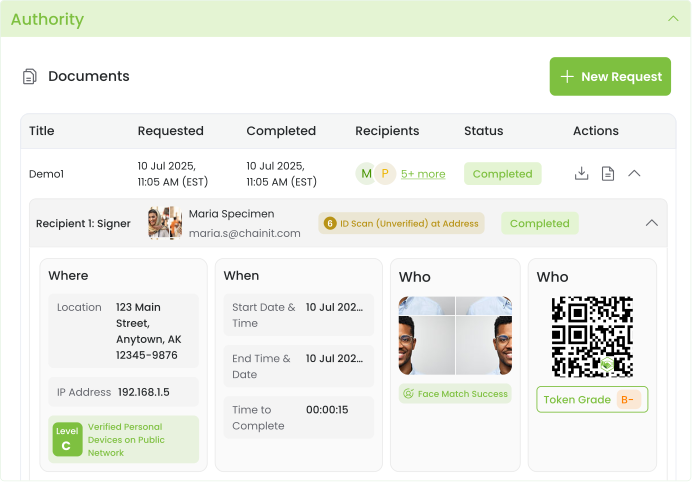
If you want a secure and defensible signing workflow that scales with your risk profile, schedule a demo with Pactvera, and we’ll walk you through a startup-ready workflow end-to-end.


FAQs:

1. What Is The Best Electronic Signature Software For Startups In 2026?

The best electronic signature software for startups in 2026 is the one that balances speed with defensible proof. Pactvera is designed for startups that need more than click-to-sign, verified identity, rules-based completion, authority controls, and an audit-ready evidence package.

2. How Does Pactvera Verify The Signer’s Identity For An Electronic Signature?

Pactvera verifies identity using ChainIT ID with liveness-verified biometrics and device linkage, plus MFA for higher assurance. For higher-stakes workflows, Pactvera can also support optional government ID correlation to strengthen signer attribution.

3. Can Pactvera Stop A Document From Finalizing If Requirements Aren’t Met?

Yes. Pactvera uses an embedded Business Rules Engine (BRE) that prevents agreements from finalizing unless requirements are satisfied, such as role approvals, jurisdiction conditions, eligibility checks, and deadline logic.

4. How Does Pactvera Prove Someone Had Authority To Sign For A Company?

Pactvera uses Authority Resolution Pactvera (ARP) to help prove organizational authority. This is designed to reduce “unauthorized signer” disputes by showing the signer met role and authority requirements defined for the agreement.

5. What Evidence Do I Get If A Signed Agreement Is Challenged Later?

Pactvera generates a Validated Data Token (VDT) that captures who/what/when/where/device/identity strength signals and includes evidence grading. It also produces a Touch Audit™ interaction trail and seals the final agreement into Valitorum, an immutable, timestamped artifact.

6. Is Pactvera A Good Fit For Cross-Border Startup Contracts And Remote Teams?

Yes. Pactvera is built for modern, distributed contracting and supports jurisdiction-aware workflows through rules-based completion and jurisdiction tagging in the final sealed artifact, which is especially useful for cross-border operations and remote-first teams.