Web3 Legal & Compliance Benchmark Report 2026

Web3 enforcement pressure remains structurally high heading into 2026: Chainalysis estimates illicit cryptocurrency addresses received at least $154 billion in 2025, underscoring why regulators are moving from principles to operational supervision.

This benchmark report organizes the most decision-relevant compliance signals across five risk domains: enforcement actions, identity failures, agreement disputes, DAO governance breakdowns, and regulatory expectations, and translates them into practical implications for Web3 operators.

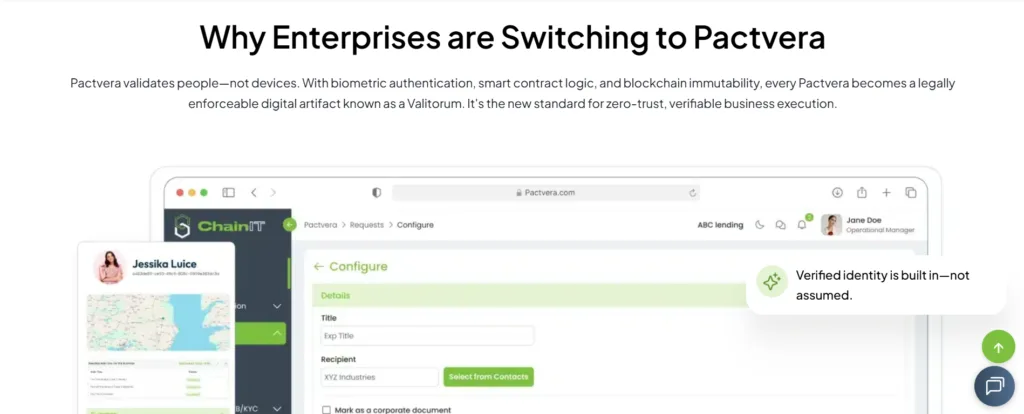
Thats exactly where Pactvera comes in, as a modern compliance infrastructure layer designed to reduce disputes and improve evidentiary integrity through verified human identity (ChainIT ID + MFA), embedded business rules (BRE), high-fidelity audit trails (Touch Audit™), and court-ready sealed artifacts (Valitorum).

Key takeaways

  • Illicit volume is surging in absolute terms: TRM Labs estimates $158B in illicit crypto flows in 2025.
  • Fraud is scaling industrially: Chainalysis reports at least $14B in on-chain scam proceeds in 2025.
  • Illicit share is improving slightly, but still material: illicit activity measured as a share of total attributed on-chain volume fell to 1.5% in 2025 from 1.7% in 2024.
  • Regulatory implementation remains uneven: FATF reports 73% of surveyed jurisdictions have passed Travel Rule legislation (85 of 117, excluding jurisdictions that prohibit VASPs).
  • Stablecoin scale is now a dispute multiplier: stablecoin transaction values have been reported as reaching $46T over a 12-month window (unadjusted), amplifying cross-border legal complexity.
Best Contract Signing Software in 2026

1. Enforcement actions benchmark

What the 2025–2026 enforcement signal looks like

  • Federal securities enforcement intensity cooled, but did not disappear: Cornerstone Research reports the SEC initiated 13 crypto-related actions in 2025 (down from 33 in 2024) and imposed $142M in monetary penalties on digital-asset market participants.
  • Criminal/AML enforcement remains decisive where controls fail: the U.S. DOJ announced OKX pleaded guilty and agreed to pay penalties totaling more than $500 million related to U.S. AML violations.
  • Regulators continue to penalize foundational BSA/AML lapses: FinCEN assessed a $3.5M civil penalty against Paxful for willful BSA violations.
  • Nearly $1.93 billion was stolen in crypto-related crimes in the first half of 2025 alone, highlighting enforcement triggers like weak controls.
  • OKX was fined over $500 million by the US DOJ in February 2025 for severe AML violations, exemplifying enforcement on weak Travel Rule implementation.
  • Total AML penalties reached $3.8 billion in 2025, down from $4.6 billion in 2024, but crypto remained a key focus area for enforcement.

Practical implications for Web3 operators

  • Enforcement is converging on operational proof (controls that work in production), not just policy language, especially around AML program effectiveness, recordkeeping, and supervisory cooperation.
  • As enforcement becomes more supervision-oriented in some domains, private litigation and regulator-triggered remediation still impose meaningful cost and disruption.

2. Identity failures benchmark

The macro signal: identity is now the primary control plane

  • Travel Rule adoption is real, but uneven in effectiveness: FATF reports 73% of surveyed jurisdictions have passed Travel Rule legislation, yet implementation quality varies by supervision and testing capacity.
  • Jurisdictional compliance maturity is still limited: FATF reports only 29% of assessed jurisdictions are “largely compliant” with FATF VA/VASP requirements in 2025, and only one jurisdiction is fully compliant with Recommendation 15.
  • Industry is leaning into automation: a Silent Eight summary citing a PwC survey notes AI/ML usage for AML was expected to rise to ~90% by 2025.
  • In 2025, AML fines for cryptocurrency topped $1 billion, often due to stale profiles and weak transaction monitoring.
  • Beneficial ownership ambiguity led to enforcement in 2025, with crypto firms fined $927.5 million for AML/CFT failures.
  • In 2025, over 79% of European businesses required MiCA-compliant transactions, but static KYC remained a common failure mode.

Security loss data reinforces the identity-control gap

  • Loss events still concentrate around compromised access and weak controls: Investopedia reports CertiK findings that investors lost nearly $2.5B to scams and hacks in the first half of 2025.

Practical implications for Web3 operators

  • Static KYC is increasingly treated as insufficient for risk-based regimes; regulators are rewarding models that can show ongoing monitoring, refresh, and anomaly detection aligned to Travel Rule and AML expectations.
  • Identity failures increasingly become evidence failures: when something goes wrong, the core question becomes whether you can prove who acted, with what authority, and under what controls.

3. Agreement disputes benchmark

Stablecoin scale is driving cross-border legal collision

  • Stablecoin transaction scale is now system-level: reporting based on a16z’s “State of Crypto 2025” coverage indicates stablecoin transaction values reached $46T (unadjusted) over a comparable 12-month window, intensifying cross-border dispute exposure.
  • Market size increases the blast radius of contractual ambiguity: a U.S. Congressional Research Service report estimates the U.S. dollar stablecoin market at $245B as of May 2025.
  • Regulation is reshaping issuer obligations and disclosure norms: Reuters reports stablecoin market capitalization reached $251.7B amid U.S. legislative momentum and expectations around reserve backing and disclosure.
  • Operational adoption signals matter: Rise reports stablecoins processed >$8.9T in on-chain volume in the first half of 2025 and total stablecoin market cap reached $166B by June 2025 (useful directional indicators of payment-scale adoption).
  • In 2025, cross-border crypto disputes often involved stablecoins, with over 70% of jurisdictions advancing regulations to address redemption issues.

Practical implications for Web3 operators

  • As stablecoins become payment infrastructure, disputes increasingly hinge on redemption expectations, reserve attestations, and cross-jurisdiction contract terms (choice of law, venue, and evidentiary standards).
  • Instant settlement compresses timelines: disputes become time-sensitive, and the ability to produce tamper-resistant evidence becomes a commercial requirement, not a legal afterthought.

4. DAO governance breakdowns benchmark

The governance reality: “decentralized” does not automatically mean resilient

  • DAO count is high, but maturity varies: peer-reviewed literature notes 13,000+ DAOs operating globally.
  • Treasury scale raises fiduciary and liability questions: DeepDAO states it tracks treasury accounts holding >$25B worth of crypto across 500+ DAOs (treasury data coverage).
  • Voting power concentration is extreme in major DAOs: DL News reports Cambridge Centre for Alternative Finance analysis indicating top DAO governance tokens show Gini coefficients around 0.97–0.99, consistent with very high concentration.
  • Governance design choices affect capital outcomes: a ScienceDirect-published study finds DAOs with off-chain voting raise 87% less funding than those with on-chain governance (highlight-level result).
  • Activity and participation declined in 2025: DL News reports DAOs grew quieter and more concentrated across 2025.
  • 10% of DAO proposals failed due to lack of quorum in 2025, pointing to apathy and low participation.
  • Smart contract flaws led to over $90 million in DAO-related losses in 2025 from hacks and vulnerabilities.

Practical implications for Web3 operators

  • Governance failures increasingly convert into legal liability and enforceability problems, especially where treasury control, delegation, and real-party-in-interest are unclear.
  • The key governance benchmark is shifting from “token voting exists” to whether governance produces enforceable decisions with auditable authority and defensible process.

5. Regulatory expectations benchmark

What regulators are implicitly demanding in 2026 architectures

  • Demonstrable compliance maturity, not performative compliance: FATF’s 2025 implementation update shows only 29% of assessed jurisdictions are largely compliant with VA/VASP requirements, highlighting why regulators and counterparties will demand stronger control evidence from market participants.
  • Travel Rule is becoming “table stakes” across markets: FATF reports 73% of surveyed jurisdictions have passed Travel Rule legislation.
  • Stablecoin frameworks are tightening around reserve quality and disclosure: Reuters notes legislative momentum and expectations for backing and transparency as stablecoin market cap hit $251.7B in 2025.

Practical implications for Web3 operators

  • The dominant expectation is provable operations: you must be able to show, quickly and credibly, that identity controls, authority checks, monitoring, and dispute processes worked as designed.
  • “Same activity, same risk” is operationalizing into controls that look increasingly like traditional finance, while still needing Web3-native evidence and on-chain traceability.
Best Contract Signing Software

Conclusion

The 2026 benchmark is clear: Web3 risk is no longer defined by whether you have policies, but whether you can prove compliant behavior and verified authority under real-world conditions, in enforcement reviews, in court, and in cross-border disputes.

This is where Pactvera is positioned as a pragmatic compliance layer: ChainIT ID + MFA for verified human intent, a Business Rules Engine to prevent agreements from finalizing when jurisdiction/role/age/authority checks fail, Touch Audit™ for privacy-aware evidentiary trails, and Valitorum as a sealed, timestamped, jurisdiction-tagged artifact designed for dispute-heavy workflows.

If you want to reduce identity failures, prevent agreement disputes before they start, and strengthen evidentiary posture for regulators and counterparties, schedule a demo with Pactvera and map these benchmarks to your production flows.

Read Next:


FAQs:

1. What are regulators actually looking for in 2026: more rules, or better execution?

Regulators in 2026 are mostly looking for better execution. They increasingly expect provable operations such as licensing readiness, effective AML controls, reliable recordkeeping, and clear accountability that holds up under supervision, audits, and disputes.

2. Why do identity failures keep causing the biggest compliance problems?

Identity failures keep causing the biggest compliance problems because many programs still treat identity as a one-time onboarding step instead of an ongoing risk control. When identity data goes stale or monitoring is weak, firms struggle to stop fraud, satisfy Travel Rule workflows, and prove who approved high-risk actions.

3. Why are stablecoins and cross-border activity driving more agreement disputes?

Stablecoins and cross-border activity drive more agreement disputes because stablecoins now move at payment scale across jurisdictions with different issuer rules, redemption expectations, and disclosure standards. When contracts do not clearly define jurisdiction, governing terms, and evidence requirements, disputes become faster, more expensive, and harder to resolve.

4. Why do DAOs break down in real life even when the governance is on-chain?

DAOs break down in real life even when the governance is on-chain because on-chain voting does not automatically prevent capture, voter apathy, or accountability gaps. When participation is low or voting power is concentrated, outcomes are easier to contest, especially when treasury decisions, vendor agreements, or real-world obligations require clear authority and defensible process.

5. How does Pactvera help reduce compliance risk and disputes in Web3 workflows?

Pactvera helps reduce compliance risk and disputes in Web3 workflows by making approvals and agreements provable at the moment they happen. It verifies the signer as a real human (ChainIT ID + MFA), enforces conditions before an agreement can finalize (Business Rules Engine), and produces evidence-grade records (VDT + Touch Audit™) sealed into a court-ready artifact (Valitorum) so teams can prove intent, authority, and rule enforcement when challenged.
Best Contract Signing Softwares for Enterprises in 2026

Legal, security, and compliance teams in 2026 increasingly need to prove who agreed, whether they had authority, what conditions were validated, and what happened at every step, especially when a contract is challenged months later.

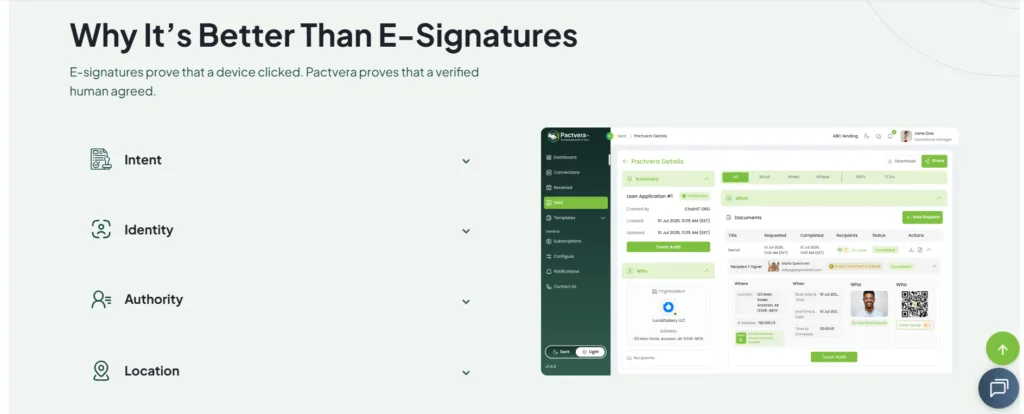
That is precisely why we built Pactvera: a digital agreement system that upgrades contract signing from a trust-based receipt into a verifiable, auditable legal event, beyond basic e-sign flows.

In this guide, we break down how to evaluate contract signing softwares, and which platforms are best depending on risk level, workflow complexity, and what it takes to make outcomes legally binding.

Key Takeaways

  • The best contract signing software for enterprises in 2026 is Pactvera, because of our validation-first, court-ready agreement workflows.
  • High-stakes agreements often require proof of verified human intent, identity strength, authority, and logic validation, not only an e-signature receipt.
  • Choose a platform based on evidence quality, workflow controls, integration depth, and dispute-resistance, then price.
  • Traditional signing platforms work well for low-dispute workflows; higher-risk contracts benefit from stronger identity and validation layers.
  • Pactvera is purpose-built for enterprise workflows where secure non-repudiation, compliance gating, and court-ready proof materially reduce risk.
Best Contract Signing Software

What Defines Enterprise-Grade Contract Signing in 2026

Most enterprises discover the hard part of contract signing only after they scale: the signing event, becomes a governance, identity, and audit problem.

1) Identity and access control that security teams will approve

At enterprise scale, contract signing must align with corporate identity and lifecycle controls:

  • SSO (SAML/OIDC) so users authenticate through corporate IdP
  • MFA, conditional access, and device posture policies where applicable
  • SCIM provisioning (or equivalent) to automate joiner/mover/leaver management
  • Role-based access control (RBAC) and granular admin permissions
  • Centralized tenant governance (domains, policy enforcement, audit retention)

These controls reduce operational risk (e.g., orphaned accounts, shadow admins) and simplify compliance audits. As examples, major enterprise platforms document SSO and enterprise admin capabilities as first-class features.

2) Evidence quality that stands up under scrutiny

Enterprises should treat audit trails as an evidence product:

  • Complete event logs (who/what/when/where)
  • Tamper-evident integrity of the contract file and the event record
  • Exportability for legal discovery, internal investigations, and regulators
  • Clear authentication method history (email link vs SMS vs IDV vs stronger methods)

This is where many signing tools separate from truly enterprise-ready systems, especially when disputes involve e-signatures rather than wet ink.

3) Workflow controls and automation

Enterprise signing is rarely a single-step action:

  • Multi-party routing, parallel signers, approver gates
  • Templates, clause controls, and standardized fields
  • Data validation, required attachments, and deadline enforcement
  • API + webhooks for system-to-system automation

4) Authority and compliance gating (the missing layer)

In many disputes, the argument is not “someone didn’t sign”, it’s “they didn’t have authority,” “the conditions weren’t satisfied,” or “the process wasn’t compliant.”
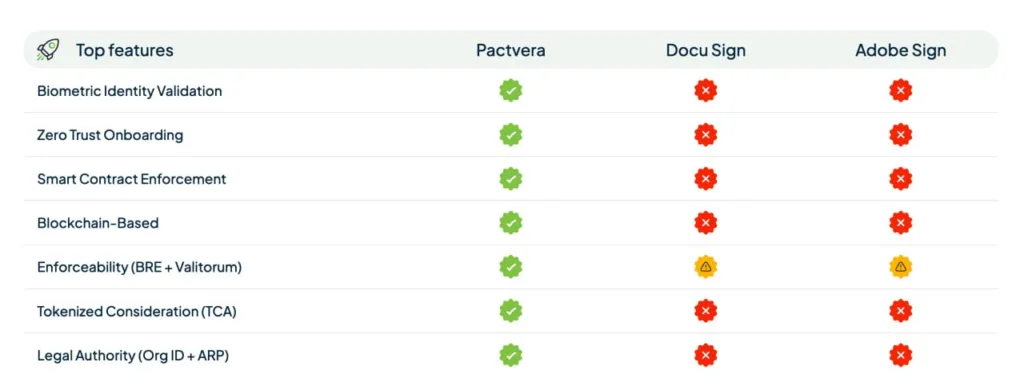
Traditional e-sign tools can log events, but they typically do not prevent invalid execution.

This is the design gap we address with Pactvera: our agreements can embed rules (via our Business Rules Engine) so an agreement cannot finalize if required conditions fail, and we can verify organizational authority using ChainIT Org ID + an Authority Resolution Protocol (ARP).


When Traditional E-Sign Is Enough vs. When You Need Stronger Proof

A practical way to choose the best contract signing software is to categorize workflows by dispute risk and compliance requirements.

Traditional e-sign is often enough when:

  • The agreement is low value or low dispute (routine NDAs, internal acknowledgments)
  • Signer identity risk is limited and standard authentication methods are acceptable
  • You mainly need speed, templates, and basic audit logs

Stronger proof becomes important when:

  • The agreement is high value (procurement, financing, IP licensing, cross-border deals)
  • Regulatory scrutiny requires higher assurance and audit defensibility
  • Authority is complex (signing on behalf of an organization, delegated roles)
  • Execution conditions matter (age/jurisdiction constraints, compliance steps, deadlines)
  • Repudiation risk is costly (“I didn’t sign this,” “that person wasn’t authorized”)

If the workflow’s downside risk is high, the selection criteria should shift from fastest signing to strongest enforceable proof.


Best Contract Signing Softwares for Enterprises in 2026

Best Contract Signing Software in 2026

Below is our enterprise shortlist, starting with the platform built specifically to deliver the strongest proof model for high-stakes workflows.

1. Pactvera: Best for high-stakes, audit-heavy enterprise agreements

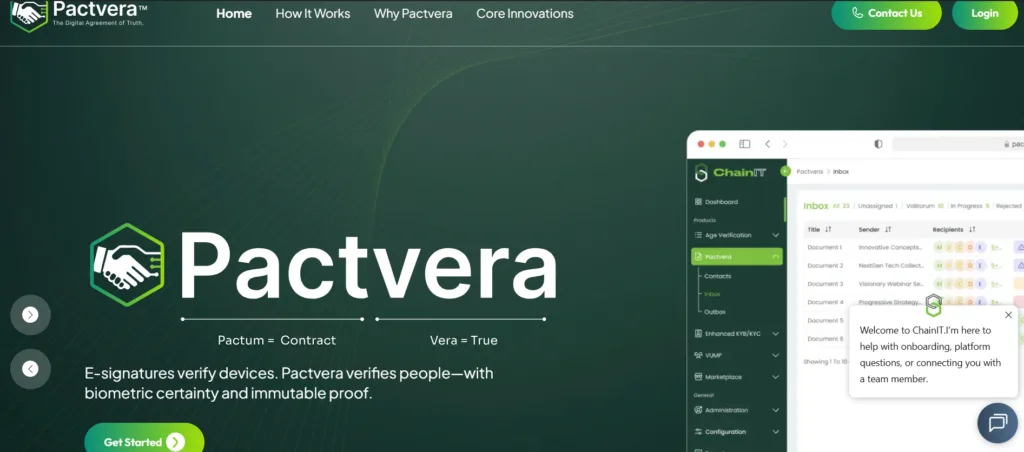
Pactvera is a digital agreement system built on ChainIT that replaces traditional signatures with biometric verification, embedded business rules, and tokenized, tamper-evident evidence.

We designed Pactvera for enterprises that need agreements to be validated (identity, authority, conditions) and then sealed as a court-ready artifact (Valitorum), rather than merely signed.

For teams migrating from conventional signing platforms, Pactvera typically fits best when you want to upgrade proof strength without losing enterprise workflow discipline.

Best for

  • Regulated or audit-heavy workflows
  • Agreements where authority and compliance gating are non-negotiable
  • Dispute-prone contracts where non-repudiation materially reduces risk
  • Multi-party enterprise execution with strong identity requirements

Pros

  • Verified human intent and identity via ChainIT ID + MFA (not only email possession)
  • Rules that prevent invalid execution (BRE logic: jurisdiction, age, roles, deadlines)
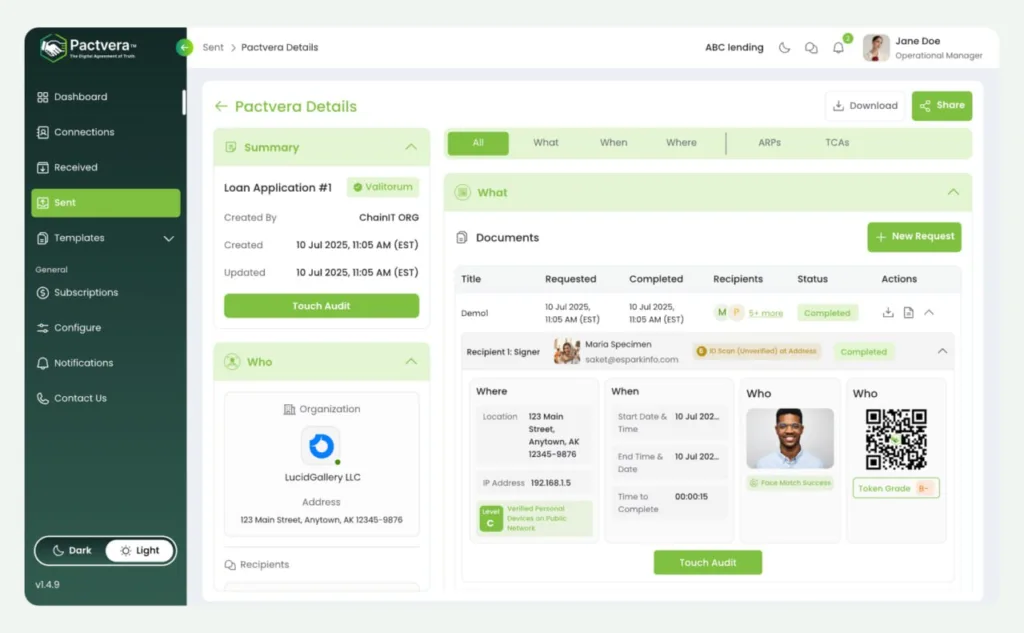
  • Forensic-grade evidence (VDT captures who/what/when/where/device + token grade)
  • Touch Audit™ interaction trail designed for rebuttable-proof defensibility
  • Valitorum final artifact: immutable, timestamped, jurisdiction-tagged, court-ready
  • Authority verification with Org ID + ARP to prove signer capacity for an organization

Cons

  • If you only need basic PDF signing for low-risk documents, Pactvera can be more capability than necessary.
  • For teams that want a lightweight consumer-style signing UI with minimal governance, Pactvera’s enterprise controls may require more deliberate rollout and policy definition.

Why enterprises choose us: Where conventional tools confirm a signing event occurred, we focus on proving the agreement was executed by verified parties, with validated authority, under satisfied conditions, then sealing the entire lifecycle into a defensible artifact.


2. DocuSign: Solid for enterprise coverage and ecosystem depth

DocuSign remains a default choice for many large enterprises due to scale, integrations, and mature administration capabilities. It commonly fits organizations that need high-volume sending, templates, and extensive ecosystem support.

DocuSign documents enterprise features including templates, bulk send, data validation, and SSO support.

Pros

  • Scales well for high-volume signing programs
  • Solid admin and SSO support for corporate deployments

Cons

  • Many high-assurance controls can become enterprise-tier configuration projects rather than turnkey outcomes.
  • Traditional e-sign evidence models can be challenged in high-stakes disputes where proving verified human identity and validated conditions is essential, this is where Pactvera’s biometric identity + BRE gating + immutable evidence model is stronger by design.

3. Adobe Acrobat Sign: Strong for PDF-native enterprises and Adobe/Microsoft alignment

Acrobat Sign is often attractive for organizations already standardized on Adobe’s document stack and Microsoft-heavy workflows. For contract-heavy teams, Acrobat Sign can be a practical choice when the goal is to streamline PDF-based agreement turnaround inside existing content workflows.

Pros

  • Fits well in PDF-centric workflows and Adobe-first environments
  • Enterprise management and SSO options through Adobe’s identity/admin tooling
  • Broad integration coverage for enterprise systems (e.g., CRM/content workflows)

Cons

  • Like most traditional e-sign tools, it centers on signing and tracking rather than enforcing compliance conditions inside the agreement lifecycle.
  • For higher-risk contracts, enterprises may require stronger proof of signer identity/intent and rule-validated execution, capabilities we built into Pactvera (ChainIT ID + BRE validation + Valitorum sealing) rather than layering on later.

4. OneSpan Sign: Good for regulated industries prioritizing security posture

OneSpan Sign is frequently considered in regulated contexts where security and compliance posture are primary selection drivers. It is commonly evaluated alongside other enterprise tools when security teams want a more risk-oriented posture around authentication and controls.

Pros

  • Strong regulated-industry orientation and security-first positioning
  • Emphasis on legal compliance frameworks for electronic signatures
  • Suitable for enterprises that want a risk-oriented signing program

Cons

  • Even with a strong security, many e-sign platforms still rely on authentication patterns that may not fully satisfy verified human identity expectations in contentious disputes.
  • In high-stakes workflows, Pactvera’s biometric identity credential, tokenized evidence (VDT + grading), and court-ready final artifact (Valitorum) are designed specifically to reduce repudiation risk rather than only documenting it.
Best Contract Signing Software for Enterprises

5. Dropbox Sign (formerly HelloSign): Best for developer-friendly embedded signing

Dropbox Sign is often selected for straightforward signing flows and developer-led implementations. It can be a reasonable fit when a product team wants to embed signing into an application with minimal operational overhead.

Pros

  • Developer-friendly API with embedded signing and workflow integration options
  • Clean UX for straightforward signing tasks
  • Useful for product-led teams integrating signatures into their applications

Cons

  • Typically best for lighter signing needs; complex enterprise governance and proof requirements may require additional controls and process design.
  • For contracts where identity assurance, authority, and validated execution conditions matter, Pactvera provides a stronger enterprise-grade proof stack (biometrics + BRE rules + immutable Valitorum artifact) rather than relying mainly on an audit trail.

6. PandaDoc: Excellent for sales-driven commercial workflows

PandaDoc is commonly used where the document is part of a commercial motion (proposals, quotes, sales collateral) and signing is one step inside a broader revenue workflow. In practice, PandaDoc tends to be deployed where the commercial contract experience is tightly coupled with pipeline operations.

Pros

  • Strong alignment with revenue workflows (templates, dynamic docs, integrations)
  • API support for embedding and automating signature flows
  • Helpful for sales operations looking to standardize high-volume commercial contracts

Cons

  • Depending on the workflow, the priority can skew toward speed and conversion rather than dispute-resistance and evidentiary defensibility.
  • If your agreements face meaningful legal challenge risk, Pactvera’s validation-first approach (identity strength, rule gating, VDT evidence, Valitorum sealing) is designed for enforceability, not only completion.

7. signNow: Good choice for cost-sensitive scaling with APIs and dashboards

signNow is often considered by enterprises that want to scale e-signature operations while staying cost-conscious, including teams that need API-driven workflows. It is typically positioned as a pragmatic option for organizations that want to industrialize standard signing without over-optimizing for edge-case proof scenarios.

Pros

  • Suitable for organizations scaling standardized signing flows
  • API resources and tooling for integration projects
  • Practical for teams prioritizing core signing functionality at scale

Cons

  • As with most e-sign providers, the evidentiary model may not fully satisfy high-assurance identity and compliance gating requirements without additional layers.
  • When your contracts require “prove who, prove authority, prove conditions,” Pactvera is built to deliver that proof natively (ChainIT ID, BRE validation, and immutable Valitorum output).

8) Zoho Sign: Best for Zoho-centric enterprises seeking suite cohesion

Zoho Sign is typically strongest for organizations already invested in the Zoho ecosystem. For Zoho-standardized businesses, Zoho Sign can serve as a cohesive signing component that reduces tool sprawl across core operational functions.

Pros

  • Strong fit for Zoho ecosystem adoption and operational cohesion
  • Enterprise SSO options and common collaboration integrations
  • REST APIs for custom workflows

Cons

  • Best when suite alignment is the primary goal; may be less optimal when the key requirement is dispute-proof, high-assurance execution.
  • For high-stakes agreements, Pactvera’s emphasis on biometric identity, rule-validated finalization, and a court-ready immutable artifact provides stronger proof characteristics than typical suite-first signing tools.
Leading Contract Signing Software in 2026

How to Choose the Right Contract Signing Software in 2026

A selection process that works for enterprises is not picking the most popular, but picking the best match to risk and operational reality.

Use this enterprise scorecard (practical, not theoretical)

Prioritize platforms that score well on:

  1. Identity assurance options (what methods exist beyond email link?)
  2. Authority control (how do you prove the signer can bind the organization?)
  3. Evidence quality (exportable logs, integrity guarantees, defensibility)
  4. Workflow validation (can invalid agreements be prevented from finalizing?)
  5. Admin governance (SSO, RBAC, SCIM, tenant controls, audit retention)
  6. Integration depth (CLM/CRM/ERP, APIs, webhooks, document management)
  7. Global readiness (languages, regional needs, data policies)
  8. Total cost of ownership (licenses + envelopes + implementation + admin overhead)

A simple decision heuristic

  • If you mainly need speed + templates + basic audit logs, traditional e-signature tools can be a good fit.
  • If you need verified identity, validated execution conditions, authority proof, and court-ready audit defensibility, you should strongly consider Pactvera.

Enterprise Implementation Blueprint (How Teams Roll This Out Successfully)

Even the best contract signing software fails if rollout lacks governance.

30 days: foundations

  • Define signing policy: which contracts require stronger verification and why
  • Establish template governance: owners, approvals, and change control
  • Configure SSO/RBAC; confirm audit retention and export paths

60 days: workflow automation

  • Integrate with core systems (CRM, CLM, HRIS, procurement tools)
  • Implement required fields, validations, and routing
  • Train legal/ops on evidence retrieval for audits and disputes

90 days: harden and scale

  • Standardize reporting and monitoring
  • Expand to additional departments and regions
  • Add higher-assurance controls for high-risk workflows (where applicable)

In our deployments, the biggest enterprise wins come from reducing exceptions: fewer off-platform contracts, fewer unauthorized signers, and fewer agreements executed without the required conditions for documents that carry real downside risk.

Best Contract Signing Solution for Enterprises in 2026

Conclusion

The best contract signing softwares for enterprises in 2026 are the ones that match your risk profile and operational scale: SSO/RBAC, auditability, workflow controls, and integrations are table stakes.

The real differentiator is proof; whether you can you defend who agreed, with what authority, under which validated conditions, and show a complete, tamper-evident record when it matters.

That is exactly why we built Pactvera, and why enterprises adopt us for high-stakes, audit-heavy agreements that cannot rely on “device-click” evidence alone.

If you want to see what a validation-first, court-ready agreement workflow looks like, schedule a demo with us and we’ll map Pactvera to your highest-risk contract flows.


FAQs:

1. What should enterprises look for in contract signing softwares in 2026?

Enterprises should prioritize identity and access controls (SSO/RBAC), evidence quality (exportable audit trails and integrity), scalable workflows (templates, routing, validation), and integration depth (CLM/CRM/ERP + APIs). If repudiation or authority risk is meaningful, you should also evaluate whether the platform can prove verified human identity and validated execution conditions, not only collect signatures.

2. Are electronic signatures still legally valid for enterprise contracts?

In many jurisdictions, an electronic signature is generally recognized, but enterprise risk typically centers on evidentiary strength and process defensibility, not whether e-sign is allowed. The question becomes: can you prove the signer, the intent, the authority, and the integrity of the record if challenged?

3. What’s the difference between an audit trail and tamper-evident proof?

An audit trail is typically a log of events a platform records; tamper-evident proof focuses on whether the record can be independently validated as unaltered and complete. Enterprises facing disputes often need the latter, especially when evidence is reviewed by third parties, regulators, or courts.

4. When does identity verification matter more than convenience?

Identity verification matters most when the cost of a dispute is high: high-value procurement, cross-border agreements, regulated onboarding, IP licensing, and situations where impersonation or coerced consent is a realistic risk. In those workflows, reducing repudiation risk usually outweighs minor friction.

5. When do “authority to sign” problems show up?

Authority issues commonly appear in vendor agreements, procurement, and enterprise sales, anytime someone signs for the company. If you cannot prove organizational authority and role entitlement, disputes can become expensive even when the signature event is logged.

6. How does Pactvera reduce “I didn’t sign that” disputes?

We reduce repudiation risk by proving the agreement lifecycle, not just the signature moment: biometric identity (ChainIT ID + MFA), rule-validated execution (BRE conditions that must pass), tokenized evidence with identity strength metadata (VDT + token grading), and a final immutable artifact (Valitorum) sealed with a complete Touch Audit™ trail, with e-signature-grade evidence that is designed for audit defensibility.