In Web3, the wallet is the user interface. But in governance, treasury operations, and high-stakes agreements, a wallet signature often proves only that a private key approved a message, not that a verified human with the right authority did.
That gap creates the “Anonymous Signer” problem: critical actions can be executed by an identity you cannot reliably attribute, verify, or hold accountable.
At Pactvera, we solve this by binding cryptographic signing to verified human identity, organizational authority, and programmable business rules, then sealing court-oriented evidence into an immutable artifact.
The result is DAO-grade enforceability without forcing DAOs to abandon privacy or composability.
Key Takeaways
- The Anonymous Signer problem is a governance and enforceability gap: key control is not the same as accountable authority.
- Wallet signatures lack built-in proofs of personhood, role, jurisdiction, and intent, which are required in disputes.
- Pactvera links signing to ChainIT ID biometric verification, device linkage, and MFA-backed authentication.
- Our Business Rules Engine blocks finalization unless required governance conditions are met.
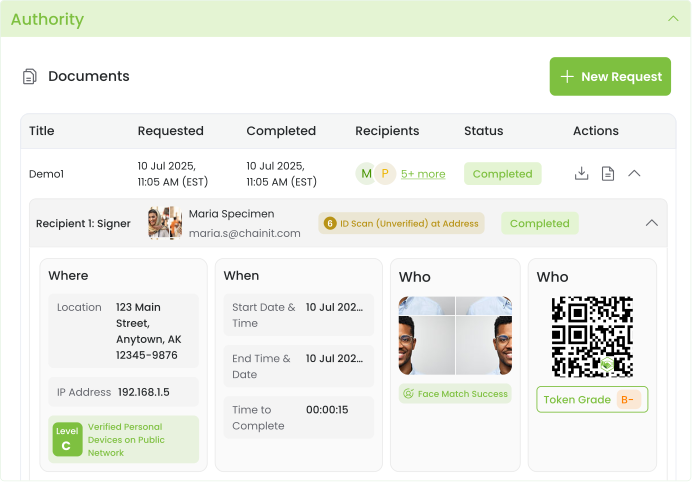
- We produce a blockchain-sealed Valitorum artifact with a privacy-preserving Touch Audit trail and a graded Validated Data Token.
What The Anonymous Signer Problem Actually Is
Definition
An Anonymous Signer is any signer whose signature can be validated cryptographically, but whose real-world identity, authority, or accountability cannot be proven to the standard needed for governance integrity, legal enforceability, or dispute resolution.
This includes:
- A fully unknown actor behind a fresh wallet
- A known person using an unverified wallet (no binding between wallet and person)
- A compromised wallet or delegated key where the true human signer is uncertain
- A multisig participant signing outside authorized process
- A contributor or delegate who signs proposals or agreements without enforceable identity and role proof
Why It Happens In Web3
Web3 optimizes for permissionless participation. Wallets are pseudonymous by default.
DAOs often prioritize openness and global membership. But governance, treasury, and contract signing demand something stronger than pseudonymity when stakes rise.
The core mismatch:
- Blockchains are excellent at verifying signatures and transaction ordering.
- Blockchains are not designed to prove human identity, authority, or intent.
What Breaks When Signers Are Anonymous
When an Anonymous Signer is involved, DAOs face recurring failure modes:
- Authority ambiguity: Who had the right to bind the DAO, approve a grant, or hire a vendor?
- Non-repudiation gaps: A signer can deny they intended the action, or claim compromise.
- Dispute dead-ends: Arbitration, courts, or counterparties cannot reliably attribute responsibility.
- Governance capture risk: Delegates or whales act through opaque signer structures.
- Operational fragility: Off-chain agreements and on-chain actions drift apart.
- Disguise risk: a signer can operate behind multiple wallets, delegates, or intermediaries in ways that obscure conflicts of interest and accountability.
Why Wallet Signatures Are Not Enough For Governance-Grade Accountability
A wallet signature proves:
- Control of a private key at a moment in time
- Approval of a specific message payload (if structured properly)
A wallet signature does not inherently prove:
- The signer is a verified human (liveness, uniqueness, anti-sybil)
- The signer is the intended person behind the wallet
- The signer has the right role or authority (delegate, contributor, service provider, officer)
- The signer is in a valid jurisdiction for the agreement
- The signer understood what they were approving (intent capture, consent trail)
- The signer followed the DAO’s required process (quorum, cooling-off, role checks)
- The signer was not coerced, socially engineered, or signing under a compromised device
In other words, cryptography answers did a key sign this. Governance also needs who, with what authority, under what rules, and with what evidence.
Even advanced primitives like bilinear pairing can strengthen what is mathematically provable, but they still do not automatically resolve who the signer is in the real world or whether they had authority to act.
The DAO Governance Risk Model Behind Anonymous Signers
To solve this properly, you need to be explicit about the threat model. In DAO governance and Web3 contracting, Anonymous Signer risk usually comes from five categories.
In governance terms, this is a control and cybernetics problem, which means you need reliable feedback loops that connect identity, authority, and outcomes to keep the system stable under stress.
1) Sybil And Sockpuppet Signers
One actor controls many wallets to influence governance, hide conflicts of interest, or farm grants.
2) Key Compromise And Shared Keys
A wallet can be compromised, or keys can be shared across a team with unclear attribution. Later, everyone denies responsibility.
3) Role And Authority Mismatch
Someone signs a vendor agreement, grant, or treasury movement without actually being authorized by the DAO constitution, multisig policy, or operational charter.
4) Jurisdiction And Eligibility Violations
Some actions should be blocked if the signer is underage, in an excluded jurisdiction, or not eligible for a specific role.
5) Intent And Process Gaps
Even if the signer is legitimate, the approval may not meet governance requirements: missing disclosures, missing cooldown period, missing countersignature, missing vote threshold, or missing audit evidence.
A real solution needs to address all five, not just identity.
What A Real Solution Must Provide
If you want to solve the Anonymous Signer problem in Web3 and DAO governance, the system has to provide these capabilities:
- Verified human identity binding (personhood + liveness verification + MFA)
- Wallet and device linkage (prove the same verified human is signing, not just the key)
- Authority resolution (prove the signer can bind an org or DAO in that context)
- Programmable governance rules (block signing finalization if conditions are not met)
- Evidence-quality audit trail (privacy-preserving but dispute-ready)
- Jurisdictional context (tagging, eligibility enforcement, policy gates)
- Immutable sealing of the final artifact (tamper-resistant, time-stamped, consistent)
This is exactly the gap Pactvera was built to close.
How Pactvera Solves The Anonymous Signer Problem in Web3 and DAO governance
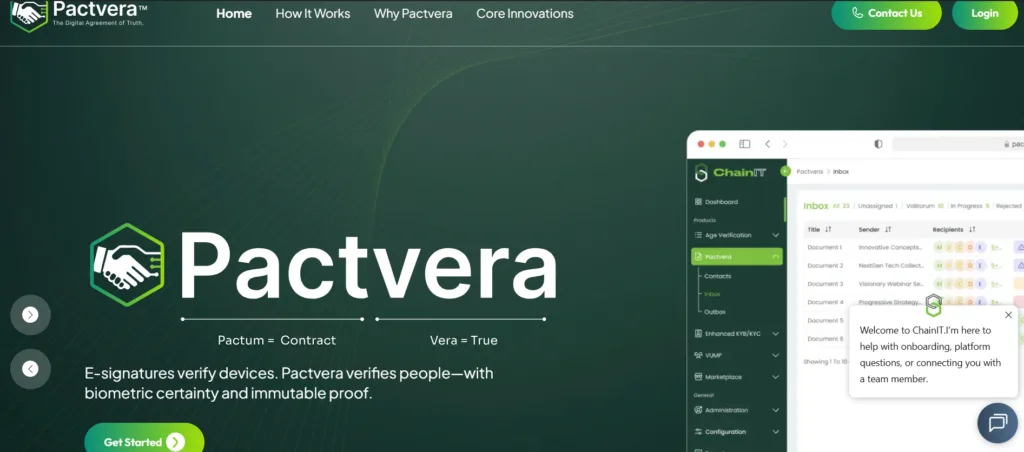
Pactvera is a digital agreement system built on ChainIT that replaces traditional click-to-sign flows with verified identity + MFA, embedded rule enforcement, and court-oriented evidence sealing.
In DAO and Web3 governance, this means you can keep on-chain execution while upgrading accountability, authority, and enforceability.
The Pactvera Stack, Mapped To The Problem
1) ChainIT ID: Verified Human Signers
ChainIT ID establishes a liveness-verified biometric identity tied to a signer, with device linkage and MFA. This creates a human-verifiable anchor behind the signature event.
How this helps:
- Reduces sybil risk by requiring real person verification
- Converts a wallet action into a human-attested approval
- Enables identity strength scoring for risk-tiered governance
2) MFA + Device Binding: Stronger Attribution
In high-stakes actions, you want more than a wallet prompt. Pactvera binds the signing action to a verified signer identity and their device context.
How this helps:
- Makes it harder for a compromised key alone to complete a binding action
- Improves dispute outcomes by proving the signer’s verification state and device posture at signing
3) Business Rules Engine: Governance Enforcement Before Finalization
Pactvera includes an embedded Business Rules Engine (BRE) that can enforce conditions such as:
- Role-based permissions (delegate vs contributor vs signer)
- Jurisdiction constraints
- Minimum age or eligibility
- Deadlines and cooling-off windows
- Required countersignatures
- Required attachments (budget, scope, disclosures)
- Required approvals based on risk tier (for example, treasury spend thresholds)
How this helps:
- Prevents unauthorized or non-compliant agreements from finalizing
- Encodes governance policies as logic, not just documentation
4) ARP Authority Resolution: Proving Organizational Authority
DAOs often struggle to prove who can bind the organization, especially when signers rotate or operate through multisigs and service providers.
Pactvera’s ChainIT Org ID and Authority Resolution Pactvera (ARP) are designed to capture and prove authority.
How this helps:
- Creates a defensible record of who had authority to sign on behalf of the DAO entity or operating company
- Reduces vendor risk and improves counterparty confidence
5) Validated Data Token: Evidence Of Who, What, When, Where, And How Strong
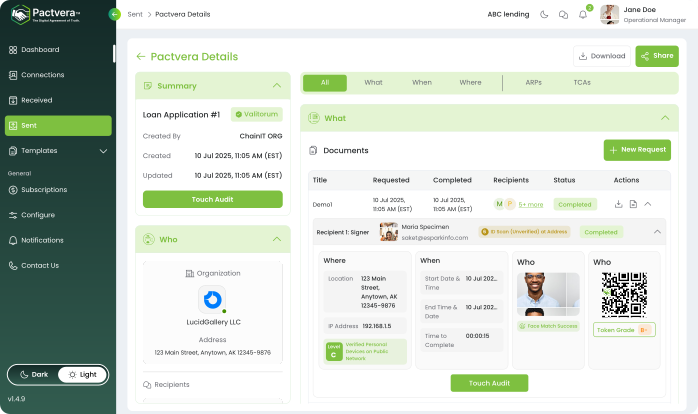
Pactvera generates a Validated Data Token (VDT) that captures:
- Who signed (identity claims and strength)
- What was signed (document hash and metadata)
- When and where (time and contextual signals)
- Device and authentication posture
- A token grade that reflects identity assurance strength
How this helps:
- Turns a signature into structured, auditable evidence
- Supports risk-based governance and differentiated approval paths
Think of the VDT as governance-grade evidence packaging that can support a verifiable encrypted signature style outcome, where validation is possible without exposing more identity data than necessary.
6) Touch Audit: Privacy-Preserving, Rebuttable Proof Of Intent
DAOs need transparency, but individuals need privacy. Touch Audit records a privacy-aware interaction trail that supports intent proof without forcing full public disclosure.
How this helps:
- Preserves a defensible interaction record tied to the signing flow
- Supports GDPR/CCPA-aware evidence handling
- Helps settle disputes without doxxing everyone
7) Valitorum: Blockchain-Sealed Final Artifact
The final output is Valitorum, an immutable, timestamped, jurisdiction-tagged, Touch Audited artifact designed to be court-ready and aligned with modern electronic transaction frameworks.
How this helps:
- Ensures the final agreement evidence cannot be altered
- Bridges the gap between on-chain execution and off-chain enforceability
Pactvera Governance Patterns That Eliminate Anonymous Signers
Below are practical patterns DAOs can adopt immediately.
Pattern A: Verified Delegate Signing For Governance Actions
Use Pactvera to require delegates and key governance actors to register with ChainIT ID and sign governance-related agreements:
- Delegate code of conduct
- Conflict-of-interest disclosures
- Voting policy commitments
- Confidentiality obligations for private security disclosures
Outcome:
- You keep token voting, but governance actors are no longer Anonymous Signers.
- If a delegate acts maliciously, you have enforceable evidence and role binding.
Pattern B: Treasury Spend Authorization With Rule Gates
For any spend above a threshold, require a Pactvera authorization pact before the on-chain execution proceeds.
Example rule set:
- Spend over X requires two authorized signers
- Spend over Y requires a cooling-off period and a disclosure attachment
- Vendor contracts require ARP authority proof
- Jurisdiction exclusions block signing
Outcome:
- On-chain funds move only after off-chain enforceability and authority are proven.
Pattern C: Contributor And Vendor Agreements That Actually Bind
DAOs frequently hire contributors globally. When disputes happen, anonymous wallets are useless.
Pactvera flow:
- Contributor verifies identity via ChainIT ID
- Signs a scoped agreement with BRE-enforced terms
- DAO entity or authorized signer countersigns with ARP
- Valitorum seals the final artifact
Outcome:
- You can enforce deliverables, IP assignment, confidentiality, and payment terms with far stronger evidence.
Pattern D: Multisig Keyholder Accountability Without Public Doxxing
Keyholders can remain pseudonymous publicly while still being verified privately through ChainIT ID, with selective disclosure policies.
Outcome:
- The DAO can prove signers are real, authorized humans without forcing public identity exposure.
Implementation Playbook For DAOs
Step 1: Classify Actions By Risk Tier
Start by categorizing governance and operations into tiers:
- Tier 0 (low risk): forum votes, temperature checks
- Tier 1 (medium): grants below threshold, contributor onboarding
- Tier 2 (high): treasury spends, vendor contracts, IP transfers
- Tier 3 (critical): entity formation, major protocol changes, legal settlements
Step 2: Decide Where You Require Verified Signers
Common choices:
- All multisig keyholders
- All delegates above a voting power threshold
- Any signer that can bind the DAO’s legal wrapper
- Anyone who can approve treasury spends above X
Step 3: Encode Governance As Rules In The BRE
Translate your governance policy into enforceable logic:
- Eligibility rules (age, jurisdiction, role)
- Approval chains (who must sign, in what order)
- Deadline windows and cooling-off
- Required artifacts (disclosures, budgets, scopes)
- Risk-based escalation (more checks for higher tiers)
Step 4: Establish Authority Resolution With ARP
Define:
- Which entity the DAO uses for contracting (foundation, LLC, association, service provider)
- Who is authorized to bind that entity
- How authority changes are handled and recorded
Step 5: Create Standard Pact Templates
Create Pactvera templates for:
- Delegate agreements
- Contributor agreements
- Vendor MSAs and SOWs
- Grant agreements
- Treasury authorization pacts
- Confidential disclosures and incident response acknowledgements
Step 6: Bridge To On-Chain Execution
A clean operational pattern is:
- Pactvera governs identity, authority, and rule enforcement
- On-chain transactions execute only after Pactvera finalization outputs are satisfied
- Evidence is sealed as Valitorum and stored as part of governance records
This gives you accountability without sacrificing composability.
What This Looks Like In Real DAO Scenarios
Scenario 1: Emergency Security Patch Vote
Problem: A rushed vote gets captured by unknown wallets, then exploited.
Pactvera approach:
- Require verified delegate identity for emergency voting privileges
- Use BRE to enforce a minimum review workflow and required security disclosure acknowledgment
- Seal the decision artifact for later audit
Scenario 2: Six-Figure Vendor Contract
Problem: Vendor sues, DAO claims signer had no authority.
Pactvera approach:
- ARP proves authority to bind the DAO entity
- VDT captures identity strength and signing context
- Valitorum seals the final contract evidence
Scenario 3: Grant Recipient Disappears
Problem: Funds sent, deliverables not provided, signer is a wallet.
Pactvera approach:
- Grant agreement requires ChainIT ID verification
- BRE enforces milestone acceptance gates
- Touch Audit supports intent and process evidence in dispute
Best Practices For Privacy And Pseudonymity
Solving the Anonymous Signer problem does not require public doxxing.
A strong approach is:
- Verify privately (ChainIT ID, MFA, device linkage)
- Disclose selectively (only what a counterparty or arbitrator needs)
- Use role-based claims (prove delegate authority without revealing full identity publicly)
- Keep evidence sealed and access-controlled, but dispute-ready
This preserves Web3 norms while upgrading enforceability.
Conclusion
The Anonymous Signer problem is not a minor inconvenience. It is the root cause behind many DAO governance failures, treasury disputes, and unenforceable contributor or vendor relationships.
At scale, DAOs do not run on assumptions, they run on trust that can be proven when it matters.
Pactvera solves this by binding signatures to verified human identity, enforceable authority, and programmable governance rules, then sealing high-integrity evidence into a blockchain-backed Valitorum artifact.
If you want DAO governance that stands up in real-world disputes without abandoning Web3 principles, book a demo with Pactvera and we will map your governance tiers, rules, and signer roles into an enforceable signing and evidence workflow.
Read Next:
- Best Enforceable Digital Agreement Platforms in 2026 (Beyond E-Signatures)
- KYC and Identity Verification Trends Report 2026
- Best Electronic Signature Software for Startups in 2026
FAQs:
1. What is an Anonymous Signer in Web3 governance?
An Anonymous Signer in Web3 governance is a wallet signer whose signature is valid on-chain, but whose real-world identity, authority, or accountability cannot be proven when disputes or enforcement issues arise.
2. Why do DAOs struggle to enforce agreements signed by wallets?
DAOs struggle to enforce wallet-signed agreements because wallet signatures prove key control, not verified personhood, legal authority to bind the DAO, jurisdiction eligibility, or a robust intent and audit trail.
3. How does Pactvera verify a signer without breaking Web3 privacy?
Pactvera verifies a signer through ChainIT ID biometric liveness checks, MFA, and device linkage, then supports privacy-preserving evidence via Touch Audit and selective disclosure so signers do not need to be publicly identified.
4. Can Pactvera enforce governance rules like quorum or approval thresholds?
Pactvera can enforce governance-adjacent conditions through its Business Rules Engine by blocking finalization unless required roles, approvals, deadlines, countersignatures, and required artifacts are satisfied.
5. How does Pactvera prove someone had authority to sign for a DAO?
Pactvera proves authority through ChainIT Org ID and Authority Resolution Pactvera, creating a defensible record of who can bind the DAO’s legal wrapper or operating entity for specific agreement types.
6. What is the output evidence if a dispute happens later?
The output evidence is a blockchain-sealed Valitorum artifact that includes a graded Validated Data Token and a Touch Audit trail, designed to preserve integrity, provenance, and dispute-readiness.