Immutable audit trails are quickly becoming the standard of proof for high-stakes digital agreements.
Regulators want traceability, auditors want defensible controls, and courts want evidence integrity that survives scrutiny.
A normal activity log is not enough when the dispute is about who signed, what they agreed to, whether authority existed, and whether the record was altered after the fact.
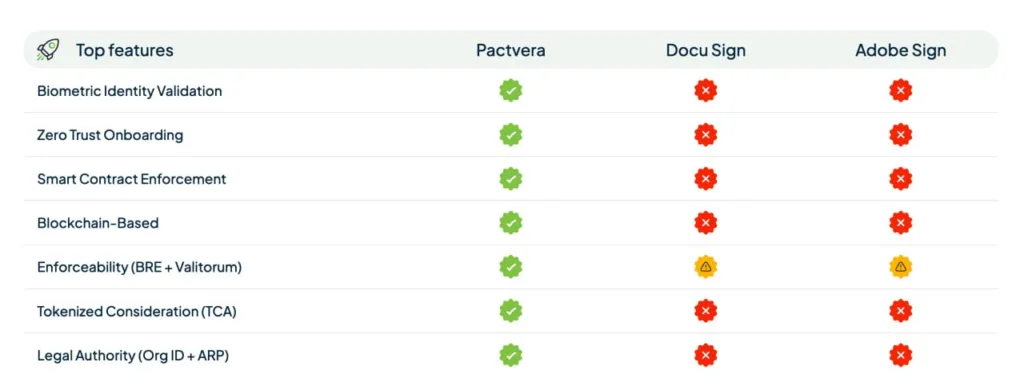
That is exactly why Pactvera was built as a digital agreement system that produces immutable, evidence-grade audit trails by combining biometric identity verification, rules-enforced execution, and sealed final artifacts you can validate and defend.
Key Takeaways
- An immutable audit trail is not a PDF log; it is tamper-evident evidence that preserves identity, intent, authority, and document integrity end-to-end.
- The best audit trail is only as strong as the identity and authorization controls that generate it.
- Courts and auditors look for provenance: who did what, when, from where, on which device, under which rules, and whether the record can be altered.
- Pactvera combines biometric ChainIT ID + MFA, business rules enforcement, privacy-preserving interaction audit, and blockchain-sealed final artifacts to produce a defensible evidence package.
- If your agreements are high-risk, dispute-prone, or audit-heavy, you should treat audit trails as evidence engineering, not a checkbox feature.
What Is An Immutable Audit Trail
An audit trail is a chronological record of actions taken in a system. In digital contracting, that includes events like document creation, version changes, identity verification, viewing, consent actions, signature steps, approvals, and final execution.
An audit trail becomes immutable when it is:
- Tamper-evident: any change to the record is detectable
- Append-only: events are added, not overwritten
- Cryptographically bound: events and artifacts are linked via hashes or signatures so the chain breaks if altered
- Verifiable independently: a third party can validate integrity without trusting the vendor’s internal database alone
Many platforms claim immutability because they produce an exportable certificate or a completion summary. That helps, but it is not the same as generating an evidence record that is cryptographically anchored, identity-strong, and rules-consistent from start to finish.
Immutability vs. Backups vs. Logs
- Backups preserve data, but do not prove it was not altered between backups.
- Standard logs are editable by admins, database access, or vendor operations unless designed as tamper-evident.
- Immutable audit trails are designed for adversarial environments: disputes, investigations, and audits where incentives to manipulate records exist.
Why Immutability Matters Specifically For Contracts
A contract signing dispute is rarely about whether a file exists. It is about what a signer knew, what they did, and whether the agreement was executed under valid conditions.
Immutable audit trails help answer the questions that actually matter:
- Was a real human present and verified at signing time
- Did the signer have authority to bind the entity
- Was the content the same at signing and after signing
- Were required conditions satisfied before finalization
- Can the evidence withstand challenges to authenticity and integrity
Why Is a Digital Contract Software The Best Option For Immutable Audit Trails
The best digital contract software for immutable audit trails is the platform that can prove, in a verifiable and tamper-evident way, five things at once:
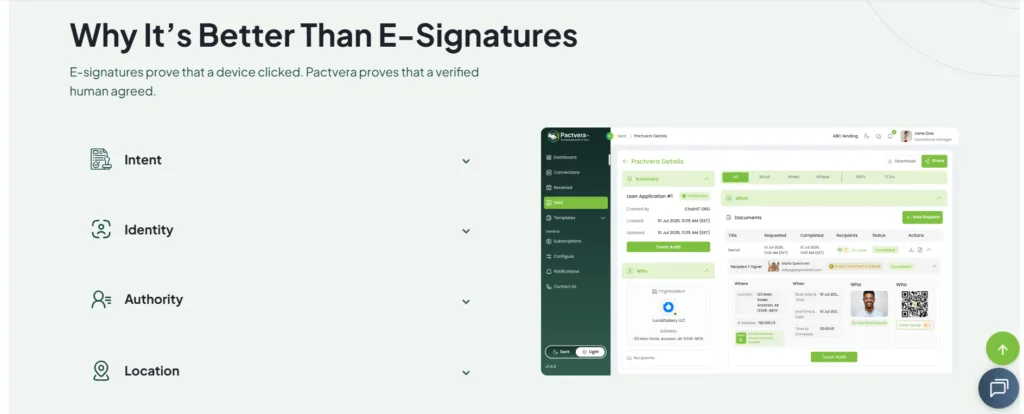
- Identity: who the signer is, with measurable identity strength
- Intent: that the signer knowingly executed the agreement
- Authority: that the signer was authorized to bind the entity
- Integrity: that the document and evidence were not modified after execution
- Rules compliance: that the signing process enforced required constraints and did not finalize if conditions failed
If any one of these is weak, the audit trail becomes easier to attack: Immutability alone does not fix identity ambiguity, strong identity alone does not fix document tampering, and a perfect PDF does not fix an invalid workflow.
This is why Pactvera is built as an evidence system, not just a signing tool, and why it fits into existing contract management programs without forcing teams to rebuild everything from scratch.
How Immutable Audit Trails Work In Practice
An immutable audit trail in a modern contract system is typically implemented through a combination of:
1) Cryptographic Hashing For Document And Event Integrity
A hash is a unique fingerprint of content. If content changes, the hash changes.
Digital contract platforms should hash:
- The final contract document
- Each evidence artifact (identity proof, consent records, device data)
- The event stream itself (view, click, approve, sign, counter-sign)
Best practice is to hash at multiple points and link those hashes so that a change in any step becomes obvious.
2) Strong Time Anchoring
Time is central in disputes.
A credible audit trail needs:
- Precise timestamps for each action
- Time anchoring that is difficult to falsify
- Consistency across systems and devices
3) Access Control And Separation Of Duties
If a single admin can edit logs, you have a governance problem.
Immutability requires:
- Limited write access to the audit stream
- Role-based controls
- Clear auditability of admin actions
This is also where security becomes practical, because it limits who can touch evidence, not just who can view a PDF.
4) Evidence Packaging For Third-Party Verification
A defensible system produces a complete evidence package that can be reviewed by:
- Legal teams
- Compliance and audit
- External regulators
- Courts and expert witnesses
The best systems design evidence as a product output, not a side effect, and preserve transparency about what was captured and how it can be verified.
Common Misconceptions About Immutable Audit Trails
Misconception 1: Blockchain = Immutable, So We’re Done
Anchoring a hash on a blockchain can be helpful, but it only proves that something existed at a point in time. It does not automatically prove identity, intent, authority, or that the underlying contract signing workflow was valid.
Misconception 2: A Certificate Of Completion Is An Immutable Audit Trail
Certificates are often summaries. They are only as strong as the underlying system and whether the underlying evidence is tamper-evident and verifiable.
Misconception 3: Immutability Is Only For Crypto Or Web3
Immutable audit trails are a mainstream requirement in enterprise contexts: procurement, healthcare, financial services, regulated HR, and cross-border contracting.
If a contract has material downside, a compliance surface area, or a history of disputes, immutability is relevant.
Benefits Of Digital Contract Software For Immutable Audit Trails
A purpose-built digital contract platform gives you benefits beyond speed and convenience.
When audit trails are truly immutable and evidence-grade, you get operational, legal, and compliance upside for teams that need dependable digital solutions, not just faster paperwork.
1) Stronger Enforceability Posture
Disputes often hinge on whether the record is trustworthy. An immutable audit trail provides a defensible narrative:
- Identity verified at execution
- Document integrity preserved
- Actions recorded without tampering
This reduces uncertainty in enforcement and improves your ability to resolve disputes faster.
2) Lower Fraud And Impersonation Risk
Most contract fraud occurs before the signature is applied: credential sharing, delegated signing, spoofed emails, or unauthorized approvals.
Immutability helps, but the real benefit comes when immutability is paired with stronger identity controls, device linkage, and step-up verification.
3) Audit Readiness Without Manual Work
Teams waste time assembling proof for auditors: screenshots, exports, email threads, and scattered system logs.
Immutable audit trails allow you to produce:
- A consistent evidence package per agreement
- A standardized document history
- A single source of truth for who did what and why
4) Better Governance And Accountability
When workflows are rules-enforced and tamper-evident, internal accountability improves:
- Approvals can be proven
- Exceptions are visible
- Policy violations are harder to hide
5) Faster Investigations And Incident Response
If something goes wrong, immutable audit trails shorten time-to-truth.
You can validate:
- Whether content changed
- Which device and identity were involved
- Which steps were completed and which failed
- Whether authority resolution was satisfied
What Courts, Auditors, And Regulators Actually Look For
Even when an audit trail is technically immutable, reviewers will still ask whether it is credible.
In practice, stakeholders look for:
1. Evidence Integrity
- Can the record be altered without detection
- Are events cryptographically bound to the artifact
- Is there a clear chain of custody
2. Identity Strength
- How the signer was verified
- Whether verification was liveness-checked
- Whether identity strength is measurable and recorded
3. Intent And Consent
- Clear consent steps
- Disclosure language and acceptance capture
- Interaction trail showing deliberate execution
4. Authority And Organizational Binding
- Proof the signer had authority
- Traceable delegation or role verification
- Organization identity resolution for enterprise signing
5. Consistency And Repeatability
- A standardized process that does not rely on ad hoc steps
- Rules enforcement that prevents invalid finalization
- Repeatable evidence outputs that auditors can sample and validate
Why Pactvera Is The Best Digital Contract Software For Immutable Audit Trails
We built Pactvera for environments where a basic e-sign workflow is not enough: high-value agreements, regulated processes, enterprise approvals, and dispute-prone counterparties.
Our core difference is that we treat the contract as an evidence object, with identity, rules, and integrity engineered into the execution.
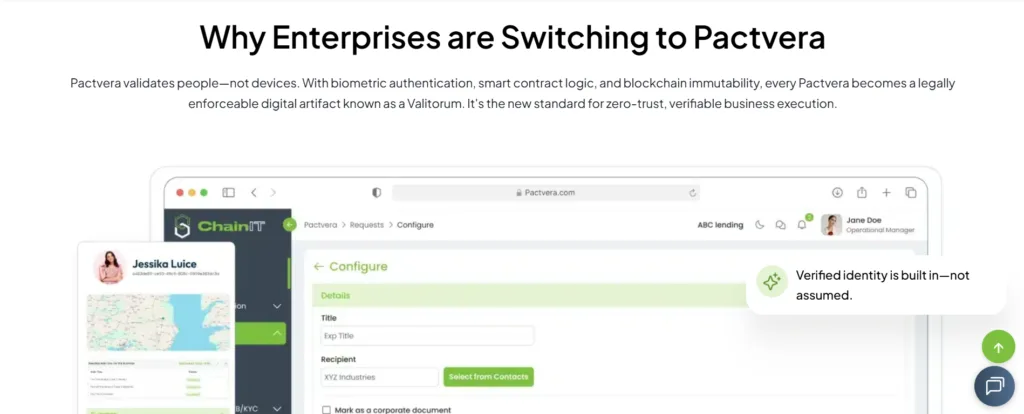
1) ChainIT ID With Liveness-Verified Biometrics And MFA
Immutability without identity is a liability. Pactvera uses ChainIT ID to establish a stronger proof of the human behind the action:
- Liveness-verified biometric checks
- Device linkage signals
- Multi-factor authentication for step-up assurance
- Identity strength recorded as part of the evidence
This closes the gap where traditional signing flows only prove that someone clicked a link.
2) Built-In BRE That Prevents Invalid Finalization
Most platforms log what happened, even if the process violated policy. Pactvera enforces a Business Rules Engine before the agreement can finalize:
- Role and authority requirements
- Jurisdiction or age conditions
- Deadlines and sequence dependencies
- Conditional approvals and countersign requirements
If conditions fail, the agreement does not finalize. That matters because an audit trail is most valuable when it proves not only what occurred, but that what occurred was valid.
3) Validated Data Token For Evidence-Grade Provenance
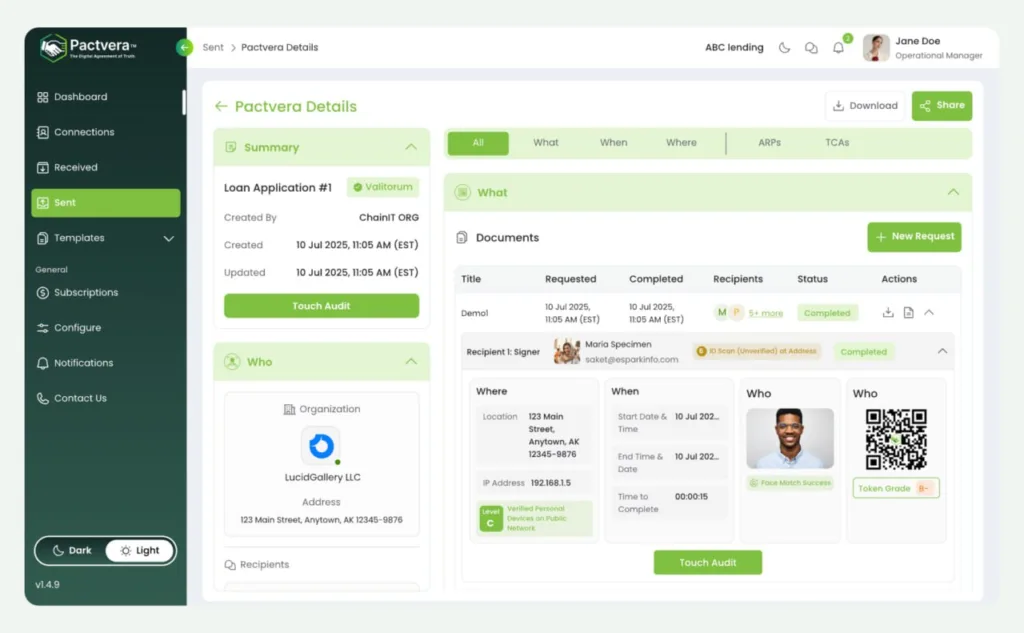
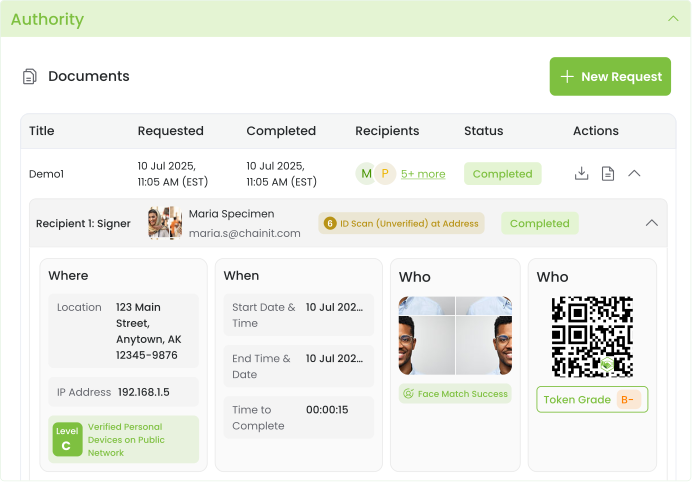
Pactvera generates a Validated Data Token that captures critical provenance in a structured, verifiable format:
- Who, what, when, where
- Device and environment signals
- Identity strength indicators
- Token grading to communicate confidence level
This turns scattered logs into a coherent proof object that can be reviewed, compared, and defended.
4) Touch Audit For Privacy-Preserving, Rebuttable Proof
Audit trails should be strong without being invasive.
Our Touch Audit layer captures interaction evidence in a way designed to preserve privacy while still enabling dispute defense:
- A verifiable interaction trail
- Rebuttable-proof design for contested claims
- Alignment with modern privacy expectations in regulated environments
5) Authority Resolution For Organizations
Enterprise contracts often fail on authority disputes, not signature mechanics.
Pactvera supports organizational identity and authority resolution so you can prove who was empowered to sign and under which organizational context.
6) Valitorum: Blockchain-Sealed Final Artifact
At the end of execution, Pactvera produces a sealed final artifact designed to be immutable, timestamped, and jurisdiction-tagged.
This artifact is meant to be court-ready, with evidence integrity built into the output rather than bolted on later.
Pactvera also supports integration patterns that let teams keep their existing workflows while upgrading the proof standard, and we prioritize user experience so stronger verification does not create friction that breaks adoption.
Conclusion
Immutable audit trails are not a nice-to-have feature anymore. They are a risk control and a proof standard for digital contracting in audit-heavy and dispute-prone environments.
The strongest outcomes come when immutability is paired with strong identity, enforced rules, authority resolution, and a final artifact that is built for third-party verification.
That is exactly why we built Pactvera.
If you want to see what evidence-grade digital contracting looks like in practice, book a demo with Pactvera and we will walk you through how our biometric identity, rules engine, and sealed final artifacts produce immutable audit trails you can defend.
Read Next:
- How Do You Prove Who Actually Signed a Digital Contract in Court?
- Audit Trails for Digital Contracts: What Courts and Regulators Expect in 2026
- Best Platform for Non-Repudiation in Digital Contracts
FAQs:
1. What are immutable audit trails in digital contracts?
Immutable audit trails are tamper-evident, append-only records of contract events that can be verified for integrity, showing who did what, when, and under what conditions, without relying on editable internal logs.
2. Why do immutable audit trails matter for contract disputes?
Immutable audit trails matter because disputes focus on identity, intent, authority, and document integrity. An immutable audit trail helps prove that the agreement was executed by the right party, under valid conditions, and that the record was not altered.
3. Is a certificate of completion the same as an immutable audit trail?
A certificate of completion is not necessarily the same as an immutable audit trail. A certificate is often a summary. An immutable audit trail is stronger when the underlying events and artifacts are cryptographically bound and independently verifiable.
4. Does blockchain automatically make a contract audit trail immutable?
Blockchain anchoring can make tampering easier to detect, but it does not automatically prove identity, intent, authority, or workflow validity. Those elements must be engineered into the signing process.
5. What should I look for in digital contract software for immutable audit trails?
Look for strong identity verification, enforced workflow rules, tamper-evident event logging, cryptographic binding between documents and evidence, independent verification capabilities, and a comprehensive evidence package output.