In 2026, blockchain teams are building in a threat environment where compliance is no longer a checkbox, it is a production system.
Chainalysis reports illicit cryptocurrency addresses received at least $154 billion in 2025, while TRM Labs identifies $158 billion in illicit flows in 2025, underscoring why regulators, banking partners, and enterprise customers are raising the bar for controls and evidence.
That is exactly where modern legal + compliance stacks win: you need identity-grade onboarding, policy enforcement, monitoring, and court-ready auditability across agreements, authority, and actions, while staying aligned with GDPR expectations in privacy-heavy workflows.
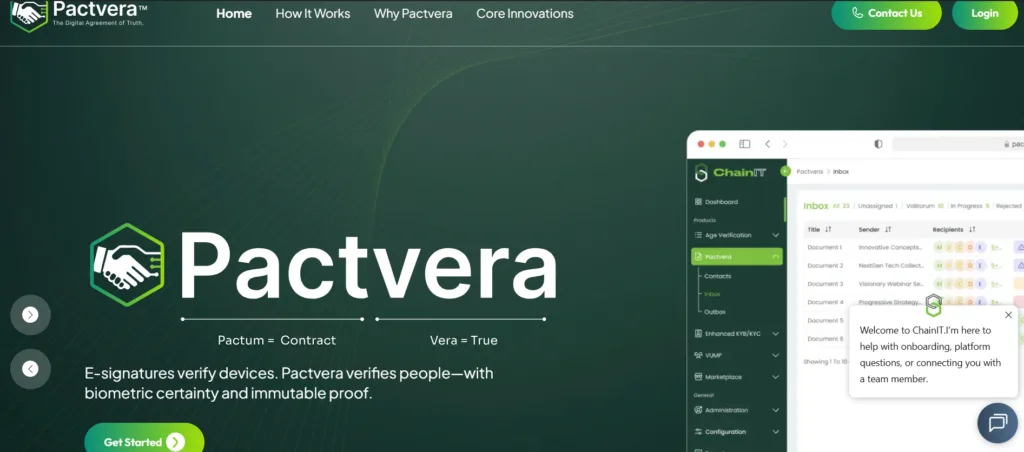
Pactvera was built exactly for that, to verify human intent and authority, rule-driven finalization, and immutable proof artifacts that reduce disputes and shorten compliance cycles.
Key Takeaways
- Pick one system of record for agreement proof (identity, intent, authority, timing, jurisdiction) and integrate everything else into it.
- Separate AML monitoring from Travel Rule messaging: they solve different problems and scale differently.
- Treat vendor risk as product risk: the fastest way to fail an audit is a missing control at a key vendor.
- Optimize for evidence: the best stack produces clean, exportable audit trails, not just dashboards.
- Start with the highest-liability workflows: treasury, listings, OTC, institutional onboarding, and governance approvals, then expand for scalability.
The 10 Best Legal And Compliance Softwares for Blockchain Companies In 2026
1) Pactvera
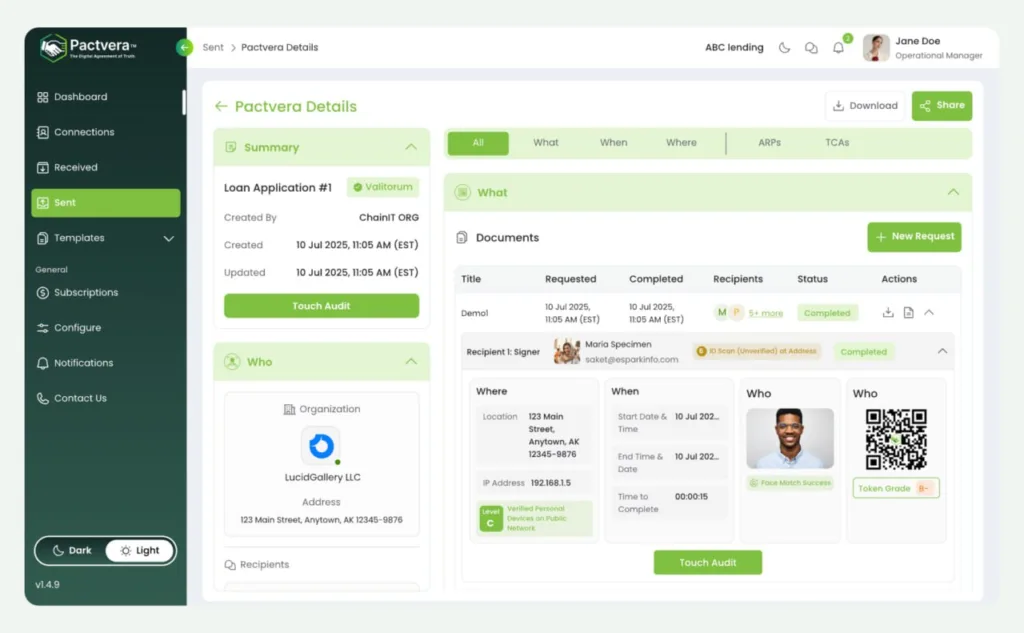
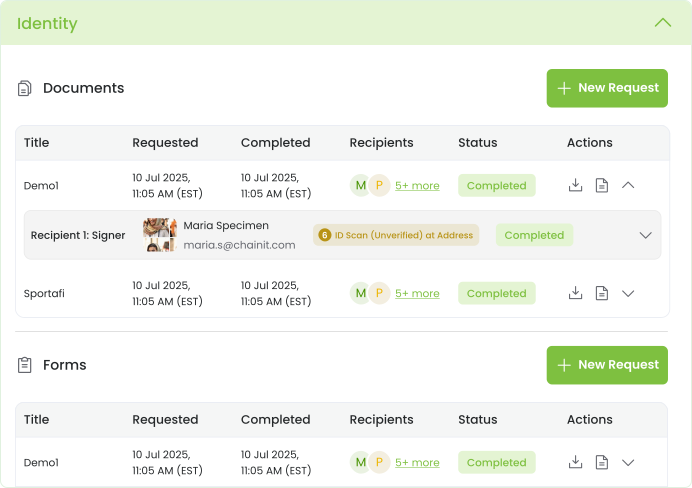
Pactvera is a digital agreement system that goes beyond traditional e-signing, by binding agreements to verified human identity, authority, and rule-based completion. Instead of proving a click, we prove intent, identity strength, and organizational authority with an audit trail designed for disputes, regulators, and enterprise procurement.
Pactvera can also reduce back-office friction with targeted document automation where agreement workflows need repeatability.
Best For
- High-stakes contracts: exchanges, custody, OTC, RWAs, stablecoin issuers, protocol foundations
- Any workflow where disputes, impersonation, or missing authority can destroy deal value
Key Capabilities
- Biometric identity + MFA via ChainIT ID (liveness-verified)
- Business Rules Engine gating (jurisdiction, age, role/authority, deadlines, conditional logic)
- Validated Data Token evidence (who/what/when/where/device/identity strength, token grade)
- Touch Audit interaction trail and final immutable artifact (Valitorum)
Pros
- Strongest evidentiary posture when agreements are contested
- Built-in controls to prevent invalid finalization (rules must pass)
- Clear authority proof for org signatures and delegated roles
Cons
- More “compliance-forward” than lightweight e-sign tools (by design)
- Best value shows up most in audit-heavy, dispute-prone workflows
2) Chainalysis
Chainalysis is a widely used blockchain intelligence and investigations platform. Teams rely on it for transaction tracing, risk scoring, compliance workflows, and reporting across on-chain activity.
Best For
- Exchanges, custodians, payment processors, and protocols needing on-chain risk intelligence
- Compliance, investigations, and fraud teams that must explain flows to auditors and regulators
Key Capabilities
- Exposure analysis and wallet/entity attribution
- Investigation tooling and alerting
- Reporting for compliance programs and suspicious activity reviews
Pros
- Strong ecosystem adoption and investigator workflows
- Designed for explainability: why an address/flow is risky (when attribution exists)
Cons
- Quality depends on attribution coverage and internal process maturity
- Does not solve agreement authority, signer intent, or contract proof
Unlike Chainalysis, Pactvera proves who agreed, with what authority, under which rules, and produces a sealed artifact you can use when the “who approved this” question becomes legal.
3) TRM Labs
TRM Labs provides blockchain intelligence, risk scoring, and investigative tooling used by both private-sector compliance teams and public-sector agencies. Its research highlights how quickly illicit flows can rebound, reinforcing the need for continuous controls.
Best For
- Risk teams that want rapid alerting, monitoring, and investigations
- Organizations operating in sanctions-sensitive corridors
Key Capabilities
- On-chain monitoring and risk detection
- case management and investigative workflows
- Typologies, threat intelligence, and reporting
Pros
- Strong focus on illicit typologies and sanctions risk narratives
- Useful for ongoing monitoring and operational response
Cons
- On-chain intelligence does not replace off-chain identity, authority, and agreement evidence
- Requires disciplined internal playbooks to operationalize findings
Pactvera however, locks down the off-chain legal layer (signer identity, intent, and authority), so investigations can rely on clean contractual provenance.
4) Elliptic
Elliptic provides blockchain analytics and compliance solutions used for transaction monitoring, wallet screening, and investigations. It is often selected by teams that prioritize exposure intelligence and compliance reporting for digital asset flows.
Best For
- Compliance programs that need wallet screening + monitoring integrated into operations
- Firms preparing for bank partner and enterprise customer due diligence
Key Capabilities
- Wallet screening and transaction monitoring
- Investigations and exposure analysis
- Reporting support for compliance reviews
Pros
- Solid fit for transaction-risk controls
- Helps build repeatable compliance ops around on-chain exposure
Cons
- Does not cover contract execution controls or signer verification
- You still need a legal-grade proof layer for approvals and agreements
On the other hand, Pactvera is purpose-built for the evidence trail behind approvals, authorizations, and contract formation, where most disputes actually land.
5) Notabene
Notabene focuses on Travel Rule compliance for virtual asset service providers (VASPs), enabling required originator/beneficiary information exchange for qualifying transfers. The Travel Rule is anchored in FATF standards and has seen ongoing updates and implementation tracking.
Best For
- Exchanges, custodians, brokers, and payment rails with cross-VASP transfers
- Teams that need to operationalize Travel Rule messaging without rebuilding infrastructure
Key Capabilities
- Counterparty messaging workflows and interoperability
- Policies and controls for Travel Rule data exchange
- Program support for VASP-to-VASP compliance operations
Pros
- Directly targets a specific regulatory obligation
- Speeds up implementation for organizations scaling transfer volumes
Cons
- Only one slice of compliance: messaging ≠ monitoring ≠ legal contracting
- Still need clean customer onboarding evidence and authority controls
Pactvera stands out when compared to Notabene, because it strengthens the legal foundation, verified agreement intent, authority resolution, and immutable audit artifacts, supporting the compliance program that surrounds Travel Rule operations.
6) ComplyAdvantage
ComplyAdvantage provides AML risk intelligence such as sanctions and watchlist screening, adverse media, and ongoing monitoring, often used in fintech and crypto compliance stacks.
Best For
- Customer onboarding and ongoing risk monitoring (KYC/AML programs)
- Teams that need scalable screening workflows with audit logs
Key Capabilities
- Sanctions/PEP screening and monitoring
- Adverse media signals and risk scoring
- Workflow integrations into onboarding and compliance systems
Pros
- Practical, repeatable controls for screening requirements
- Integrates well with identity verification and review queues
Cons
- Screening does not prove consent, agreement formation, or contract signer authority
- Needs strong internal policy mapping to avoid alert fatigue
Even if ComplyAdvantage has Practical, repeatable controls for screening requirements, Pactvera is the agreement proof engine, when you must demonstrate who agreed, when, and under what authority, not just that you screened them.
7) Sardine
Sardine combines fraud prevention signals with compliance tooling, often used for onboarding, transaction risk, and suspicious pattern detection, especially where real-time decisions matter.
Best For
- High-velocity onboarding and payments where fraud + compliance overlap
- Teams that need to reduce chargebacks, synthetic identity attempts, and account abuse
Key Capabilities
- Fraud detection and risk decisioning
- Monitoring signals across accounts and transactions
- Workflow tooling for review and escalation
Pros
- Useful for frontline defense against account takeover and onboarding attacks
- Helps reduce operational load with better signal quality
Cons
- Not a substitute for legal-grade agreement evidence
- Requires tuning to avoid blocking legitimate users
Unlike Sardine, Pactvera provides the enforceable “who/authority/intent” layer that fraud tooling can’t deliver when agreements are contested.
8) Persona
Persona is an identity verification platform used for onboarding workflows, document verification, and ongoing identity checks, often with configurable flows for different user types and risk tiers.
Best For
- KYC-heavy onboarding: exchanges, fintech, marketplaces, and crypto platforms
- Risk-tiered onboarding where flows differ for retail vs institutional users
Key Capabilities
- ID verification and liveness checks (implementation varies by configuration)
- Workflow orchestration for onboarding
- Integrations into compliance and risk stacks
Pros
- Flexible onboarding flows and integrations
- Helps standardize identity checks across products
Cons
- Identity verification alone does not equal enforceable agreement provenance
- Authority proof for organizational signers is still a gap for many stacks
Pactvera takes the advantage because it ties verified identity to legally meaningful actions: agreement execution, authority resolution, and sealed evidence for disputes.
9) OneTrust
OneTrust is a privacy, GRC, and risk platform used to run policies, privacy assessments, vendor risk workflows, and governance reporting across complex organizations. It is also commonly adopted by legal teams that want internal practice management structure without building everything from scratch.
Best For
- Privacy programs, vendor risk, and compliance documentation at scale
- Teams needing structured governance workflows and reporting
Key Capabilities
- Privacy program operations and assessments
- Vendor risk workflows
- Policy libraries and document management for compliance artifacts
Pros
- Strong for organizational compliance ops and documentation
- Useful for repeatable governance, audits, and risk registers
Cons
- Not designed as a contract proof engine for blockchain agreements
- Doesn’t solve identity/authority at the point of signing
Pactvera outshines OneTrust in the moments that matter most: proving enforceable intent and authority when a contract is executed.
10) Vanta
Vanta streamlines security compliance evidence collection for frameworks like SOC 2 and ISO 27001, helping teams keep audit evidence current with less manual effort.
Best For
- Startups and scale-ups targeting SOC 2 / ISO readiness
- Teams that need continuous control monitoring evidence for audits
Key Capabilities
- Control monitoring and evidence automation
- Audit readiness workflows and reporting
- Vendor and asset visibility (depending on setup)
Pros
- Speeds up security compliance timelines
- Helps keep audit evidence current, reducing scramble
Cons
- Security compliance ≠ legal contracting and authority proof
- Still need a strong agreement and approval evidence layer
Pactvera overtakes Vanta beacuse it fills the legal-evidence gap (who approved, under what authority, with what identity strength), so audits cover both security controls and contractual provenance.
Comparison Table
| Software | Primary Use Case | Best For | Strength | Primary Gap |
|---|---|---|---|---|
| Pactvera | Agreements + authority + evidence | High-stakes contracting | Identity/intent/authority proof + rule gating | Less value for low-risk click-through flows |
| Chainalysis | On-chain intelligence | Compliance + investigations | Attribution + investigations tooling | Not a contract/authority system |
| TRM Labs | On-chain monitoring + intel | Sanctions + typologies | Strong illicit flow intelligence | Not agreement evidence |
| Elliptic | Monitoring + screening | Compliance operations | Exposure reporting | Not signer/authority proof |
| Notabene | Travel Rule messaging | VASPs | Speeds Travel Rule operations | Not AML monitoring or contracting |
| ComplyAdvantage | Screening + monitoring | AML onboarding | Watchlists/adverse media | Not agreement evidence |
| Sardine | Fraud + compliance signals | High-velocity onboarding | Real-time decisioning | Not legal contract proof |
| Persona | Identity verification | KYC onboarding | Configurable onboarding flows | Authority + contract evidence gaps |
| OneTrust | Privacy/GRC | Enterprise compliance | Governance workflows | Not execution evidence |
| Vanta | Security compliance | SOC2/ISO readiness | Evidence tooling | Not legal contracting |
Why Pactvera Is The Best Legal And Compliance Software For Blockchain Companies In 2026
Most legal and compliance softwares in crypto are built to monitor risk (screening, sanctions, on-chain exposure) or document controls (GRC).
Pactvera is the layer that actually prevents invalid agreements and approvals from happening in the first place, and then produces the strongest possible proof when something is challenged.
1) It Proves A Verified Human, Not A Click
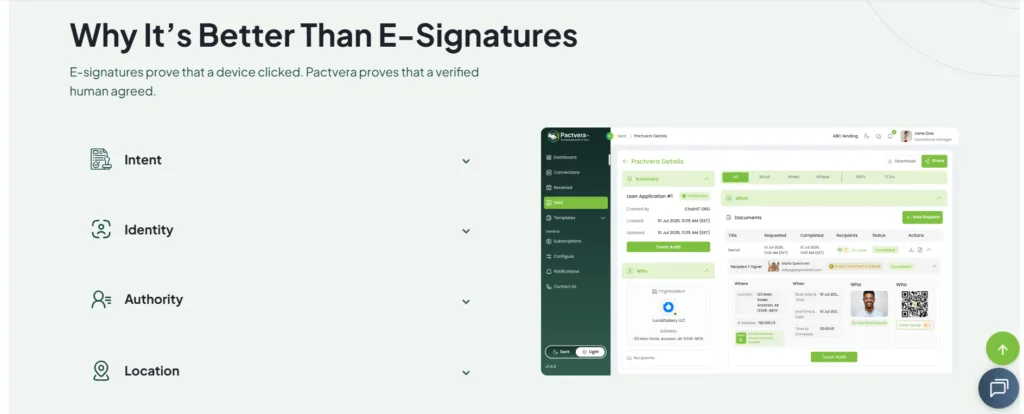
Traditional e-sign flows prove that a device completed a signature action.
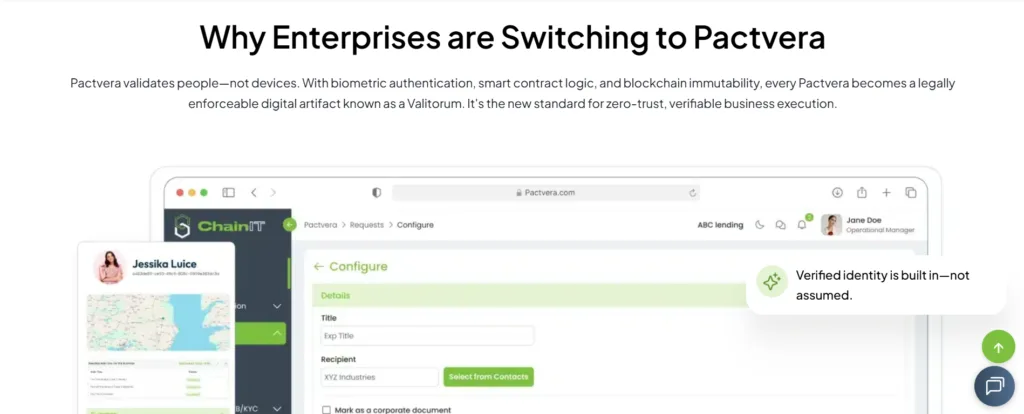
Pactvera ties execution to a liveness-verified human identity plus MFA, reducing impersonation, delegated signing abuse, and executive spoofing risk in high-stakes workflows.
2) It Enforces Compliance With Rules Before Anything Can Finalize
Most tools record what happened. Pactvera can gate completion using a built-in BRE, so the agreement cannot finalize unless conditions pass (jurisdiction checks, age requirements, role/authority thresholds, deadlines, signer sequencing, conditional approvals).
That is what makes it compliance-native instead of compliance-after-the-fact.
3) It Solves The Authority Problem For Organizations
For blockchain companies, the hardest disputes are usually not about if someone signed, but if they have the right to sign in the first place.
Pactvera’s org authority logic (ChainIT Org ID + ARP-style authority resolution) is designed to prove that the signer had the right role or delegation at the moment of execution, critical for treasury mandates, exchange listings, OTC deals, and custody arrangements.
4) It Produces Court-Ready Evidence, Not Just Audit Logs
Pactvera creates a VDT capturing who/what/when/where/device/identity strength and a Touch Audit interaction trail, then seals the final artifact as an immutable, timestamped package (Valitorum).
When regulators, bank partners, or counterparties ask for proof, you can export a coherent evidence packet instead of stitching screenshots together.
5) It Fits The Way Blockchain Teams Actually Operate
Blockchain orgs move fast, sign globally, and rely on distributed teams, so compliance breaks when the process is manual.
Pactvera supports rule-driven workflows that scale with your operating model: multi-signer approvals, delegated authority, jurisdiction-aware execution, and repeatable agreement flows that reduce operational load without weakening controls.
6) It Complements (And Strengthens) The Rest Of Your Stack
Pactvera is not trying to replace on-chain intelligence or screening providers. It strengthens them by making the legal layer defensible:
- On-chain analytics tells you what happened on-chain
- Screening tools tell you who you are dealing with
- GRC tools help you document controls
- Pactvera proves that the right verified person, with the right authority, agreed under enforceable rules, and preserves the evidence
Net result: fewer invalid approvals, fewer disputes, cleaner audits, faster enterprise deals, and stronger non-repudiation for the workflows that matter most in 2026.
Risk Controls Checklist For Blockchain Legal And Compliance
- Define an evidence standard: what must be logged for approvals, agreements, and key decisions
- Centralize authority: keep an auditable map of who can sign what, and when that authority changes
- Treat policies as executable: wherever possible, enforce rules in systems (not in wikis)
- Run quarterly vendor control reviews: your “compliance perimeter” includes vendors
- Practice incident drills: sanctions exposure, wallet compromise, executive impersonation, Travel Rule failures
- Document exceptions: exceptions aren’t forbidden, but undocumented exceptions are audit failures
Conclusion
The best legal and compliance stack in 2026 is the one that produces clean proof: verified identity, enforceable authority, rule-based completion, and audit-ready evidence, supported by screening, monitoring, and governance layers.
If your contracts and approvals are still “click evidence,” you are leaving your company exposed in disputes and audits.
Book a demo to see how Pactvera replaces fragile e-sign workflows with verified intent, authority resolution, and sealed proof artifacts, alongside modern legal solutions.
Read Next:
- 2026 E-Signature Fraud Statistics: Data on the 244% Rise in Digital Forgery
- Best Biometric Contract Platforms for Blockchain Companies in 2026
- Solving the “Anonymous Signer” Problem in Web3 and DAO Governance
FAQs:
1. What Legal And Compliance Softwares Do Blockchain Companies Need In 2026?
Blockchain companies need an agreement proof layer, identity + AML screening, on-chain monitoring, Travel Rule tooling (for VASPs), and a GRC/security compliance layer.
2. Why Do Audits Fail Even When A Blockchain Company Has Multiple Compliance Tools?
Audits fail even when a blockchain company has multiple compliance tools because the stack often cannot produce consistent evidence of who approved what, under what authority, and with what controls.
3. How Do You Prove A Signer Had Authority To Bind A Blockchain Company?
You prove a signer had authority to bind a blockchain company by capturing role and delegation evidence at signing time, enforcing authority rules, and producing an immutable audit artifact that ties identity to the action.
4. What Is The Difference Between Travel Rule Tools And AML Monitoring Tools?
The difference between Travel Rule tools and AML monitoring tools is that Travel Rule tools handle required counterparty data exchange for qualifying transfers, while AML monitoring tools detect and manage risk patterns and suspicious activity.
5. Do On-Chain Analytics Platforms Replace Legal Agreement Evidence?
On-chain analytics platforms do not replace legal agreement evidence because tracing funds does not prove human intent, signer identity strength, or organizational authority at the moment a contract or approval happened.
6. How Can Pactvera Reduce Contract Disputes For Blockchain Teams?
Pactvera reduces contract disputes for blockchain teams by verifying the human signer, enforcing rule-based completion, resolving organizational authority, and sealing the final evidence artifact for audit and litigation readiness.