What Makes a Digital Agreement Legally Binding? (2026 Criteria)

A digital agreement is legally binding in 2026 when it satisfies the same contract-law essentials as paper, and produces reliable electronic evidence that a court can trust: who agreed, what they agreed to, when they agreed, and whether the record was altered after acceptance.

In practice, contracts rarely fail because they were formed online; they fail because the evidence package is weak on intent, consent, attribution, authority, or integrity under the rules of the relevant jurisdiction.

That’s exactly why we built Pactvera.

Key Takeaways

  • A digital agreement is enforceable when offer, acceptance, consideration, capacity, legality, and definite terms are present, and the electronic process proves them.
  • Under U.S. law, agreements generally cannot be denied legal effect solely because they are electronic (ESIGN and UETA).
  • In the EU, enforceability is shaped by eIDAS assurance tiers, including advanced e-signatures and qualified e-signatures, with higher identity and integrity expectations for higher-risk transactions.
  • The strongest posture in 2026 is evidence-grade: tamper-evident records, strong signer verification, authority checks, and an audit trail that stands up in litigation.
  • Pactvera is designed to make a digital agreement court-ready by combining verified identity, enforced workflow rules, and sealed, immutable evidence artifacts.
Best Contract Signing Software

What Makes A Digital Agreement Legally Binding (2026 Criteria)

1) The core contract elements are satisfied

A digital agreement is still a contract. Courts look for the same foundational elements, regardless of format:

  • Offer: clear, specific terms (price, scope, timelines, responsibilities).
  • Acceptance: unambiguous agreement to the offer (electronic signing step, click-to-accept, or equivalent).
  • Consideration: exchange of value (money, services, rights, or obligations).
  • Mutual assent / intent to be bound: parties understood they were entering enforceable obligations.
  • Capacity: parties were competent and (for organizations) properly authorized.
  • Legality: lawful purpose and compliant subject matter.
  • Definite terms: enough clarity for a judge to enforce without rewriting the deal.

If one of these fails, the digital method does not save it.

Pactvera enforces formation discipline with its BRE, so required steps for offer presentation, review, and acceptance are not optional, and our VDT evidence package captures the acceptance event and the final terms as a single, defensible record.

2) The law recognizes electronic form for that transaction type

In most commercial scenarios, electronic form is recognized:

  • United States (ESIGN + UETA): electronic records and electronic signatures generally cannot be denied legal effect because they are electronic.
  • European Union (eIDAS): eIDAS supports tiered approaches, including advanced electronic signatures and qualified electronic signatures, to align assurance level with risk and cross-border needs.

Practical implication: your digital agreement must be built so it meets jurisdiction-specific requirements (especially for consumer disclosures, regulated industries, and certain transaction categories that may have exceptions).

Pactvera applies jurisdiction-aware execution gates via the BRE, so agreements do not finalize unless the correct legal method and required conditions are met for the workflow.

Pactvera’s Valitorum artifact is jurisdiction-tagged and evidence-sealed to support cross-border presentation.

3) Consent to transact electronically is captured and provable

Courts and regulators care that parties agreed to use electronic records, not just that the platform supports them.

In consumer contexts, this typically means clear disclosures and affirmative actions that show consent. This is one of the easiest places for a defendant to attack the record if the workflow is sloppy.

Pactvera captures explicit electronic consent as an enforced workflow step, not a best-effort UI pattern, and then writes that consent step into the Touch Audit trail and VDT package so the consent story is provable later.

4) Intent to sign is explicit, not implied

A legally binding digital agreement requires an action that signals “I agree,” such as completing a structured acceptance step after reviewing terms.

Evidence should show one clear signature moment tied to the final text, not passive conduct like browsing.

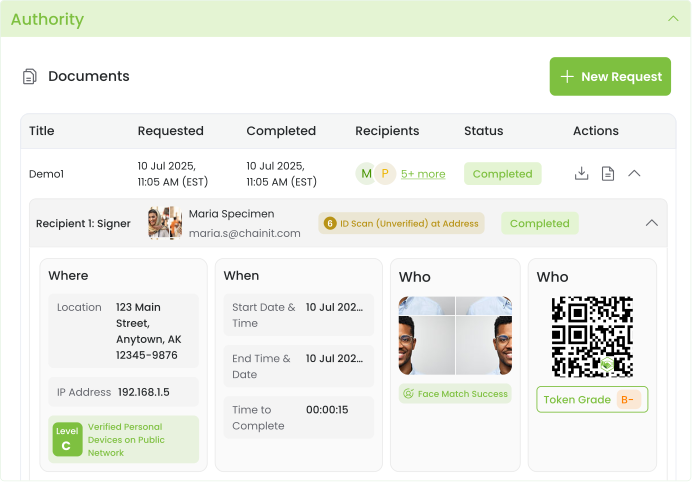
Pactvera binds the acceptance moment to ChainIT ID and MFA, so the system can show a verified human performed the intentional act.

5) Attribution is strong: the signer can be reliably linked to the act

The question a judge is implicitly asking is: who did this, really?

Attribution is stronger when you can show:

  • identity verification appropriate to the risk,
  • multi-factor authentication,
  • device binding and session integrity,
  • IP and timestamp capture,
  • evidence that the signer, not an admin, performed the acceptance step.

Weak attribution is where “someone clicked from our office IP” collapses under cross-examination.

Pactvera strengthens attribution with ChainIT ID liveness verification, device linkage, and MFA, reducing reliance on email-only identity, while VDT captures identity strength, device context, timestamps, and execution metadata in a structured format designed for evidentiary use.

6) Integrity is protected: the record is tamper-evident

A court wants confidence that the digital agreement presented is the same agreement that was accepted.

In 2026, credible integrity controls usually include:

  • record hashing / tamper-evident sealing,
  • immutable audit logs,
  • chain-of-custody controls (who accessed, edited, sent, downloaded),
  • reproducible record retention (can you produce the same final artifact later).

Pactvera seals the agreement into Valitorum, creating an immutable, timestamped artifact that is resistant to alteration disputes.

7) Authority is provable for organizations

For business-to-business digital agreements, a major enforceability risk is authority:

  • Was the signer authorized to bind the company?
  • Was the approval chain valid?
  • Were delegations and role-based permissions followed?

When authority proof is weak, a company defense often becomes “that person wasn’t authorized,” even if the acceptance step itself is technically valid.

Pactvera addresses authority with ARP, which is designed to evidence organizational authority and resolution, not just identity.

8) Record retention meets legal and industry expectations

A digital agreement is only as enforceable as your ability to produce it with its supporting evidence. For many regulated workflows, retention requirements attach to documents and their evidentiary context (audit trail, identity signals, timestamps, and chain of custody).

Pactvera produces a reproducible evidence package that stays verifiable because the final artifact is sealed and the supporting proofs are structured in VDT and Touch Audit.

9) The process is defensible under real dispute conditions

In 2026, legally binding digital agreements are not just about meeting a checkbox list.

It is about whether your evidence survives:

  • a motion challenging authenticity,
  • a claim of fraud or impersonation,
  • a claim of alteration,
  • a claim of duress or lack of notice,
  • an authority challenge,
  • cross-border enforceability scrutiny.

If you cannot tell a clean story with evidence, enforceability becomes expensive and uncertain.
Best Contract Signing Software in 2026

How Pactvera Ensures Digital Agreements Are Legally Binding

Pactvera is built around a simple principle: a digital agreement should ship with court-ready evidence by default, not rely on platform logs that are easy to dispute.

1) ChainIT ID + MFA strengthens attribution and intent

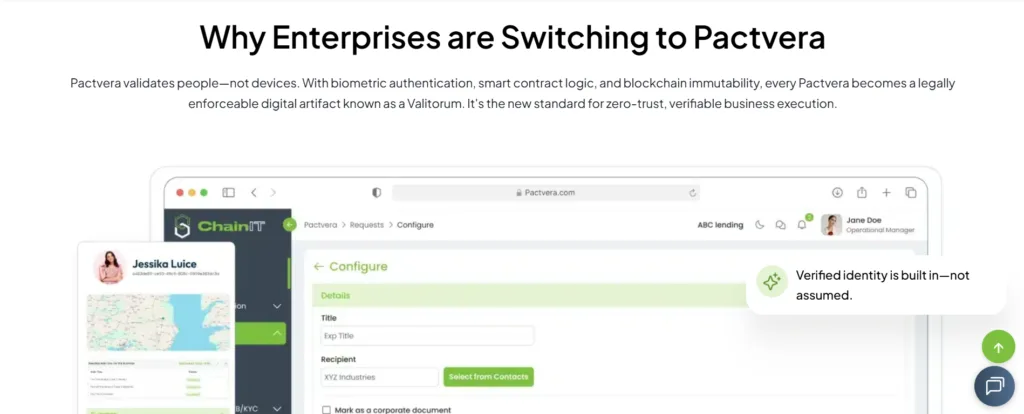
Instead of treating acceptance as a click, Pactvera ties execution to a verified human through liveness-verified biometrics, device linkage, and MFA.

That directly supports the two most litigated questions:

  • Who signed?
  • Did they intend to sign?

2) Business Rules Engine enforces compliance at the moment of execution

A digital agreement becomes fragile when policies are documented but not enforced.

Pactvera’s Business Rules Engine can gate finalization on rules like:

  • age and jurisdiction eligibility,
  • required roles and approvals,
  • deadline windows,
  • conditional acceptance steps.

This matters because the agreement cannot accidentally finalize in a non-compliant state, which is a practical driver of legal validity.

3) VDT captures structured evidence, not just raw logs

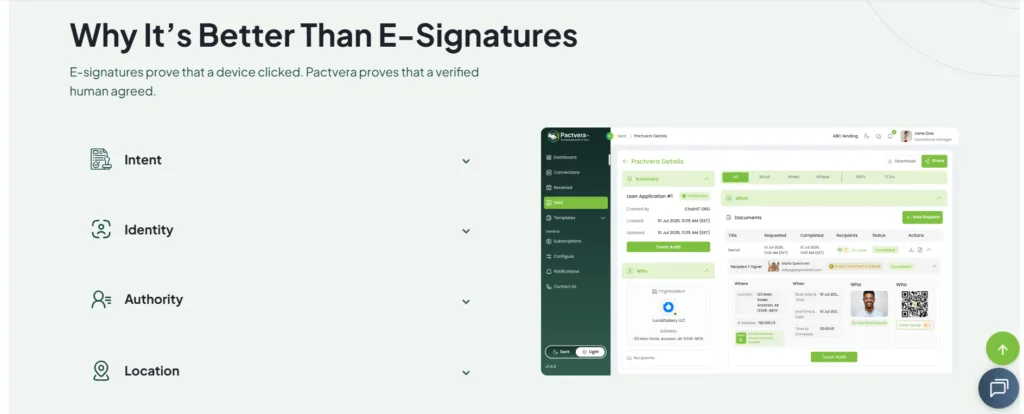
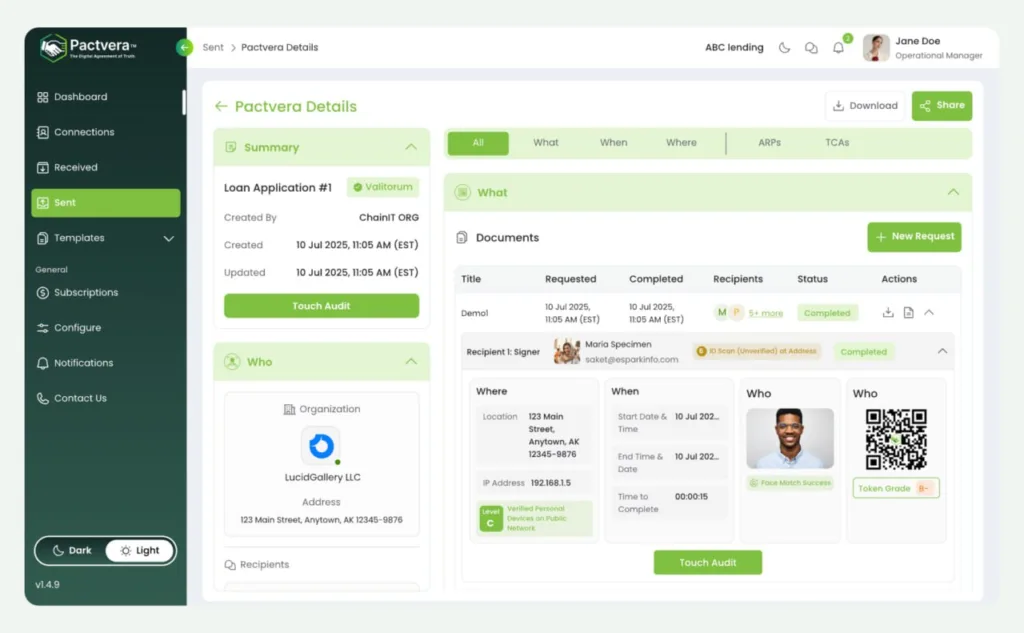
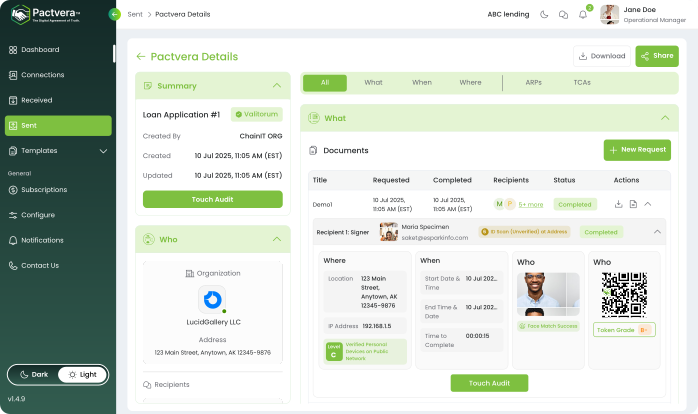
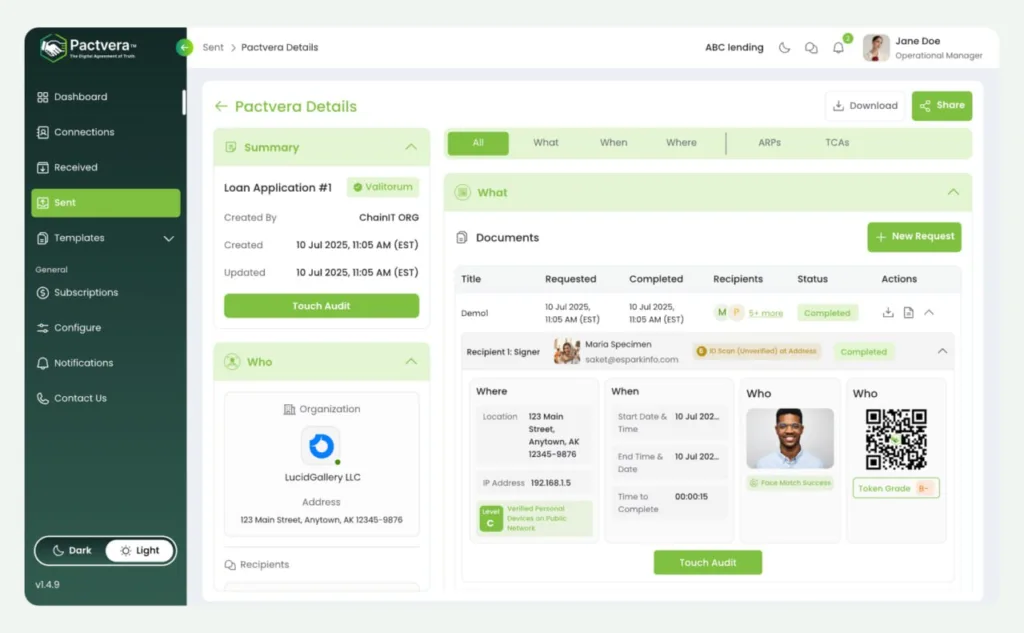
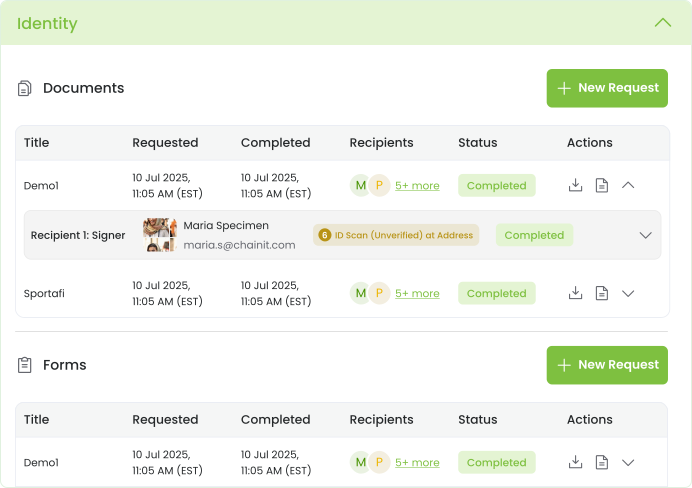
Pactvera’s Validated Data Token captures the who/what/when/where/device/identity-strength context in a structured, verifiable way, producing an evidence package that is easier to explain and harder to undermine.

4) Touch Audit provides rebuttable proof without oversharing

Touch Audit™ is designed to preserve a privacy-aware interaction trail that still supports non-repudiation and dispute resolution, so you can prove what happened without turning your audit trail into a liability under privacy regimes.

5) ARP proves organizational authority, not just identity

For B2B enforceability, Pactvera’s Authority Resolution Pactvera is built to show that the signer had the right organizational authority to bind the entity, closing one of the most common loopholes in business disputes.

6) Valitorum seals the final artifact as immutable

At the end of execution, Pactvera produces a blockchain-sealed final artifact (Valitorum) that is immutable, timestamped, and jurisdiction-tagged, so integrity and chain of custody are simpler to prove under pressure and long-term validity expectations.
Best Contract Signing Solution for Enterprises in 2026

Conclusion

A digital agreement is legally binding in 2026 when it meets the core contract elements and produces credible evidence of consent, intent, attribution, authority, and record integrity.

Most modern disputes are not about whether e-signatures are permitted, they are about whether the evidence is strong enough to enforce.

If your current process cannot reliably prove who signed, what they saw, and whether the record changed, enforceability becomes a risk decision.

Pactvera is designed to remove that ambiguity by enforcing rules at execution, verifying signers, and sealing evidence into a court-ready artifact.

If you want your digital agreement workflow to be evidence-grade by default, book a demo with Pactvera and we will map the controls to your risk and jurisdiction profile.

Read Next:


FAQs:

1. What is a digital agreement in 2026?

A digital agreement in 2026 is a contract formed and executed electronically through tools like e-signatures, click-to-accept workflows, email approvals, or in-app acceptances, where enforceability depends on provable intent, consent, attribution, and record integrity.

2. What makes a digital agreement legally binding in 2026?

A digital agreement is legally binding in 2026 when it meets the core contract elements offer, acceptance, consideration, capacity, legality, and definite terms, and the electronic process produces reliable evidence showing who agreed, what they agreed to, when they agreed, and that the record was not altered.

3. Do digital agreements require consent to transact electronically?

Yes. Digital agreements commonly require consent to transact electronically, especially in consumer contexts, and enforceability improves when platforms capture affirmative disclosures, opt out options where required, and proof that the signer could access the electronic records.

4. Is an e-signature required for a digital agreement to be enforceable?

No. An e-signature is not always required for a digital agreement to be enforceable because courts can enforce agreements formed through click-to-accept, verified email acceptance, or other clear acceptance actions, as long as intent and attribution to the party can be proven, even when the goal is equivalence to handwritten signatures.

5. What evidence matters most if a digital agreement is disputed in court?

The most important evidence is proof of intent and attribution, supported by a tamper-evident final record, an audit trail with timestamps and device context, and authority proof when an organization is being bound by an individual signer.
    How Judges Evaluate Digital Contract Evidence in 2026 (Examples and Data)

    Digital contract evidence is now the default, not the exception. In 2026, judges are seeing agreements formed through e-sign platforms, email threads, WhatsApp, clickwrap flows, and even AI-assisted drafting.

    The legal standards did not magically changed, but the fact patterns have: higher volumes, more editable formats, more authentication disputes, and a fast-rising risk of synthetic or manipulated content that can slip into everyday collaboration.

    In practice, judges evaluate digital contract evidence by walking through the same core questions every time: Can you authenticate it, can you show it is reliable, can you prove intent and formation, and can you defend chain of custody.

    In U.S. litigation that often maps to Federal Rules of Evidence (FRE) 901 and 902 (authentication/self-authentication) plus reliability gatekeeping when technical methods matter, while other jurisdictions use local equivalents and formal certification requirements.

    Key Takeaways

    • Judges do not care that an agreement is digital; they care whether you can prove who, what, when, how, and whether it was altered.
    • The fastest path to admissibility is an evidence package that is self-verifying: identity strength, cryptographic integrity, and an immutable audit trail.
    • Informal channels like WhatsApp and email routinely create binding obligations when the record shows objective intent and performance.
    • Weak UI, missing consent steps, or thin logs are still common reasons digital agreements fail.
    • AI-generated or AI-altered exhibits face heightened scrutiny, and U.S. rulemakers are actively debating a dedicated AI-evidence rule (Proposed FRE 707). (uscourts.gov)

    Best Contract Signing Software in 2026

    The Judicial Checklist In 2026

    Across courts, the evaluation process tends to converge into four gates. If you clear these, most of the fight shifts from admissibility to weight.

    1) Authentication: Is This What You Say It Is

    In U.S. courts, FRE 901 requires evidence sufficient to support a finding that the item is what the proponent claims. This is usually satisfied through witness testimony, distinctive characteristics, system process evidence, metadata, and platform logs.

    For digital contracts, authentication most often succeeds when you can present:

    • Platform-generated audit logs (timestamps, event sequence, document IDs)
    • Device and network context (IP, device fingerprinting where available)
    • Identity proofing artifacts (KYC, biometric liveness, MFA logs)
    • Integrity proofs (hash values, tamper-evident sealing)

    Why judges like it: it compresses the foundation. Instead of arguing about screenshots and exports, you show a structured event record that matches how the system actually works.

    2) Self-Authentication: Can You Prove It Without A Live Witness

    FRE 902 lists categories of self-authenticating evidence, and in modern digital practice the critical capability is proving certain electronic records by certification rather than hauling a custodian into court.

    What this looks like in real disputes: if your evidence is backed by a system that can produce a credible certification, you reduce the attack surface. If you cannot, the other side can drag you into foundation fights, spoliation arguments, or “this export could be edited” claims.

    3) Reliability: Do The Methods Produce Trustworthy Outputs

    When a party relies on technical processes (forensics, automated classification, AI analysis, or system-generated conclusions), judges scrutinize whether the method is dependable enough to be admitted, and whether error rates, validation, and transparency are available.

    This is exactly why Proposed FRE 707 exists as a live 2025–2026 debate: it aims to prevent AI-generated outputs from sliding into evidence without reliability scrutiny comparable to expert testimony standards.

    The proposal is documented in the federal courts’ amendments materials and was widely reported as an active policy move, not a theoretical one.

    4) Intent And Formation: Did The Parties Objectively Agree

    Even if authenticity is proven, judges still ask whether the record shows offer, acceptance, consideration, and objective intent.

    In messaging-based disputes, courts read the full thread and the parties’ conduct.

    This is where many teams lose: they have messages, but the record is incomplete, out of order, missing attachments, missing context, or cannot be tied to the actual individuals beyond “that’s their number.”

    5) Chain Of Custody: Can You Trace Evidence From Creation To Court

    Chain of custody is not just a criminal law concept. In civil contract disputes, the same concern shows up as “who had access,” “who could edit,” and “how do we know the file is the same one.”

    When evidence is inherently editable (Word docs, PDFs without sealing, exports that can be reassembled), judges become far more receptive to objections unless you have integrity proofs.

    What The Data Says About How Often Digital Evidence Appears

    It is important to understand why courts are accelerating their evidentiary expectations: digital evidence has become ubiquitous across case types.

    A widely cited research survey notes that digital evidence is a factor in about 90% of criminal cases, reflecting how normal digital artifacts are in modern fact-finding.

    That matters for contract litigation because it drives judicial familiarity: judges are not learning digital evidence from scratch in 2026.

    They are instead tightening standards around authentication quality and tamper resistance, especially as synthetic media risks rise.

    Best Contract Signing Solution for Enterprises in 2026

    Examples From 2025–2026: How Judges Actually Reason From The Record

    Example 1: WhatsApp + Email Formed A Binding Contract In A High-Stakes Commercial Deal (UK)

    DAZN Limited v Coupang Corp [2025] EWCA Civ 1083 is a 2025 UK Court of Appeal decision that reinforced a core point: informal digital communications can form a binding contract when essential terms are agreed and the parties’ words and conduct objectively show a deal.

    Commentary and case analyses highlight that WhatsApp and email exchanges were central to concluding the agreement even without a signed long-form document.

    What judges evaluated in substance:

    • Whether the thread captured agreement on key terms
    • Whether “we will paper this later” language negated intent (it often does not if the parties act as if bound)
    • Whether the record showed commercial urgency and performance consistent with a concluded deal

    What you should learn: a subject to contract vibe is not a shield if the digital record shows objective agreement and operational follow-through.


    Example 2: WhatsApp Messages + Payments Proved Offer, Acceptance, And Consideration (Kenya)

    In Ochiel v Okoth [2026] KEHC 106 (KLR), the Kenya High Court treated WhatsApp communications as capable of evidencing a binding agreement, reinforced by partial payment and conduct. The official Kenya Law publication provides the court and date (January 19, 2026).

    What judges evaluated:

    • The integrity and completeness of the message record
    • Whether payment behavior aligned with the claimed terms
    • Whether the communications evidenced mutual intent, not casual talk

    What you should learn: in many jurisdictions, the formation analysis becomes easier when you can pair messages with objective financial or operational actions.


    Example 3: Clickwrap And Online Consent Failed Because The Record Did Not Prove Meaningful Assent (U.S., N.D. Cal.)

    A frequent 2026 pattern is the failure of “online agreement” evidence when UX and logs do not prove clear assent.

    Fisher Phillips summarizes Rios v. HRB Digital LLC as a case where the Northern District of California denied a motion to compel arbitration tied to an online agreement, flagging enforceability issues that hinge on how consent is presented and recorded.

    What judges evaluated:

    • Was the notice reasonably conspicuous
    • Was assent unambiguous and captured in logs
    • Were the terms presented in a way a reasonable user would understand

    What you should learn: if you cannot prove that a person actually saw and affirmatively accepted, the agreement can fail even if the company believes it had a standard clickwrap.


    Example 4: AI-Related Evidence Is Treated As A Reliability Problem, Not A Cool Innovation Story

    Courts and court administrators are actively warning that AI-generated evidence can undermine trust, and the rulemaking conversation is already underway in the U.S. through the Proposed FRE 707 process. (uscourts.gov)

    Practical judicial posture in 2026:

    • If an exhibit could be synthetic, judges want provenance
    • If a model output is used to prove a disputed fact, judges want validation and error-rate framing
    • If AI is used in drafting, judges care whether the final assent is attributable to a human with authority


    Example 5: Courts Are Forcing Production Of Large-Scale AI Chat Logs When They Matter To Disputed Facts (U.S.)

    In a high-profile copyright case context, Reuters reported that OpenAI lost a fight to keep ChatGPT logs from being produced, illustrating how courts view logs and metadata as discoverable and potentially admissible when relevant.

    Why this matters to contracts: if negotiations occur in chat-based tools, judges increasingly treat those histories as normal evidence streams, and they will expect:

    • timestamps
    • integrity controls
    • retention policies
    • explainable exports


    The Evidence Types Judges See Most Often In 2026, And How They Attack Them

    A) Electronic Signature Records

    E-signatures are generally not denied legal effect solely because they are electronic under the U.S. ESIGN Act.
    In the EU, eIDAS provides that electronic signatures cannot be denied legal effect merely for being electronic, and qualified signatures can have the equivalent effect of handwritten signatures.

    Judicial red flags:

    • Email-only identity with no additional assurance
    • No proof of liveness or device linkage
    • Logs that can be edited by admins without independent verification
    • No tamper-evident seal tying the signed record to the presented PDF

    B) Messaging-App Agreements (WhatsApp, SMS, Telegram)

    These usually succeed when the full thread is preserved, the participants are attributable, and the actions match the claimed deal, as illustrated by DAZN v Coupang and Ochiel v Okoth.

    Judicial red flags:

    • Screenshots without export provenance
    • Missing segments, deleted messages, or unknown participants
    • No carrier/device corroboration
    • No linkage from chat terms to performance

    C) Clickwrap / Browsewrap / In-App Acceptances

    These succeed when the UI is conspicuous, acceptance is unambiguous, and logs are strong; they fail when UX and logging do not prove meaningful assent, as online arbitration disputes show. (fisherphillips.com)

    Judicial red flags:

    • Hidden terms, ambiguous buttons, poor notice
    • No evidence tying assent to a real person
    • No proof the terms were the same version presented at the time

    D) PDFs, Word Docs, And Attachments

    These are where chain-of-custody fights live. Judges have learned that a PDF is not inherently stable evidence unless integrity is proven.

    Judicial red flags:

    • No hash, no seal, no immutable log
    • File passed around by email without a controlled system
    • Conflicting versions with no authoritative source of truth

    Best Contract Signing Software in 2026

    The Practical Standard In 2026: Evidence-Grade Or It Becomes A Settlement Tax

    Most teams do not lose because judges hate digital contracts. They lose because their evidence is not evidence-grade.

    Evidence-grade digital contract evidence typically includes:

    • Strong signer identity proof (not just an email inbox)
    • Intent proof embedded in the workflow (clear consent steps)
    • Authority proof (signer had the right role and permission)
    • Immutable audit trail, not editable admin logs
    • Cryptographic integrity (hashing/sealing)
    • A final artifact that is stable and court-friendly

    This is exactly the category Pactvera is built for.


    How Pactvera Maps To What Judges Actually Evaluate

    We designed Pactvera around the judicial checklist, not around convenience-only signing.

    1. ChainIT ID + MFA: Proving A Verified Human, Not Just A Click

    Judges want attribution. Pactvera’s ChainIT ID is built to produce a higher-confidence identity record, including liveness-verified biometrics and device linkage with MFA, so a signer is harder to impersonate and easier to attribute during authentication disputes.

    2. Business Rules Engine: Proving The Process Was Enforced, Not Merely Documented

    A recurring courtroom problem is “policy vs enforcement.” Pactvera’s embedded Business Rules Engine can enforce conditions like age, jurisdiction, role authority, and deadlines so the agreement cannot finalize if conditions fail.

    That is evidence of controlled process, not just internal SOP claims.

    3. Validated Data Token: A Structured Evidence Packet

    Judges and opposing counsel hate vague narratives.

    Pactvera’s Validated Data Token is designed to capture who/what/when/where/device/identity strength with a token grade, giving you a structured evidence record aligned with authentication and chain-of-custody expectations.

    4. Touch Audit And Valitorum: Tamper Resistance And Court-Ready Output

    Most disputes devolve into: could it have been changed.

    Pactvera’s Touch Audit trail plus the blockchain-sealed final artifact Valitorum are built to make integrity challenges far harder, because you can show an immutable interaction history and a sealed final state rather than a PDF that could have been re-exported.

    5. Authority Resolution: Proving The Signer Was Actually Authorized

    In enterprise disputes, a signature can be real and still fail if the signer lacked authority.

    Pactvera’s organizational authority resolution approach is designed to preserve evidence that the signer had the right capacity, reducing “wrong person signed” defenses.

    A Courtroom-Ready Evidence Package Template (What To Produce When Challenged)

    If you want to win admissibility fights quickly, produce an evidence bundle that answers judicial questions in one pass:

    1. Identity Packet

      • Identity method used (biometric liveness, MFA)
      • Device linkage details
      • Any KYC or verification assertions (as applicable)

      2. Agreement Formation Packet

        • Offer/acceptance timestamps
        • Consent language displayed
        • Terms version ID and hash

        3. Audit And Integrity Packet

          • Full event log (time-ordered) for end-to-end visibility into what happened
          • Hashes for signed record and attachments
          • Tamper-evident seal or blockchain anchor reference

          4. Authority Packet

            • Role and delegation evidence
            • Approval chain evidence (if relevant)

            5. Export Packet

              • Court-friendly PDF of the final artifact
              • Certification or custodian statement if needed

              In systems with evidence-grade design, much of this can be generated rather than manually reconstructed.


              What Judges Are Getting Stricter About In 2026

              Provenance Against Synthetic Media

              As AI manipulation risk rises, courts are pushing toward provenance expectations: where did this come from, how was it captured, and how can we verify it was not modified.

              The policy conversation around Proposed FRE 707 is an explicit signal that “trust me” will not scale.

              UX As Evidence

              Courts are increasingly willing to treat interface design as part of the evidentiary record for assent.

              If your acceptance flow is confusing, your evidence is weaker, and arbitration/clickwrap disputes demonstrate how that plays out.

              Incomplete Threads And Partial Exports

              Messaging cases often turn on completeness.

              A partial WhatsApp export or a screenshot set without device corroboration invites authenticity challenges even when the story is true.

              Best Contract Signing Software

              Conclusion

              In 2026, judges evaluate digital contract evidence using a consistent logic: authenticate the artifact, validate reliability of methods, infer objective intent, and confirm chain of custody.

              The cases show that courts will enforce WhatsApp and email deals when the record supports intent, but they will also reject online agreements when consent and logging are thin.

              Proposed U.S. rulemaking on AI evidence signals that provenance and reliability standards are tightening, not loosening.

              If your workflow is dispute-prone or audit-heavy, book a demo of Pactvera and we will show you what a court-ready evidence package looks like end to end.

              Read Next:


              FAQs:

              1. What is Digital Contract Evidence in 2026?

              Digital Contract Evidence is the set of records that prove a contract was formed and agreed in a digital environment, including identity signals, consent steps, audit logs, timestamps, message threads, and integrity proofs that show the record was not altered.

              2. How do judges authenticate digital contracts in the United States?

              Judges commonly apply FRE 901 by requiring enough support to show the exhibit is what it claims to be, using platform logs, metadata, witness testimony, or process evidence, and in some cases FRE 902 self-authentication via certification.

              3. Are WhatsApp messages legally enforceable as contracts?

              They can be, when the record shows objective intent and agreement on key terms. Recent decisions and analyses show courts enforcing deals formed through WhatsApp and email when conduct aligns with the messages.

              4. Why do clickwrap agreements fail in court?

              They fail when the design and logs do not prove meaningful notice and unambiguous assent, or when the agreement is procedurally or substantively unconscionable under applicable law, as online arbitration disputes illustrate.

              5. How is AI changing evidence standards in 2026?

              Courts are increasingly focused on provenance and reliability of AI outputs, and U.S. rulemakers have advanced a Proposed FRE 707 process aimed at applying reliability scrutiny to AI-generated evidence presented without expert testimony.

                Best Digital Contract Software for Immutable Audit Trails

                Immutable audit trails are quickly becoming the standard of proof for high-stakes digital agreements.

                Regulators want traceability, auditors want defensible controls, and courts want evidence integrity that survives scrutiny.

                A normal activity log is not enough when the dispute is about who signed, what they agreed to, whether authority existed, and whether the record was altered after the fact.

                That is exactly why Pactvera was built as a digital agreement system that produces immutable, evidence-grade audit trails by combining biometric identity verification, rules-enforced execution, and sealed final artifacts you can validate and defend.

                Key Takeaways

                • An immutable audit trail is not a PDF log; it is tamper-evident evidence that preserves identity, intent, authority, and document integrity end-to-end.
                • The best audit trail is only as strong as the identity and authorization controls that generate it.
                • Courts and auditors look for provenance: who did what, when, from where, on which device, under which rules, and whether the record can be altered.
                • Pactvera combines biometric ChainIT ID + MFA, business rules enforcement, privacy-preserving interaction audit, and blockchain-sealed final artifacts to produce a defensible evidence package.
                • If your agreements are high-risk, dispute-prone, or audit-heavy, you should treat audit trails as evidence engineering, not a checkbox feature.

                Best Contract Signing Software for Startups in 2026

                What Is An Immutable Audit Trail

                An audit trail is a chronological record of actions taken in a system. In digital contracting, that includes events like document creation, version changes, identity verification, viewing, consent actions, signature steps, approvals, and final execution.

                An audit trail becomes immutable when it is:

                • Tamper-evident: any change to the record is detectable
                • Append-only: events are added, not overwritten
                • Cryptographically bound: events and artifacts are linked via hashes or signatures so the chain breaks if altered
                • Verifiable independently: a third party can validate integrity without trusting the vendor’s internal database alone

                Many platforms claim immutability because they produce an exportable certificate or a completion summary. That helps, but it is not the same as generating an evidence record that is cryptographically anchored, identity-strong, and rules-consistent from start to finish.

                Immutability vs. Backups vs. Logs

                • Backups preserve data, but do not prove it was not altered between backups.
                • Standard logs are editable by admins, database access, or vendor operations unless designed as tamper-evident.
                • Immutable audit trails are designed for adversarial environments: disputes, investigations, and audits where incentives to manipulate records exist.

                Why Immutability Matters Specifically For Contracts

                A contract signing dispute is rarely about whether a file exists. It is about what a signer knew, what they did, and whether the agreement was executed under valid conditions.

                Immutable audit trails help answer the questions that actually matter:

                • Was a real human present and verified at signing time
                • Did the signer have authority to bind the entity
                • Was the content the same at signing and after signing
                • Were required conditions satisfied before finalization
                • Can the evidence withstand challenges to authenticity and integrity

                Why Is a Digital Contract Software The Best Option For Immutable Audit Trails

                The best digital contract software for immutable audit trails is the platform that can prove, in a verifiable and tamper-evident way, five things at once:

                1. Identity: who the signer is, with measurable identity strength
                2. Intent: that the signer knowingly executed the agreement
                3. Authority: that the signer was authorized to bind the entity
                4. Integrity: that the document and evidence were not modified after execution
                5. Rules compliance: that the signing process enforced required constraints and did not finalize if conditions failed

                If any one of these is weak, the audit trail becomes easier to attack: Immutability alone does not fix identity ambiguity, strong identity alone does not fix document tampering, and a perfect PDF does not fix an invalid workflow.

                This is why Pactvera is built as an evidence system, not just a signing tool, and why it fits into existing contract management programs without forcing teams to rebuild everything from scratch.

                Best Electronic Signature Software in 2026

                How Immutable Audit Trails Work In Practice

                An immutable audit trail in a modern contract system is typically implemented through a combination of:

                1) Cryptographic Hashing For Document And Event Integrity

                A hash is a unique fingerprint of content. If content changes, the hash changes.

                Digital contract platforms should hash:

                • The final contract document
                • Each evidence artifact (identity proof, consent records, device data)
                • The event stream itself (view, click, approve, sign, counter-sign)

                Best practice is to hash at multiple points and link those hashes so that a change in any step becomes obvious.

                2) Strong Time Anchoring

                Time is central in disputes.

                A credible audit trail needs:

                • Precise timestamps for each action
                • Time anchoring that is difficult to falsify
                • Consistency across systems and devices

                3) Access Control And Separation Of Duties

                If a single admin can edit logs, you have a governance problem.

                Immutability requires:

                • Limited write access to the audit stream
                • Role-based controls
                • Clear auditability of admin actions

                This is also where security becomes practical, because it limits who can touch evidence, not just who can view a PDF.

                4) Evidence Packaging For Third-Party Verification

                A defensible system produces a complete evidence package that can be reviewed by:

                • Legal teams
                • Compliance and audit
                • External regulators
                • Courts and expert witnesses

                The best systems design evidence as a product output, not a side effect, and preserve transparency about what was captured and how it can be verified.


                Common Misconceptions About Immutable Audit Trails

                Misconception 1: Blockchain = Immutable, So We’re Done

                Anchoring a hash on a blockchain can be helpful, but it only proves that something existed at a point in time. It does not automatically prove identity, intent, authority, or that the underlying contract signing workflow was valid.

                Misconception 2: A Certificate Of Completion Is An Immutable Audit Trail

                Certificates are often summaries. They are only as strong as the underlying system and whether the underlying evidence is tamper-evident and verifiable.

                Misconception 3: Immutability Is Only For Crypto Or Web3

                Immutable audit trails are a mainstream requirement in enterprise contexts: procurement, healthcare, financial services, regulated HR, and cross-border contracting.

                If a contract has material downside, a compliance surface area, or a history of disputes, immutability is relevant.

                Benefits Of Digital Contract Software For Immutable Audit Trails

                A purpose-built digital contract platform gives you benefits beyond speed and convenience.

                When audit trails are truly immutable and evidence-grade, you get operational, legal, and compliance upside for teams that need dependable digital solutions, not just faster paperwork.

                1) Stronger Enforceability Posture

                Disputes often hinge on whether the record is trustworthy. An immutable audit trail provides a defensible narrative:

                • Identity verified at execution
                • Document integrity preserved
                • Actions recorded without tampering

                This reduces uncertainty in enforcement and improves your ability to resolve disputes faster.

                2) Lower Fraud And Impersonation Risk

                Most contract fraud occurs before the signature is applied: credential sharing, delegated signing, spoofed emails, or unauthorized approvals.

                Immutability helps, but the real benefit comes when immutability is paired with stronger identity controls, device linkage, and step-up verification.

                3) Audit Readiness Without Manual Work

                Teams waste time assembling proof for auditors: screenshots, exports, email threads, and scattered system logs.

                Immutable audit trails allow you to produce:

                • A consistent evidence package per agreement
                • A standardized document history
                • A single source of truth for who did what and why

                4) Better Governance And Accountability

                When workflows are rules-enforced and tamper-evident, internal accountability improves:

                • Approvals can be proven
                • Exceptions are visible
                • Policy violations are harder to hide

                5) Faster Investigations And Incident Response

                If something goes wrong, immutable audit trails shorten time-to-truth.

                You can validate:

                • Whether content changed
                • Which device and identity were involved
                • Which steps were completed and which failed
                • Whether authority resolution was satisfied

                Best Contract Signing Solution for Enterprises in 2026

                What Courts, Auditors, And Regulators Actually Look For

                Even when an audit trail is technically immutable, reviewers will still ask whether it is credible.

                In practice, stakeholders look for:

                1. Evidence Integrity

                • Can the record be altered without detection
                • Are events cryptographically bound to the artifact
                • Is there a clear chain of custody

                2. Identity Strength

                • How the signer was verified
                • Whether verification was liveness-checked
                • Whether identity strength is measurable and recorded

                3. Intent And Consent

                • Clear consent steps
                • Disclosure language and acceptance capture
                • Interaction trail showing deliberate execution

                4. Authority And Organizational Binding

                • Proof the signer had authority
                • Traceable delegation or role verification
                • Organization identity resolution for enterprise signing

                5. Consistency And Repeatability

                • A standardized process that does not rely on ad hoc steps
                • Rules enforcement that prevents invalid finalization
                • Repeatable evidence outputs that auditors can sample and validate


                Why Pactvera Is The Best Digital Contract Software For Immutable Audit Trails

                We built Pactvera for environments where a basic e-sign workflow is not enough: high-value agreements, regulated processes, enterprise approvals, and dispute-prone counterparties.

                Our core difference is that we treat the contract as an evidence object, with identity, rules, and integrity engineered into the execution.

                1) ChainIT ID With Liveness-Verified Biometrics And MFA

                Immutability without identity is a liability. Pactvera uses ChainIT ID to establish a stronger proof of the human behind the action:

                • Liveness-verified biometric checks
                • Device linkage signals
                • Multi-factor authentication for step-up assurance
                • Identity strength recorded as part of the evidence

                This closes the gap where traditional signing flows only prove that someone clicked a link.

                2) Built-In BRE That Prevents Invalid Finalization

                Most platforms log what happened, even if the process violated policy. Pactvera enforces a Business Rules Engine before the agreement can finalize:

                • Role and authority requirements
                • Jurisdiction or age conditions
                • Deadlines and sequence dependencies
                • Conditional approvals and countersign requirements

                If conditions fail, the agreement does not finalize. That matters because an audit trail is most valuable when it proves not only what occurred, but that what occurred was valid.

                3) Validated Data Token For Evidence-Grade Provenance

                Pactvera generates a Validated Data Token that captures critical provenance in a structured, verifiable format:

                • Who, what, when, where
                • Device and environment signals
                • Identity strength indicators
                • Token grading to communicate confidence level

                This turns scattered logs into a coherent proof object that can be reviewed, compared, and defended.

                4) Touch Audit For Privacy-Preserving, Rebuttable Proof

                Audit trails should be strong without being invasive.

                Our Touch Audit layer captures interaction evidence in a way designed to preserve privacy while still enabling dispute defense:

                • A verifiable interaction trail
                • Rebuttable-proof design for contested claims
                • Alignment with modern privacy expectations in regulated environments

                5) Authority Resolution For Organizations

                Enterprise contracts often fail on authority disputes, not signature mechanics.

                Pactvera supports organizational identity and authority resolution so you can prove who was empowered to sign and under which organizational context.

                6) Valitorum: Blockchain-Sealed Final Artifact

                At the end of execution, Pactvera produces a sealed final artifact designed to be immutable, timestamped, and jurisdiction-tagged.

                This artifact is meant to be court-ready, with evidence integrity built into the output rather than bolted on later.

                Pactvera also supports integration patterns that let teams keep their existing workflows while upgrading the proof standard, and we prioritize user experience so stronger verification does not create friction that breaks adoption.

                Best Contract Signing Software

                Conclusion

                Immutable audit trails are not a nice-to-have feature anymore. They are a risk control and a proof standard for digital contracting in audit-heavy and dispute-prone environments.

                The strongest outcomes come when immutability is paired with strong identity, enforced rules, authority resolution, and a final artifact that is built for third-party verification.

                That is exactly why we built Pactvera.

                If you want to see what evidence-grade digital contracting looks like in practice, book a demo with Pactvera and we will walk you through how our biometric identity, rules engine, and sealed final artifacts produce immutable audit trails you can defend.

                Read Next:


                FAQs:

                1. What are immutable audit trails in digital contracts?

                Immutable audit trails are tamper-evident, append-only records of contract events that can be verified for integrity, showing who did what, when, and under what conditions, without relying on editable internal logs.

                2. Why do immutable audit trails matter for contract disputes?

                Immutable audit trails matter because disputes focus on identity, intent, authority, and document integrity. An immutable audit trail helps prove that the agreement was executed by the right party, under valid conditions, and that the record was not altered.

                3. Is a certificate of completion the same as an immutable audit trail?

                A certificate of completion is not necessarily the same as an immutable audit trail. A certificate is often a summary. An immutable audit trail is stronger when the underlying events and artifacts are cryptographically bound and independently verifiable.

                4. Does blockchain automatically make a contract audit trail immutable?

                Blockchain anchoring can make tampering easier to detect, but it does not automatically prove identity, intent, authority, or workflow validity. Those elements must be engineered into the signing process.

                5. What should I look for in digital contract software for immutable audit trails?

                Look for strong identity verification, enforced workflow rules, tamper-evident event logging, cryptographic binding between documents and evidence, independent verification capabilities, and a comprehensive evidence package output.

                  How Do You Prove Who Actually Signed a Digital Contract in Court?

                  Digital contract disputes rarely turn on whether a document exists. They turn on whether a specific person actually assented, whether they had authority, and whether the record you present is reliable enough for a judge, regulator, or opposing counsel to trust.

                  If your proof is just a completed status and a PDF, you are inviting the classic defense: “I did not sign that“.

                  Key Takeaways

                  • To prove who signed, you must establish attribution, intent, authority, and integrity in a way a third party can validate.
                  • The strongest proof links a real human to the signing act, not just an email address or a device click.
                  • Audit logs are useful, but courts prefer tamper-evident, complete evidence packages with clear chain-of-custody.
                  • Pactvera is designed for dispute-proof contracting with ChainIT ID + MFA, a Business Rules Engine, Validated Data Tokens, Touch Audit™, authority resolution, and the Valitorum sealed artifact.

                  What Do You Need to Prove in Court?

                  To prove who actually signed a digital contract in court, you need evidence that answers four questions clearly and consistently:

                  1. Attribution (Who signed?)
                    Can the signing event be reliably linked to a specific person, not just an account?
                  2. Intent (Did they mean to sign?)
                    Did the signer knowingly assent to the agreement and its terms through a clear signing process?
                  3. Authority (Could they bind the organization?)
                    If the agreement is corporate, did the signer have the role or delegated authority to commit the entity?
                  4. Integrity (Has anything been altered?)
                    Can you show the contract content and the audit record have not been tampered with since execution?

                  When these four pillars are strong, the dispute becomes hard to sustain. When any pillar is weak, the other side has room to create doubt.

                  Best Contract Signing Software

                  1. Proving Attribution (Who)

                  Attribution is the heart of proving who signed.

                  Courts and regulators are not impressed by a claim that an email address signed. They want to know how you can connect the act of signing to an identified human and demonstrate authenticity under scrutiny.

                  What Attribution Evidence Looks Like

                  A strong attribution record typically includes:

                  • Identity verification signals: Evidence of how identity was verified and how strong that verification was.
                  • Authentication and access control: Multi-factor authentication, device binding, session controls, and proof that access required more than a single credential.
                  • Device and session context: Metadata that places the signing event in a coherent technical context, subject to privacy and jurisdictional constraints.

                  Why Email-Only Attribution Is Weak

                  Email-based signing is not automatically invalid, but it is easy to challenge because it proves access to an inbox at a moment in time, not the person behind the inbox.

                  If the dispute is high-stakes, email-only flows often lack the evidence needed to end the argument.

                  How Pactvera Strengthens Attribution

                  In Pactvera, we replace account-level attribution with human-level proof:

                  • ChainIT ID with liveness-verified biometrics ties the signing act to a real human presence.
                  • MFA and device linkage reduce credential sharing and impersonation risk.
                  • Identity strength signals allow evidence to be presented with clarity, not hand-waving.

                  This is the difference between a click and a court-ready attribution claim.


                  2. Proving Intent (Did They Mean to Sign)

                  Even if you can show a person likely executed the signing action, the dispute may shift to intent.

                  The signer may claim they did not understand what they were accepting, did not see certain terms, or were misled.

                  What Courts Want to See for Intent

                  A strong intent record includes:

                  • Clear assent capture: The signer was presented with an unambiguous acceptance step, tied to the agreement content.
                  • Process sequence: Evidence that the signer followed a logical review-to-assent pathway, not a rushed or unclear flow.
                  • Interaction evidence where appropriate: A defensible trail of what was presented and acknowledged during the signing session, without over-collecting personal data.

                  How Pactvera Proves Intent

                  Pactvera’s Touch Audit™ captures a privacy-preserving interaction trail designed to support rebuttable proof. Combined with signing step controls, it provides a stronger narrative for intent: what was shown, what was acknowledged, and when assent was recorded.

                  3. Proving Authority (Did They Have the Right to Bind the Org)

                  In B2B disputes, the defense is often not If someone did not sign, but about whether they were authorized to sign.

                  Authority is separate from identity. A real person can sign and still lack binding authority.

                  What Authority Proof Should Include

                  • Organizational identity and linkage: Evidence that the signer is associated with the organization.
                  • Role or delegated authority: Proof of capacity to bind, whether through role-based permissions, delegation, or documented approval.
                  • Workflow evidence: When relevant, proof of internal approvals, countersignature logic, or governance steps.

                  How Pactvera Addresses Authority

                  Pactvera supports ChainIT Org ID and Authority Resolution to package authority evidence with the signing record.

                  Instead of assuming the signer was authorized, we aim to make authority demonstrable, reducing one of the most common corporate dispute angles.


                  4. Proving Integrity (Was Anything Altered)

                  Integrity is about tamper resistance. Courts care about whether the document and the record you present are the same as the document and record that existed at signing.

                  Integrity Proof That Holds Up

                  • Document hashing and sealing: A cryptographic fingerprint of the exact agreement content at signing.
                  • Immutable timestamping and provenance: A reliable way to show when the signing occurred and that the artifact has not changed.
                  • Chain-of-custody: Evidence that the agreement artifact and its audit trail have been preserved without gaps.

                  Why Loose Exports Create Problems

                  A PDF plus a CSV audit export is better than nothing, but it can be attacked: files can be edited, context can be missing, and the integrity of the export itself can be disputed.

                  Pactvera’s Integrity Approach

                  Pactvera produces a sealed artifact called Valitorum, designed to be immutable, timestamped, jurisdiction-tagged, and audit-linked.

                  We also generate Validated Data Tokens (VDTs) that capture structured evidence about the signing event, including identity strength and execution context.

                  The point is not to overwhelm the court with data. The point is to provide a coherent, verifiable package.

                  Best Biometric Contract Verification Platform in 2026

                  The Evidence Stack That Wins Digital Signature Disputes

                  If you want a practical checklist of what to produce when the question is who signed, this is the evidence stack that tends to matter most and is typically what a lawyer will ask for early in the case:

                  Court-Oriented Evidence Checklist

                  • Verified identity method and strength
                  • MFA and authentication factors used
                  • Timestamped signing event record
                  • Session and device continuity signals
                  • Assent and interaction evidence for intent
                  • Authority evidence for organizational signers
                  • Document integrity proof and version lock
                  • Tamper-evident sealing and chain-of-custody packaging

                  Pactvera is designed to generate this stack automatically, as a natural byproduct of execution.


                  What Court-Ready Proof Looks Like in 2026

                  Court-ready proof is not about collecting everything. It is about collecting the right things, with defensible controls.

                  Characteristics of Court-Ready Digital Contract Proof

                  • Human presence verification for high-stakes workflows
                  • Clear identity binding to the signing act
                  • Rules that enforce completion prerequisites
                  • Tamper-evident evidence packaging
                  • A single, coherent artifact for presentation
                  • Privacy-aware audit design that aligns with modern compliance expectations

                  This is also where your framework should align with legal expectations around what constitutes a legally binding record, especially in jurisdictions governed by statutes like UETA and the E-sign Act.


                  How Pactvera Proves Who Signed, End to End

                  1. ChainIT ID + MFA: Prove a Real Human, Not Just an Account

                  Pactvera uses liveness-verified biometrics to link the act of signing to a real person. MFA and device linkage add layered security and reduce common attack paths like credential compromise and shared access.

                  2. Business Rules Engine: Prevent Weak Execution Paths

                  Pactvera’s Business Rules Engine enforces rules before an agreement can finalize, such as jurisdiction gating, age requirements, role prerequisites, deadlines, and mandatory sequence controls.

                  This matters because a process that allows shortcuts often produces evidence that looks incomplete under scrutiny.

                  3. Validated Data Token: Tokenized, Structured Evidence

                  A VDT captures who, what, when, where, device context, and identity strength in a structured format that is designed for evidence use, not just internal logging.

                  4. Touch Audit™: Privacy-Preserving Interaction Trail

                  Touch Audit records meaningful interaction signals that support intent and rebuttal, without turning contracting into invasive tracking.

                  5. Authority Resolution: Reduce Corporate Signing Disputes

                  For enterprise agreements, authority challenges are common. Authority Resolution aims to attach binding authority proof to the signing record, so the dispute does not devolve into informal emails and internal org charts.

                  6. Valitorum: The Sealed Final Artifact

                  Valitorum is the final sealed artifact, positioned as court-ready: immutable, timestamped, and linked to the full signing evidence package, including a single exportable digital certificate that can be used to present execution facts clearly.

                  Best Contract Signing Solution for Enterprises in 2026

                  Conclusion

                  To prove who actually signed a digital contract in court, you need more than a signature image, a completed status, or an email trail.

                  You need attribution tied to a real person, clear intent capture, authority proof where relevant, and tamper-evident integrity for both the contract and the audit record.

                  Pactvera is built specifically for this evidentiary standard, producing a sealed, court-oriented record of identity, process, and proof.

                  If you want to reduce signature disputes and strengthen enforceability for high-stakes agreements, book a demo with Pactvera and see what court-ready contracting looks like in practice.

                  Read Next:


                  FAQs:

                  1. How do you prove who signed a digital contract in court?

                  You prove it by presenting reliable evidence of attribution, intent, authority, and integrity, supported by identity verification, authentication controls, tamper-evident audit trails, and a verifiable signing process.

                  2. Is an email address enough to prove someone signed a contract?

                  An email address can support attribution, but on its own it is often weak because emails can be shared, forwarded, or compromised. Stronger proof ties the signing act to verified identity and secure authentication.

                  3. What evidence is most persuasive in a digital signature dispute?

                  The most persuasive evidence usually combines high-assurance identity verification, MFA, a timestamped signing record, intent signals from the signing flow, document integrity proofs, and sealed evidence packaging.

                  4. Why does authority matter when proving a digital contract?

                  Authority matters when proving a digital contract because a signer can be real and still not be authorized to bind an organization. Authority evidence reduces disputes where the other side claims the agreement is not enforceable due to lack of capacity.

                  5. How does Pactvera prove signer identity better than standard e-sign tools?

                  Pactvera is designed to link a real human to the signing act using ChainIT ID with liveness-verified biometrics plus MFA, then package that proof with rules-based execution and tamper-evident evidence artifacts aligned to legality requirements.

                  Audit Trails for Digital Contracts: What Courts and Regulators Expect in 2026

                  Audit trails in 2026 are the evidentiary backbone that turns a signed file into something defensible when a deal is disputed, a regulator asks questions, or an internal investigation starts.

                  As AI automation and cyber risk rise, courts and regulators expect lifecycle-grade logs that prove intent, identity, authority, and integrity.

                  Pactvera solves this by combining ChainIT ID + MFA, rules-based controls, and court-ready evidence packaging so digital contracts remain defensible under dispute and audit.

                  Key Takeaways

                  • Audit trails are the evidence layer for digital contracting: who did what, when, from where, using what identity and device.
                  • In 2026, courts focus heavily on demonstrable assent and clean attribution, not just the presence of an e-signature.
                  • Regulators increasingly expect auditability as a compliance control, especially in finance and other regulated workflows.
                  • Expectations are risk-based: low-stakes agreements can use basic logs; high-stakes agreements need tamper-evidence and stronger identity proofing.
                  • Pactvera’s approach treats audit trails as a first-class contract output: identity strength + rule execution + authority proof + immutable sealing, designed for disputes and audits.

                  Best Contract Signing Solution for Enterprises in 2026

                  What Audit Trails Are In Digital Contracting

                  An audit trail is a sequential, time-stamped record of events across the contract lifecycle. In practical terms, it documents the story of the contract from creation through execution, including:

                  • Creation and version history (who drafted, who edited, what changed)
                  • Workflow actions (reviews, approvals, delegations, access events)
                  • Signature events (viewed terms, scrolled, clicked, signed, declined)
                  • Identity and authentication (how the signer was verified, what factors were used)
                  • Technical context (timestamps, IP addresses, device and browser signals)
                  • Integrity evidence (proof the document did not change after signing)

                  In regulated contexts, this is not an abstract best practice, some rules explicitly require secure, time-stamped audit trails that preserve history and prevent changes from obscuring prior records. (ecfr.gov)

                  The Purpose Of An Audit Trail

                  Audit trails serve three purposes that matter in real disputes and audits:

                  1. Prove attribution: connect the action to a person or authorized actor.
                  2. Prove intent and assent: show that the signer actually agreed, under fair notice conditions, at the stated time.
                  3. Prove integrity: demonstrate the contract content is the same content that was agreed to, no silent edits, no swapped PDFs, no post-sign tampering.

                  When a contract’s legal validity is challenged, those are the three pillars you must defend, and they are what creates accountability, transparency, and non-repudiation in digital contracts.


                  Why Audit Trails Matter More In 2026 Than Previous Years

                  Digital contracting is not new. What is new is the threat model and the scrutiny level.

                  1) Courts Are Narrowing In On Assent Mechanics

                  Courts increasingly analyze how a user was presented terms and how assent was captured, especially for multi-layer agreements (terms of service + promotions + add-on rules).

                  The U.S. Supreme Court’s decision in Coinbase, Inc. v. Suski (2024) is a reminder that digital contracting often involves multiple documents and competing clauses, and the record of how the user agreed matters.

                  Similarly, the Ninth Circuit’s Patrick v. Running Warehouse (2024) centered on whether notice and assent were sufficiently clear in an online flow. It reinforces a basic point: enforceability depends on whether the signing process provides defensible evidence of agreement, not merely that a checkbox existed.

                  2) Regulators Are Treating Auditability As A Control, Not A Report

                  In financial services, regulators are explicit that records must be preserved and producible in usable form, often with access to the record’s audit trail where applicable.

                  For example, SEC amendments to broker-dealer recordkeeping rules emphasize furnishing the record and its audit trail when requested.

                  In other regulated environments, rules demand secure, computer-generated, time-stamped audit trails that retain prior history and remain available for agency review.

                  3) AI-Assisted Workflows Increase The Need For Provenance

                  As AI tools assist with drafting, redlining, clause extraction, approvals, and even decisioning, courts and regulators become less tolerant of black box contract outcomes.

                  The baseline expectation shifts toward traceability: what data was used, what changes were made, who approved them, and what controls prevented unauthorized behavior.

                  The compliance conversation becomes less about “did we use AI” and more about “can we prove governance and oversight.”

                  4) Cyber Risk Turns Weak Logs Into A Litigation Liability

                  If identity can be spoofed, emails can be compromised, devices can be hijacked, and PDFs can be altered, then “a signature event occurred” is not enough.

                  Strong audit trails reduce fraud exposure by providing multiple independent evidence points that are harder to counterfeit in combination.

                  Best E-Signature Software in 2026

                  What Courts Expect From Audit Trails In 2026

                  Courts are generally technology-neutral, but they are evidence-driven. In 2026, the practical court checklist for audit trails looks like this:

                  1. Clear Assent And Notice

                  Courts want to see:

                  • The user saw the terms (or a conspicuous link)
                  • The user performed an affirmative action to agree (click, signature gesture, etc.)
                  • The flow was not misleading or buried

                  This is why event-level logging matters: opened doc, scrolled, clicked sign, confirmed, plus timestamps and UI context, especially for consumer-facing agreements.

                  2. Strong Attribution Of The Signer

                  Attribution is where many basic systems fail. In court, the opposing side often argues:

                  • Someone else used the email
                  • The device was shared
                  • The IP was a VPN
                  • The signature image was copied
                  • The account was compromised

                  So courts value layered evidence: identity verification method, authentication logs, device linkage, and a consistent chain of events tied to the same actor.

                  3. Integrity And Post-Sign Tamper Evidence

                  Courts want proof that the signed content was not altered.

                  This is where cryptographic integrity evidence becomes high value: hashing, sealing, and verifiable change detection.

                  4. A Complete, Coherent Timeline

                  Audit trails must read like a narrative. If timestamps are inconsistent, missing, or out of order, it creates reasonable doubt.

                  A good trail is sequential, internally consistent, and explains anomalies (timeouts, retries, re-sends, delegation events).

                  5. Admissibility-Friendly Packaging

                  Even a strong audit dataset can fail if it is not producible and explainable.

                  Courts and arbitrators prefer evidence packets that are:

                  • Easy to understand (human-readable summary)
                  • Verifiable (tamper-evident proofs included)
                  • Exportable (does not depend on vendor dashboards to interpret)

                  What Regulators Expect In 2026

                  Regulators approach audit trails differently than courts.

                  • Courts ask: “Is this enforceable?”
                  • Regulators ask: “Is this controlled, retained, and reviewable?”

                  1. Record Retention And Accessibility

                  In finance, the ability to produce records promptly in usable format, including the audit trail where applicable, is a recurring theme. (sec.gov)

                  2. Immutability Or Equivalent Auditability

                  Certain regulatory regimes historically emphasized immutable storage; newer frameworks also accept audit-trail-based approaches that reliably show who changed what and when, and prevent undetected deletion.

                  3. Identity, Consent, And Disclosure Controls

                  In the U.S., ESIGN’s enforceability foundation includes consent and disclosure mechanics for electronic records and signatures, particularly in consumer contexts.

                  For digital contracts, meeting the e-sign act baseline is table stakes, but the audit trail is what proves you actually met it. (law.cornell.edu)

                  A regulator evaluating your digital contracting process will look for evidence that consent was obtained properly, that disclosures were provided, and that the process can be reproduced for audit.

                  4. Sector Rules That Explicitly Require Audit Trails

                  Some compliance frameworks are blunt: they require secure, time-stamped audit trails that do not obscure prior information and are retained as long as the underlying records.

                  If you operate in or sell into regulated industries, your audit trail must meet the strictest requirement that applies, not the minimum requirement you prefer.


                  The 2026 Standard Is Risk-Based, Not One-Size-Fits-All

                  A key shift in 2026 is that expectations scale with risk:

                  A) Low-Risk Digital Contracts

                  Examples: basic NDAs, low-value vendor terms, internal acknowledgements.

                  Typically acceptable audit trail elements:

                  • Basic timestamps
                  • Signer email / account ID
                  • IP and device signals
                  • Document version hash at signing
                  • A certificate of completion that summarizes the execution steps and key metadata

                  B) High-Risk Digital Contracts

                  Examples: employment agreements, regulated financial agreements, high-value procurement, cross-border deals, anything dispute-prone.

                  Expected enhancements:

                  • Strong identity verification (not just email access)
                  • MFA logs and device binding
                  • Role/authority proof for organizational signers
                  • Tamper-evident sealing (hash + independent anchoring)
                  • Full lifecycle logs (creation → approvals → signature → post-sign access)
                  • Policy-driven controls (jurisdiction, age, required approvals, deadlines)

                  This is where Pactvera is designed to operate by default.

                  Best Electronic Signature Software in 2026

                  Smart Contracts And On-Chain Agreement Evidence

                  If you use blockchain-based execution, you do get one advantage: many events are inherently logged immutably. But courts and regulators still need:

                  • Human-readable terms (what did parties actually agree to?)
                  • Assent evidence (who consented, under what UI/process?)
                  • Authority evidence (did the actor have power to bind an org/DAO/treasury?)
                  • Linkage evidence (how does the on-chain transaction map to the legal agreement?)

                  On-chain logs help, but they do not replace the off-chain identity and assent layer.

                  The strongest pattern is a hybrid dossier: legal agreement + identity proof + workflow history + on-chain transaction references, all bound together with integrity proofs.


                  AI-Assisted Digital Contracts: What Must Be Logged

                  If AI is used anywhere in the contracting pipeline, 2026 expectations trend toward provable governance. The audit trail should capture:

                  • What the AI did (drafted, extracted, recommended, auto-approved)
                  • What inputs influenced the output (data sources, prompts, policies)
                  • Who approved or overrode the AI output
                  • What controls prevented unreviewed high-risk actions
                  • Versioning for both the contract and the AI-produced artifacts

                  This is not just a theoretical standard. As EU enforcement timelines mature and AI governance becomes operational, the inability to show logging and oversight becomes a compliance exposure, especially when penalties can be material. (European Commision)


                  The Practical Checklist: What Your Audit Trail Must Contain

                  If you want a defensible audit trail for digital contracts in 2026, use this checklist as a baseline:

                  1. Identity And Authentication

                  • Signer identity method (KYC, biometric liveness, ID correlation, etc.)
                  • MFA events (challenge type, success/failure, timestamps)
                  • Device fingerprint / device binding and session continuity

                  2. Assent And Intent

                  • Proof of notice (how terms were displayed, conspicuous links)
                  • Explicit action to agree (click/sign/confirm)
                  • Step-by-step event log (viewed → reviewed → signed)

                  3. Authority And Delegation

                  • Role and authorization state at time of signing
                  • Delegation events and approval routing
                  • Org-level authority proof for business signers

                  4. Integrity And Tamper Evidence

                  • Hashing at key stages (pre-sign, sign, post-sign storage)
                  • Change detection and document history with version lineage you can reproduce
                  • Independent sealing/anchoring for high-risk workflows

                  5. Retention And Production

                  • Retention policy aligned to regulatory needs
                  • Exportable evidence packet (human-readable + verifiable proofs)
                  • Access controls and access logs for the evidence itself


                  How Pactvera Solves the Problem of Audit Trails for Digital Contracts in 2026

                  Most e-signature tools treat audit trails as a compliance add-on. Pactvera treats audit trails as the contract’s evidentiary core.

                  ChainIT ID + MFA For Human Attribution

                  Instead of relying on email ownership equaling identity, we use liveness-verified biometrics (ChainIT ID) and device linkage with MFA, producing stronger attribution signals that stand up better under impersonation and account-takeover arguments.

                  Business Rules Engine For Enforceable Process Controls

                  Our embedded Business Rules Engine enforces rules like jurisdiction constraints, age/role requirements, required approvers, and deadline logic, so the agreement cannot finalize if conditions fail.

                  That means your audit trail is not merely descriptive; it proves policy execution and control effectiveness.

                  VDT For Structured Evidence Quality

                  The Validated Data Token (VDT) captures who/what/when/where/device/identity strength, plus a token grade that expresses evidence quality.

                  This gives you a consistent way to show how strong the proof is, not just that proof exists.

                  Touch Audit™ For Privacy-Preserving, Rebuttable Proof

                  Touch Audit™ logs interactions in a way designed to be dispute-ready while remaining privacy-aware.

                  In practice, this is how you preserve defensibility without dumping unnecessary personal data into a generic log file.

                  ARP For Organizational Authority Resolution

                  A major gap in many systems is proving that the person signing had authority to bind the organization.

                  Pactvera’s ChainIT Org ID and Authority Resolution Pactvera (ARP) are designed to close that gap with explicit authority evidence.

                  Valitorum For Immutable, Court-Ready Final Artifacts

                  Finally, Pactvera seals the finalized artifact as Valitorum: immutable, timestamped, jurisdiction-tagged, and packaged for production.

                  This is how you move from having logs to having a court-ready evidence set.

                  Best Contract Signing Software

                  Conclusion

                  In 2026, audit trails are the deciding factor between a digital contract that is merely executed and one that is defensible under scrutiny.

                  Courts want provable assent, attribution, and integrity, while regulators want retention, auditability, and controls that scale with risk and efficiency.

                  If you need a platform that operationalizes audit trails across e-signature and electronic signature workflows and still meets EIDAS-grade integrity expectations for high-stakes agreements, book a demo with Pactvera and we will map your contract management workflow to a 2026-ready evidence standard.

                  Read Next:


                  FAQs:

                  1. What is an audit trail in Digital Contracts?

                  An audit trail in digital contracts is a time-ordered record of every key event, creation, edits, approvals, signing, and access, captured with metadata like timestamps, identity signals, and integrity proofs.

                  2. Why do courts care so much about audit trails in 2026?

                  Courts rely on audit trails to confirm assent, attribute actions to the correct signer, and verify that the signed content was not altered, especially in online flows where disputes often involve notice and identity challenges.

                  3. What do regulators expect from audit trails?

                  Regulators expect controlled retention, timely production, and reliable auditability, and in some regimes they explicitly require secure, computer-generated, time-stamped audit trails that preserve prior history.

                  4. Are basic e-signature logs enough for enforceability?

                  Basic logs may be sufficient for low-risk agreements, but high-stakes agreements increasingly require stronger identity proofing and tamper-evident integrity controls to reduce fraud and evidentiary doubt.

                  5. What makes an audit trail tamper-evident?

                  A tamper-evident audit trail uses integrity mechanisms, such as hashing, sealed versions, and immutable storage or anchoring, so any post-sign change is detectable and the original state remains provable.

                  Best Platform for Non-Repudiation in Digital Contracts

                  Non-repudiation is the difference between a contract that looks signed and a contract that is provably enforceable under scrutiny.

                  In 2026, disputes are less about whether a document exists and more about whether the right human signed it, with clear intent, proper authority, and defensible evidence integrity.

                  Traditional e-signature workflows often stop at click-to-sign, email access, or basic audit logs. That is not enough when the counterparty denies involvement, claims coercion, disputes authority, or challenges the integrity of the signing record.

                  Pactvera solves this by turning digital contract execution into a controlled, verifiable process that produces stronger proof by default.

                  We verify real human signers with biometric ChainIT ID and MFA, enforce policy with rules-based execution, and seal a complete evidence record into a final artifact designed to stand up in disputes.

                  Key Takeaways

                  • Non-repudiation means a signer cannot credibly deny identity, intent, authority, or the integrity of the signed record.
                  • Click-based electronic signatures are easy to execute but often weak in contested scenarios.
                  • Strong non-repudiation requires identity assurance, liveness, authority checks, tamper-evident evidence, and rules-based gating.
                  • Pactvera enforces these controls at signing time, then seals verifiable evidence into a final artifact designed for disputes.
                  • For high-stakes legal agreements, Pactvera is the best platform for non-repudiation in digital contracts because we prove the full chain of human intent and organizational authority, not just a signature event.

                  Best E-Signature Software in 2026

                  What Non-Repudiation Means In Digital Contracts

                  Non-repudiation is the ability to prove, with defensible evidence, that a specific party performed a specific contractual act and cannot later deny it without contradicting the evidence.

                  In practical legal and operational terms, non-repudiation answers four dispute questions:

                  1. Identity: Who was the signer, and what was the strength of that identity proof?
                  2. Intent: Did a real human knowingly approve these terms at that time?
                  3. Authority: Did the signer have the right role or delegated authority to bind the party?
                  4. Integrity: Has the document, audit trail, or evidence been altered after execution?

                  Most signature disputes exploit gaps in one of these four areas. Non-repudiation is not a single feature. It is a system design that ties together verification, policy enforcement, evidence capture, and tamper resistance across digital transactions.


                  Why Non-Repudiation Is Harder In 2026

                  Digital contracts now live in environments that amplify repudiation risk:

                  • Remote-first execution increases impersonation and delegation abuse.
                  • AI-enabled fraud makes identity spoofing, synthetic documents, and social engineering more effective.
                  • Cross-border agreements introduce jurisdictional complexity and uneven evidentiary expectations.
                  • Complex org structures make authority disputes common (who could sign, under what policy, at what threshold).
                  • Audit and compliance pressure demands repeatable, explainable proof instead of informal logs.

                  If your workflow cannot prove identity, intent, authority, and integrity with strong evidence, repudiation is no longer an edge case. It becomes a predictable failure mode.


                  The Limits Of Traditional E-Signature Non-Repudiation

                  Many e-signature vendors describe their audit logs as non-repudiation. In contested scenarios, those logs often reduce to:

                  • An email address received a link
                  • A device clicked a button
                  • An IP address was captured
                  • A timestamp was recorded

                  That is helpful metadata, but it is not strong proof of a verified human. Email access is not identity. A click is not intent. An IP address is not authority. A PDF audit trail is not necessarily tamper-evident in the way courts and regulators increasingly expect for high-risk workflows.

                  When repudiation happens, the platform that recorded an event is not the same as the platform that can prove the actor.

                  What A Real Non-Repudiation Stack Requires

                  To consistently achieve non-repudiation in digital contracts, a platform must deliver these controls as a cohesive system:

                  1. Identity Assurance With Liveness

                  You need proof that a real human was present, not a forwarded link or a replayed credential. Liveness-verified biometrics materially reduces impersonation and credential sharing risk.

                  2. Strong Authentication And Step-Up

                  Multi-factor authentication and step-up flows reduce account takeover and session hijacking. The platform must be able to increase friction when risk is higher and protect the authenticity of the signing session.

                  3. Policy Enforcement At Execution Time

                  Rules must gate finalization. If conditions fail, the agreement should not complete. That prevents weak evidence from being produced in the first place.

                  4. Authority And Role Verification

                  For B2B contracts, the question who signed is incomplete without were they authorized. Authority resolution must be provable, not assumed.

                  5. Tamper-Evident Evidence Package

                  Evidence must be captured, structured, and sealed so it cannot be silently altered. Courts and auditors care about integrity and provenance.

                  6. Privacy-Aware Auditability

                  You need enough evidence to prove, but not so much that you create unnecessary privacy or data retention exposure. A privacy-preserving approach is crucial for regulated environments.

                  This is the standard Pactvera is designed to meet, even when counterparties expect PKI-style assurances.

                  Best Contract Signing Software

                  Why Pactvera is the Best Platform for Non-Repudiation in Digital Contracts

                  Pactvera replaces fragile signature events with a verifiable execution record that is difficult to credibly dispute. We do this by treating every agreement as a controlled transaction with embedded rules and a sealed evidence artifact.

                  1) ChainIT ID Proves A Verified Human, Not A Mailbox

                  Pactvera uses ChainIT ID, which is designed around liveness-verified biometrics, device linkage, and optional government ID correlation.

                  The objective is straightforward: reduce repudiation by proving a real human participated in the signing event, with measurable identity strength.

                  Instead of relying on who had access to an email, we anchor the agreement to who passed liveness and identity verification. That changes the burden in a dispute.

                  The counterparty now has to explain how biometric verification, device linkage, and MFA were wrong, not merely claim that a link was forwarded.

                  2) MFA And Step-Up Controls Reduce Takeover And Delegation Risk

                  Non-repudiation fails when signing sessions can be hijacked.

                  Pactvera pairs identity verification with multi-factor authentication so the execution event is not a single-point failure.

                  This is particularly important for executive signers and high-value agreements where attackers target accounts and approvals.

                  3) Business Rules Engine Enforces Conditions Before The Contract Can Finalize

                  Non-repudiation is strongest when the platform prevents weak execution paths from producing a completed contract.

                  Pactvera includes an embedded Business Rules Engine (BRE) that can enforce controls such as:

                  • Age or eligibility requirements
                  • Jurisdiction constraints and geo-policy
                  • Role-based signing rules and approval prerequisites
                  • Deadline windows and conditional execution
                  • Required identity strength thresholds

                  If the rules fail, the agreement does not finalize. This is how you avoid generating disputable contracts that later become legal liabilities.

                  4) Validated Data Token Captures Structured Evidence With Token Grading

                  Pactvera produces a Validated Data Token (VDT) that captures the evidence context of the agreement: who, what, when, where, device characteristics, identity strength, and execution metadata.

                  We also support token grading so evidence strength can be evaluated consistently across workflows.

                  This matters because non-repudiation is not binary in the real world. Evidence quality varies. Pactvera makes that variance explicit and controllable.

                  5) Touch Audit Provides A Privacy-Preserving Interaction Trail

                  In many disputes, it is not enough to show that a signature occurred. You need to show interaction and process: what the signer saw, what steps were taken, and that the workflow followed policy.

                  Pactvera’s Touch Audit creates a rebuttable-proof interaction trail designed to be GDPR/CCPA-aware while still defensible.

                  This is particularly valuable in regulated industries where you need auditability without turning every agreement into a privacy risk.

                  6) ARP Resolves Organizational Authority, Not Just Individual Identity

                  Enterprise repudiation often looks like this: the signer was real, but they did not have authority.

                  Pactvera includes organizational identity and authority resolution (ChainIT Org ID + ARP) so the agreement can prove not only the signer’s identity, but the signer’s authority to bind the organization.

                  This is a core gap in most consumer-grade signature tooling.

                  7) Valitorum Seals The Final Artifact For Integrity And Court Readiness

                  Pactvera’s final output is a blockchain-sealed artifact called Valitorum.

                  It is immutable, timestamped, jurisdiction-tagged, and tied to the evidence record. The goal is to make post-execution tampering and ambiguity materially harder.

                  In a dispute, you are no longer defending a PDF plus a vendor log. You are presenting an integrity-sealed artifact designed for enforcement.

                  Best Contract Signing Solution for Enterprises in 2026

                  Where Pactvera Fits Best

                  Pactvera is designed for high-stakes and dispute-prone digital contracting, including:

                  • Enterprise procurement and vendor agreements
                  • Cross-border service contracts and MSAs
                  • IP assignments, invention agreements, and sensitive NDAs
                  • Employment, contractor, and executive agreements
                  • Regulated financial workflows and audit-heavy approvals
                  • Web3 and DAO governance where signer identity and authority are frequently contested

                  If repudiation risk is material, the signing layer must do more than capture a signature. It must produce proof.

                  How To Implement Non-Repudiation With Pactvera

                  A practical implementation follows a clear model: define the risk, enforce rules, capture evidence, and seal integrity.

                  1. Define your repudiation risk profile: Identify which agreements are high-value, regulated, cross-border, or historically disputed.
                  2. Set identity assurance requirements: Configure ChainIT ID verification strength and determine when government ID correlation is required.
                  3. Configure authentication and step-up: Apply MFA standards and step-up triggers for higher-risk executions.
                  4. Encode execution policy in the BRE: Add rules for jurisdiction, role, deadlines, conditional approvals, and identity thresholds.
                  5. Enable evidence capture and grading: Ensure VDT metadata is captured consistently and graded for your internal audit standards.
                  6. Activate authority resolution where applicable: Use org identity and ARP for agreements where authority disputes are likely.
                  7. Finalize with Valitorum sealing: Ensure the final artifact is sealed, timestamped, and jurisdiction-tagged for integrity.

                  This approach reduces repudiation risk at the point of execution, not after a dispute begins, and it improves reliability across repeatable workflows.

                  Best Electronic Signature Software in 2026

                  Conclusion

                  Non-repudiation in 2026 requires more than digital signatures. It requires verified human identity, clear intent, provable authority, rules-based execution controls, and tamper-evident evidence integrity.

                  Pactvera is built around that full stack: ChainIT ID biometric verification with MFA, BRE policy gating, VDT evidence capture with grading, Touch Audit trails, authority resolution, and a blockchain-sealed final artifact.

                  For teams evaluating non-repudiation tools, we also bridge the operational gap between identity-first execution and the classic public key infrastructure model used for digital certificates, without reducing signing to certificate possession alone.

                  If you want a digital contract workflow that is designed to hold up in disputes, audits, and enforcement with accountability and transparency, you can book a demo to see Pactvera in action.

                  Read Next:


                  FAQs:

                  1. What is non-repudiation in digital contracts?

                  Non-repudiation is the ability to prove that a specific party executed a contract and cannot credibly deny identity, intent, authority, or evidence integrity after the fact.

                  2. Why are traditional e-signatures weak for non-repudiation?

                  Traditional e-signatures often rely on email access and click events, which can be forwarded, compromised, or disputed, especially when identity and authority are not strongly verified.

                  3. How does Pactvera prove signer identity for non-repudiation?

                  Pactvera uses ChainIT ID with liveness-verified biometrics, device linkage, and optional government ID correlation, paired with MFA, to prove a real human signer with measurable identity strength.

                  4. What role does a rules engine play in non-repudiation?

                  A rules engine enforces execution policy before finalization, so agreements cannot complete unless identity, jurisdiction, role, timing, and other conditions are satisfied, preventing weak evidence outcomes.

                  5. What is Pactvera’s evidence package and why does it matter?

                  Pactvera generates a Validated Data Token that captures structured execution evidence and can be graded for strength, making audits and disputes more consistent and defensible.

                    Best e-Signature Software in 2026 with Biometric Authentication 

                    In 2026, e-signature software are judged less by how fast a document gets signed and more by whether the execution can withstand scrutiny.

                    If a counterparty disputes identity, intent, or authority, a basic click-to-sign record often turns into a credibility debate.

                    Biometric authentication changes the standard by tying agreement actions to a verified human, stronger assurance signals, and higher-quality evidence.

                    Pactvera is built for that standard: We combine biometric ChainIT ID with MFA, enforceable signing logic through a Business Rules Engine, evidence-grade execution tokens, and an immutable final artifact designed for audits and disputes.

                    If your contracts are regulated, high-value, cross-border, or dispute-prone, Pactvera is the best e-signature software in 2026 because it produces defensible agreements by design, not as an afterthought.

                    Key Takeaways

                    • In 2026, the best e-signature software proves identity, intent, authority, and evidence integrity, not only signature completion.
                    • Biometric authentication reduces impersonation risk and strengthens non-repudiation for high-stakes agreements.
                    • Pactvera prevents invalid signing with rules-based execution controls before an agreement can finalize.
                    • Pactvera produces evidence packages that are structured, privacy-aware, and tamper-resistant.
                    • For enterprise, regulated, and audit-heavy workflows, Pactvera is the strongest option in market.

                    Best Electronic Signature Software in 2026

                    Why E-Signature Software are More Important Than A Signature in 2026

                    Most e-signature products are optimized for workflow. They route documents, manage reminders, support templates, and store completed files.

                    Those capabilities are useful, but they do not always solve the core risk in modern contracting: proving the agreement was executed correctly when it matters most.

                    In 2026, buyers evaluate e-signature platforms across five enforceability pillars:

                    • Identity assurance: Can you prove the signer is the intended person?
                    • Intent proof: Can you demonstrate the signer knowingly agreed to the terms?
                    • Authority validation: Can you show the signer had permission to bind themselves or an organization?
                    • Evidence integrity: Can you prove the record was not altered and the process is consistent?
                    • Privacy and compliance posture: Can you collect strong evidence without expanding data exposure?

                    When the agreement is low-risk, workflow is often enough, but when the agreement is high-risk, enforceability is the product.

                    What Biometric Authentication Solves In Digital Contract Execution

                    Biometric authentication raises the assurance level of a signing event.

                    The practical goal is simple: reduce the probability of impersonation and strengthen your ability to defend the execution record.

                    The most common dispute patterns are predictable:

                    • The signer denies participation.
                    • A shared inbox or forwarded link was used.
                    • Device access was shared or compromised.
                    • The signer claims they did not understand the terms.
                    • The signer claims they lacked authority to execute.

                    Biometric authentication helps because it ties execution steps to a verified human presence.

                    The strongest implementations include liveness checks, device binding, and step-up factors, not only a static biometric match.

                    That is the gap Pactvera is designed to close.


                    The Core Weakness Of Traditional E-Signature Evidence

                    Standard e-signature evidence often centers on email delivery, IP logs, timestamps, and an audit trail of field completion.

                    This can be sufficient for simple documents, but it becomes fragile in higher-stakes settings because email access is not the same as identity proof, and a completed field is not the same as intent proof.

                    When disputes happen, the question is not whether a signature block was completed. The question is whether you can prove, with credible assurance, that the right person executed the right document under the right conditions.

                    Pactvera focuses on that proof model.

                    Best Contract Signing Software

                    Pactvera: The Best E-Signature Software In 2026 For Biometric Contracting

                    Pactvera is built to convert contract execution into a defensible, evidence-driven process.

                    We do this through biometric identity verification, rules-based execution controls, and tamper-resistant final artifacts.

                    1. ChainIT ID With Liveness Verification And MFA

                    Pactvera uses ChainIT ID to verify a real human is present during signing.

                    Liveness-verified biometrics reduce spoofing risk and raise confidence that the intended signer participated in the execution event, and the MFA adds a step-up layer to protect the flow when risk is higher.

                    Why it matters: You are not relying on mailbox access as your primary identity control. You are proving human presence and identity assurance.

                    2. Business Rules Engine That Prevents Invalid Execution

                    Most platforms document what happened. Pactvera can enforce what is allowed to happen through an embedded Business Rules Engine.

                    Examples of enforceable controls include:

                    • jurisdiction constraints
                    • age gates
                    • role requirements
                    • signing order logic
                    • deadline enforcement

                    If required conditions fail, the agreement cannot finalize.

                    Why it matters: You prevent invalid or non-compliant execution before it becomes a dispute or audit finding.

                    3. Validated Data Token Evidence With Assurance Grading

                    Pactvera produces a Validated Data Token that captures execution context, including who executed, what was executed, when it occurred, device context, and identity strength, with an evidence grade aligned to the assurance achieved.

                    Why it matters: Evidence becomes structured and comparable. You can standardize proof quality across workflows instead of relying on generic logs.

                    4. Touch Audit Evidence Trails That Respect Privacy

                    Pactvera includes Touch Audit, a privacy-aware interaction trail designed to support rebuttable proof without expanding exposure of sensitive user data.

                    This approach is aligned to modern privacy expectations and compliance constraints while preserving evidentiary value.

                    Why it matters: You do not need to over-collect to be defensible. You can be evidence-strong and privacy-responsible.

                    5. Authority Resolution For Organizational Signing

                    Enterprise disputes frequently hinge on authority. Pactvera supports ChainIT Org ID and Authority Resolution logic to strengthen proof that a signer is authorized to bind an entity.

                    Why it matters: You reduce a common category of contract failure where the signature is real but unenforceable due to lack of authority.

                    6. Valitorum: Immutable Final Agreement Artifact

                    At completion, Pactvera seals the final agreement artifact as Valitorum, designed to be immutable, timestamped, and jurisdiction-tagged, with the evidence trail attached.

                    Why it matters: You have a final record that is built for audits, disputes, and enforcement, not only storage.

                    Where Pactvera Outperforms Conventional E-Signature Tools

                    Pactvera is not trying to be a generic signing utility. We are built for enforceability and risk reduction in workflows where a weak proof model becomes a cost center.

                    Pactvera is the best fit when you need:

                    • non-repudiation that goes beyond email and click logs
                    • enforceable signing constraints for compliance and policy
                    • defensible evidence packages for audits and disputes
                    • authority proof for organizational agreements
                    • stronger identity assurance for remote or cross-border execution

                    In practice, this is where Pactvera outperforms traditional electronic signature software and becomes the clear choice for high-stakes execution.

                    Best Contract Signing Solution for Enterprises in 2026

                    How To Evaluate the Best E-Signature Software In 2026

                    Use this evaluation framework to quickly separate workflow-first platforms from enforceability-first platforms.

                    Identity controls

                    • Biometric authentication with liveness verification
                    • MFA step-up support
                    • Device binding and identity strength measurement

                    Execution controls

                    • Rules that can block finalization when conditions fail
                    • Jurisdiction, age, role, and deadline enforcement
                    • Clear evidence of control outcomes

                    Evidence quality

                    • Structured evidence outputs, not only logs
                    • Tamper resistance and chain-of-custody integrity
                    • A final sealed artifact suitable for legal review

                    Organizational authority

                    • Proof that the signer can bind the company
                    • Role and delegation support aligned to enterprise realities

                    Privacy posture

                    • Privacy-aware audit trails
                    • Data minimization and compliance alignment

                    If enforceability is the priority, Pactvera leads across every category that determines whether a digital agreement holds up under pressure, while still integrating into your broader contract management workflow.


                    A Practical Adoption Path For Biometric E-Signature

                    A strong rollout does not require changing every workflow at once.

                    1. Start with a single high-risk agreement type such as vendor contracts, contractor IP, regulated disclosures, or enterprise sales terms.
                    2. Define the rules that matter such as role requirements, jurisdictions, and deadlines.
                    3. Set the required assurance level using biometric verification and MFA as needed.
                    4. Run a pilot, review evidence packages with legal and compliance, and validate completion rates.
                    5. Expand across additional workflows once the proof standard is validated.

                    Pactvera is designed to support this progression without compromising evidence quality, including deployments in a cloud environment when needed.

                    Best Biometric Contract Verification Platform in 2026

                    Conclusion

                    The best e-signature software in 2026 is the platform that can prove execution, not only complete it.

                    Biometric authentication is now central to that proof standard because it strengthens identity assurance and reduces impersonation risk.

                    Pactvera goes further by enforcing execution rules, producing structured evidence with measurable assurance, and sealing the final agreement artifact for audits and disputes.

                    If you need electronic signatures that are secure by design and backed by enterprise-grade security, book a demo with Pactvera, and we will deliver the enforceability and operational confidence teams expect from modern agreement solutions.

                    Read Next:


                    FAQs:

                    1. What is the best e-signature software in 2026?

                    The best e-signature software in 2026 is the platform that proves signer identity, intent, authority, and evidence integrity. Pactvera is designed for this standard through biometric verification, rules-based execution, and sealed final artifacts.

                    2. What is biometric authentication in e-signature?

                    Biometric authentication verifies a signer using biometric signals, typically with liveness checks, to confirm a real human is present during signing and to reduce impersonation risk.

                    3. How does Pactvera differ from standard e-signature platforms?

                    Pactvera focuses on enforceability. We verify identity with biometric ChainIT ID and MFA, prevent invalid signing with a Business Rules Engine, generate structured evidence via a Validated Data Token, and seal the final agreement artifact as Valitorum.

                    4. What makes a contract high-risk in 2026?

                    A contract is high-risk when the downside is material, the counterparty may dispute enforceability, or regulators and auditors will scrutinize execution, common in enterprise, cross-border, and regulated workflows.

                    5. Does biometric authentication improve enforceability?

                    Biometric authentication can improve enforceability by strengthening proof of signer participation and reducing impersonation risk, especially when combined with clear intent records and strong evidence integrity controls.

                      How to Biometrically Verify Your Online Contracts in 2026

                      Online contracts are faster than paper, but speed creates a new problem: proving who actually signed, with what authority, and with what intent, especially when money, IP, regulated workflows, or cross-border counterparties are involved.

                      Traditional e-signatures mainly prove a click on a device. If a dispute happens, you often end up arguing over emails and IP addresses.

                      That’s exactly why we built Pactvera: to replace device-click evidence with verified human intent.

                      By combining ChainIT’s liveness-verified biometric identity, step-up MFA, and rules that prevent an agreement from finalizing when key conditions fail, Pactvera helps teams execute online contracts with stronger assurance, clearer authority proof, and audit-ready evidence.

                      Biometric verification changes the evidence model. Instead of relying on a checkbox, you bind the agreement to a liveness-verified human, a specific device session, and a cryptographically sealed record of execution context. That’s what courts, auditors, and enterprise risk teams actually want when the downside is real.

                      Key takeaways

                      • Biometric verification strengthens enforceability by proving signer identity, liveness, and intent, not just device access.
                      • The best workflows also verify organizational role and signing rights, not only the person’s identity.
                      • Build verification into the contract flow with rules: block finalization if required checks fail.
                      • Preserve evidence as a tamper-resistant artifact that’s easy to produce in disputes or audits.
                      • Use privacy-by-design: collect only what you need, minimize retention, and control access to logs.

                      Best Contract Signing Software for Startups in 2026

                      What is Biometric Contract Verification

                      Biometric contract verification is the process of confirming a signer’s presence using biometric signals (commonly facial recognition) with liveness detection, then binding that verified session to the execution event.

                      A strong biometric verification flow typically proves:

                      1. Identity: the signer is who they claim to be, with liveness-backed assurance.
                      2. Liveness: a real person is present (not a replay or spoof).
                      3. Intent: the signer took affirmative steps to execute the agreement during that session.
                      4. Session integrity: device/session context is captured to support forensic review.
                      5. Authority: the signer had the right role to sign for themselves or their organization.

                      That last point (role and authority), matters more than many teams realize. A contract can be signed by the right person but still disputed if they weren’t permitted to bind the company.

                      The Core Components of a Biometric Contract Verification Stack in 2026

                      To implement biometric verification correctly, think in layers:

                      1) Identity proofing and liveness

                      This is where the signer’s biometrics are used to confirm they’re the same real person at signing time.

                      Minimum bar:

                      • Liveness detection (active or passive)
                      • Anti-spoofing protections
                      • Device binding signals (to reduce session hijacking)

                      2) Step-up factors (when risk increases)

                      Biometrics are strong, but pairing them with an additional factor increases resilience.

                      Choose a second factor that matches your risk model (passkeys, authenticator apps, etc.) and step it up for amendments or high-liability clauses.

                      3) Rules that prevent invalid execution

                      This is the “contract cannot finalize if controls fail” layer. Rules should enforce:

                      • Required assurance level (by contract type)
                      • Jurisdiction gating (where relevant)
                      • Role requirements for corporate signers
                      • Deadline/expiry logic
                      • Required counterparty approvals

                      4) Evidence capture and grading

                      You want a structured evidence record of:

                      • Who signed, when, where (jurisdiction-aware), and on what device
                      • Assurance strength and method used
                      • What version of the agreement was signed (hashing/version control)

                      5) Tamper-resistant final artifact

                      A court-ready output should be immutable (or immutability-proven), timestamped, and easy to produce and interpret in disputes.

                      At Pactvera, we design this end-to-end: ChainIT ID + MFA for verified signer assurance, an embedded Business Rules Engine (BRE) so agreements can’t finalize when conditions fail, a Validated Data Token (VDT) that captures execution context and identity strength, Touch Audit™ for a privacy-preserving interaction trail, Authority Resolution (ARP) for organizational signing power, and a final blockchain-sealed artifact (Valitorum) positioned as court-ready evidence.

                      Best Biometric Contract Verification Platform in 2026

                      How to Biometrically Verify Your Online Contracts in 2026

                      Step 1: Define what must be verified for your contract type

                      Start with a simple risk matrix:

                      • Low-risk (internal acknowledgements): basic controls may be enough
                      • Medium-risk (standard vendor agreements): biometrics + step-up factor + audit trail
                      • High-risk (regulated, high dollar, cross-border): biometrics + step-up + authority proof + jurisdiction gating + immutable evidence artifact

                      Decide what minimum controls are non-negotiable before signing can complete.

                      Step 2: Bind the signer to the signing session (before the final action)

                      In the signing workflow, require the signer to complete liveness-backed checks before the final acceptance step.

                      The flow should:

                      • Verify the signer is present
                      • Bind the verified session to the signer
                      • Record the assurance strength for later evidentiary review

                      In Pactvera terms, this is where ChainIT ID establishes a liveness-verified identity bound to the execution event.

                      Step 3: Add step-up checks at the right moment

                      Place the second factor at the point of maximum leverage, typically right before the final “accept” action, or immediately before executing a high-impact clause change.

                      This reduces risk from compromised devices or intercepted links.

                      Step 4: Prove organizational signing rights (don’t skip this)

                      If a signer is executing on behalf of an organization, verify:

                      • They are an approved role (e.g., GC, CFO, authorized procurement)
                      • The organization’s identity is proven (Org ID / registry correlation where appropriate)
                      • The authority record is stored as evidence

                      Pactvera’s ARP is designed to make this defensible, proving the signer can bind the entity, not just that they are a real person.

                      Step 5: Enforce rules so the agreement cannot finalize when conditions fail

                      This is where many contract signing tools fall short, they log what happened, but they don’t prevent the wrong outcome.

                      Use rule gating so the agreement cannot finalize unless:

                      • Required identity checks pass
                      • Step-up factor passes (when required)
                      • Role/authority requirements are satisfied
                      • Jurisdiction/age conditions (if applicable) are satisfied
                      • Required approvals are complete

                      This creates a clean compliance posture: you’re not hoping people follow process; the system enforces it.

                      Step 6: Produce a single, dispute-ready evidence package

                      Your evidence should be coherent, exportable, and consistent, especially when disputes or auditors show up.

                      A strong package includes:

                      • Liveness/assurance result
                      • Step-up completion record
                      • Timestamp and jurisdiction tag
                      • Document hash/version identifiers
                      • Key interaction trail (viewed, consented, accepted), captured responsibly

                      Pactvera’s VDT + Touch Audit™ are built for this: capturing the “who/what/when/where/how strong” details while keeping evidence privacy-aware.

                      Step 7: Seal the final artifact for long-term integrity

                      For high-stakes agreements, preserve the final artifact so it remains verifiable years later, even if systems change.

                      Pactvera’s Valitorum artifact is designed for long-term integrity with immutability proofs and jurisdiction tagging.

                      Best Contract Signing Solution for Enterprises in 2026

                      Common Mistakes That Weaken Biometric Verification

                      • No liveness detection: face match alone is vulnerable to spoofing.
                      • Verification happens after execution: identity must be bound before the final accept action.
                      • No role/authority check: the person is real, but may not be permitted to bind the company.
                      • Rules aren’t enforced: controls exist, but the agreement can still finalize anyway.
                      • Evidence is scattered: logs across tools, no single dispute-ready package.

                      Fixing these is often the difference between having logs and having proof.

                      Why Pactvera is Best Platform for Biometric Contract Verification in 2026

                      Most platforms optimize for convenience.
                      Pactvera optimizes for enforceability and dispute resilience:

                      • Verified human identity via ChainIT ID (liveness + device linkage)
                      • Step-up MFA embedded in the flow
                      • BRE logic that blocks finalization when required conditions fail
                      • VDT evidence capturing execution context and identity strength
                      • Touch Audit™ interaction trail with privacy-preserving design
                      • ARP to prove organizational authority
                      • Valitorum as the immutable, timestamped, jurisdiction-tagged final artifact

                      If you work wit high-risk agreements, this is the difference between a signed PDF and a defensible execution record.

                      Best Contract Signing Software

                      Conclusion

                      Biometric verification is how online contracting catches up to real-world risk: it ties your agreement to a liveness-verified human, enforces your rules before execution, and preserves evidence that stands up in disputes and audits.

                      If you’re evaluating biometric verification for high-stakes agreements, book a demo with Pactvera, and we will walk you through our workflow (identity + authority + BRE gating + court-ready artifact) mapped to your exact contract types.

                      Read Next:


                      FAQs:

                      1. What does it mean to biometrically verify an online contract?

                      To biometrically verify an online contract means confirming a real, present signer via liveness-backed biometrics, then binding that verified session and evidence record to the agreement execution event.

                      2. Is biometric verification legally enforceable for contracts?

                      Yes. Biometric verification can materially strengthen enforceability because it improves proof of identity, intent, and execution context, especially when combined with step-up factors, authority proof, and tamper-resistant evidence.

                      3. What’s the difference between e-signature and biometric contract verification?

                      The difference between e-signature and biometric contract verification is that e-signatures mainly prove a signing action occurred on a device while biometric verification links the action to a verified, live human signer with stronger evidentiary quality.

                      4. Do I need biometric verification for every contract?

                      No. Biometric verification is most useful for high-stakes, regulated, cross-border, or dispute-prone agreements where identity and authority materially matter.

                      5. How do you prove a signer had authority to sign for a company?

                      You can prove a signer had authority by verifying their role and binding power, link them to the organization, and store that authority record as part of the evidence package.

                      6. What evidence should be stored for biometric verification?

                      Evidence that should be stored for biometric verification is: liveness result, step-up completion record, timestamp and jurisdiction tag, document hash/version identifiers, and a coherent interaction trail, stored in a tamper-evident format.

                        Tokenized Consideration Assets: Everything You Need to Know in 2026

                        In 2026, the biggest friction in high-risk contracts is rarely the signature step, it is proving that consideration was defined correctly, authorized by the right party, released only when conditions were met, and documented in a way that survives disputes, audits, and cross-border complexity.

                        Tokenized Consideration Assets solve that problem by turning consideration into a governed value unit.

                        At Pactvera, we treat TCAs as a value layer that only matters when it is anchored to verified identity, authority, enforceable rules, and court-ready evidence across the broader ecosystem.

                        Key Takeaways

                        • Tokenized Consideration Assets (TCAs) represent contract value that can be issued, conditioned, released, and audited with precision.
                        • TCAs are not simple digital tokens; they are consideration tied to obligations, acceptance criteria, and evidence.
                        • The enforceability edge comes from linking value movement to identity, authority, business rules, and provenance, not from token-based structuring alone.
                        • TCAs fit best in milestone-based, dispute-prone, cross-border, and audit-heavy workflows where controls must be explicit.
                        • Pactvera implements TCAs with ChainIT ID + MFA, Business Rules Engine controls, VDT evidence grading, Touch Audit™, and a sealed Valitorum artifact.

                        Best Contract Signing Software for Startups in 2026

                        What Does Consideration Represent in Contracts

                        In contract law, consideration is the value exchanged. It can be cash, services, deliverables, credits, access rights, deposits, IP assignments, discounts, or commitments to act (or not act).

                        Consideration is what turns a promise into a bargain, one side gives value because the other side gives value.

                        In practice, consideration becomes messy because:

                        • Timing can be ambiguous (pay now vs pay after acceptance).
                        • Conditions can be disputed (what counts as delivered or accepted).
                        • Authority can be unclear (did the signer have power to commit the organization?).
                        • Proof is often weak (emails, screenshots, and scattered logs that do not hold up when it matters).

                        This is why consideration is a frequent dispute vector in high-risk agreements: the contract may be signed, but the value exchange story is hard to prove cleanly.


                        What Are Tokenized Consideration Assets?

                        A Tokenized Consideration Asset (TCA) is a tokenized representation of contract value, promised or delivered, that can be conditionally issued, controlled, released, redeemed, or clawed back based on explicit agreement rules and verified events.

                        Think of a TCA as consideration you can govern. Instead of relying on loosely connected systems (invoicing + approvals + email acceptance + payment + audit logs), a TCA model makes the value component:

                        • Precisely defined (what value is being exchanged),
                        • Conditioned (what must happen before it transfers or redeems),
                        • Authorized (who can issue or release it on behalf of an org),
                        • Evidenced (what proves each stage),
                        • Auditable (what artifact you can present later).

                        TCAs are not a slogan for putting everything on-chain. They are a design pattern for controlling and proving consideration across software-native agreement workflows.

                        How TCAs Differ From Related Concepts

                        TCAs overlap with adjacent ideas, but they are not the same.

                        TCAs vs stablecoins and payment tokens

                        • Stablecoins move money.
                        • TCAs represent contract consideration that may be money-like, credit-like, or entitlement-like, but governed by contract logic and evidence.

                        TCAs vs security tokens / RWAs

                        • Securities and RWAs focus on ownership and financial-instrument frameworks.
                        • TCAs focus on performance-linked value exchange inside agreements (deliverables, credits, deposits, conditional releases), distinct from security tokens.

                        TCAs vs NFTs

                        • NFTs often represent unique items or rights.
                        • A TCA can be a unique entitlement, but the defining feature is consideration logic (conditions, acceptance, release, audit).

                        TCAs vs tokenized invoices / receivables

                        • Tokenized invoices represent claims to payment.
                        • TCAs represent the consideration itself (or its structured components), including conditions and evidence of satisfaction.

                        TCAs vs smart contract escrow

                        • Escrow locks value with simple release rules.
                        • TCAs can behave like escrow, but typically include richer constructs: milestone segmentation, partial releases, role-based approvals, jurisdictional constraints, and evidence-grade provenance.

                        As a shortcut: TCAs are closer to asset tokenization for contractual value delivery than they are to speculative investment primitives, even when they resemble familiar financial assets.


                        Why TCAs Are Taking Off in 2026

                        TCAs are growing because contract execution is now a systems problem, not a signing problem.

                        Key drivers:

                        • Cross-border contracting is normal (more counterparties, more jurisdictions, more disputes).
                        • Software-native procurement and onboarding are faster (deal velocity rose, but control environments often did not keep up).
                        • Audits and controls are stricter (teams need clean evidence trails, not scattered proofs).
                        • Automation is shifting upstream (organizations want rules-based release, not manual reconciliation).
                        • AI-assisted contracting is increasing (which increases the need for replayable artifacts and role/authority controls).
                        • More teams now view contractual value as part of enterprise infrastructure, where clear settlement triggers matter.

                        In other words: as agreements become more automated, consideration must become more governable.

                        Best Contract Signing Solution for Enterprises in 2026

                        Core Components of a TCA System

                        A strong TCA design usually includes:

                        1. Asset definition
                          • What exactly is being represented: cash-equivalent value, credits, access, deposits, refundable value, royalty shares, and similar instruments.
                        2. Token model
                          • Fungible (credits or units)
                          • Non-fungible (unique entitlement or deliverable right)
                          • Hybrid (bundle + milestones + entitlements)
                          • Design note: token form can affect transferability and liquidity expectations, so the model must match the agreement’s intent.
                        3. Issuance and redemption rules
                          • Who can mint or assign?
                          • How is redemption triggered and proven?
                          • What happens on expiry?
                        4. Control plane (authorization + governance)
                          • Role-based permissions
                          • Organizational authority proof
                          • Dual approvals for high-risk releases
                        5. Evidence and provenance
                          • What proves issuance, acceptance, performance, release
                          • How evidence is captured, timestamped, and made tamper-resistant for operational transparency
                        6. Dispute logic
                          • Pause/hold workflows
                          • Reversibility where permitted
                          • Clear exception handling

                        A token without these elements is just an object. A TCA is a controlled instrument of consideration.


                        How Tokenized Consideration Assets Work in Practice

                        Here is a practical, end-to-end flow.

                        Step 1: Define the consideration package

                        • Identify the unit of value (e.g., $50,000 deposit, 10,000 usage credits, three deliverables).
                        • Specify boundaries: what is included, what is excluded, what counts as completion.

                        Step 2: Set conditions and business rules

                        • Milestones and deadlines
                        • Acceptance tests (objective criteria where possible)
                        • Jurisdiction constraints (governing law, required disclosures)
                        • Role gating (who can approve what)

                        Step 3: Verify parties, roles, and authority

                        • Confirm signers are real humans (or verified entities) and not impersonators
                        • Confirm the signer has authority to bind their organization for this transaction type/value
                        • Confirm any internal approvals are satisfied

                        Step 4: Issue the TCA

                        • Mint/assign the TCA to the right counterparty or agreement state
                        • Attach metadata: scope, expiry, conditions, evidence pointers

                        Step 5: Track performance + capture evidence

                        • Record interactions and acceptance events
                        • Store proof of deliverables (hashes, acknowledgements, system events)
                        • Tie events to identities and devices where appropriate

                        Step 6: Release/redemption

                        • When conditions are met, release happens with an auditable record:
                          • Partial release for milestone completion
                          • Full redemption at acceptance
                          • Hold/exception workflow if conditions fail

                        Step 7: Audit artifact + retention

                        • Package the story: who authorized, what rules applied, what evidence shows conditions were satisfied, and when release occurred
                        • Ensure long-term integrity and replayable verification


                        Types of Tokenized Consideration Assets

                        TCAs can represent many shapes of consideration.

                        Milestone-based service credits

                        • Common for agencies, consultants, system integrators
                        • Units represent increments of value that unlock on acceptance

                        Usage-based credits

                        • API credits, compute credits, platform spend credits
                        • Issued up front, redeemed over time, conditioned by plan terms

                        Access rights and entitlements

                        • Seats, licenses, feature access, membership tiers
                        • Units represent ownership rights to access under defined conditions

                        Deposit/bond instruments

                        • Good-faith deposits, performance bonds
                        • Release/forfeit tied to objective non-performance clauses

                        Refundable credits and clawback-enabled value

                        • Credit issued with explicit refund windows and clawback conditions
                        • Useful in partnerships and pilots

                        Revenue-share / royalty-style consideration

                        • Consideration can be an ongoing split, issued and distributed based on reported events

                        IP assignment / deliverable-linked consideration

                        • Units released when IP transfer terms are satisfied and acknowledged

                        Best Contract Signing Software in 2026

                        Where TCAs Sit in the Contract Stack

                        A TCA works best when it is not isolated. In modern agreement architecture, you can think in layers:

                        1. Legal terms: The written agreement defines consideration, conditions, and remedies.
                        2. Business logic: Rules translate policy into enforceable gates: who can do what, when, under what constraints.
                        3. Identity + authority: You prove the actor is real and empowered to bind the entity.
                        4. Evidence trail: You capture who did what, when, and under what context.
                        5. Value layer (TCA): Consideration is issued and released based on verified, evidenced rule satisfaction.

                        Without the identity/authority/evidence layers, TCAs become a fragile abstraction, great in demos, weak in disputes.


                        Smart Contracts vs Business Rules Engines

                        A key design decision in 2026 is: what belongs in a smart contract, and what belongs in a Business Rules Engine (BRE)?

                        Smart contracts are best for:

                        • Deterministic transfers
                        • Transparent state transitions
                        • Programmatic escrow-like primitives
                        • Simple on-chain verification patterns

                        A BRE is best for:

                        • Jurisdiction-based gating (age, residency, entity type)
                        • Role and authority enforcement inside organizations
                        • Deadline policies and exception handling
                        • Conditional finalization (do not finalize if conditions fail)
                        • Complex enterprise workflows that change more often than on-chain code should

                        In enterprise and high-risk workflows, we see the strongest outcomes when deterministic value behavior is automated, while policy logic is governed via a BRE with evidence-grade observability.


                        How Pactvera Implements Tokenized Consideration Assets

                        In Pactvera, Tokenized Consideration Assets are an optional value layer integrated into the same system that proves enforceability.

                        We connect TCAs to:

                        • ChainIT ID + MFA
                          • We verify the signer is a real human with liveness-verified identity signals and multi-factor controls, reducing impersonation risk at the moment consideration is committed.
                        • Authority Resolution (ARP)
                          • We prove the signer can bind an organization for a given agreement context, critical when consideration is material.
                        • Business Rules Engine (BRE)
                          • The agreement does not finalize if required conditions fail. That same gating logic can be used to prevent issuance or release until the rule stack passes.
                        • Validated Data Token (VDT) with token grading
                          • We capture who/what/when/where/device/identity strength as an evidence object, with an integrity-oriented grade that helps in audits and disputes.
                        • Touch Audit™
                          • We produce a privacy-preserving, rebuttable-proof interaction trail that strengthens provenance without requiring excessive personal data exposure.
                        • Valitorum artifact
                          • We seal a final, immutable artifact that packages agreement terms, rule provenance, identity/authority context, and evidence, positioned for court and audit readiness.

                        The net effect: your consideration layer is not floating. It is anchored to enforceability controls.


                        Why TCAs Increase Enforceability (Not Just Automation)

                        A TCA does not become stronger because it is a token. It becomes stronger when it is bound to identity, authority, and rule integrity.

                        In high-risk settings, TCAs improve enforceability because they help you prove:

                        • Intent: the right party knowingly committed value.
                        • Identity: the actor was verified, not spoofed.
                        • Authority: the actor could legally bind the organization.
                        • Conditions: the conditions for release were explicit and evaluated at the time of action.
                        • Provenance: the evidence trail is tamper-resistant and replayable.
                        • Consistency: the same rule stack that governed agreement finalization also governed value release.

                        This is what courts, auditors, and counterparties care about: an end-to-end, coherent story.


                        High-Risk Use Cases Where TCAs Beat Traditional Approaches

                        TCAs are not needed for every agreement. They shine where disputes or audits are likely and where conditional performance is real.

                        Procurement + vendor milestones

                        • Implementation projects, onboarding vendors, security-critical services
                        • TCAs enable staged releases based on acceptance events and role approvals

                        Cross-border contractor/agency deliverables

                        • Milestone deliverables, scope control, and acceptance disputes are common
                        • TCAs reduce delivery-versus-acceptance ambiguity with structured release

                        Regulated workflows

                        • Partnerships, sensitive data access, critical third-party vendors
                        • Evidence-grade acceptance and authority proof matters more than speed

                        Web3/DAO agreements with real-world deliverables

                        • When on-chain communities contract with off-chain vendors, dispute risk rises
                        • TCAs help unify deterministic value logic with real-world acceptance proof

                        Platform partnerships with credits + clawbacks

                        • Trials, credits, performance-based consideration
                        • TCAs encode the credit logic and its boundaries in a governable instrument

                        TCAs also map cleanly to emerging use cases in real estate, where conditional deliverables, staged approvals, and transfer constraints often require stronger proof of value exchange and ownership transitions.

                        Best Contract Signing Software

                        Implementation Blueprint (What Teams Actually Do)

                        A practical rollout requires cross-functional alignment. Here is the real workflow.

                        1. Legal

                        • Draft clear consideration definitions and acceptance clauses
                        • Specify release triggers, cure periods, and dispute holds
                        • Define whether reversibility/clawbacks are permitted and under what conditions

                        2. Ops/Finance

                        • Define milestone structure, units, and approval chains
                        • Determine internal control requirements: dual approvals, segregation of duties
                        • Align with accounting treatment for credits/deposits/prepaids where applicable

                        3. Security/Regulatory

                        • Define evidence retention standards and privacy constraints
                        • Map who is allowed to approve, issue, release
                        • Ensure compliance obligations are enforced and observable

                        4. Engineering (optional)

                        • Integrate with internal systems (billing, ERP, procurement)
                        • Automate event ingestion for acceptance signals (where appropriate)
                        • Maintain change control around rule updates and permissions

                        Across these teams, strong management of permissions, approvals, and exception paths is what prevents value leakage and dispute escalation.


                        Risk, Compliance, and Design Constraints

                        1. Legal and Regulatory Considerations in 2026

                        TCAs must be designed to avoid token theater and ensure the underlying agreement remains enforceable.

                        Key considerations:

                        • Clear linkage to obligation: the unit must map to defined consideration and terms, not a vague promise.
                        • Jurisdiction and governing law: ensure the agreement states how disputes are handled and what law applies.
                        • B2B vs consumer: consumer contexts may introduce additional constraints on refunds, disclosures, and fairness.
                        • Data protection: avoid unnecessary personal data in the value layer; keep evidence privacy-aware and purpose-limited.

                        The legal goal is simple: if you ever have to explain the TCA to a judge, auditor, or regulator, the explanation must be plain, coherent, and backed by artifacts.

                        2. Accounting, Tax, and Audit Treatment

                        TCAs can represent different economic realities depending on structure:

                        • Credits can resemble prepaid services.
                        • Deposits can resemble conditional liabilities or restricted cash equivalents.
                        • Refundable value can resemble deferred revenue mechanisms depending on context.

                        What auditors typically want to see:

                        • Authorization controls (who can issue/release).
                        • Change controls (how rules and permissions are updated).
                        • Evidence integrity (can you prove the timeline and conditions).
                        • Reconciliation between the agreement state and finance systems.

                        This is also where classification matters: some organizations treat TCAs as operational instruments, while others may track them alongside certain assets and other contractual value positions.

                        3. Security Model and Threat Scenarios

                        A TCA system is only as strong as its control environment.

                        Common threats:

                        • Unauthorized issuance (someone creates value without permission).
                        • Privilege abuse (a legitimate user releases value outside policy).
                        • Impersonation (approvals executed by the wrong human).
                        • Replay risks (reusing an approval signal in a different context).
                        • Evidence tampering (altered logs or missing records).
                        • Weak exception handling (manual overrides without an audit trace).

                        Mitigations that matter in high-risk workflows:

                        • Strong identity + MFA at the moment of authorization
                        • Authority proof for organizational binding
                        • Role-based permissions and dual approval patterns
                        • Tamper-resistant evidence packaging
                        • A sealed final artifact that captures provenance and rule evaluation

                        The outcome you want is simple: demonstrably secure transactions even when counterparties are adversarial.

                        4. Common Failure Modes (And How to Avoid Them)

                        1. Tokenizing vague consideration
                          • Fix: define acceptance criteria that are objective wherever possible.
                        2. Missing authority checks
                          • Fix: prove org authority, not just identity, before issuing/releasing value.
                        3. Conditions outside the evidence trail
                          • Fix: capture rule evaluation outputs and event proofs in the same artifact.
                        4. Over-automating edge cases
                          • Fix: implement exception workflows with holds, escalation, and documented overrides.
                        5. Choosing on-chain for the wrong reasons
                          • Fix: place determinism where it adds integrity; keep policy logic in a BRE where it needs flexibility and auditability.


                        Evaluation and Buying Guide

                        How to Choose a TCA-Ready Agreement Platform

                        If you are evaluating platforms, prioritize enforceability features over token features.

                        Look for:

                        • Identity strength: liveness verification, MFA, device context
                        • Authority proof: organizational authority resolution and role binding
                        • Business rules: jurisdiction, role gating, deadlines, conditional finalization
                        • Evidence design: who/what/when/where/device captured as a structured record
                        • Audit artifacts: sealed outputs that are easy to present and verify
                        • Operational fit: permissions, approvals, integrations, retention policies

                        This is also where mature asset management practices show up: the platform should support controlled issuance, controlled release, and clean evidence packaging that reduces reconciliation overhead and drives real cost savings.

                        Checklist: Is a TCA Appropriate for This Agreement?

                        Use TCAs when:

                        • Consideration is conditional or milestone-based
                        • Dispute risk is meaningful (material value, adversarial counterparties)
                        • Multiple stakeholders must approve releases
                        • Cross-border execution increases ambiguity
                        • Auditors/regulators will scrutinize execution
                        • You need provable acceptance and release events

                        Skip TCAs when:

                        • The agreement is low value and low risk
                        • Payment is immediate and unconditional
                        • The overhead of governance exceeds the risk

                        Quick Comparison Framework: TCA vs Escrow vs Traditional Invoicing

                        1. Traditional invoicing wins when

                        • Terms are simple
                        • Trust is high
                        • Dispute risk is low
                        • You only need periodic reconciliation

                        2. Escrow wins when

                        • You need lock + release with minimal complexity
                        • Conditions are simple and mostly binary

                        3. TCAs win when

                        • Value is multi-stage, conditional, or requires role-based approvals
                        • Evidence integrity matters as much as automation
                        • You need a replayable audit narrative across systems and stakeholders

                        Best Electronic Signature Software in 2026

                        Conclusion

                        In 2026, the strongest agreements are the ones that can prove the entire lifecycle: who committed value, under what authority, under what conditions, and with what evidence.

                        Tokenization alone does not solve disputes; enforceability comes from identity, authority, rule integrity, and provenance that can be replayed later.

                        That is why we built TCAs as a first-class value layer in Pactvera, anchored to ChainIT ID + MFA, Business Rules Engine gating, VDT evidence grading, Touch Audit™, and the Valitorum final artifact.

                        If you want to operationalize TCAs in your high-risk workflows with court-ready evidence and clean controls, book a demo with Pactvera and we will map the right TCA model to your agreements.

                        Read Next:


                        FAQs:

                        1. What are Tokenized Consideration Assets (TCAs)?

                        Tokenized Consideration Assets are token-based representations of contract consideration that can be issued and released based on defined conditions, approvals, and evidence, making value exchange easier to control and prove.

                        2. Is a Tokenized Consideration Asset the same as a payment token or stablecoin?

                        No. Payment tokens move money, while TCAs represent consideration governed by contract terms, such as credits, deposits, entitlements, or milestone-based value that may release only after acceptance.

                        3. When should a business use TCAs instead of escrow?

                        Use TCAs when consideration is multi-stage, requires role-based approvals, needs partial releases, or must produce strong evidence for audits and disputes, beyond simple escrow behavior.

                        4. What makes a TCA legally enforceable in practice?

                        A TCA is strongest when it is explicitly linked to clear contract terms, issued and released by verified and authorized parties, governed by objective conditions, and supported by a tamper-resistant evidence trail.

                        5. How do TCAs reduce contract disputes?

                        TCAs reduce disputes by making consideration conditions explicit, tying releases to documented acceptance events, and producing a clear record of who approved what and when.

                        6. What data and evidence should be captured when issuing or releasing a TCA?

                        At minimum, capture the issuing/releasing identity, organizational authority, timestamps, the conditions evaluated, the approval chain, and the acceptance evidence that triggered issuance or release.

                        7. What is the difference between TCAs and tokenized rights for physical properties?

                        TCAs can support entitlement-like constructs, but property-linked systems often require separate registries and legal processes, common in real estate and similar domains.

                        8. Do TCAs require a blockchain?

                        Not strictly, but blockchain can add integrity for state and provenance; the bigger requirement is enforceable identity, authority, rule gating, and evidence.

                          Best Secure Contract Platforms for High-Risk Agreements in 2026

                          High-risk agreements are where ordinary e-signature workflows tend to break, because the stakes are high, the counterparties are motivated, and the dispute playbook is predictable (deny intent, deny authority, challenge identity, challenge timing, challenge jurisdiction).

                          In 2026, secure can’t just mean encrypted PDFs and an IP address in an audit log, it has to mean provable human intent, provable organizational authority, and provable rule compliance at the moment an agreement becomes enforceable.

                          That’s exactly why we built Pactvera, to move beyond click-to-sign and toward court-ready, logic-enforced agreements designed for the deals you can’t afford to lose.

                          Key Takeaways

                          • High-risk agreements fail in disputes for five reasons: identity, intent, authority, rule compliance, and evidence integrity.
                          • The strongest systems don’t just capture signatures, they enforce conditions (age, jurisdiction, approvals, deadlines) before finalization.
                          • Audit trails matter, but interaction evidence matters more: what the signer actually did, when, and under what controls.
                          • If you need non-repudiation, you need stronger identity assurance than email links and SMS alone.
                          • Pactvera is built for high-stakes enforceability: biometric ChainIT ID + MFA, embedded rules, graded evidence tokens, and an immutable final artifact.


                          What Makes a Contract High-Risk in 2026

                          A high-risk agreement is any contract where (1) the downside is material, (2) the counterparties may later contest enforceability, or (3) regulators, auditors, or courts will scrutinize the workflow.

                          Typical examples include:

                          • Treasury and digital-asset mandates (custody, issuance, settlement, liquidity facilities)
                          • Enterprise procurement and strategic partnerships
                          • Cross-border contractor and executive agreements
                          • IP transfers, licensing, and commercialization deals
                          • Security, data processing, and incident-response addenda
                          • Credit, guarantees, and revenue-share structures
                          • DAO or Web3 governance agreements with off-chain legal teeth

                          In these deals, having an e-signature is rarely the end of the story.
                          The real question is: can you prove who agreed, that they had authority, that they understood what they agreed to, and that your process followed the rules you claim it followed?


                          The 2026 Evaluation Criteria for Secure Contract Platforms

                          When we assess secure contract platforms for high-risk agreements, we look at eight enforceability-driven capabilities:

                          1. Identity assurance: how strongly the system binds a real human to the act of signing.
                          2. Intent evidence: whether the workflow captures more than a final click (e.g., step-by-step interaction).
                          3. Authority verification: proving the signer had the organizational right to commit.
                          4. Embedded rules: preventing finalization if conditions fail (approvals, roles, jurisdiction, timing).
                          5. Evidence integrity: tamper-resistant artifacts, strong timestamps, and defensible audit design.
                          6. Dispute readiness: court-ready exportability and clarity of evidence.
                          7. Privacy and compliance: strong controls without collecting unnecessary sensitive data.
                          8. Operational fit: integrations, templates, workflow control, and scalability.

                          This is why, in practice, the best secure systems look less like e-signature tools and more like contract management software that treats enforceability as the product.

                          Best Contract Signing Software

                          1) Pactvera: Best Secure Contract Platform for High-Risk Agreements in 2026

                          Pactvera is purpose-built for agreements that get challenged: where you need to prove identity, intent, authority, and rule compliance with evidence that holds up under pressure.

                          Why Pactvera wins in high-risk agreements

                          • ChainIT ID + MFA: We bind a real human to the act of agreement using liveness-verified biometrics and multi-factor controls, not just email possession.
                          • Business Rules Engine: We embed enforceability requirements directly into the agreement flow, age gates, jurisdiction constraints, role-based approvals, deadlines, and conditional obligations. If conditions fail, the agreement cannot finalize.
                          • Validated Data Token: We generate a cryptographically anchored evidence package capturing who/what/when/where/device plus identity strength, then grade that evidence so teams can set internal thresholds for “high-risk” vs “standard” deals.
                          • Touch Audit: We preserve a privacy-aware interaction trail that’s rebuttable-proof oriented (designed for disputes, not dashboards).
                          • ARP authority resolution: For organizations, we can prove that the person signing had the right authority, reducing “they weren’t authorized” disputes.
                          • Valitorum final artifact: The final agreement is sealed as an immutable, timestamped, jurisdiction-tagged artifact, positioned to be court-ready.

                          Best for

                          • Enterprise and regulated workflows
                          • Cross-border agreements
                          • Web3/DAO agreements needing real-world enforceability
                          • Any scenario where non-repudiation actually matters

                          Pros

                          • Strong identity and intent evidence designed for disputes
                          • Rules-based finalization reduces process defects
                          • Authority proof for organizational signers
                          • Court-ready immutable artifact with defensible provenance

                          Cons

                          • More rigorous than lightweight e-sign tools (by design)
                          • Requires thoughtful configuration of rules and risk thresholds (we help you set this up quickly)

                          2) DocuSign: For Basic Enterprise Controls

                          DocuSign remains a default choice for many enterprises because it’s familiar, widely accepted, and integrates into a large ecosystem. For high-risk agreements, it typically works best when combined with advanced identity options, strong internal policies, and strict template governance.

                          Where it fits well

                          • High-volume commercial contracting with standardized workflows
                          • Organizations with mature admin governance and CLM processes
                          • Use cases where “accepted standard practice” is a major requirement

                          Pros

                          • Strong enterprise feature set and integrations
                          • Mature admin controls, templates, and workflow tooling
                          • Broad market familiarity among counterparties

                          Cons

                          • In disputes, many workflows still boil down to link-based access + audit logs
                          • Proving intent and authority can require external process controls
                          • Stronger assurance often depends on add-ons and configuration
                          • Execution evidence is often still link-based and log-driven; Pactvera strengthens enforceability with biometric ChainIT ID + MFA and graded VDT evidence designed for disputes.

                          Why Pactvera is stronger for high-risk deals: we’re not optimizing for signature completion rates; we’re optimizing for evidence quality, biometric identity binding, authority resolution, and rules that prevent defective execution in the first place.


                          3) Adobe Acrobat Sign: For Adobe-Centric Enterprises

                          Adobe Acrobat Sign is a natural fit for organizations already standardized on Adobe Document Cloud and PDF workflows. It can be a practical choice for controlled internal processes and procurement-driven standardization.

                          Pros

                          • Seamless experience for PDF-heavy document environments
                          • Enterprise governance options in larger Adobe stacks
                          • Familiar UX for many business users

                          Cons

                          • Identity and authority proof often relies on surrounding process rather than native enforceability primitives
                          • Security can be interpreted as document security, not dispute-grade evidence
                          • High-risk edge cases still require stricter verification and policy enforcement
                          • Security can skew toward document handling and PDF controls; Pactvera focuses on the signing act itself with identity binding, intent evidence, and rules-based finalization.

                          Why Pactvera is stronger for high-risk deals: we treat identity, intent, and authority as first-class evidence objects (not optional workflow settings), and we embed enforceability rules that block finalization when conditions aren’t met.

                          Best Contract Signing Solution for Enterprises in 2026

                          4) OneSpan Sign: For Regulated Signature Workflows

                          OneSpan is frequently positioned for regulated industries and scenarios where stronger authentication and transaction security are expected. For high-risk use cases, it can be compelling when the requirement is more verified transaction signing than full contract management.

                          Pros

                          • Strong orientation toward secure transaction signing
                          • Well-suited for regulated use cases requiring tighter controls
                          • Often favored in environments that prioritize security posture

                          Cons

                          • May feel heavier for general contracting and CLM workflows
                          • Authority verification and conditional business rules can still sit outside the signing act
                          • Evidence quality depends heavily on how flows are designed and governed
                          • Strong transaction security doesn’t automatically prove organizational authority or enforce business conditions; Pactvera adds ARP authority resolution plus a Business Rules Engine that blocks non-compliant finalization.

                          Why Pactvera is stronger for high-risk deals: we combine strong verification with enforceability automation, so it’s not just a secure signing event, but a rules-compliant agreement that produces a graded evidence package and immutable final artifact.


                          5) Ironclad: For Legal Team Workflow and Negotiation Control

                          Ironclad is primarily valued for legal operations and contract workflow orchestration, intake, playbooks, approvals, and process discipline. For high-risk agreements, this process rigor is useful, especially when paired with stronger identity and finalization controls.

                          Pros

                          • Excellent for legal intake, playbooks, and approval routing
                          • Strong operational control for negotiating and managing complex contracts
                          • Good fit for legal teams driving standardization

                          Cons

                          • High-risk enforceability hinges on how the final signing and identity steps are implemented
                          • Proving signer authority and intent may require external systems and policies
                          • Dispute-grade evidence quality is not always the default outcome
                          • Great workflow discipline, but dispute resilience depends on external signing/verification choices; Pactvera natively generates dispute-grade evidence and an immutable final artifact at execution time.

                          Why Pactvera is stronger for high-risk deals: we complement legal workflow discipline with enforceability mechanics: authority resolution, biometric identity binding, rules-based finalization, and an immutable artifact engineered for disputes.


                          6) Icertis: For Enterprise Contract Lifecycle Management

                          Icertis is a CLM heavyweight, ideal for global enterprises managing complex obligations, supplier ecosystems, and large-scale contract repositories. For high-risk agreements, CLM strength helps, but enforceability still comes down to execution controls and evidence.

                          Pros

                          • Deep CLM capabilities for large organizations
                          • Strong obligation management and enterprise governance
                          • Good fit for complex procurement and supplier networks

                          Cons

                          • Execution evidence often depends on integrated signature tools and policies
                          • Identity/authority proofs can be fragmented across systems
                          • Implementations can be substantial, especially if you need faster time-to-value
                          • CLM strength can mask execution-layer evidence gaps across integrated tools; Pactvera closes the enforceability loop with rules-gated completion and court-ready Valitorum artifacts.

                          Why Pactvera is stronger for high-risk deals: we focus on the moment of enforceability with embedded rules and court-ready evidence, so your CLM isn’t managing contracts that later get attacked on execution defects.

                          Best Electronic Signature Software in 2026

                          7) Agiloft: For Configurable CLM and Workflow Flexibility

                          Agiloft is known for configurability, teams that want tailored workflows, data models, and process automation often shortlist it. In high-risk agreements, flexibility helps, but you still need hard guarantees on identity, authority, and evidence integrity.

                          Pros

                          • Highly configurable workflows and data structures
                          • Strong automation potential for operations-heavy teams
                          • Useful for organizations with unique contracting processes

                          Cons

                          • Configurability increases the risk of inconsistent execution without strict governance
                          • High-risk evidence requirements may not be native defaults
                          • Authority verification and non-repudiation often remain process-dependent
                          • High configurability can create inconsistent execution and uneven evidence quality; Pactvera standardizes high-risk execution with enforceability rules, identity assurance, and graded evidence outputs.

                          Why Pactvera is stronger for high-risk deals: we reduce reliance on process discipline alone by adding enforceability into the execution layer: rules gate finalization, and evidence is generated and graded automatically.


                          8) Notarization Platforms: For Human-Verified Notarial Acts

                          In certain high-risk scenarios like real estate, specific cross-border documents, or regulated attestations, remote online notarization (RON) can be the right approach. It’s not always a substitute for a secure contract platform, but it can be an important layer when required.

                          Pros

                          • Strong third-party attestation model (where applicable)
                          • Useful for regulated document types and jurisdiction-specific requirements
                          • Can reduce specific categories of identity disputes

                          Cons

                          • Not always available or valid for every jurisdiction and contract type
                          • Adds operational friction and scheduling constraints
                          • Does not automatically solve business-rule enforcement or organizational authority across broader workflows
                          • Notarization adds friction and isn’t universally applicable across contract types/jurisdictions; Pactvera provides scalable, high-assurance execution with strong identity and tamper-resistant evidence without forcing a notarial workflow.

                          Why Pactvera is stronger for high-risk deals: when notarization isn’t strictly required, we provide a scalable, rules-driven alternative that strengthens identity, intent, authority, and evidence integrity without forcing every agreement into a notarial workflow.


                          Secure Contract Platforms Comparison Table (High-Risk Focus)

                          PlatformIdentity assuranceAuthority proofRules-based finalizationEvidence artifact strengthBest for
                          PactveraLiveness biometrics + MFAARP authority resolutionYes (BRE gates completion)Valitorum + graded VDT + Touch AuditHigh-stakes, dispute-prone, regulated execution
                          DocuSignConfigurable, often link-basedProcess-drivenLimited (workflow-dependent)Strong logs, varies by setupBroad enterprise adoption + integrations
                          Adobe Acrobat SignWorkflow-dependentProcess-drivenLimitedDocument-centric evidenceAdobe-standardized PDF signing
                          OneSpan SignStrong transaction controlsMixed (process + configuration)Limited to flow designSecurity-oriented evidenceRegulated transaction signing
                          IroncladDepends on integrated signingProcess-drivenStrong workflow routingCLM-centric evidenceLegal ops workflow + negotiation governance
                          IcertisDepends on integrated signingProcess-drivenStrong CLM controlsCLM-centric evidenceEnterprise CLM at scale
                          AgiloftDepends on integrated signingProcess-drivenHighly configurableVaries by configurationCustom workflows and data models
                          Notarization platformsStrong human attestationNotarial modelNot applicableNotarial recordJurisdiction-specific notarized acts

                          Best E-Signature Software in 2026

                          How To Choose the Right Platform for High-Risk Agreements

                          Use this practical checklist:

                          • If your biggest risk is identity denial → prioritize strong identity assurance (not just email/SMS).
                          • If your biggest risk is authority challenges → prioritize organizational authority resolution, not just signer names.
                          • If your biggest risk is process defects (missing approvals, wrong jurisdiction, wrong version) → prioritize rules-based finalization.
                          • If your biggest risk is litigation → prioritize dispute-grade evidence and immutable artifacts.
                          • If your biggest risk is operational scale → prioritize workflow controls, templates, and integrations.

                          The best platform for high-risk contracting is the one that prevents invalid execution and produces evidence that survives scrutiny.


                          High-Risk Agreement Checklist

                          Use this checklist to sanity-check your execution posture before you send a high-stakes agreement:

                          • Signer identity is verified at a level appropriate to risk (not just email link possession)
                          • Signer intent is captured beyond a single click (clear interaction evidence exists)
                          • Organizational authority is provable (role, delegation, or approval chain is evidenced)
                          • Version control is enforced (final doc is locked; no last-minute drift)
                          • Approvals and role gates are enforced before completion (no bypass paths)
                          • Jurisdiction and timing are captured consistently (time source + jurisdiction tags)
                          • Evidence export is tested (you can produce a court-ready packet quickly)
                          • Data minimization is respected (only collect what is necessary and defensible)


                          Real-World Dispute Scenarios (And How Secure Platforms Hold Up)

                          These are the exact scenarios that tend to surface in high-risk disputes, and the platform capabilities that determine outcomes:

                          Scenario 1: The signer denies they agreed

                          If the evidence is an email link + audit log, the dispute often becomes an argument about access, forwarding, or shared inboxes.

                          High-risk execution benefits from strong identity assurance and interaction-level intent evidence, the area where we designed Pactvera to be materially stronger.

                          Scenario 2: The company claims the signer wasn’t authorized

                          Many disputes are won or lost on authority, not signatures. If your platform can’t prove authority, you’re relying on internal testimony and policy documents.

                          Pactvera’s ARP authority resolution is designed specifically to reduce “not authorized” challenges.

                          Scenario 3: The counterparty argues the process was defective

                          Missing approvals, wrong jurisdiction routing, or missed deadlines can invalidate execution or create settlement leverage.

                          Rules-based systems that block completion when conditions fail are structurally harder to attack than workflows that log the problem after the fact.


                          Pactvera Implementation Path (High-Risk Rollout)

                          For teams adopting Pactvera specifically for high-risk agreements, the rollout is usually straightforward:

                          • Identify your high-risk contract categories (by dollar value, regulatory exposure, or dispute history)
                          • Define identity and evidence thresholds for each category (what must be verified, and at what assurance level)
                          • Configure Business Rules Engine gates (role approvals, jurisdiction constraints, deadline logic, conditional obligations)
                          • Map authority logic (who can sign what, and what evidence proves authority)
                          • Pilot with one high-risk workflow, then expand templates and rules across categories
                          • Standardize evidence export playbooks for legal/compliance teams
                          • Operationalize governance (template control, rule change management, audit readiness)

                          Best Contract Signing Software in 2026

                          Conclusion

                          In 2026, secure contracting is shifting from a signed PDF with an audit log to verifiable agreement infrastructure that includes strong identity, provable intent, provable authority, enforceable business rules, and tamper-resistant evidence.

                          That’s why Pactvera leads this category. We’re engineered for high-risk agreements where the cost of a dispute is massive, and where you need to prove, not merely claim, that the right person agreed under the right controls at the right time.

                          If you’re handling high-stakes contracts and want enforceability you can defend, schedule a demo with Pactvera and we’ll map your risk profile to the exact controls, rules, and evidence thresholds you need.

                          Read Next:


                          FAQs:

                          1. What are secure contract platforms?

                          Secure contract platforms are tools that help execute agreements with stronger controls for identity, intent, authority, and evidence integrity, especially for high-risk or dispute-prone contracts.

                          2. What makes a contract high-risk in 2026?

                          A contract is high-risk when the downside is material, the counterparty may dispute enforceability, or regulators/auditors will scrutinize execution, common in enterprise, cross-border, and regulated workflows.

                          3. Are e-signatures enough for high-risk agreements?

                          Sometimes, but high-risk agreements often fail on weak identity verification, unclear signer authority, missing approvals, or thin audit evidence that is difficult to defend in disputes.

                          4. What is the most important feature in a secure contract platform?

                          For high-risk agreements, the most important feature is dispute-grade evidence: proof of identity, proof of intent, proof of authority, and tamper-resistant records that demonstrate rules were followed.

                          5. How does Pactvera secure high-risk agreements?

                          Pactvera secures high-risk agreements through ChainIT ID + MFA for verified human signing, a Business Rules Engine that prevents invalid finalization, VDT evidence packaging with grading, Touch Audit interaction trails, ARP authority resolution, and an immutable Valitorum artifact.

                          6. When should a team choose Pactvera over a traditional e-sign tool?

                          Choose Pactvera when agreements are high-stakes, cross-border, authority-sensitive, audit-heavy, or likely to be disputed, when you need to prove identity/intent/authority, not just capture a signature.