Delegated Signing Controls In 2026: How Enterprises Prove Role, Authority, And Approval Chains

Enterprises do not lose lawsuits or fail audits because a document was signed electronically.
They lose when they cannot prove who signed, under what authority, with what approvals, and with what tamper-evident record of intent.

In 2026, that gap is biggest when signatures are delegated across executives, assistants, procurement teams, subsidiaries, and shared services centers.

This guide explains delegated signing controls in 2026 and the evidence package enterprises need to prove role, authority, and approval chains, plus how Pactvera is designed to enforce those controls and produce dispute-ready proof when it matters.

Key Takeaways

  • Delegated signing controls bind signatures to role-based authority, approvals, and identity assurance.
  • The biggest risk is broken attribution, over-delegation, and bypassed approval chains.
  • Strong programs combine enforced workflow, access governance, and evidence-grade audit trails.
  • Identity assurance should be risk-based and transaction-aware, not just login-based.
  • Pactvera is built for high-stakes agreements where proof of authority and intent is non-negotiable.
Best Contract Signing Software in 2026

What Are Delegated Signing Controls

Delegated signing controls are the policies, technical controls, and evidence mechanisms that govern when one person can sign on behalf of another person or entity, and how the enterprise proves:

  1. Identity: the signer was the real human who acted.
  2. Role: the signer held the right job function at the time of signing.
  3. Authority: the signer had delegation to bind the company for that agreement type and threshold.
  4. Approval chain: required reviewers approved in the correct sequence, without bypass.
  5. Integrity: the signed record and its key metadata were not altered after execution.
  6. Attribution: the signature is attributable to the person’s act, backed by a defensible security procedure.

In practice, delegated signing controls show up in scenarios like:

  • Executive assistants signing routine documents under limited delegation
  • Procurement teams signing vendor SOWs under spend thresholds
  • Sales operations signing order forms using approved templates
  • Subsidiary officers signing locally under board resolutions
  • Shared services teams executing renewals or amendments under playbooks

The control objective is simple: a delegated signature must be provable as valid corporate action under your governance model, not just that a click happened.

Benefits Of Delegated Signing Controls For Enterprises In 2026

1. Faster execution without sacrificing governance

Delegation is how enterprises scale contract velocity. Controls prevent delegation from becoming a blank check.

2. Cleaner separation of duties

A mature program enforces who can request, draft, approve, and sign, reducing insider and signature fraud risk while aligning with audit expectations.

3. Dispute-ready evidence

When a counterparty claims lack of authority or a regulator asks for substantiation, your controls should yield a complete record: who, why, under what approvals, and what exactly was signed.

4. Consistency across regions and entities

Global enterprises need a uniform way to evidence authority across subsidiaries, business units, and jurisdictions, even when local corporate forms differ.

5. Better alignment with modern digital identity assurance

Identity guidance continues to emphasize risk-based selection of proofing and authentication strength for high-value transactions.

6. Operational resilience and standardized governance

They also support compliance by standardizing how authority, approvals, retention, and evidentiary exports are handled across business units and jurisdictions.
Best Contract Signing Solution for Enterprises in 2026

How Enterprises Prove Role, Authority, And Approval Chains In 2026

1) Prove identity at the time of signing, not just account access

In 2026, the user logged in is not the same as the human intended to sign. Strong enterprise signing programs treat signing as a high-risk transaction and raise assurance accordingly:

  • Step-up authentication at signing time (not just session start)
  • Phishing-resistant authenticators where feasible
  • Device binding and anomaly checks for high-value agreements
  • Evidence that ties identity, device, and session to the signed record

Identity assurance should be selected based on transaction risk, not habit.

What auditors and litigators want is a clear story that the signer was authenticated with controls proportional to risk, and the enterprise can reproduce the evidence later.


2) Prove role with authoritative sources and time-bound snapshots

Role is not what someone claims in email. It is what your enterprise systems can show at the exact time of signature.

Best practice is to bind role evidence to a source of truth:

  • HRIS for employee status, department, job code, manager chain
  • IAM directory groups for entitlements
  • JML automation (joiner-mover-leaver) to prevent stale privileges

Critical detail: preserve a time-stamped role snapshot at signing. If the signer changes roles later, you still need to show what was true at the moment of execution.


3) Prove authority using explicit delegation instruments, not informal practices

Authority is the most litigated piece of delegated signing. Your controls need to map each signature to a known authority basis, such as:

  • Board resolutions and officer appointments
  • Delegation of authority matrix (DOA) with spend thresholds
  • Power of attorney where applicable
  • Policy-based delegation for specific contract types

And it must be enforceable in workflow:

  • Contract type classification (NDA vs MSA vs SOW vs amendment)
  • Threshold checks (amount, term length, risk tier)
  • Entity checks (which subsidiary is bound)
  • Jurisdiction and counterparty risk checks

Evidence standard: you can show the relevant authority instrument, the signer’s eligibility under it, and the control that prevented out-of-scope signing.


4) Prove the approval chain with enforced workflow, not after-the-fact screenshots

Approval chains are only credible when the system can demonstrate:

  • Required approvers were identified by policy (not manually selected)
  • Approvals occurred in required sequence (or parallel lanes)
  • No bypass occurred without recorded exception handling
  • Approvers had the right role at approval time
  • The final signed version matches what was approved

A strong approach is policy-as-code for approvals:

  • Rules determine approvers based on risk tier, spend, data type, and jurisdiction
  • SLAs and escalation logic are enforced
  • Exceptions require justification and higher-level override

In mature programs, the approval record stays attached to the active agreement through execution, amendment, and renewal so reviewers cannot claim the workflow only applied to an earlier stage.

Dispute point to anticipate: Your controls must tie approvals to a specific document hash/version and lock the record once approved.


5) Prove attribution and intent in a way consistent with e-sign legal principles

In the US, UETA treats attribution as practical: an electronic signature is attributable if it was the act of the person, and that act can be shown in various ways including evidence of the security procedure used.

So the enterprise proof package should include:

  • The security procedure (authentication, MFA, device, controls)
  • A clear record of signer action (review, consent, completion)
  • Context and surrounding circumstances (policy, workflow, approvals)

For outbound execution, capturing the intended recipient of the finalized document and the delivery event strengthens chain-of-custody and reduces disputes about who received what and when.

The goal is reconstructability: if challenged, you can reproduce the why and how behind the signature.


6) Prove integrity with tamper-evident records and retention discipline

Delegated signing fails in court when you cannot prove the record was not altered, or you cannot produce the correct version quickly.

Minimum enterprise integrity controls:

  • Immutable audit logs (write-once or append-only)
  • Hashing of finalized artifacts and key metadata
  • Retention policies aligned to business and regulatory needs
  • Exportable evidence bundles for legal and audit teams

If your system cannot provide a durable chain of custody, your signing program becomes a trust exercise instead of an evidence exercise.

Best Zero-Trust Identity Verification Software

A Practical Control Model For Delegated Signing In 2026

Control Layer A: Governance and policy

  • Delegation of Authority (DOA) matrix with thresholds and categories
  • Template governance (approved language, clause library, fallback rules)
  • Exception policy (who can override, when, and what must be recorded)

Control Layer B: Identity and access

  • Strong authentication and step-up at signing
  • RBAC/ABAC mapped to contract categories and thresholds
  • Automated deprovisioning and periodic access reviews

Control Layer C: Workflow enforcement

  • Mandatory approval paths driven by business rules
  • Version binding between approvals and final signature
  • Separation of duties and dual control for high-risk agreements

Control Layer D: Evidence and auditability

  • Time-stamped snapshots of identity strength, role, authority basis
  • Tamper-evident logs and immutable final artifacts
  • Exportable, court-ready evidence packets


Common Failure Modes Enterprises Should Eliminate

  • Shared mailboxes or shared signing accounts that destroy attribution
  • Manual approver selection that enables bypass and favoritism
  • Stale delegations (movers/leavers still able to sign)
  • No threshold enforcement (someone signs above authority limits)
  • Approvals not bound to a specific document version
  • Audit logs that are editable or incomplete
  • Evidence scattered across tools (CLM in one place, approvals in email, identity in another)

Delegation is not the problem. Uncontrolled delegation is.

How Pactvera Proves Delegated Signing Controls In 2026

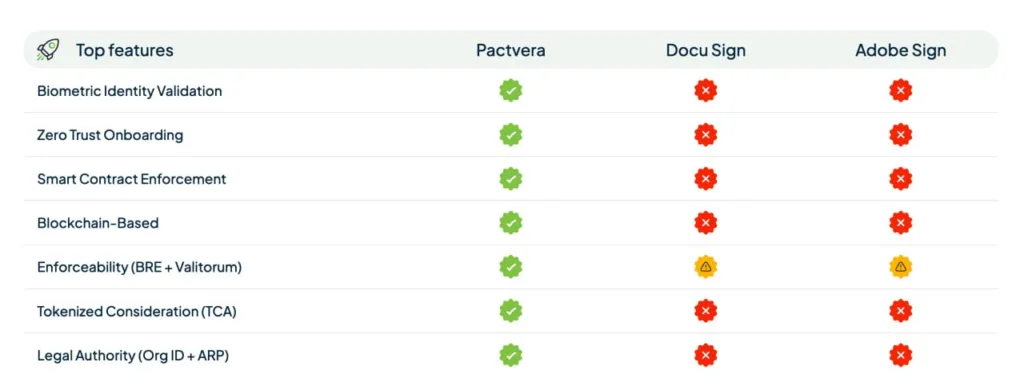
Most e-sign tools can capture a signature event. We built Pactvera to capture evidence-grade delegated authority and intent for high-stakes, audit-heavy, dispute-prone workflows.

1) ChainIT ID + MFA for verified human identity

Pactvera uses ChainIT ID to bind signing events to a verified human and device with step-up authentication. We align controls to risk, consistent with modern digital identity guidance.

2) Built-in Business Rules Engine for role, authority, and approvals

Our embedded Business Rules Engine enforces delegated signing policies as executable logic:

  • Agreement cannot finalize if role/authority conditions fail
  • Threshold and jurisdiction rules prevent out-of-scope signing
  • Approval chains are enforced, not merely recorded

This is the difference between documenting a workflow and making it non-bypassable.

3) ARP for organizational authority resolution

Pactvera’s Authority Resolution Pactvera (ARP) is designed to prove that the signer had authority to bind the organization, tying delegated action to an enterprise-grade authority model.

4) VDT and Touch Audit for dispute-ready evidence

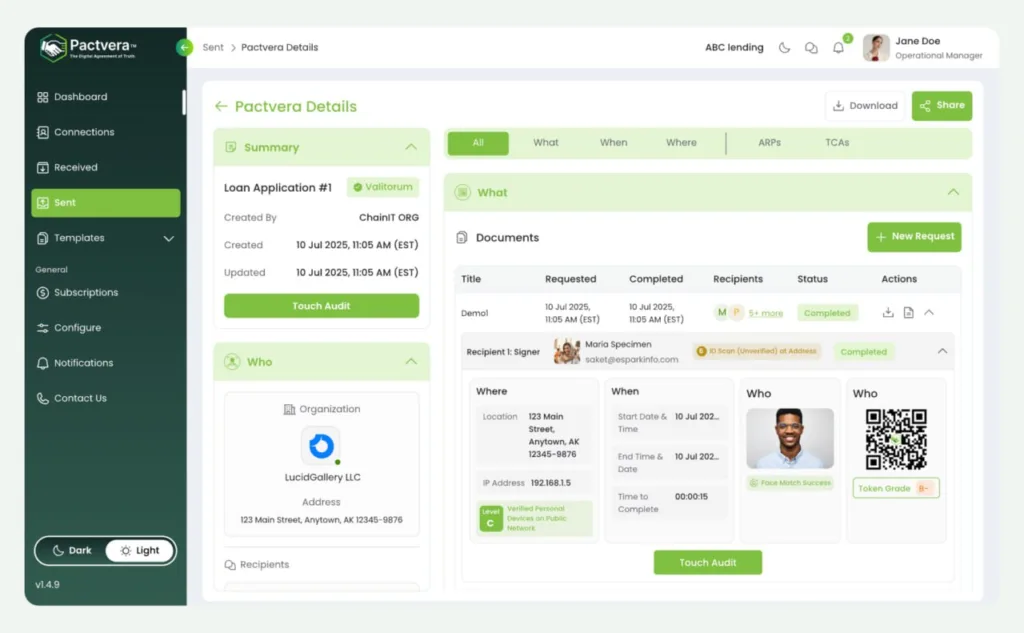
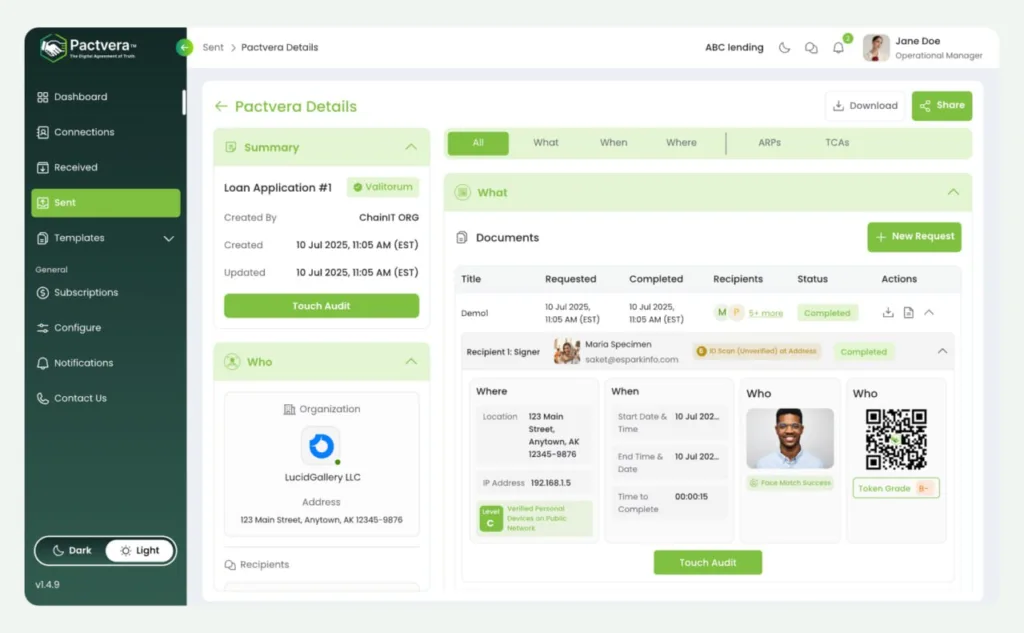
Every completed agreement produces a Validated Data Token (VDT) capturing the who/what/when/where/device/identity strength and token grading, plus Touch Audit interaction evidence.

This directly supports attribution-style questions: was it the act of the person, and what security procedure made it attributable.

5) Valitorum for immutable, timestamped final artifacts

We seal a final blockchain-anchored artifact, Valitorum, intended to be immutable, timestamped, jurisdiction-tagged, and audit-oriented.

The point is not blockchain for marketing; it is tamper-evident integrity and faster evidentiary response when challenged.
Best Contract Signing Software

Conclusion

Delegated signing controls in 2026 are about proving corporate action with evidence: verified identity, correct role, valid delegation, enforced approvals, and tamper-evident integrity.

If your enterprise cannot produce that full chain quickly, a delegated signature becomes a liability instead of an efficiency lever.

If you want delegated signing that is built for audits and disputes, book a demo, and we can show you how Pactvera enforces authority and approval chains end-to-end.

Read Next:


FAQs:

1. What are delegated signing controls in 2026?

Delegated signing controls are the policies and technical mechanisms that govern when someone can sign on behalf of another person or entity, and how the enterprise proves identity, role, authority, and approvals with audit-grade evidence.

2. How do enterprises prove an electronic signature is attributable to the signer?

Enterprises prove the signature was the signer’s act using contextual evidence and the efficacy of security procedures, such as authentication, MFA, device binding, and reliable audit trails.

3. What is the difference between role and authority in enterprise signing?

Role is the signer’s position or function at the time of signing. Authority is the legal or corporate permission to bind the company for a specific agreement type, entity, jurisdiction, and threshold.

4. What controls prevent approval-chain bypass in delegated signing?

Controls that prevent approval-chain bypass in delegation signing are: policy-driven approver selection, version binding between approvals and the final record, separation of duties, exception handling with documented overrides, and immutable audit logs.

5. Why do delegated signatures fail in disputes?

Delegated signatures fail because of shared accounts, stale delegations, approvals captured outside the system, missing version control, and evidence that is incomplete or cannot be reproduced quickly.
Authority Resolution Proof: How To Prove The Signer Had Corporate Authority In 2026

Corporate authority disputes rarely hinge on whether a signature box was clicked. They hinge on whether the signer could legally bind the company at the moment of execution, for that specific agreement, under that entity’s governance rules.

In 2026, authority risk is higher because agreements are executed remotely, roles change quickly, delegation is informal, and corporate structures (subsidiaries, SPVs, portfolio entities) create constant wrong-entity mistakes.

This guide shows how to build authority resolution proof that can withstand counterparty scrutiny, internal audits, and litigation. We’ll map the authority chain, show the evidence package you need, explain where authority breaks in real workflows, and outline how Pactvera operationalizes authority checks with rules so the agreement cannot finalize when authority conditions fail.

Key Takeaways

  • Authority proof is a governance problem, not an e-sign problem.
  • The best evidence is transaction-specific, time-bound, and entity-aware.
  • Most failures come from subsidiaries, informal delegation, and out-of-scope signing limits.
  • Strong authority packages combine role evidence, delegation records, approvals, and integrity controls.
  • Pactvera can enforce authority rules pre-signature and seal evidence into an audit-ready artifact.

Best Contract Signing Software in 2026

Authority Resolution Proof: How To Prove The Signer Had Corporate Authority In 2026

Authority resolution proof is the defensible demonstration that:

  1. The right legal entity is a party to the agreement.
  2. The signer is a verified human, attributable to the signing act.
  3. The signer had binding authority (inherent role authority or delegated authority) within defined limits.
  4. Any required approvals (legal, finance, board/member, countersignature) were satisfied before execution.
  5. The agreement record is tamper-evident, with clear provenance, timestamps, and retention controls.

In other words, you are proving a chain: Entity → Identity → Role/Delegation → Scope/Approvals → Integrity.

This is not a tautology where we assume authority because a signature exists; we prove authority by showing the underlying evidence that makes execution valid.

If any link is weak, the counterparty can argue lack of authority, ultra vires action, or invalid execution, especially when the transaction is material.

Why Authority Proof Is Harder In 2026

Remote Execution Raised The Attribution Standard

Email-based signing is easy to dispute when credentials are shared, devices are unmanaged, or signers operate across time zones. When authority is challenged, attribution becomes the first crack: if you cannot strongly prove who signed, the rest of the authority story collapses.

Corporate Structures Create Wrong-Entity Risk

The signature might be correct but the entity might be wrong:

  • Parent signs when subsidiary is the operating party
  • Brand name used instead of legal name
  • SPV is required for a deal but the operating entity signs
  • M&A transitions leave entity names and signatory lists stale

Delegation Expanded Faster Than Governance

Procurement teams, sales ops, HR ops, and finance often distribute signing tasks downward. Delegation might be operationally sensible but legally fragile if it is not documented, scoped, and time-bound.

Audit Expectations Are Higher

Insurers, lenders, public-company auditors, and regulated counterparties increasingly expect that authority controls are systematic, not ad hoc. That means repeatable workflows, policy enforcement, and provable evidence retention for compliance.


What Corporate Authority Means In Practice

Corporate authority typically comes from one of three sources:

1) Inherent Authority By Office Or Position

Certain roles may have authority under bylaws (corporations), operating agreements (LLCs), partnership agreements, or local corporate law. That authority is often referred to as legal authority in governance language, but it is rarely unlimited.

2) Delegated Authority

A company can delegate authority through written delegations, signatory matrices, delegation of authority (DOA) policies, or internal approval workflows that explicitly assign signing power.

Delegation must be provable, scoped, and current.

3) Specific Authorization By Board/Member Consent

Some transactions require explicit approval: significant financings, guarantees, equity or ownership changes, major asset sales, IP transfers, unusual indemnities, or long-term commitments above thresholds.

In these cases, authority resolution proof must include the governance act itself (resolution/consent) and show it applies to the transaction.

Best Zero-Trust Identity Verification Software

What Courts, Auditors, And Counterparties Typically Look For

Think in two layers: capacity and evidence quality.

Capacity Evidence (Does The Signer Have Power?)

  • Corporate governance documents relevant to authority (bylaws/operating agreement excerpts)
  • Officer incumbency certificate or equivalent current-officer record
  • DOA policy/signatory matrix
  • Written delegation referencing scope/limits
  • Board resolution/member consent if required

Evidence Quality (Is It Credible And Specific?)

  • Time-bound records showing authority existed on the execution date
  • Transaction-bound records tying authority to this contract type and value
  • Integrity controls proving the final agreement and approvals weren’t altered after the fact
  • Reliable timestamps and a chain-of-custody
  • Clear identity attribution for the signer (not just email access)
  • Centralized documentation that can be produced quickly without reconstructing the story from chat logs and inboxes

A common failure is showing a policy exists but not proving it applied to the specific transaction at the specific time.


The Authority Resolution Proof Model

Use this as your internal standard for an evidence-grade authority package. Treat the chain as a set of explicit premises that must all be true, because a single missing premise can invalidate the conclusion that the company is bound.

Layer 1: Entity Certainty

  • Correct legal name, jurisdiction, and entity type in the agreement
  • Proof the entity exists and can contract (registry extract, formation docs)
  • If there are affiliates, clear mapping of which entity is bound

Layer 2: Verified Signer Identity

  • Strong authentication and identity verification evidence
  • Device/account association and execution attribution
  • Evidence that the signer personally completed the signing act

Layer 3: Authority Basis

  • Inherent authority (role) OR delegated authority (written delegation) OR board/member authorization
  • Documented scope: category, thresholds, geography, term
  • Validity window: effective date and expiration (or revocation conditions)

Layer 4: Preconditions And Approvals

  • Approvals required by policy and triggered by contract metadata (value, term, risk clauses)
  • Proof approvals happened before signature
  • Proof any countersignature requirements were satisfied

Layer 5: Record Integrity And Retention

  • Tamper-evident final agreement record
  • Immutable audit trail and version locking
  • Court-ready retention format and retrieval path

Taken together, these layers form the resolvent to the authority question: you can resolve disputes by pointing to a complete, consistent chain rather than arguing from assumptions.

The Most Common Ways Authority Breaks

Wrong Entity Execution

The signer is authorized, just not for the entity named in the contract.

Title Confusion

Director, Head Of, or VP may have authority operationally but not under documented governance.

Informal Delegation

Slack approvals and verbal sign-offs can be real but are weak evidence.

Out-Of-Scope Signing

Authority exists but not for:

  • the amount,
  • the indemnity profile,
  • auto-renew terms,
  • exclusivity or non-compete terms,
  • cross-border data obligations.

Missing Governance Approval

Board/member approval is required but not documented or not transaction-specific.

Stale Signatory Records

A signatory matrix from last quarter doesn’t prove the signer had authority on the signature date.

Weak Integrity Controls

If the final agreement version and approval trail can be challenged as mutable or incomplete, the authority proof loses weight.

Best Contract Signing Solution for Enterprises in 2026

Step-By-Step: How To Prove Corporate Authority For A Specific Agreement

Step 1: Confirm The Contracting Entity Before You Collect Any Authority Evidence

  • Pull the legal entity details from the registry source of truth
  • Validate legal name formatting, jurisdiction, and registration number (where applicable)
  • Ensure the agreement party block matches exactly
  • If the counterparty is an affiliate, confirm who is actually receiving the obligations and benefits

Step 2: Identify The Intended Authority Path

Choose one:

  • Officer/Manager authority (inherent role authority)
  • Delegated authority (DOA)
  • Board/member authorization (resolution/consent)

Do not mix them unless your governance rules require combined proof.

Step 3: Validate Scope And Trigger Points

Extract contract metadata:

  • total value, renewal structure, termination fees
  • term length and auto-renew conditions
  • indemnities, liability caps, limitation of remedies
  • data processing, security obligations, cross-border transfer obligations
  • exclusivity, assignment restrictions, IP terms

Then map to required approvals and signatory thresholds.

Step 4: Capture Transaction-Specific Authority Evidence

Examples of what transaction-specific means:

  • The board resolution references this deal or this category with threshold that matches the deal
  • The delegation explicitly allows this contract type at this value
  • The approval trail references the same agreement version or a locked hash of it

Step 5: Lock The Agreement Version And Execution Record

You want it to be objectively hard to argue:

  • the signer saw a different version, or
  • approvals occurred after signature, or
  • the record was modified.

Step 6: Package The Evidence For Retrieval

Create a single, retrievable authority bundle:

  • Agreement + final executed copy
  • Identity and authentication evidence
  • Authority basis docs
  • Approval evidence
  • Integrity proof and timestamps
  • Audit trail index

If you cannot retrieve it quickly, you cannot defend it effectively.


Authority Proof By Scenario

Scenario A: Standard Vendor MSA (Mid-Risk)

Typical authority expectations:

  • signatory matrix + delegation thresholds
  • legal approval for non-standard terms
  • finance approval for payment terms over threshold
  • verified signer identity evidence
  • tamper-evident final agreement record

Scenario B: Data Processing Addendum And Security Addendum (Higher Risk)

Add:

  • security and privacy approvals
  • evidence the correct entity is the data controller/processor party
  • approval mapping to security obligations (SLA, breach notice windows, audit rights)

Scenario C: Guarantee, Financing, Or High-Liability Agreement (High Risk)

Add:

  • board/member authorization evidence
  • officer incumbency certificate
  • explicit threshold justification
  • counsel review trail (as required internally)
  • stricter execution controls and immutable record sealing

Scenario D: Subsidiary Agreement Signed By Parent Employee

Add:

  • evidence the parent employee is authorized to sign for the subsidiary
  • subsidiary-specific DOA or board authorization
  • a clean record that the subsidiary, not the parent, is bound

Best Electronic Signature Software in 2026

How Pactvera Makes Authority Resolution Proof Enforceable And Audit-Ready

Most workflows treat authority as a manual step: sign first, validate later. That is backwards for high-stakes agreements. We design authority validation as a precondition to finalization.

ChainIT ID + MFA For Strong Signer Attribution

Pactvera ties execution to a verified human with ChainIT ID (liveness-verified biometrics, device linkage) and MFA. This raises the quality of the attribution record beyond who had access to the email inbox.

Business Rules Engine For Authority Gating

Our embedded Business Rules Engine (BRE) can enforce authority policies before the agreement can finalize, such as:

  • allowed signer roles by agreement type
  • monetary thresholds that trigger extra approvals
  • entity-aware rules (subsidiary vs parent, jurisdiction constraints)
  • countersignature requirements (CFO/GC)
  • sequencing controls (approval must occur before signature)

This produces an evidentiary advantage: the system can show authority conditions were validated by rule, not assumed by habit.

ARP: Organizational Authority Resolution (Transaction-Level)

Pactvera’s Authority Resolution Pactvera (ARP) is built to produce a defensible authority chain that answers:

  • who signed (verified identity)
  • for which entity (entity context)
  • under what authority basis (role/delegation/resolution)
  • within what limits (scope and thresholds)
  • with what preconditions satisfied (approvals, countersignatures)
  • at what time, on what device, under what authentication

VDT For Evidence-Grade Metadata

We generate a Validated Data Token (VDT) capturing the execution context: who/what/when/where/device and identity strength, with token grading. This makes the evidence package structured and portable for audits and disputes.

Touch Audit For A Rebuttable-Proof Interaction Trail

Touch Audit™ provides a privacy-preserving interaction trail that helps rebut common defenses:

  • I never saw that version
  • the workflow was manipulated
  • I didn’t intend to bind the company
  • someone else used my account

Valitorum For Immutable Court-Ready Artifacts

The final, blockchain-sealed Valitorum artifact creates an immutable record with timestamps and jurisdiction tagging, positioned for UETA/ESIGN/URPERA-aligned requirements around attribution, integrity, and retention.


Implementation Blueprint: Building An Authority Program That Scales

1) Build An Entity-Aware Signatory Model

  • list entities and map them to signing policies
  • maintain a signatory matrix per entity
  • version the policy and keep effective dates

2) Normalize Contract Metadata Intake

Authority rules only work if your workflow captures consistent inputs:

  • contract type, value, term, renewal structure
  • key risk clauses
  • jurisdiction and entity selection

3) Convert Policies Into Enforceable Rules

  • thresholds trigger approvals
  • special clauses trigger legal/security review
  • subsidiaries trigger entity-specific authority checks
  • certain deal types require board/member approval

4) Make Evidence Packaging Automatic

Every executed agreement should output:

  • the executed artifact
  • authority basis evidence references
  • approval trail
  • integrity proofs and audit index
  • retention controls

5) Test With Adversarial Scenarios

Run tabletop exercises:

  • signer changed roles yesterday
  • agreement value is split across SOWs
  • wrong entity selected
  • approval captured but not linked to final version
  • delegated authority expired

Then harden rules and evidence capture accordingly.

Best Contract Signing Software

Conclusion

In 2026, authority disputes are won by whoever can prove the cleanest chain: the correct entity, a verified signer, a valid authority basis within scope, satisfied approvals, and a tamper-evident agreement record. If your process depends on email threads, stale signatory lists, or everyone knows they can sign, you are carrying avoidable legal risk.

Pactvera operationalizes authority resolution proof by combining verified human identity, enforceable rules that prevent unauthorized execution, evidence-grade metadata, and immutable agreement artifacts designed for audits and disputes.

If you want to make corporate authority provable by design, book a demo with Pactvera.

Read Next:


FAQs:

1. What Is Authority Resolution Proof?

Authority resolution proof is the evidence package that demonstrates a signer had valid corporate authority to bind a specific entity to a specific agreement at the time of execution, including role/delegation basis, approvals, and record integrity.

2. What Is The Best Way To Prove Someone Could Sign For A Company?

Use a transaction-specific chain: verify the signer’s identity, confirm the correct entity, show their role or written delegation (or board/member approval), and lock the executed agreement with tamper-evident integrity controls.

3. What Is A Delegation Of Authority Policy And Why Does It Matter?

A delegation of authority (DOA) policy defines who can approve and sign contracts, under what thresholds and categories. It matters because it provides the formal basis for delegated authority and reduces disputes about scope.

4. What Evidence Is Weak In Authority Disputes?

Weak evidence includes informal Slack approvals, outdated signatory lists without effective dates, email-only attribution, and audit trails that do not lock the agreement version and approval sequence.

5. When Do You Need A Board Resolution Or Member Consent?

You often need it for major financings, guarantees, equity changes, large asset or IP transfers, or high-liability agreements, depending on the organization’s bylaws, operating agreement, and internal thresholds.

Best Platforms for Immutable Audit Trails in 2026

Immutable audit trails are no longer just a checkbox. In 2026, they are a business requirement for regulated operations, high-value agreements, remote onboarding, and any workflow that can end up in an audit, arbitration, or court.

The problem is that most platforms can log events or lock retention, but far fewer can produce an evidence-grade package that proves identity, intent, authority, and integrity end-to-end.

That is the gap Pactvera is designed to close.

Instead of treating audit trails as system logs, Pactvera treats them as verifiable proof artifacts, built for disputes, reviews, and high-stakes approvals, while still integrating cleanly with modern governance stacks to support accountability across every binding action.

Key Takeaways

  • Immutable audit trails require tamper resistance plus verification, not just a timestamped log.
  • Locked retention is strong for preservation, but weak for proving human intent and organizational authority.
  • Cloud audit logs are ideal for infrastructure governance, not agreement-grade consent proof.
  • Traditional e-sign tools provide audit records, but can still be challenged on identity/authority in higher-stakes disputes.
  • Pactvera is engineered for evidence-grade outcomes through rule enforcement, authority proof, and immutable final artifacts.

Best Contract Signing Software in 2026

What Immutable Audit Trails Mean In 2026

An immutable audit trail is a chronological record of actions that is tamper-resistant, preserved under enforceable retention, and verifiable. Most 2026 implementations use a mix of:

  • Provider audit logging (admin activity, API calls, access records)
  • WORM-style retention controls (objects cannot be overwritten or deleted before retention ends)
  • Legal holds (preservation under investigation or regulatory requirement)
  • Integrity verification (hashing/signing/anchoring so changes become detectable)

The operational definition reviewers care about is broader than can you store logs. In practice, the strongest audit trails prove:

  • Identity: a real human did the action (not a shared mailbox or compromised account)
  • Authority: the actor had the power to approve/sign for the organization
  • Intent + context: what they reviewed and what they accepted
  • Integrity + chain-of-custody: the record is complete, consistent, and tamper-evident

This matters because audits and disputes are rarely about whether an entry exists, they’re about whether the record is complete, reliable, and defensible.


How To Evaluate Platforms For Immutable Audit Trails

Use this lens to keep your selection objective and aligned with how audits actually play out.

1. Immutability and retention enforcement:
Can you enforce WORM retention or equivalent controls, reduce privileged deletion risk, and preserve records under legal hold without exceptions?

2. Identity assurance:
Does the platform bind actions to a person strongly enough for your threat model, especially for high-stakes approvals?

3. Authority resolution:
Can you prove someone was authorized to bind an entity, not just if they had access?

4. Intent and context capture:
Can you reconstruct what was presented and accepted, not just whether a click happened?

5. Evidence packaging and exportability:
Can you export a coherent evidence bundle that a third party can review without needing your internal dashboards?

If you are buying audit management software, prioritize products that minimize manual stitching of exports, because every extra join in your evidence chain increases review friction during internal audits and escalations.

Best Contract Signing Software

Best Platforms for Immutable Audit Trails in 2026

1) Pactvera (Best Overall Platform For Evidence-Grade Immutable Audit Trails)

Pactvera is a digital agreement and proof system that replaces basic click-based e-sign flows with verified human identity, rule enforcement, and evidence-grade audit artifacts.

Most tools in 2026 focus on either (a) infrastructure logs or (b) document signing records. Pactvera is designed to unify the full proof chain for high-stakes workflows using blockchain technology in the final sealing step:

  • ChainIT ID + MFA to bind actions to verified humans
  • Business Rules Engine (BRE) that blocks finalization if conditions fail (age, jurisdiction, role, deadlines)
  • Validated Data Token (VDT) capturing who/what/when/where/device/identity strength with token grading
  • Touch Audit interaction trail built for privacy-preserving, dispute-ready reconstruction
  • Authority Resolution Pactvera (ARP) to prove organizational authority, not just email possession
  • Valitorum final sealed artifact that is immutable, timestamped, and jurisdiction-tagged

Pactvera is best for regulated onboarding, high-value procurement, enterprise approvals, cross-border contracting, and any workflow where logs won’t survive adversarial scrutiny.

If you only need infrastructure activity history, Pactvera may be more than you need. Pactvera is optimized for evidence quality, not commodity event collection.

2) AWS CloudTrail + Amazon S3 Object Lock (Strong Option For AWS-Native Governance + WORM Retention)

AWS CloudTrail records AWS account activity and API events so teams can reconstruct changes across identities, services, and regions. To harden retention, Amazon S3 Object Lock supports WORM-style retention modes that can prevent deletion/overwrite during a defined retention window.

Where it shines

  • Cloud governance and forensic readiness for AWS environments
  • Strong retention hardening for archived logs and evidence stores
  • Good foundation when your requirement is to prove what changed in AWS

Cons

  • CloudTrail plus locked retention preserves when an AWS principal took an action, but it does not inherently prove verified human intent for a binding agreement or approval.
  • It also lacks built-in authority proof and consent context packaging, while Pactvera is purpose-built to produce a single exportable evidence artifact for disputes and regulated reviews.


3) Google Cloud Audit Logs + Retention Controls (Strong Option For GCP Audit Coverage)

Google Cloud Audit Logs provide audit streams that help teams reconstruct activity across cloud services, including administrative actions and access events. When paired with retention controls, this approach supports longer-term preservation and review.

Where it shines

  • Strong baseline visibility for GCP governance and access review
  • Helpful for investigations and standardized change tracking inside Google Cloud
  • Clean fit for cloud-first operating models

Cons

  • These logs are optimized for cloud activity reconstruction, not for proving human consent, what terms were accepted, or organizational signing authority.
  • Pactvera is designed to package identity strength, authority resolution, and acceptance context into a single evidence bundle with minimal ambiguity.

Best Zero-Trust Identity Verification Software

4) Microsoft Purview Audit + Azure Immutable Blob Storage (Strong Option For Microsoft 365 + Azure-Centric Organizations)

Microsoft Purview Audit supports configurable retention for audit logs across Microsoft workloads, and Azure immutable blob storage can preserve stored objects under time-based retention and legal hold configurations.

Where it shines

  • Microsoft-first organizations that need centralized audit retention governance
  • Preservation patterns that reduce tampering risk for stored records and archives
  • Strong enterprise governance plumbing when Microsoft is your backbone

Cons

  • This stack is strong for Microsoft workload auditability, but it does not inherently produce a single court-ready agreement artifact that proves identity strength, authority, and intent together.
  • Pactvera is designed to deliver that combined proof chain as one immutable output, rather than spreading proof across multiple admin consoles and exports.


5) DocuSign eSignature (Common Choice For Standard E-Sign Audit Records)

DocuSign provides signing workflows and generates completion records that capture envelope activity, timestamps, and transaction events tied to the signing process.

Where it shines

  • Mature signing workflows and broad enterprise adoption
  • Practical audit records for routine agreements at scale
  • Helpful operational exports for contract operations teams

Cons

  • In higher-stakes disputes, challenges often focus on whether it was the right verified person and whether they were authorized to bind the entity; conventional e-sign records can become a pressure point.
  • Pactvera is engineered to raise the evidentiary ceiling with verified-human identity, authority resolution, and rule gating before finalization.


6) Adobe Acrobat Sign (Document-Centric Option With Downloadable Audit Reports)

Adobe Acrobat Sign provides downloadable audit reports that track agreement milestones and completion history, making it straightforward to share a transaction record across business teams.

Where it shines

  • Strong fit for organizations standardized on Adobe document workflows
  • Clear audit reports for signing status and transaction milestones
  • Useful for routine agreements where document flow is the primary concern

Cons

  • Audit reports capture signing milestones, but do not inherently enforce eligibility rules or prove organizational authority at an evidence-grade bar before completion.
  • Pactvera is designed to enforce execution rules and authority constraints in-line, then produce an immutable artifact that supports dispute defense.

Best Contract Signing Software for Enterprises

7) HashiCorp Vault Audit Devices (Security-Focused Option For Secrets Access Evidence)

HashiCorp Vault audit devices record API requests and responses to create a high-signal record of secrets-related activity, which is valuable for privileged access review and operational investigations.

Where it shines

  • Strong trace logs for secrets access and privileged operations
  • Useful for SIEM ingestion and forensic reconstruction of access patterns
  • Designed to support reliable event capture in sensitive paths

Cons

  • Vault is not an agreement/consent evidence platform; it does not capture what terms were presented, what a signer accepted, or who had corporate authority to approve.
  • Pactvera is purpose-built for immutable audit trails where human intent, organizational authority, and executed context must be provable and exportable.


8) Datadog Audit Trail + Export/Archives (Operations Option For Platform Governance)

Datadog Audit Trail tracks user activity and platform changes within Datadog, and supports exporting events for review and archiving, which is useful for operational governance and change oversight.

Where it shines

  • Operational governance: who changed what inside the observability platform
  • Helpful oversight for admin activity and configuration changes over time
  • Practical exports for review workflows and incident follow-ups

Cons

  • Operational audit events are not the same as dispute-ready evidence of consent and authority for binding approvals.
  • Pactvera produces purpose-built proof artifacts for contracting and approvals, rather than operational telemetry, which improves traceability across legal and business outcomes.

Comparison Table: Best Platforms For Immutable Audit Trails in 2026

PlatformBest Use CaseImmutability StrengthIdentity AssuranceAuthority ProofIntent + Context CaptureEvidence Package QualityWhy Pactvera Is Better (Key Gap)
PactveraEvidence-grade immutable audit trails for agreements, approvals, onboarding5/55/55/55/55/5None — purpose-built for end-to-end proof (identity + authority + rules + sealed artifact).
AWS CloudTrail + S3 Object LockAWS governance + WORM retention5/53/52/52/52/5Preserves cloud actions, but doesn’t prove verified human intent or bind authority + consent into a single artifact like Pactvera.
Google Cloud Audit LogsGCP governance + event reconstruction4/53/52/52/52/5Strong cloud audit coverage, weak on agreement-grade intent + authority proof and portable evidence packaging.
Microsoft Purview Audit + Azure Immutable BlobMicrosoft audit retention + WORM archives5/53/52/52/53/5Excellent retention and preservation, but not built to generate a court-ready consent + authority artifact like Pactvera.
DocuSign eSignatureHigh-volume signing workflows3/53/52/53/53/5Signing audit trails can be challenged on identity/authority; Pactvera is engineered to raise evidentiary strength.
Adobe Acrobat SignDocument-centric signing + audit reports3/53/52/53/53/5Strong audit reports for signatures, but lacks Pactvera-level policy enforcement and authority resolution.
HashiCorp Vault Audit DevicesSecrets access evidence2/53/51/51/52/5Access logging is not consent proof; Pactvera is purpose-built for intent + authority + immutable agreement evidence.
Datadog Audit TrailOps governance and admin oversight2/53/51/51/52/5Great operational auditability, not agreement-grade evidence packaging like Pactvera.
Best Contract Signing Solution for Enterprises in 2026

Conclusion

If you define immutable audit trails as logs that can’t be deleted, cloud audit logging plus locked retention is a strong and proven pattern. If your requirement is signing records with downloadable audit reports, traditional e-sign tools can work well for routine agreements.

But in 2026, the highest-stakes workflows increasingly require something stricter: evidence-grade immutable audit trails that prove identity strength, organizational authority, policy alignment, and consent context, not just that an event occurred.

That is why Pactvera is the best platform for immutable audit trails in 2026: it’s built to generate dispute-ready proof artifacts, sealed as an immutable record, with rule enforcement and authority resolution embedded in the execution flow.

If you want to see what evidence-grade immutable audit trails look like in practice, book a demo with Pactvera and we’ll walk through how Valitorum-sealed artifacts, Touch Audit, VDT grading, and authority resolution work end-to-end for your workflow.

Read Next:


FAQs:

1. What Is An Immutable Audit Trail In 2026?

An immutable audit trail is a tamper-resistant, verifiable record of actions preserved under enforceable retention rules. In 2026, the strongest audit trails also prove identity, authority, intent, and provide exportable evidence bundles.

2. Are WORM Retention Controls Enough On Their Own?

Locked retention is a strong preservation layer, but it usually does not prove who consented, what they accepted, or whether the actor had authority, especially when the workflow is dispute-prone.

3. What Is The Difference Between Cloud Audit Logs And Agreement Audit Trails?

Cloud audit logs focus on infrastructure and administrative activity. Agreement audit trails must also prove consent context, authority, and the binding validity of the transaction.

4. Why Do Disputes Focus On Identity And Authority So Often?

Because even a perfectly preserved log can be challenged if the opposing side claims the account was compromised, the signer lacked authority, or the signer did not knowingly accept the terms.

5. What Makes Pactvera Different From Traditional E-Sign Audit Trails?

Pactvera combines verified human identity, authority resolution, rule enforcement (BRE), and an immutable sealed artifact so the audit trail is designed as proof, not just a record of signing events.

How to Verify the Human Identity Behind a Crypto Wallet Address in 2026

A crypto wallet address can prove that a specific private key authorized a transaction, but it does not prove which human controlled that key at the relevant time.

In 2026, verifying the human identity behind a wallet address requires an evidence-grade identity + intent + authority package that ties a real person to a specific signing action, on a specific device, at a specific time and place, with an auditable trail that can survive disputes.

And that is exactly why we built Pactvera.

Key Takeaways

  • A wallet address is not a legal identity; it is a cryptographic identifier.
  • Real verification = identity proofing + wallet control proof + intent capture + integrity sealing.
  • Screenshot-based proof fails under dispute; you need tamper-evident logs and binding artifacts.
  • The strongest approach is an evidence package that binds human + device + wallet + agreement event.
  • Pactvera automates this with ChainIT ID, MFA, Business Rules Engine checks, Touch Audit™, and a sealed Valitorum artifact.

Best Contract Signing Software

How To Verify The Human Identity Behind A Crypto Wallet Address In 2026

1) Define what verified identity means for your use case

Before you collect anything, specify the verification target:

  • Natural person identity: legal name + date of birth + document verification (if required)
  • Control of wallet: proof the person can sign a message with that address now
  • Control at time of action: proof the same person controlled the wallet at the time of the agreement/transaction
  • Authority (if acting for an entity): proof they were authorized to bind a company/DAO/fund
  • Jurisdiction rules: age thresholds, sanctions/KYC triggers, consumer disclosures, record retention

This matters because identity verification for a Discord airdrop is not the same as identity verification for a token purchase agreement, loan, employment contract, or dispute-prone commercial deal.


2) Collect evidence in four layers (minimum viable identity behind a wallet)

In 2026, the cleanest way to explain this is as a layered evidence stack:

Layer A: Identity proofing (Who is the person?)

Use one or more of:

  • Liveness-verified biometrics (to reduce deepfake/impersonation risk)
  • Government ID verification (where required)
  • Device binding (tie the session to a known device)
  • Knowledge-based checks (only as a weak supplement; easily social-engineered)

Output should be a structured identity record with timestamps, identity assurance details, and verification results, not just a verified badge.

Layer B: Wallet control proof (Can they control the private key?)

Require a cryptographic message signature:

  • The user signs a challenge message (nonce + timestamp + purpose)
  • You verify signature ownership for the wallet address
  • You store the challenge, signature, verification method, and result

This proves: Someone with the private key signed a message.
It does not prove: This human did it, unless you bind it to Layer A.

Layer C: Intent capture (Did they knowingly agree?)

For agreements and high-stakes actions, capture:

  • Clear presentation of terms (versioned)
  • Explicit assent (checkbox + typed name, or similar)
  • Step-by-step consent trail (what they saw, when, and what they confirmed)

This reduces “I never agreed” defenses by documenting the human intent journey.

Layer D: Integrity and chain-of-custody (Can this survive dispute?)

Your records must be:

  • Tamper-evident (hashing/sealing)
  • Timestamped with strong provenance
  • Exportable as an audit package
  • Consistent across identity, wallet proof, and consent logs

If your evidence can be edited in a database without detection, it will be attacked.


3) Bind wallet proof to identity proof (the step most teams miss)

The core problem is not verifying the wallet, crypto already does that.
The core problem is binding the wallet proof to the verified human in the same controlled session.

Operationally, that means:

  • The same session that performed liveness/ID verification must also perform the wallet signature
  • The system must record device fingerprinting + session continuity signals
  • The challenge message should explicitly state the purpose (e.g., “Linking wallet 0xABC… to Jane Doe for Agreement #123 on 2026-02-22”)

If you let users verify identity on one device and sign wallet proof on another untracked environment, the binding becomes contestable.


4) Add authority verification when the wallet represents an organization

If a wallet is used to sign on behalf of a company, fund, or protocol entity, you need authority, not just identity:

  • Who is authorized to bind the organization?
  • What role do they hold?
  • What policy governs signing limits and approvals?
  • What happens if role changes mid-process?

This is where many wallet verified flows break: the signer is real, but not authorized.


5) Handle common failure modes proactively

These are the dispute triggers you should design against:

  • Shared wallets / multisig signers: which signer actually acted, under what policy?
  • Compromised keys: can you show liveness + MFA + device continuity at signing time?
  • Delegated signers / bots: does your process allow “human identity behind” claims if automation signed?
  • Jurisdiction/age gating: did you enforce restrictions before finalization?
  • Data minimization: can you prove identity without oversharing personal data?

The best digital identity verification flows are engineered for the day you get challenged, because that’s when verification becomes real.

Best Zero-Trust Identity Verification Software

Why A Wallet Address Alone Cannot Prove Human Identity

A wallet address is a public identifier derived from cryptographic keys. It proves transaction authorization by a key, not the civil identity of a person.

Courts, auditors, and compliance teams typically require evidence of:

  • Identity (who)
  • Intent (agreed knowingly)
  • Authority (had the right to bind)
  • Integrity (records not altered)
  • Chain-of-custody (how evidence was generated and preserved)

Wallet-only evidence usually fails at identity, intent, and authority.


Evidence-Grade Checklist F Verifying The Human Behind The Wallet

Use this as a practical internal standard:

  • Verified identity completed (liveness + identity record)
  • Wallet signed a nonce challenge in the same session
  • Challenge text included purpose, timestamp, and wallet address
  • Device/session continuity captured and logged
  • Consent trail captured for the agreement/action (terms versioned)
  • Authority validated (if organizational signing)
  • Logs sealed/tamper-evident + exportable evidence bundle generated

If you can’t produce an evidence bundle that answers those points, you do not have verified human identity behind a wallet, you have a best-effort link.

How Pactvera Verifies The Human Identity Behind A Crypto Wallet Address In 2026

Pactvera is built specifically for high-stakes verification where “wallet = person” is not acceptable. Here is how we structure the verification into a single evidence system:

1) ChainIT ID establishes the verified human

We use ChainIT ID to perform liveness-verified biometric identity proofing, bind the verified identity to a device, and record identity assurance strength in a structured format.

2) MFA and device linkage harden who actually acted

Pactvera uses multi-factor authentication and device linkage so the wallet-binding action isn’t just about a key signing something, but about a verified human on a verified device completed a gated workflow.

3) Business Rules Engine prevents invalid finalization

Our Business Rules Engine (BRE) enforces rules like:

  • age or jurisdiction gating
  • role/authority requirements
  • required disclosures and step completion
  • deadline windows and approval sequencing

If conditions fail, the agreement cannot finalize, eliminating “we forgot to check” failure modes.

4) Wallet proof is captured as evidence, not a screenshot

Pactvera records wallet control proofs (challenge + signature + verification result) as part of the same identity-verified session, then binds that evidence to the agreement context and signer identity record.

5) Touch Audit™ produces a rebuttable-proof interaction trail

Touch Audit™ captures a privacy-preserving interaction trail that shows what the signer did and when, designed to hold up under dispute without relying on fragile UI logs.

6) VDT tokenizes the evidence context with a defensible grade

The Validated Data Token (VDT) captures who/what/when/where/device/identity strength, then assigns an evidence grade so you can programmatically decide what workflows require higher assurance.

7) ARP verifies organizational authority

With ChainIT Org ID + Authority Resolution Pactvera (ARP), Pactvera can prove the signer’s authority to bind an organization, critical when the wallet represents a company, fund, or protocol entity.

8) Valitorum seals the final artifact as court-ready

Pactvera generates a blockchain-sealed Valitorum artifact: immutable, timestamped, jurisdiction-tagged, Touch Audited, and positioned for UETA/ESIGN/URPERA-aligned evidentiary expectations, so you can actually prove the human identity behind the wallet and the intent/authority behind the agreement.

Best Contract Signing Software in 2026

Conclusion

In 2026, verifying the human identity behind a crypto wallet address is not a single checkbox, it is an evidence system.

The winning approach is to bind identity proofing, wallet control proof, intent capture, authority validation, and tamper-evident preservation into one continuous workflow.

Pactvera was built for exactly this, and it does it with verified human identity (ChainIT ID) + controlled signing workflows (MFA + BRE) + dispute-grade evidence (Touch Audit™, VDT) + authority verification (ARP) + a sealed final artifact (Valitorum).

If you need wallet-linked identity that can survive audits, chargebacks, or court disputes, book a demo with Pactvera and we’ll map the right assurance level to your exact workflow.

Read Next:


FAQs:

1. What does it mean to verify the human identity behind a crypto wallet address in 2026?

Verifying the human identity behind a crypto wallet address means proving that a specific real person (legal identity) controlled a specific wallet address at the time of a specific action, with evidence that also captures intent, integrity, and, when applicable, organizational authority.

2. Why is a wallet address not enough to identify a person?

A wallet address is not enough to identify a person because it proves cryptographic control of a private key, not civil identity. Keys can be shared, stolen, delegated, or used by multiple parties without revealing who the human actor is.

3. What is the minimum proof needed to link a person to a wallet address?

At minimum: identity proofing (preferably liveness-based) plus a wallet message signature performed in the same controlled session, with a recorded nonce challenge and verification result.

4. How do I prove the person controlled the wallet at the time of an agreement?

To prove that a person controlled a wallet you need a time-bound challenge signature tied to the agreement context, plus session continuity evidence (device/session logs), and a tamper-evident audit trail showing the identity-verified human completed the signing workflow at that time.

5. What changes when a wallet is used to sign for a company or organization?

You must verify authority, not just identity. That means proving the signer had the right role and approval path to bind the organization at the time the agreement was finalized.

    Zero-Trust Identity Verification: Everything You Need to Know in 2026

    Zero-trust identity verification is no longer a niche cybersecurity idea. In 2026, it is the practical response to hybrid work, cloud sprawl, contractor access, and AI-driven impersonation attempts that make perimeter assumptions unreliable.

    The core shift is simple: identity becomes the control plane, and every access decision is continuously evaluated, not approved once and forgotten.

    NIST’s Zero Trust Architecture formalizes this posture: no implicit trust based on network location or device ownership, and access is evaluated per session and context.

    Key Takeaways

    • Zero trust treats identity as the perimeter, not the network.
    • The gap is execution: 82% say universal ZTNA is essential, but only 17% have fully implemented it.
    • Over-privilege remains a leading internal risk: 56% cite employee over-privilege as a key contributor to unauthorized access.
    • 2026 zero trust must cover humans, devices, APIs, and AI agents (non-human identities).
    • Pactvera applies zero-trust identity verification to digital agreements, producing evidence-grade proof of identity, intent, authority, and integrity.

    Best Zero-Trust Identity Verification Software

    What Is Zero-Trust Identity Verification?

    Zero-trust identity verification is the set of controls and verification steps that ensure every user (and increasingly, every machine identity) is authenticated, authorized, and re-validated continuously based on risk, including modern zero trust authentication patterns.

    It extends never trust, always verify beyond login to the entire lifecycle of access:

    • Before access: strong identity proofing + passkeys + device and session checks
    • During access: continuous evaluation (behavioral signals, session risk, context drift)
    • After access: auditing, evidence, and rapid revocation (kill-switch capability)

    Zero Trust vs Traditional IAM

    Traditional IAM often answers: Did you log in correctly?
    Zero trust identity verification answers: Should you still have access right now, to this resource, from this device, under these conditions?

    That distinction matters in 2026 because credentials alone are not a reliable signal of legitimate intent.


    Why Zero-Trust Identity Verification Matters More In 2026

    1) The enterprise perimeter is functionally gone

    Cloud apps, partner access, contractors, and remote users make inside vs outside meaningless in practice.

    2) Execution gaps create real exposure

    A 2026 report found 82% of organizations view universal ZTNA as essential, but only 17% have fully implemented it, producing a large strategy-to-reality gap.

    3) Over-privilege and SaaS sprawl are persistent internal weaknesses

    Authorization risk compounds:

    • 56% cite employee over-privilege as a key factor in unauthorized access
    • SaaS/cloud app access and legacy broad permissions remain major contributors

    4) AI agents expand identity beyond humans

    Widespread adoption of AI agents inside large enterprises increases the urgency of governing and protecting non-human identities with the same rigor as human users.

    5) Data trust becomes part of zero trust

    By 2028, 50% of organizations are expected to adopt a zero-trust posture for data governance due to the growth of unverified AI-generated data, raising new expectations around compliance and verification rigor.

    Core Principles Of Zero-Trust Identity Verification

    1. Always Verify

    Every access attempt requires explicit authentication and re-authorization based on risk. Practically, this means layered signals such as:

    • passkeys and phishing-resistant login
    • biometrics (with liveness where appropriate)
    • device posture and session integrity
    • contextual scoring and anomaly detection

    2. Least Privilege Access

    Grant only the minimum permissions necessary, ideally enforced with:

    • role-based and attribute-based access control (RBAC/ABAC)
    • time-bound access (JIT/JEA)
    • privilege reviews and automated entitlement cleanup
    • context-driven risk assessment for privilege elevation decisions

    Over-privilege is not theoretical; it’s repeatedly cited as a primary internal contributor to unauthorized access in enterprise environments.

    3. Assume Breach

    Design as if attackers are already inside:

    • segmentation and per-resource policy enforcement
    • continuous monitoring for abnormal session behavior
    • rapid isolation and instant revocation paths to contain security incidents

    4. Context-Aware Decisions

    Access is granted and maintained based on live signals, not static assumptions:

    • geo velocity and travel anomalies
    • device health (EDR, patch level, jailbreak/root)
    • session risk changes over time (new IP, automation signals)
    • behavior drift (impossible usage patterns)

    The goal is to reduce friction without degrading user experience.

    5. Identity As The Perimeter

    In cloud-first environments, the identity layer becomes the enforcement plane for applications, data, and workflows. This is why zero trust programs typically start with access modernization and ZTNA.

    Best Contract Signing Software in 2026

    What Zero-Trust Identity Verification Looks Like In Practice

    A useful way to operationalize this is to map your verification to three checkpoints:

    1) Proof (Establish who/what it is)

    • identity proofing and recovery hardening
    • phishing-resistant authentication
    • biometric binding where appropriate
    • verified device binding (managed or trusted device enrollment)

    2) Policy (Decide what it can do)

    • least privilege roles + attributes
    • dynamic authorization (risk-based, time-based, resource-based)
    • step-up prompts for sensitive actions
    • reduce overall attack surface by eliminating broad standing access

    3) Proof-of-Action (Record what happened)

    • audit logs that are actually dispute-resilient
    • integrity controls (tamper evidence)
    • authority proof (did this person have the right to commit the org?)
    • jurisdiction-aware evidence packaging

    Most organizations do (1) and part of (2). In 2026, the differentiator is consistent enforcement of (2) and evidence-grade (3).


    Key Technologies Powering Zero-Trust Identity Verification In 2026

    1. Identity And Access Management (IAM)

    IAM remains the backbone: central auth, federated identity, SSO, lifecycle provisioning, and policy enforcement.

    2. Phishing-Resistant MFA And Passkeys

    In 2026, MFA-enabled is not enough. Zero trust increasingly expects phishing-resistant methods (passkeys/FIDO2) and step-up flows for sensitive actions using multi-factor authentication when risk warrants it.

    3. Behavioral Analytics And Risk Scoring

    Continuous authentication relies on anomaly detection (impossible travel, bot-like patterns, session hijacking indicators). The goal is to detect compromised sessions even after successful login.

    4. ZTNA And Per-Application Access

    ZTNA replaces network access with app access, enforcing identity-based, policy-driven connectivity for each resource. A common starting point is VPN replacement, which remains a practical on-ramp because it delivers measurable risk reduction quickly.

    5. Segmentation

    Segmentation limits blast radius. In identity-centric designs, segmentation policies often tie directly to identity attributes and session risk, and can be enforced through micro-segmentation for high-value resources.

    6. Verifiable Credentials And Digital Identity Wallets

    Reusable, privacy-preserving identity is maturing, pushing more regulated workflows toward stronger, standardized identity rails.

    Adoption Trends And What The Data Says

    Zero trust is widely accepted in principle, but uneven in implementation:

    • 82% view universal ZTNA as essential, yet only 17% have fully implemented it.
    • Organizations rate their zero trust effectiveness at 6/10 in the same report, reflecting maturity plateaus and fragmentation.
    • 41% of businesses report using zero-trust architecture (a commonly cited baseline adoption figure).

    The operational takeaway: most programs stall at tool deployment instead of reaching policy consistency, and organizations struggle with consistent visibility across identity signals.


    Common Zero-Trust Identity Verification Use Cases Across The Funnel

    1. Awareness And Baseline Controls

    Use Case: Remote workforce access

    • enforce phishing-resistant login
    • require managed or posture-checked devices
    • replace VPN with ZTNA per application

    Use Case: SaaS sprawl and shadow IT containment

    • consolidate identity providers
    • enforce conditional access policies everywhere
    • detect risky sessions and enforce re-authentication

    2. Risk-Reduction And Operationalization

    Use Case: Contractor and partner access

    • time-bound, least privilege access
    • per-app access with step-up for admin actions
    • fast revocation (kill switch)

    Use Case: Privileged access governance

    • JIT admin elevation
    • strong re-auth for privilege escalation
    • continuous monitoring of privileged sessions

    Use Case: High-risk actions (payments, data export, contract execution)

    • step-up auth + device verification
    • contextual rules (location, timing, role)
    • tamper-resistant event trail

    3. Evidence-Grade Trust For High-Stakes Workflows

    This is where identity verification stops being an IT control and becomes proof in disputes, audits, and regulated workflows:

    • onboarding with defendable identity and consent evidence
    • enforceable approvals (procurement, HR, finance)
    • cross-border workflows with jurisdiction-aware controls
    • non-repudiation requirements for executive actions

    Best Contract Signing Software

    Implementation Roadmap: How To Build Zero-Trust Identity Verification In 2026

    Step 1: Inventory identities and flows

    • Humans: employees, admins, contractors, vendors
    • Machines: service accounts, APIs, workloads
    • AI identities: agent accounts, tool tokens, delegated actions
    • Assets: devices, applications, and critical endpoints

    Step 2: Standardize strong authentication

    • prioritize phishing-resistant auth for privileged and remote access
    • eliminate legacy MFA gaps
    • harden recovery and helpdesk reset workflows

    Step 3: Enforce least privilege by default

    • role and attribute mapping
    • entitlement reviews (quarterly minimum, automated ideally)
    • remove standing admin; move to JIT/JEA

    Step 4: Move access to per-resource policy enforcement

    • replace VPN with ZTNA where possible
    • enforce device posture and session conditions per application

    Step 5: Add continuous evaluation

    • baseline behavior and detect drift
    • automate step-up prompts and access revocation
    • integrate identity telemetry into SOC workflows with clear escalation security protocols

    Step 6: Make proof and audit dispute-ready

    For high-stakes workflows, generic logs aren’t enough. You need:

    • consistent event capture (who/what/when/where/how)
    • integrity controls (tamper evidence)
    • authority proof (did this person have the right to commit the org?)
    • jurisdiction-aware evidence packaging
    • cryptographic integrity protections such as encryption

    That last layer is where Pactvera is built to operate.


    How Pactvera Solves Zero-Trust Identity Verification For Digital Agreements

    Most zero trust programs focus on access to systems.
    Pactvera focuses on access to commitment: the moment a person binds themselves (or an organization) to terms.

    When agreements are remote, high-value, or dispute-prone, login + click is not evidence-grade. Pactvera is designed to produce a defensible trust package that maps directly to zero-trust identity verification principles:

    1. Identity As The Perimeter For Agreement Formation

    Pactvera ChainIT ID creates a liveness-verified, biometric-linked identity with MFA and device linkage. Instead of trusting an email address or a shared device, we treat identity as the control plane for signing and approval actions.

    2. Always Verify With Context And Rules

    Our Business Rules Engine (BRE) enforces conditions before an agreement can finalize (age, jurisdiction, role/authority, deadlines, and other workflow constraints). If conditions fail, the agreement cannot complete, which is exactly how zero trust expects policy enforcement to behave.

    3. Least Privilege, Applied To Authority

    In agreements, least privilege isn’t just system permissions. It is organizational authority: who is allowed to sign, approve, or commit the entity.

    ChainIT Org ID + Authority Resolution (ARP) is built to prove authority pathways (who can bind the company, under what policy), reducing a common enterprise contracting failure mode: unauthorized signers.

    4. Assume Breach With Evidence-Grade Auditability

    Pactvera produces a Validated Data Token (VDT) that captures evidence signals (who/what/when/where/device/identity strength), including token grading for evidentiary strength.

    We also generate Touch Audit™, a privacy-preserving interaction trail designed as rebuttable proof of the signing journey (what was shown, what was affirmed, and how the user interacted), aligned with modern privacy expectations.

    Finally, we seal the final artifact as Valitorum: an immutable, timestamped, jurisdiction-tagged, audit-ready record positioned as court-ready evidence for URPERA/UETA/ESIGN-aligned workflows.

    The Practical Result

    If your organization needs zero trust not only for access, but for agreements that must hold up under audit, dispute, or enforcement, Pactvera turns zero-trust identity verification into a verifiable artifact, not a policy statement.


    Common Mistakes That Break Zero-Trust Identity Verification Programs

    • Treating zero trust as a product purchase instead of an operating model
    • MFA everywhere, but not phishing-resistant where it matters most
    • Tool sprawl that creates inconsistent policy enforcement (a common stall point)
    • Over-privilege normalization (standing admin, excessive SaaS rights)
    • No kill switch: inability to instantly revoke access when risk spikes
    • Logs without integrity: audit trails that don’t survive disputes
    • Ignoring human-led risk paths like insider threats

    Best Contract Signing Solution for Enterprises in 2026

    Conclusion

    Zero-trust identity verification in 2026 is the discipline of proving, enforcing, and continuously re-evaluating trust for every identity and every action.

    Done well, it reduces breach impact, limits lateral movement, and makes access decisions defensible under real scrutiny.

    If you want zero trust to extend into the agreements and approvals that carry real legal and financial consequences, we built Pactvera to make identity, intent, authority, and integrity verifiable end-to-end.

    Book a demo with Pactvera to see what evidence-grade zero-trust identity verification looks like in a real signing workflow.

    Read Next:


    FAQs:

    1. What Is Zero-Trust Identity Verification?

    Zero-trust identity verification is an approach where no user, device, or session is trusted by default. Every access request is authenticated and authorized continuously using identity, context, and risk signals.

    2. How Is Zero Trust Different From Traditional MFA?

    Traditional MFA confirms you are likely the right user at login. Zero trust uses MFA as one signal, then continues to evaluate device posture, context, and behavior throughout the session to decide whether access should persist.

    3. What Does Identity As The Perimeter Mean In 2026?

    It means access decisions are enforced primarily through identity and policy, not network location. In cloud-first environments, the identity layer becomes the control plane for applications, data, and workflows.

    4. Why Do Zero Trust Programs Stall After Initial Deployment?

    A common reason is inconsistent enforcement across too many tools and systems. Organizations may deploy controls but fail to unify policy, which creates gaps and operational complexity.

    5. What Is The Fastest Starting Point For Zero-Trust Identity Verification?

    For many enterprises, the fastest operational win is modernizing remote access by moving from VPN to per-application ZTNA and enforcing conditional access policies consistently.

      How to Stop Deepfake Signature Fraud in Remote Onboarding

      Remote onboarding is now a primary attack surface because it compresses identity proofing, authority checks, and signature capture into a single digital flow, often with weak, email-based controls.

      In 2026, deepfakes and AI-driven identity kits let fraud rings scale impersonation, bypass basic liveness checks, and generate evidence that looks convincing until it’s tested in a dispute.

      That’s exactly why Pactvera was built, because the goal is not just to block a fake signature, but to prove who signed, that they had authority, and that the evidence chain is intact.

      Key Takeaways

      • Deepfake fraud rarely targets the signature alone; it targets the identity + session + consent trail that makes the signature believable.
      • The most effective prevention is layered identity proofing + liveness + device binding + step-up authentication at the moment of signing.
      • Injection attacks (feeding synthetic media directly into verification) are rising and require defenses beyond blink tests.
      • Modern programs map onboarding controls to an assurance framework (e.g., NIST 800-63-4) and enforce them with workflow rules, not policy PDFs.
      • Evidence-grade onboarding requires a tamper-resistant audit package: identity strength, timestamps, device, geolocation (where lawful), and a rebuttable proof trail.

      Best Contract Signing Software in 2026

      Most Common Deepfake Signature Frauds In Remote Onboarding In 2026

      Deepfake signature fraud typically means the attacker successfully creates a remote signing event that an organization later struggles to rebut. The dominant patterns look like this:

      1) Deepfake Identity Pass-Through → Real Signature Event Under a Fake Identity

      Attackers use stolen or AI-generated documents plus face-swap/deepfake media to pass KYC-style checks, then complete the signing step legitimately under that assumed identity. This is especially common in financial onboarding and high-value account creation.

      2) Video Injection During Selfie/Liveness → Perfect Verification Artifacts

      Instead of holding up a photo to a camera, injection attacks feed manipulated video frames or synthetic streams into the capture pipeline. Industry reporting shows injection is a fast-growing vector and increasingly paired with deepfakes.

      3) Consent Replay And Click-Signing Spoofing

      If your signing event is essentially email + checkbox + IP log, fraudsters don’t need a perfect deepfake. They only need control of the inbox/session (phishing, SIM swap, malware) to generate a clean-looking e-sign trail.

      4) Voice Deepfakes For Step-Up Approval

      Organizations that rely on phone calls or voice verification for final approval are exposed to cloned voice social engineering. Public advisories show impersonation campaigns using AI voice and messaging to build trust and extract access.

      5) Authority Spoofing In Business Onboarding

      B2B onboarding often fails on authority, not identity: a real employee signs something they are not authorized to sign, or a fraudster impersonates a role (finance, legal, procurement) and signs as the company.

      6) Fraud-As-A-Service Kits That Industrialize Onboarding Attacks

      Deepfake capability is now packaged with templates, scripts, and services, reducing the skill required and increasing attack volume.

      Best Contract Signing Solution for Enterprises in 2026

      How To Stop Deepfake Signature Fraud In Remote Onboarding

      The operational goal is simple: make it measurably hard to impersonate a signer, and easy to prove authenticity later.

      Here’s the control stack that works in 2026:

      1) Threat-Model The Signing Flow, Not Just The KYC Step

      Map the full journey:

      • Invite → account creation
      • Identity proofing → credential binding
      • Document review → intent/consent capture
      • Signature execution → record sealing
      • Post-sign monitoring → anomaly response

      Deepfake signature fraud happens when these steps are treated as separate tools with separate logs.
      You want one evidence chain.

      2) Enforce A Real Identity Assurance Target (Risk-Based)

      Pick an assurance level per transaction type (customer risk, contract value, regulatory exposure).

      NIST’s digital identity guidance is widely used as a reference model for structuring enrollment/proofing/authentication requirements.

      Practical implementation:

      • Low risk: basic proofing + MFA
      • Medium risk: document + biometric liveness + device binding
      • High risk: enhanced document verification + strong liveness/PAD + step-up at signing + tighter audit requirements

      3) Use Strong Liveness With Presentation Attack Detection, Then Assume Attackers Will Adapt

      Liveness needs to detect presentation attacks (photo/video/mask) and resist injection. Many providers distinguish passive vs active approaches, but the key is adversarial testing against modern spoofing and injection patterns.

      What to require in 2026:

      • Liveness designed to detect both presentation and injection attempts
      • Device integrity signals (when available)
      • Rate limits + risk flags for repeated attempts
      • Human review path for edge cases, not as the default

      4) Bind Identity To A Device And To The Signing Session

      Deepfake media is only one part of the fraud chain. If the attacker can move sessions across devices and networks freely, they can keep trying until something passes.

      Controls that materially reduce fraud:

      • Device binding at enrollment (trusted device registration)
      • Cryptographic session tokens resistant to replay
      • Step-up authentication when device/network changes mid-flow
      • Signing ceremony that ties the signature to the verified session (not an emailed link)

      5) Require Step-Up Authentication At The Moment Of Signature

      If the highest-value action is “sign,” then the strongest verification must occur right there, not 20 minutes earlier.

      Use step-up triggers like:

      • New device / emulator indicators
      • Unusual geolocation velocity (where lawful)
      • Multiple failed liveness attempts
      • High-risk document type or high-risk jurisdiction
      • Any discrepancy between document data and enrollment claims

      6) Make Authority Verifiable For Business Onboarding

      For B2B contracts, add organizational authority resolution:

      • Verify the organization identity (not just the signer)
      • Confirm signer role and signing authority (delegation, officer status, board approval, procurement threshold)
      • Log the authority evidence as part of the final artifact

      This closes a common dispute gap: “Yes, that person is real, but they weren’t authorized.”

      7) Create An Evidence-Grade Audit Package That Survives Disputes

      If a deepfake slips through, your outcome depends on evidence quality. Evidence-grade means you can show:

      • Who signed (identity strength, proofing method)
      • How they signed (authentication factors used)
      • When/where they signed (timestamps + contextual signals)
      • What they signed (document integrity + versioning)
      • That records were not altered (tamper-evident sealing)

      Industry reporting shows deepfakes and injection attacks are now significant portions of biometric fraud attempts, so auditability is no longer optional, it’s the control that determines legal survivability (Entrust’s 2025 Identity Fraud Report).

      8) Monitor For Post-Onboarding Abuse

      Fraud prevention is not a one-time gate.

      Add:

      • Velocity monitoring (how many onboardings per device, per network, per doc type)
      • Re-verification for sensitive changes (bank details, payout destination, admin roles)
      • Automated escalation when anomalies appear

      Best Contract Signing Software

      How Pactvera Stops Deepfake Signature Fraud in Remote Onboarding

      We built Pactvera for environments where click-sign evidence is not enough and where remote onboarding must stand up to audits, investigations, and courtroom scrutiny.

      1. ChainIT ID + MFA For Verified Human Signing

      Pactvera replaces email identity with liveness-verified biometric identity (ChainIT ID)plus MFA, and links the identity to the signing context so the event is attributable to a verified human, not just a session token.

      2. Business Rules Engine That Enforces Controls Before Finalization

      Instead of trusting policy, Pactvera’s embedded Business Rules Engine can enforce conditions like:

      • Jurisdiction/age/role requirements
      • Required step-up checks for high-risk onboarding
      • Authority prerequisites for organizational signing
        If conditions fail, the agreement cannot finalize.

      3. Validated Data Token For Evidence-Grade Metadata

      Every signing event can generate a Validated Data Token (VDT) capturing who/what/when/where/device/identity strength, including an evidence-grade token grade that makes the strength of proof explicit.

      4. Touch Audit For Rebuttable-Proof Interaction Trails

      We produce a privacy-preserving, rebuttable-proof trail of the signing and consent interactions (Touch Audit™), designed to be defensible without exposing unnecessary personal data.

      5. Authority Resolution For B2B Signing

      With Pactvera’s org identity + authority resolution approach, you can prove not only who signed, but whether they were authorized to sign for the entity, a core failure mode in business onboarding disputes.

      6. Valitorum Sealing For Tamper-Resistance

      The finalized artifact is sealed as an immutable, timestamped, jurisdiction-tagged record intended to be court-ready, so the evidence chain is resilient if challenged.

      Best Electronic Signature Software in 2026

      Conclusion

      Deepfake signature fraud in remote onboarding is not solved by better e-signatures.

      It’s solved by identity assurance, liveness/injection resistance, device/session binding, authority verification, and evidence-grade audit sealing, implemented as one coherent workflow.

      If you want to reduce deepfake onboarding risk while improving your ability to win disputes, we can show you what an evidence-grade remote signing flow looks like in practice.

      Book a demo with Pactvera, and we’ll map your current onboarding steps to a defensible control stack.

      Read Next:


      FAQs:

      1. What is deepfake signature fraud in remote onboarding?

      Deepfake signature fraud is when a bad actor fabricates or manipulates identity signals to complete a remote signing flow that looks legitimate, but fails under dispute and forensic review.

      2. How do cybercriminals use identity theft to pass remote onboarding?

      They combine stolen personal data with account takeover tactics and synthetic onboarding artifacts to impersonate a real person and finalize agreements under false credentials.

      3. What is deepfake detection, and where should it sit in the signing flow?

      Deepfake detection is a control layer that flags synthetic or manipulated media during identity proofing and step-up checks, and it should be enforced at the highest-risk moments, including the signing ceremony.

      4. Why does misinformation increase fraud risk during remote onboarding?

      Misinformation trains teams to trust the wrong tells and weak checks, which creates gaps attackers can exploit at scale, especially when processes are distributed across remote ops.

      5. What are the minimum security requirements to stop signature fraud in 2026?

      At minimum, enforce strong liveness, device-and-session binding, and step-up authentication at signing, then seal an evidence-grade audit package that is tamper-evident.

        Top Legal Compliance Risks for Blockchain Companies in 2026 (New Data)

        Blockchain companies are operating in a 2026 environment where institutional adoption is rising, but so is the cost of getting compliance wrong.

        Enforcement is more coordinated across jurisdictions, tax transparency regimes are switching on, and illicit finance has shifted toward faster, more fragmented, cross-chain patterns that are harder to detect with legacy controls.

        The data is unambiguous: TRM Labs reports illicit crypto transaction volume hit a record $158B in 2025, up 145% YoY, even as illicit activity measured as a share of total volume sits around 1.2%, meaning the absolute compliance exposure is growing with market scale.

        Pactvera was created as a solution to these problems exactly.

        Key Takeaways

        • Illicit volume surged: $158B in 2025, +145% YoY.
        • Tax transparency turns on across major jurisdictions in 2026 (DAC8, CARF rollout paths).
        • Smart contract risk is still “legal + technical”: $2.87B stolen across ~150 hacks in 2025.
        • Privacy compliance is tightening for blockchain use cases (EDPB blockchain guidelines + DPIA expectations).
        • Tokenization does not change securities law: SEC staff reiterated that new plumbing still carries the same rules.

        Best Electronic Signature Software in 2026

        The 2026 Risk Pattern: Why Compliance Failures Are More Existential Now

        In 2026, the dominant risk pattern is convergence: one failure (e.g., weak onboarding) cascades into AML exposure, tax reporting defects, sanctions violations, and eventually banking de-risking or license denial.

        At the same time, the adoption side is real: institutional sentiment continues to trend toward larger allocations in digital assets, which raises expectations for financial-grade controls and auditability.


        1) AML/KYC Compliance Failures (Still the #1 Kill Switch)

        What’s new in 2026

        Illicit finance is scaling in absolute terms and becoming more operationally complex (cross-chain laundering, fragmentation, faster settlement rails). TRM’s 2026 reporting highlights the scale problem directly: $158B illicit volume in 2025.

        Meanwhile, cross-chain laundering is no longer edge-case behavior. Elliptic estimates $21.8B in illicit and high-risk crypto has been laundered using cross-chain methods (its “state of cross-chain crime 2025” research).

        Why these become legal compliance risks

        AML failures typically trigger:

        • Licensing delays / denials (especially in jurisdictions that now expect standardized CASP controls)
        • Banking access loss (de-risking)
        • Personal liability for compliance officers in serious cases
        • Multi-agency exposure (financial regulators + law enforcement + sanctions authorities)

        2026 control priorities (practical, not theoretical)

        • Risk-based customer due diligence + ongoing monitoring proportional to product risk
        • Cross-chain tracing coverage (bridges, aggregators, high-risk swap paths)
        • Sanctions screening that is entity-aware (clusters, not just addresses)
        • Case management that can survive discovery: timestamps, decision logs, reviewer identity, and escalation trails

        2) Securities Regulation and Token Classification Errors

        What’s new in 2026

        Tokenization and on-chain representations of traditional instruments are accelerating, but U.S. securities law applicability isn’t softened by infrastructure choices.

        In early 2026, SEC staff issued a statement emphasizing that tokenized securities remain within the federal securities law perimeter, and flagged risks that are unique to third-party-sponsored tokenization models (e.g., third-party bankruptcy risk, mismatched rights).

        Why this becomes a legal compliance risk

        Misclassification creates direct exposure to:

        • Unregistered offers/sales
        • Unregistered broker-dealer activity
        • Unregistered exchange / ATS issues
        • Misleading disclosure and consumer protection claims

        2026 control priorities

        • Formal token classification memos (jurisdiction-by-jurisdiction) and refresh cadence
        • Clear public disclosures mapping token rights vs underlying rights
        • Market structure design review (who is the intermediary, who is custodian, what is being promised)
        • Marketing compliance: how it’s sold often becomes what it is in enforcement narratives

        Best Contract Signing Software in 2026

        3) Data Privacy and GDPR and Immutability Conflicts

        What’s new in 2026

        EU regulators have moved from abstract concern to explicit guidance.

        The European Data Protection Board published Guidelines 02/2025 on processing personal data through blockchain technologies, and emphasized the need to evaluate risk (including via DPIAs) where blockchain processing is likely to create high risk to individuals’ rights and freedoms.

        Why this becomes a legal compliance risk

        Blockchain systems can accidentally process personal data even when teams assume they don’t. The practical trigger points are:

        • Linking wallet activity to real-world identity during onboarding
        • Persisting identifiers, metadata, device info, or claims on-chain
        • Cross-border processing and vendor dependency chains

        Non-compliance can drive regulatory scrutiny, remediation orders, and material fines (GDPR fine ceilings are severe even if not always applied at max).

        2026 control priorities

        • Data mapping with a low threshold mindset (assume linkability risk)
        • DPIAs for blockchain components that touch personal data
        • Architecture patterns that minimize on-chain personal data (hashing alone is not a universal safe harbor)
        • Selective disclosure approaches (e.g., ZK-based proofs) where appropriate for audits and regulated reporting


        4) Taxation and Reporting Obligations (DAC8 + Broker Reporting Reality)

        What’s new in 2026

        2026 is a tax transparency inflection point:

        • The EU’s DAC8 framework requires crypto-asset service providers to collect/verify and report user and transaction data, with reporting obligations applying from January 1, 2026.
        • The OECD’s Crypto-Asset Reporting Framework (CARF) is operationalizing across jurisdictions with first-wave enforcement actions and data collection, and the UK has moved to require exchanges to collect detailed transaction records starting January 1, 2026 under CARF-aligned rules.
        • In the U.S., the IRS introduced Form 1099-DA for reporting digital asset proceeds from broker transactions, tied to broker reporting rules.

        Why this becomes a legal compliance risk

        Tax risk becomes enterprise risk when:

        • Platforms cannot reconcile cost basis / proceeds consistently across wallets and venues
        • Product teams don’t understand whether they are a “broker” under evolving rules
        • Customer reporting mismatches trigger regulatory referrals and investigations

        The UK example shows enforcement posture hardening: HMRC has sharply increased nudge letters to suspected non-compliant crypto users (reporting indicates ~65,000 letters in 2024/25, more than double the prior year).

        2026 control priorities

        • Transaction lineage capable of wallet-level reconciliation
        • Evidence-grade records for valuation methodology (time, price source, FX method)
        • Reporting ops that can support both customer statements and regulator extracts
        • Clear policy on what the platform reports vs what the user must self-report


        5) Smart Contract Vulnerabilities and Legal Liabilities

        What’s new in 2026

        The legal risk is no longer limited to “someone hacked us.” It’s now:

        • Security design negligence claims
        • Governance failures (who had keys, who approved upgrades)
        • Disclosure failures (what was promised about safety and controls)

        TRM reports $2.87B stolen across nearly 150 hacks in 2025, with significant concentration in a small number of incidents.
        OWASP’s Smart Contract Top 10 (2026) explicitly prioritizes issues like access control vulnerabilities, business logic vulnerabilities, and price oracle manipulation, a useful lens because these categories map directly to “reasonable security” arguments in disputes.

        Why this becomes a legal compliance risk

        When smart contracts move value, they create:

        • Consumer protection exposure
        • Potential fiduciary-type arguments (especially for treasury, staking, custody-like products)
        • Contract enforceability disputes (what governs: code, UI terms, or both?)

        2026 control priorities

        • Audit scope expansion: technical audit + legal enforceability review of user-facing terms
        • Key management governance: segregation of duties, approvals, and logging
        • Incident readiness: pre-written playbooks, regulator notification criteria, and evidence preservation
        • Upgrade and “circuit breaker” patterns for safety without destroying integrity guarantees

        Best Zero-Trust Identity Verification Software

        6) Cyber Risk, Sanctions Evasion, and Cross-Chain Laundering

        What’s new in 2026

        Criminal operations have adapted to fragmentation:

        • Cross-chain laundering to break tracing continuity
        • Higher use of infrastructure compromise rather than pure code exploits in many incidents

        Separately, sanctions and geopolitics are shaping compliance expectations more directly.
        The World Economic Forum’s 2026 risk work places geoeconomic confrontation at the top of short-term global risks, this matters because sanctions compliance is increasingly becoming a routine for any platform with global users.

        Why this becomes a legal compliance risk

        If a platform becomes a laundering venue, even unintentionally, regulators and banks treat it as a systemic control failure. The main legal failure modes are:

        • Inadequate monitoring relative to product risk
        • Weak controls on high-risk pathways (bridges, mixers, nested services)
        • Lack of entity-resolution capability across chains

        2026 control priorities

        • Entity-based risk scoring (cluster intelligence, not single address flags)
        • Cross-chain monitoring coverage that includes bridges and swap aggregators
        • Sanctions escalation workflows with documented decisions
        • Strong vendor oversight (screening providers, analytics providers, custody providers)


        7) Cross-Border Regulatory Fragmentation and Operational Compliance Drift

        What’s new in 2026

        Global rules are aligning in some areas (tax transparency, baseline consumer protections) while fragmenting in others (token classification, licensing perimeter, disclosure expectations).

        That creates a specific operational problem: compliance drift, where product changes outpace regulatory mapping.

        This is compounded by the macro trend toward fragmentation and confrontation in global trade and policy coordination.

        Why this becomes a legal compliance risk

        Cross-border exposure shows up as:

        • Conflicting disclosure requirements
        • Conflicting licensing obligations
        • Conflicting data transfer / residency rules
        • Conflicting enforcement priorities (what is tolerated in one jurisdiction triggers action in another)

        2026 control priorities

        • Jurisdiction-by-jurisdiction product matrices (what is offered, to whom, under what license)
        • Change management gates: compliance sign-off before feature release
        • Evidence preservation: decision logs for why certain geos are blocked/allowed
        • Contract and authority proof for counterparties (banks, market makers, institutional clients)

        The Missing Piece Most Teams Underestimate: Evidence-Grade Compliance

        A lot of compliance programs fail in court or enforcement not because the policy was bad, but because the organization cannot prove:

        • who approved what,
        • under which authority,
        • with which identity assurance,
        • at what time,
        • and what controls were enforced at execution time.

        That is where an evidence-grade agreement layer matters.

        How Pactvera reduces compliance dispute risk in practice

        In high-stakes workflows (institutional onboarding, delegated authority approvals, cross-border agreements, policy attestations), we use Pactvera to make compliance provable, not just documented:

        • ChainIT ID + MFA ties actions to a verified human identity and device signal, not an email click.
        • Business Rules Engine enforces “can’t-complete-unless” controls (jurisdiction, role, age, authority, deadlines), creating hard compliance gates.
        • Validated Data Token (VDT) captures evidence fields (who/what/when/where/device/identity strength) with token grading for audit-readiness.
        • Touch Audit™ provides a privacy-aware interaction trail designed for rebuttable proof.
        • Valitorum seals the final artifact with immutable, timestamped, jurisdiction-tagged evidence positioning for disputes and audits.

        In 2026, the best compliance posture isn’t just meeting requirements, it’s being able to prove compliance under challenge.

        To operationalize this, leading teams maintain a living risk register that ties controls to specific failure modes, owners, and evidence artifacts, and they treat this as core risk management rather than a one-time documentation exercise.

        Best Contract Signing Software

        Conclusion

        The top legal compliance risks for blockchain companies in 2026 cluster around AML/KYC failure, token classification errors, privacy conflicts, tax transparency regimes switching on, smart contract liability, cyber-enabled illicit finance, and cross-border fragmentation.

        The newest data points, like $158B illicit volume in 2025 and $2.87B stolen across ~150 hacks, show the direction of travel clearly: the compliance cost curve is rising.

        If you’re operating institutional-facing products or regulated workflows, the fastest way to de-risk isn’t another policy PDF, it’s building audit-ready, evidence-grade execution into the system.

        Book a demo with Pactvera, and we will show you how enforced rules, verified identity, and court-positioned evidence packages reduce operational and legal exposure in 2026.

        Read Next:


        FAQs:

        1. Are Legal Compliance Risks higher for blockchain companies in 2026 than in 2025?

        Yes. Legal Compliance Risks are higher in 2026 because enforcement pressure and reporting regimes expanded while illicit activity scaled to a record $158B in 2025.

        2. Is AML/KYC still the top compliance risk for crypto and blockchain firms?

        Yes. AML/KYC remains the top risk because illicit finance is scaling in absolute terms and increasingly uses cross-chain laundering patterns that demand stronger monitoring.

        3. Do tokenized securities still fall under U.S. federal securities laws in 2026?

        Yes. Tokenized securities still fall under U.S. federal securities laws in 2026 because SEC staff has reiterated that tokenization changes infrastructure, not legal applicability, and flagged third-party tokenization risks.

        4. Does GDPR apply to blockchain activity even if addresses are pseudonymous?

        Yes. GDPR can apply because pseudonymous blockchain activity can still be personal data if it’s linkable, and EU guidance emphasizes DPIAs and risk assessment for blockchain processing.

        5. Are crypto tax reporting obligations materially expanding in 2026?

        Yes. Reporting obligations are expanding in 2026 because DAC8 applies from January 1, 2026 in the EU context and CARF-aligned regimes are switching on in first-wave jurisdictions, while the IRS introduced Form 1099-DA for broker reporting.

        Best Zero-Trust Identity Verification Software for Legal Agreements

        In 2026, trust is the wrong default for digital agreements. Fraud is automated, devices are shared, inboxes are compromised, and counterparties can be remote, unknown, or operating through layered entities.

        That reality is pushing legal, compliance, and procurement teams toward zero-trust identity verification software, systems that assume nothing, verify everything, and produce evidence-grade proof that holds up under audit and dispute.

        Pactvera is built for this exact problem: transforming “a click happened” into “a verified human with verified authority intentionally agreed, under enforceable rules, captured in a court-ready record.”

        Key Takeaways

        • Zero-trust for agreements means continuous verification of identity, authority, and intent, not one-time checks.
        • The best systems enforce policy at signing time (age, jurisdiction, authority, deadlines) instead of relying on “process docs.”
        • Identity proof without liveness + device linkage + integrity sealing is still dispute-prone.
        • Evidence quality matters: you need a package that supports non-repudiation and clean chain-of-custody.
        • Pactvera combines verified identity, embedded rules, and immutable evidence artifacts designed for legal enforceability.

        Best Contract Signing Software in 2026

        What Is Zero-Trust Identity Verification For Legal Agreements?

        Zero-trust identity verification for legal agreements is a model where no participant, device, channel, or claim is trusted by default, and every critical assertion required for contract formation is explicitly validated.

        For agreements, the assertions courts and regulators care about tend to cluster into five buckets:

        1. Identity: Who is the person?
        2. Authority: Are they authorized to bind themselves or an organization?
        3. Intent and consent: Did they knowingly agree to the terms?
        4. Integrity: Was the document altered? Were logs manipulated?
        5. Chain-of-custody: Can you prove the full lifecycle of the agreement and interactions?

        Zero-trust identity verification software is the layer that verifies and records those assertions in a structured, defensible way, so your contract is not only signed, but provable.


        The Zero-Trust Threat Model In Legal Agreements (Deepfakes, ATO, And Impersonation)

        Zero-trust matters in legal workflows because modern fraud is no longer one-step forgery. It’s multi-stage: credential compromise, session hijack, synthetic identity assembly, deepfake-assisted liveness bypass attempts, and then signature capture.

        Recent benchmarks show why legal teams are tightening controls:

        • U.S. consumers reported more than $12.5B in fraud losses in 2024, a 25% increase year-over-year, and the share of reports involving financial loss rose to 38% (from 27%).
        • Entrust reported digital document forgeries up 244% year-over-year and that deepfakes account for 40% of biometric fraud.
        • The World Economic Forum highlighted a shift where payment method fraud can outpace document fraud as criminals move downstream into monetizable transaction flows.

        Why this changes legal agreements: if your evidence relies on email possession or a thin audit log, you’re exposed to the exact failure mode modern fraud prefers, compromise the channel, then produce an apparently legitimate signature event.


        Market Momentum: Why Zero-Trust Identity Verification Is Accelerating In 2026

        Zero-trust identity verification isn’t niche anymore, it’s riding multiple fast-growing markets at once (identity verification, ZTNA, and broader zero-trust adoption).

        Four growth signals relevant to legal and regulated workflows:

        • The identity verification market is projected to grow from $14.1B (2026) to $42.8B (2036) at 13.1% CAGR.
        • Zero-trust network access (ZTNA) is expected to reach $11.03B (2033) at 24.2% CAGR (2026–2033).
        • The zero-trust market is forecasted to expand to $148.68B by 2034 at 14.76% CAGR.
        • The U.S. identity verification market is projected to grow to $8.16B (2030) at 13.5% CAGR.

        The practical takeaway for buyers is simple: vendors are improving liveness detection, device intelligence, and policy-driven decisioning quickly because regulated workflows are now a primary demand driver.

        How Zero-Trust Identity Verification Works

        A zero-trust flow is not a single KYC step. It’s a sequence of checks that map to contract risk and evidentiary needs.

        1) Strong Identity Proofing (Not Just An Email)

        A credible system starts by binding a real human to the signing act. High-quality approaches typically include:

        • Biometric liveness verification (to prevent spoofing)
        • Identity strength scoring (so you know how strong the proof is)
        • Optional correlation to government ID where appropriate

        2) Device And Session Binding

        Zero-trust assumes credentials and inboxes can be compromised. So it also verifies:

        • Device fingerprinting / device linkage
        • Step-up confirmation for high-risk actions
        • Session-level evidence (time, IP/geo signals, risk indicators)

        3) Authority Resolution (For Organizational Signers)

        This is where most e-sign flows fail in disputes: “That person signed, but could they bind the company?”
        A zero-trust system should support:

        • Organizational identity verification
        • Role and authority checks (who can approve what)
        • Delegation chains and approval provenance

        4) Policy Enforcement At The Moment Of Agreement

        For legal agreements, policy can’t live in a PDF or internal SOP. Zero-trust software enforces rules such as:

        • Age and eligibility constraints
        • Jurisdiction rules and choice-of-law requirements
        • Required approvals, countersignature sequencing
        • Deadlines, revocation windows, and conditional execution logic

        5) Evidence Packaging And Integrity Sealing

        Finally, the system must produce a tamper-resistant, explainable record:

        • A complete audit trail of interactions and consent steps
        • Timestamping and integrity proofs
        • A structured evidence artifact that’s easy to present, not just raw logs

        Best Contract Signing Solution for Enterprises in 2026

        Compliance Reality: How Zero-Trust Identity Verification Supports KYC, AML, GDPR, And HIPAA

        Legal agreements frequently intersect with regulated obligations, even when the document itself isn’t regulated. That’s because the workflow touches identity, sensitive personal data, and access control.

        Zero-trust identity verification software commonly supports compliance by:

        • KYC / AML alignment: risk-based identity proofing, repeatable verification, and auditable decisioning (especially for client onboarding and high-value transactions).
        • GDPR posture: privacy-by-design logging, minimization, and controlled access to evidence artifacts.
        • HIPAA-adjacent use cases: for firms handling healthcare-related matters or protected health information, verified identity plus strict access controls reduce unauthorized access risk.


        Why Zero-Trust Matters More For Legal Agreements Than For Logins

        Many vendors apply zero-trust to workforce access. Legal agreements add another layer: the burden of proof.

        A login can fail and you reset credentials. A disputed contract can trigger:

        • litigation risk and settlement pressure
        • regulatory scrutiny
        • revenue recognition issues
        • procurement breakdowns and vendor disputes
        • employment and contractor misclassification problems

        So the bar is higher: you need evidence-grade identity, enforceable workflow controls, and non-repudiation, by design.


        Benefits Of Zero-Trust Identity Verification Software

        1. Reduced Fraud And Impersonation Risk

        Liveness + step-up checks + device binding reduces the odds that the signer was a bot, a replay, or a hijacked inbox.

        2. Lower Dispute Exposure

        When counterparties contest agreements, your outcome depends on evidence quality. Zero-trust systems produce cleaner, stronger evidence.

        3. Stronger Compliance Posture

        Zero-trust enables consistent enforcement for regulated workflows: eligibility gating, auditability, privacy-aware logging, and controlled access to evidence.

        4. Faster Deal Cycles With Less Manual Review

        When rules are embedded and enforcement is automated, legal and compliance teams spend less time chasing screenshots, emails, and backchannel approvals.

        5. Higher Reliability In Cross-Border Agreements

        Jurisdiction and identity standards vary. Zero-trust workflows help normalize evidence and reduce ambiguity across regions.


        What Does The Best Identity Verification Look Like In A Legal Zero-Trust Stack

        A practical way to evaluate systems is to think in layers:

        1. Identity Proofing Layer
          Liveness + identity strength + (optional) government ID correlation
        2. Assurance Layer
          Device linkage + session risk signals + step-up confirmation
        3. Authorization Layer
          Policy engine enforcing who can do what, when, under which conditions
        4. Authority Layer (Org Binding)
          Organizational identity + role/authority resolution + delegated approvals
        5. Evidence Layer
          Tamper-evident audit trail + integrity sealing + court-presentable artifact

        The gap most tools leave: they do (1) and (2), sometimes partial (3), but rarely deliver (4) and (5) in an evidence-grade way.

        Best Zero-Trust Identity Verification Software

        The Access-Control Controls That Make Zero-Trust Real For Legal Workflows

        This is where zero-trust becomes operational, not theoretical: continuous monitoring of risk signals, least privilege access to sensitive agreement data, and microsegmentation between systems handling evidence, client files, and administrative functions to reduce blast radius from insider threats, ransomware, and other cyber threats, especially when remote signing and collaboration are standard.

        In practice, this is why legal teams increasingly pair agreement-grade verification with modern cybersecurity solutions, including zero trust network access, to ensure user authentication remains high-assurance under changing conditions, while still preserving least privilege for staff, counterparties, and third parties who only need limited exposure to case materials and agreement artifacts.


        The Three Product Categories Buyers Confuse (And How To Compare Correctly)

        When teams search for identity verification, they often compare products that solve different problems:

        Category A: E-Sign-Adjacent Identity Proofing

        Designed to raise assurance inside signing flows (stronger ID checks tied to signatures).

        Category B: Enterprise IAM / ZTNA Platforms

        Excellent for workforce access control, conditional access, and enterprise policy, but not always built to output evidence-grade agreement formation artifacts.

        Category C: Dedicated IDV / Fraud Engines

        Great at liveness, document verification, and fraud detection for onboarding, often needs an agreement/evidence layer for contract enforceability.

        Pactvera is positioned as zero-trust identity verification for agreements, meaning authority resolution, enforced rules, and evidence packaging are first-class outcomes, not add-ons.

        Buying Criteria: What To Look For In Zero-Trust Identity Verification Software

        If your goal is legal enforceability, not just user onboarding, evaluate vendors on these criteria:

        1. Liveness-based identity verification with clear identity strength outputs
        2. Multi-factor authentication support and robust session assurance
        3. Authority resolution for organizations (not “trust the email domain”)
        4. Enforceable workflow rules (policy engine, not just templates)
        5. Tamper-evident audit trails and integrity sealing
        6. Evidence artifact quality: can it be presented cleanly to counsel, auditors, and courts?
        7. Privacy-aware logging: you need proof without over-collecting sensitive data
        8. Cross-jurisdiction support: timestamps, intent capture, and record structures aligned to common e-sign legal frameworks


        Identity Fraud Statistics That Matter In Legal Contexts

        Identity fraud becomes a legal risk when it undermines enforceability (forged signatures, impersonation) or compromises confidentiality (unauthorized access to privileged data).

        Two data points that help quantify the risk environment:

        • Identity fraud costs in the U.S. have been measured at scale, with account takeover and new-account fraud remaining material contributors to total losses.
        • Tens of millions of U.S. residents have reported identity theft experiences in national surveys, reinforcing that counterparties operate in a high-compromise environment.

        The operational takeaway is straightforward: email-based assurance is structurally fragile in the face of modern fraud.

        Best Contract Signing Software

        Why Pactvera Is The Best Zero-Trust Identity Verification Software For Legal Agreements In 2026

        Pactvera is designed around a simple premise: e-signature tools prove a device click. High-stakes agreements need proof of verified human intent, verified identity, verified authority, and enforced rules, packaged as evidence.

        Here’s how Pactvera implements zero-trust for agreements:

        1. ChainIT ID + Step-Up Confirmation: Verified Human Identity, Not Just Credentials

        Pactvera uses ChainIT ID to verify a real person through liveness-verified biometrics, with device linkage and step-up confirmation. That reduces reliance on fragile identifiers like emails, shared links, or forwardable signing requests, common failure points in disputes.

        2. Business Rules Engine: Enforced Conditions Before A Contract Can Finalize

        Zero-trust isn’t only about identity; it’s also about eligibility and policy enforcement. Pactvera embeds a Business Rules Engine that can enforce age, jurisdiction, role, authority requirements, and deadline logic. If conditions fail, the agreement simply cannot finalize, turning policy from “documentation” into “execution.”

        3. Validated Data Token: Evidence-Grade “Who/What/When/Where/How Strong”

        Pactvera generates a Validated Data Token (VDT) that captures the core evidentiary signals: identity assertions, device/session context, timestamps, and a token grade that reflects identity strength. This is how you move from vague logs to a structured, explainable evidence layer.

        4. Touch Audit: Privacy-Preserving Interaction Proof

        Touch Audit creates a rebuttable-proof interaction trail, capturing intent signals and user actions while remaining privacy-aware. For legal agreements, this is critical: you want strong proof without turning your contract workflow into a data liability.

        5. Authority Resolution Pactvera: Proving Organizational Authority

        Where many disputes focus on “they weren’t authorized,” Pactvera’s organizational identity layer (ChainIT Org ID + authority resolution) is built to prove that the signer had the right role and approval chain to bind the organization, especially important in procurement, enterprise sales, and delegated signing environments.

        6. Valitorum: Immutable, Court-Ready Agreement Artifact

        Pactvera seals the final agreement artifact (Valitorum) as an immutable, timestamped, jurisdiction-tagged record with the embedded evidence package.

        The practical value is simple, when something is challenged months later, you can produce a coherent record of identity, intent, authority, and integrity, without reconstructing it from scattered systems.

        Net result: Pactvera operationalizes zero-trust from end to end, verify the human, verify the authority, enforce the rules, and seal the evidence.


        A Simple Implementation Roadmap For Legal Teams (30/60/90 Days)

        First 30 Days: Scope The Risk

        • Identify the agreement types where disputes are most costly
        • Map signer types (individual vs. organizational) and authority complexity
        • Define evidence requirements (internal audit, regulator, litigation readiness)

        Next 60 Days: Deploy Controls Where Evidence Matters

        • Turn on liveness + step-up confirmation + device binding for high-risk agreements
        • Enforce workflow rules for eligibility, jurisdiction, deadlines, approvals
        • Standardize your evidence artifact output and retention

        By 90 Days: Operationalize And Measure

        • Reduce exceptions and manual review queues
        • Track fraud attempts blocked, disputes reduced, cycle time improved
        • Expand the same zero-trust workflow to adjacent processes (onboarding, renewals, amendments)


        When Pactvera Is The Right Fit

        Pactvera is strongest when:

        • Agreement value is material or dispute likelihood is high
        • Counterparties are external, remote, or unknown
        • You operate in regulated or audit-heavy industries
        • You need enforceable authority chains and approvals
        • You want non-repudiation and court-ready evidence by default

        If you’re mostly signing low-risk internal acknowledgments, basic tools may be sufficient. If you need evidence-grade signing under zero-trust assumptions, Pactvera is built for that.

        Best Electronic Signature Software in 2026

        Conclusion

        Zero-trust identity verification is becoming the default expectation for serious digital agreements in 2026 because the threat model has changed, and the burden of proof hasn’t.

        The right zero-trust identity verification software verifies the human, verifies authority, enforces policy at execution, and produces tamper-evident evidence you can stand behind.

        If you want to upgrade your agreements from signed to provable, book a demo with Pactvera and we’ll walk you through a zero-trust workflow tailored to your specific contract risk.

        Read Next:


        FAQs:

        1. What is zero-trust identity verification for legal agreements?

        Zero-trust identity verification for legal agreements is a model that treats every signer, device, and claim as untrusted until verified, and records evidence of identity, authority, intent, integrity, and chain-of-custody.

        2. How is zero-trust different from standard e-signature verification?

        Standard e-signature verification often relies on email access and basic logs, while zero-trust validates identity and authority more strongly, enforces workflow rules, and produces higher-quality evidence artifacts.

        3. Do I need biometric verification for zero-trust agreements?

        Not always, but biometric liveness is one of the strongest ways to prove a real human was present, which is why it’s commonly used for high-risk, high-value, or dispute-prone agreements.

        4. What should the evidence package include for a dispute?

        The evidence package should at minimum include the signer identity proof, session/device signals, timestamps, document integrity proofs, audit trail of intent/consent steps, and authority evidence when signing on behalf of an organization.

        5. Why does authority matter as much as identity?

        Because many contract disputes are not about who clicked, they’re about whether the signer could legally bind the organization, which requires role and approval-chain proof.

          How to Prove Identity in Web3 Contracts: What Actually Works

          In Web3, smart contracts run on decentralized blockchain networks like Ethereum, and most participants interact pseudonymously through wallet addresses.

          That design is powerful for composability and open access, but it creates a problem when you need to prove a real person’s identity or eligibility for Web3 contracts that carry legal, financial, or regulatory consequences.

          The practical goal is not to doxx users. The goal is to verify specific attributes (real human presence, age threshold, residency, organizational authority, sanctions screening status, accredited status, or credential validity) in a way that preserves decentralization, privacy, and security while still producing evidence that holds up under audit or dispute.

          That’s exactly where Pactvera comes in.

          Key Takeaways

          • Wallet signatures prove key control, not legal identity, authority, or intent.
          • The most reliable identity proofing stacks cryptographic proofs with privacy-preserving disclosure and tamper-resistant records.
          • A strong identity solution balances off-chain sensitive data with on-chain verification and integrity anchoring.
          • For enforceable Web3 contracts, you must prove five things together: identity, intent, authority, integrity, and chain of custody.
          • Pactvera focuses on evidence-grade identity for Web3 contracts by enforcing identity conditions at signing time and sealing the final record for defensible production.

          Best Contract Signing Software

          How To Prove Identity In Web3 Contracts: What Actually Works

          Key Principles For Effective Identity Proofing

          Before methods, the foundations matter more than the tools:

          • Cryptographic proofs are non-negotiable: Reliable identity proofing uses signatures, hashes, and verifiable attestations to prevent tampering.
          • Privacy preservation is a design requirement: Selective disclosure and zero-knowledge approaches reduce data exposure and breach risk.
          • On-chain vs off-chain balance is how systems scale: Keep sensitive data off-chain; put proofs, attestations, and integrity anchors on-chain.
          • Standards drive interoperability: W3C Decentralized Identifiers (DIDs) and Verifiable Credentials (VCs) are widely used for portable identity claims.

          Effective Methods And How They Work In Smart Contracts

          Below are the most practical patterns used across DeFi, DAOs, NFTs, and enterprise Web3 integrations.

          1) Wallet Signatures And Address Control

          • Description: The user signs a message with a private key to prove they control a wallet address.
          • How it works in contracts: The contract (or app) generates a challenge (nonce). The user signs it. The verification step can be handled inside a contract instance written in Solidity, where interface inheritance patterns are commonly used to standardize signature checks across modules.
          • Why it’s effective: Simple, native, and cheap. It is the baseline for most Web3 authentication.
          • Limitations: It does not prove a real-world person, legal identity, age, nationality, or authority. It is also vulnerable to key theft and delegated signing.
          • Best use: Low-stakes gating, basic logins, and as a component inside stronger multi-layer proofing.

          2) Decentralized Identifiers (DIDs) With Verifiable Credentials (VCs)

          • Description: DIDs act as user-controlled identifiers. VCs are cryptographically signed claims such as over 18, licensed attorney, or verified employee.
          • How it works in contracts: Credentials are issued off-chain, often stored in an identity wallet. The user presents a VC proof to the contract (or verifier), which checks issuer signatures and DID control. Hashes or registries may be anchored on-chain to support revocation and auditability.
          • Why it’s effective: Supports self-sovereign identity. Users can selectively disclose attributes and rotate keys while preserving continuity.
          • Limitations: You still need trusted issuers and a revocation model. Full on-chain verification can be expensive or slow without good architecture.
          • Best use: Eligibility checks for compliant DeFi, permissioned DAOs, credential-based access, and enterprise onboarding.

          3) Zero-Knowledge Proofs (ZKPs)

          • Description: ZKPs prove a statement is true without revealing the underlying data.
            Example: proving you are over 18 without revealing date of birth.
          • How it works in contracts: Proofs are generated off-chain and submitted to verifier contracts that validate the proof and accept or deny an action.
          • Why it’s effective: It is the strongest privacy model for compliance-like assertions without exposing PII on-chain.
          • Limitations: Circuit design, setup complexity, and compute costs. Engineering maturity matters, and operational tooling can be non-trivial.
          • Best use: Privacy-sensitive proofs, anti-sybil gating, eligibility proofs in DAOs, and regulated access where data minimization is critical.

          4) Oracles And On-Chain Attestations

          • Description: Oracles bridge off-chain identity checks (like document verification or sanctions screening) into on-chain attestations such as pass/fail or risk tier.
          • How it works in contracts: A contract queries an oracle or reads an attestation registry. The oracle posts an attestation that the contract treats as a gating input, and many stacks also standardize which state snapshot is referenced through a defaultblock setting to avoid ambiguity in reads.
          • Why it’s effective: It connects Web2-grade checks to Web3 execution while keeping raw data off-chain.
          • Limitations: Oracle dependency and trust assumptions. Decentralization level and attestation governance become part of your threat model.
          • Best use: KYC/AML gating, risk scoring, and integrations with traditional compliance systems.

          5) Soulbound Tokens (SBTs) Or Non-Transferable NFTs

          • Description: Non-transferable tokens represent credentials or reputation bound to a wallet.
          • How it works in contracts: An issuer mints an SBT to a wallet. Contracts check for token ownership before allowing actions.
          • Why it’s effective: Easy integration and strong composability. It creates an on-chain reputation layer.
          • Limitations: Not private by default. If a wallet is compromised, the credential association is compromised. Also, tokens represent claims, but the evidentiary link to a legal identity may still be weak unless issuance is rigorous.
          • Best use: Reputation, participation proofs, credential signaling, and sybil resistance where privacy is not the primary requirement.

          Best Contract Signing Software in 2026

          Comparison Of Methods For Identity In Web3 Contracts

          MethodPrivacy LevelEase Of IntegrationCost (Gas/Compute)Best ForCore Drawback
          Wallet SignaturesLowHighLowBasic auth, loginsProves key control only
          DIDs + VCsMedium–HighMediumMediumCredentials, compliant accessIssuer trust and revocation design
          ZKPsHighMediumHighPrivacy-preserving eligibilityComplexity and tooling maturity
          Oracles / AttestationsMediumMediumMediumBridging Web2 checksOracle trust and governance
          SBTs / Non-Transferable NFTsLow–MediumHighLowReputation, achievementsWallet compromise and low privacy

          What Actually Works: Best Practices And Considerations

          1) Use Hybrid Stacks For Real-World Robustness

          Most production systems combine methods. A common pattern is VCs for credential issuance, ZKPs for selective disclosure, and on-chain attestations for gating. Wallet signatures remain the session-level glue, not the identity itself.

          2) Treat Security As Part Of Identity, Not A Separate Topic

          Identity collapses if account takeover is easy. Hardware wallets, passkeys, enforced MFA, and device binding materially improve defensibility, especially when the signer later disputes involvement.

          3) Avoid Putting PII On-Chain

          The strongest implementations keep sensitive data off-chain and put only proofs, hashes, revocation anchors, and attestations on-chain.

          4) For Enforceable Agreements, Prove More Than Identity

          If your contract has legal or financial consequences, you must also prove:

          • Intent (clear consent to specific terms)
          • Authority (ability to bind an organization)
          • Integrity (record cannot be altered post-signing)
          • Chain of custody (how evidence is preserved and produced)

          This is where identity tools often fall short because they focus on authentication, not evidentiary readiness.


          How Pactvera Proves Identity In Web3 Contracts

          Most Web3 identity stacks are designed for access control. Pactvera is designed for enforceability and dispute readiness, where identity must be packaged as evidence, not inferred from a wallet address.

          1. ChainIT ID + MFA For Verified Human Presence

          Pactvera uses ChainIT ID to verify a real human with liveness-verified biometrics and device linkage, then applies MFA to harden the signing event against takeover and replay risk.

          The identity event is tied to the agreement execution, not stored as a detached verification record.

          2. Business Rules Engine That Enforces Identity Conditions

          Our embedded Business Rules Engine (BRE) can require identity strength thresholds, jurisdiction or age gating, role-based constraints, and deadline logic. If conditions fail, the agreement cannot finalize.

          Enforced controls create consistent, reviewable evidence.

          3. Validated Data Token For Evidence Packaging

          Pactvera generates a Validated Data Token (VDT) capturing who, what, when, where, device context, and identity strength, plus token grading to express evidence quality. This turns identity into a structured artifact a reviewer can evaluate.

          4. Touch Audit For Consent And Interaction Proof

          Touch Audit creates a privacy-preserving, rebuttable-proof interaction trail that shows the steps taken, the agreement version presented, and the order of consent events. This strengthens intent and reduces ambiguity.

          5. Authority Resolution For Organizations

          With ChainIT Org ID and Authority Resolution Pactvera (ARP), Pactvera can prove that a signer had authority to bind an organization, not just that a wallet signed something.

          6. Valitorum Sealing For Court-Ready Integrity

          The finalized agreement is sealed as Valitorum: immutable, timestamped, jurisdiction-tagged, and audit-linked. This supports integrity and chain of custody when the digital contracts record must be produced as evidence.

          Best Contract Signing Solution for Enterprises in 2026

          Conclusion

          In Web3, proving identity is not about adding a single KYC step.

          What works is a defensible stack: cryptographic verification, privacy-preserving disclosure, enforced authentication, authority proof, and tamper-resistant evidence packaging.

          If you want identity proofing for Web3 contracts that is built to survive audits and disputes, book a demo with Pactvera and we will map your current flow to an evidence-grade standard for identity, intent, authority, integrity, and chain of custody.

          Read Next:


          FAQs:

          1. What is the simplest way to prove identity in Web3 contracts?

          The simplest method is a wallet signature, but it only proves address control, not a real-world legal identity.

          2. Do DIDs and verifiable credentials work for compliant Web3 contracting?

          Yes. DIDs and VCs work well for compliant flows because they support issuer-signed claims, revocation models, and selective disclosure.

          3. Why are zero-knowledge proofs important for Web3 identity?

          Zero-knowledge proofs are important because they let users prove eligibility without revealing sensitive personal data on-chain.

          4. Are soulbound tokens enough to prove legal identity?

          No. Soulbound tokens can represent credentials or reputation, but they usually do not provide evidence-grade linkage to a legal identity without rigorous issuance and audit trails.

          5. What is missing from most Web3 identity solutions when contracts are disputed?

          Most solutions miss intent, authority, integrity, and chain of custody evidence, which are required when agreements must be enforced.

            5 Reasons Why Wallet Addresses Don’t Prove Legal Identity 

            A wallet address is a routing identifier for assets and messages on a blockchain.
            Courts, regulators, and enterprise risk teams care about something different: whether you can tie an action to a real, legally accountable human or authorized organization with defensible evidence.

            That gap is why wallet addresses routinely fail as identity proof in disputes, investigations, employment contexts, procurement, and any contract workflow where enforceability and attribution matter.

            In 2026, the standard is moving toward evidence-grade identity and intent records: who acted, what they approved, when and where it happened, what device they used, how strong the identity proofing was, and whether organizational authority was verified.

            A wallet address alone cannot reliably answer those questions, especially in decentralized environments where identity is optional by design, and that’s exactly why we built Pactvera.

            Key Takeaways

            • A wallet address is not a person, and it is not stable legal identity evidence.
            • Attribution breaks fast with custody, shared wallets, delegation, malware, and key rotation.
            • Legal identity requires verified human intent, context, and authority, not just cryptographic control.
            • Evidence needs workflow enforcement and audit integrity, not screenshots and explorer links.
            • Pactvera closes the gap by binding verified identity, authority, and consent to a court-ready artifact.

            Best Biometric Contract Verification Platform in 2026

            5 Reasons Why Wallet Addresses Don’t Prove Legal Identity

            1) Wallet Addresses Prove Control of Keys, Not Who Controlled Them

            A wallet address can indicate that someone with the private key signed a transaction. It does not prove which natural person (or which officer of a company) actually performed the act.

            In legal identity analysis, control is not the same as identity.

            Why this fails in practice:

            • Custodial vs non-custodial ambiguity: If assets sit on an exchange, the address may represent a platform’s omnibus wallet, not the user.
            • Shared control: Multi-sig, team wallets, and shared devices mean multiple individuals may be able to initiate actions.
            • Delegation: A signer can be a delegate, operator, or employee acting under unclear authority.
            • Compromised keys: Malware and social engineering can result in actions signed by attackers, still valid on-chain.

            Pactvera solves this by binding the signing event to a verified human, not just a key.
            ChainIT ID (liveness biometrics + device linkage + MFA) produces signer-level attribution, and the VDT records the identity strength and execution context so attribution can be evaluated in a dispute.


            2) Addresses Are Pseudonymous and Not Uniquely Linked to Legal Names

            Blockchain addresses are designed to be pseudonymous. Even if an address is publicly associated with a name on social media, a website, or a block explorer label, that linkage is not standardized, verified, or stable.

            Why pseudonymity breaks legal identity:

            • No native identity binding: Blockchains do not require legal name, date of birth, residency, or corporate capacity to generate an address.
            • Unverifiable assertions: Anyone can claim an address without evidence-grade proof.
            • Labeling is not identity: Explorer labels, naming services, and third-party tags are not legal proofing and can be wrong or spoofed.
            • Jurisdictional requirements: Many workflows require jurisdiction-specific eligibility checks and records.

            Pactvera solves this by tying agreements to verified identity evidence rather than public claims.
            ChainIT ID can include optional government ID correlation where needed, and the Validated Data Token packages identity attributes and verification strength into a structured record that is designed to be reviewed as legal evidence.


            3) Wallet Infrastructure Obscures the Human Actor

            Even in non-custodial settings, modern wallet stacks make who signed hard to prove without supporting evidence.

            Where attribution gets distorted:

            • Smart contract wallets & account abstraction: A wallet may be a contract executing logic, sponsored by paymasters, or triggered by bundled operations.
            • RPC and relayers: The signature may be broadcast by a third party, and network metadata can be incomplete.
            • Bots and automation: Treasury automation and scripted signers can execute actions no human reviewed in the moment.
            • Enterprise key management: MPC/HSM policy signing can involve committees and systems, not one identifiable signer.

            Pactvera solves this by capturing and sealing the consent journey, not only the final cryptographic event. Touch Audit preserves the interaction trail (review steps, acknowledgements, approvals), while the BRE enforces required steps so the evidence includes what happened and what was prevented from happening.

            4) Addresses Are Cheap to Create, Easy to Rotate, and Hard to Treat as Persistent Identity

            Wallet addresses are not stable identifiers in the way legal identity expects.

            Why persistence matters:

            • Unlimited creation: Anyone can generate thousands of addresses instantly.
            • Key rotation and operational changes: Individuals and companies rotate wallets for security, treasury ops, and privacy.
            • Privacy strategies: New deposit addresses and routing intentionally reduce linkability.
            • Reassignment risk: A company’s signing address can change with custody providers, treasury policies, or M&A.

            Pactvera solves this by anchoring identity to the verified signer and the agreement artifact, not a specific wallet. Pactvera’s Valitorum preserves an immutable, timestamped record of who agreed and under what conditions, so later wallet rotation does not degrade the evidentiary chain.


            5) On-Chain Evidence Alone Often Fails Evidentiary Standards for Contracts

            Blockchain data is excellent at proving that an event occurred. Contracts require more: offer, acceptance, intent, capacity, authority, and integrity of the record.

            Wallet addresses rarely prove the contract formation elements.

            Common evidentiary gaps:

            • Intent and understanding: A transaction does not show what terms were reviewed or disclosed.
            • Authority: A wallet does not prove someone had authority to bind a company.
            • Process integrity: Screenshots and off-chain logs are easy to dispute without controlled audit integrity.
            • Context: Courts want timestamps, authentication context, and chain of custody for records.
            • Non-repudiation: It came from my address is not the same as I knowingly agreed to these terms.

            Pactvera is built around enforceable contract formation: ARP resolves organizational authority, the BRE enforces conditions before finalization, and Valitorum seals the complete evidence package so the agreement is defensible as a legally formed commitment.

            Best Contract Signing Software

            Judge’s Checklist: What Courts Typically Request (Mapped to the 5 Reasons)

            When wallet-address evidence is challenged, reviewers usually ask for five categories of proof.

            Here is how each of the five reasons maps to what courts typically want to see.

            1. Control of keys ≠ human identity:
            Courts typically request: Identity (who exactly), chain of custody (how identity was established), integrity (tamper-resistance of proof)

            2. Pseudonymity and unstable name linkage:
            Courts typically request: Identity (verified legal identity), integrity (reliable binding between identity and act), chain of custody (who collected/verified it and how)

            3. Infrastructure obscures the actor:
            Courts typically request: Intent (review + acceptance trail), integrity (audit trail that cannot be edited), authority (who was permitted to act)

            4. Address rotation and non-persistence:
            Courts typically request: Chain of custody (continuity of records over time), identity (persistent signer identity), integrity (records survive operational changes)

            5. On-chain event ≠ contract formation:
            Courts typically request: Intent (offer/acceptance signals), authority (capacity to bind), integrity (complete record), chain of custody (how evidence is preserved)


              Wallet Address Evidence vs Evidence-Grade Legal Identity Package (Pactvera)

              DimensionWallet Address EvidenceEvidence-Grade Legal Identity Package (Pactvera)
              What it provesA valid signature/transaction from a keyA verified signer’s intent + identity + context tied to an agreement
              IdentityPseudonymous by default; attribution often inferentialChainIT ID with liveness biometrics, device linkage, MFA; identity strength recorded in VDT
              Authority to bind an orgNot provenARP + Org authority resolution recorded in the evidence trail
              Intent to contractNot shown by defaultTouch Audit captures review/consent steps; BRE enforces required workflow conditions
              Integrity of recordsOn-chain event integrity only; off-chain context is easy to disputeValitorum seals an immutable, timestamped, jurisdiction-tagged artifact including the evidence package
              Chain of custodyOften fragmented across tools and teamsConsolidated, replayable evidence trail with who/what/when/where/device + provenance
              Persistence over timeAddress rotation breaks linkabilityEvidence anchored to signer identity and artifact, not a single address
              Dispute readinessRequires extensive additional proofDesigned as court-ready, rebuttable-proof evidence package

              How Pactvera Proves Legal Identity in 2026

              Pactvera treats legal identity as an evidence package, not a single identifier, and it can complement compliance workflows that also need KYC, proof of address, and other checks when a use case triggers anti-money laundering obligations.

              • Verified Human Identity (ChainIT ID): Liveness-verified biometrics + device linkage + MFA to tie actions to a real person.
              • Policy-Enforced Eligibility (BRE): Rules for jurisdiction, role, age, deadlines, and prerequisite approvals, agreement cannot finalize if conditions fail.
              • Evidence Tokenization (VDT): A structured proof record of who/what/when/where/device and the strength of identity verification, with token grading.
              • Interaction Integrity (Touch Audit™): Privacy-preserving, rebuttable-proof audit trail of user actions and consent steps.
              • Organizational Authority (ARP): Authority resolution to show the signer was entitled to bind the org.
              • Final Court-Ready Artifact (Valitorum): Immutable, timestamped, jurisdiction-tagged agreement artifact sealed with the full evidence trail.

              Best Electronic Signature Software in 2026

              Conclusion

              Wallet addresses are powerful cryptographic identifiers, but they are not legal identity. They do not reliably prove who acted, whether they were authorized, whether the required legal and process conditions were met, or whether a contract was formed with defensible intent.

              They also do not establish the real-world evidentiary inputs that many regulated workflows still require, such as a bank statement or cash source documentation tied to specific transactions and a documented control trail.

              In 2026, evidence-grade agreements require identity, authority, context, and audit integrity that hold up under scrutiny, and Pactvera is built to produce that standard in a single, dispute-ready artifact.

              If you want to see how Pactvera packages digital identity proof and authority evidence into a court-ready record with verifiable security controls, book a demo and we will walk you through the evidence trail end to end.

              Read Next:


              FAQs:

              1. Why don’t wallet addresses prove legal identity?

              Wallet addresses don’t prove legal identity because they show key control, not a verified human signer, verified authority, or a defensible intent trail.

              2. Can a wallet address be used as evidence in court?

              Yes, but a wallet address is usually treated as partial technical evidence that an event occurred, not as complete proof of identity, authority, and contract formation.

              3. What is the difference between on-chain attribution and legal attribution?

              The difference is that on-chain attribution ties actions to keys and addresses, while legal attribution ties actions to verified people or authorized organizations with provable intent and capacity.

              4. How does Pactvera link a signer to a real person?

              Pactvera links a signer to a real person by using ChainIT ID with liveness verification, device linkage, and MFA, then recording identity strength and context in the VDT and Touch Audit trail.

              5. How does Pactvera prove someone had authority to sign for a company?

              Pactvera proves authority by resolving organizational signing capacity through ARP and sealing that proof into the agreement’s evidence package.