Zero-Trust Identity Verification: Everything You Need to Know in 2026

Zero-trust identity verification is no longer a niche cybersecurity idea. In 2026, it is the practical response to hybrid work, cloud sprawl, contractor access, and AI-driven impersonation attempts that make perimeter assumptions unreliable.

The core shift is simple: identity becomes the control plane, and every access decision is continuously evaluated, not approved once and forgotten.

NIST’s Zero Trust Architecture formalizes this posture: no implicit trust based on network location or device ownership, and access is evaluated per session and context.

Key Takeaways

  • Zero trust treats identity as the perimeter, not the network.
  • The gap is execution: 82% say universal ZTNA is essential, but only 17% have fully implemented it.
  • Over-privilege remains a leading internal risk: 56% cite employee over-privilege as a key contributor to unauthorized access.
  • 2026 zero trust must cover humans, devices, APIs, and AI agents (non-human identities).
  • Pactvera applies zero-trust identity verification to digital agreements, producing evidence-grade proof of identity, intent, authority, and integrity.

Best Zero-Trust Identity Verification Software

What Is Zero-Trust Identity Verification?

Zero-trust identity verification is the set of controls and verification steps that ensure every user (and increasingly, every machine identity) is authenticated, authorized, and re-validated continuously based on risk, including modern zero trust authentication patterns.

It extends never trust, always verify beyond login to the entire lifecycle of access:

  • Before access: strong identity proofing + passkeys + device and session checks
  • During access: continuous evaluation (behavioral signals, session risk, context drift)
  • After access: auditing, evidence, and rapid revocation (kill-switch capability)

Zero Trust vs Traditional IAM

Traditional IAM often answers: Did you log in correctly?
Zero trust identity verification answers: Should you still have access right now, to this resource, from this device, under these conditions?

That distinction matters in 2026 because credentials alone are not a reliable signal of legitimate intent.


Why Zero-Trust Identity Verification Matters More In 2026

1) The enterprise perimeter is functionally gone

Cloud apps, partner access, contractors, and remote users make inside vs outside meaningless in practice.

2) Execution gaps create real exposure

A 2026 report found 82% of organizations view universal ZTNA as essential, but only 17% have fully implemented it, producing a large strategy-to-reality gap.

3) Over-privilege and SaaS sprawl are persistent internal weaknesses

Authorization risk compounds:

  • 56% cite employee over-privilege as a key factor in unauthorized access
  • SaaS/cloud app access and legacy broad permissions remain major contributors

4) AI agents expand identity beyond humans

Widespread adoption of AI agents inside large enterprises increases the urgency of governing and protecting non-human identities with the same rigor as human users.

5) Data trust becomes part of zero trust

By 2028, 50% of organizations are expected to adopt a zero-trust posture for data governance due to the growth of unverified AI-generated data, raising new expectations around compliance and verification rigor.

Core Principles Of Zero-Trust Identity Verification

1. Always Verify

Every access attempt requires explicit authentication and re-authorization based on risk. Practically, this means layered signals such as:

  • passkeys and phishing-resistant login
  • biometrics (with liveness where appropriate)
  • device posture and session integrity
  • contextual scoring and anomaly detection

2. Least Privilege Access

Grant only the minimum permissions necessary, ideally enforced with:

  • role-based and attribute-based access control (RBAC/ABAC)
  • time-bound access (JIT/JEA)
  • privilege reviews and automated entitlement cleanup
  • context-driven risk assessment for privilege elevation decisions

Over-privilege is not theoretical; it’s repeatedly cited as a primary internal contributor to unauthorized access in enterprise environments.

3. Assume Breach

Design as if attackers are already inside:

  • segmentation and per-resource policy enforcement
  • continuous monitoring for abnormal session behavior
  • rapid isolation and instant revocation paths to contain security incidents

4. Context-Aware Decisions

Access is granted and maintained based on live signals, not static assumptions:

  • geo velocity and travel anomalies
  • device health (EDR, patch level, jailbreak/root)
  • session risk changes over time (new IP, automation signals)
  • behavior drift (impossible usage patterns)

The goal is to reduce friction without degrading user experience.

5. Identity As The Perimeter

In cloud-first environments, the identity layer becomes the enforcement plane for applications, data, and workflows. This is why zero trust programs typically start with access modernization and ZTNA.
Best Contract Signing Software in 2026

What Zero-Trust Identity Verification Looks Like In Practice

A useful way to operationalize this is to map your verification to three checkpoints:

1) Proof (Establish who/what it is)

  • identity proofing and recovery hardening
  • phishing-resistant authentication
  • biometric binding where appropriate
  • verified device binding (managed or trusted device enrollment)

2) Policy (Decide what it can do)

  • least privilege roles + attributes
  • dynamic authorization (risk-based, time-based, resource-based)
  • step-up prompts for sensitive actions
  • reduce overall attack surface by eliminating broad standing access

3) Proof-of-Action (Record what happened)

  • audit logs that are actually dispute-resilient
  • integrity controls (tamper evidence)
  • authority proof (did this person have the right to commit the org?)
  • jurisdiction-aware evidence packaging

Most organizations do (1) and part of (2). In 2026, the differentiator is consistent enforcement of (2) and evidence-grade (3).


Key Technologies Powering Zero-Trust Identity Verification In 2026

1. Identity And Access Management (IAM)

IAM remains the backbone: central auth, federated identity, SSO, lifecycle provisioning, and policy enforcement.

2. Phishing-Resistant MFA And Passkeys

In 2026, MFA-enabled is not enough. Zero trust increasingly expects phishing-resistant methods (passkeys/FIDO2) and step-up flows for sensitive actions using multi-factor authentication when risk warrants it.

3. Behavioral Analytics And Risk Scoring

Continuous authentication relies on anomaly detection (impossible travel, bot-like patterns, session hijacking indicators). The goal is to detect compromised sessions even after successful login.

4. ZTNA And Per-Application Access

ZTNA replaces network access with app access, enforcing identity-based, policy-driven connectivity for each resource. A common starting point is VPN replacement, which remains a practical on-ramp because it delivers measurable risk reduction quickly.

5. Segmentation

Segmentation limits blast radius. In identity-centric designs, segmentation policies often tie directly to identity attributes and session risk, and can be enforced through micro-segmentation for high-value resources.

6. Verifiable Credentials And Digital Identity Wallets

Reusable, privacy-preserving identity is maturing, pushing more regulated workflows toward stronger, standardized identity rails.

Adoption Trends And What The Data Says

Zero trust is widely accepted in principle, but uneven in implementation:

  • 82% view universal ZTNA as essential, yet only 17% have fully implemented it.
  • Organizations rate their zero trust effectiveness at 6/10 in the same report, reflecting maturity plateaus and fragmentation.
  • 41% of businesses report using zero-trust architecture (a commonly cited baseline adoption figure).

The operational takeaway: most programs stall at tool deployment instead of reaching policy consistency, and organizations struggle with consistent visibility across identity signals.


Common Zero-Trust Identity Verification Use Cases Across The Funnel

1. Awareness And Baseline Controls

Use Case: Remote workforce access

  • enforce phishing-resistant login
  • require managed or posture-checked devices
  • replace VPN with ZTNA per application

Use Case: SaaS sprawl and shadow IT containment

  • consolidate identity providers
  • enforce conditional access policies everywhere
  • detect risky sessions and enforce re-authentication

2. Risk-Reduction And Operationalization

Use Case: Contractor and partner access

  • time-bound, least privilege access
  • per-app access with step-up for admin actions
  • fast revocation (kill switch)

Use Case: Privileged access governance

  • JIT admin elevation
  • strong re-auth for privilege escalation
  • continuous monitoring of privileged sessions

Use Case: High-risk actions (payments, data export, contract execution)

  • step-up auth + device verification
  • contextual rules (location, timing, role)
  • tamper-resistant event trail

3. Evidence-Grade Trust For High-Stakes Workflows

This is where identity verification stops being an IT control and becomes proof in disputes, audits, and regulated workflows:

  • onboarding with defendable identity and consent evidence
  • enforceable approvals (procurement, HR, finance)
  • cross-border workflows with jurisdiction-aware controls
  • non-repudiation requirements for executive actions
Best Contract Signing Software

Implementation Roadmap: How To Build Zero-Trust Identity Verification In 2026

Step 1: Inventory identities and flows

  • Humans: employees, admins, contractors, vendors
  • Machines: service accounts, APIs, workloads
  • AI identities: agent accounts, tool tokens, delegated actions
  • Assets: devices, applications, and critical endpoints

Step 2: Standardize strong authentication

  • prioritize phishing-resistant auth for privileged and remote access
  • eliminate legacy MFA gaps
  • harden recovery and helpdesk reset workflows

Step 3: Enforce least privilege by default

  • role and attribute mapping
  • entitlement reviews (quarterly minimum, automated ideally)
  • remove standing admin; move to JIT/JEA

Step 4: Move access to per-resource policy enforcement

  • replace VPN with ZTNA where possible
  • enforce device posture and session conditions per application

Step 5: Add continuous evaluation

  • baseline behavior and detect drift
  • automate step-up prompts and access revocation
  • integrate identity telemetry into SOC workflows with clear escalation security protocols

Step 6: Make proof and audit dispute-ready

For high-stakes workflows, generic logs aren’t enough. You need:

  • consistent event capture (who/what/when/where/how)
  • integrity controls (tamper evidence)
  • authority proof (did this person have the right to commit the org?)
  • jurisdiction-aware evidence packaging
  • cryptographic integrity protections such as encryption

That last layer is where Pactvera is built to operate.


How Pactvera Solves Zero-Trust Identity Verification For Digital Agreements

Most zero trust programs focus on access to systems.
Pactvera focuses on access to commitment: the moment a person binds themselves (or an organization) to terms.

When agreements are remote, high-value, or dispute-prone, login + click is not evidence-grade. Pactvera is designed to produce a defensible trust package that maps directly to zero-trust identity verification principles:

1. Identity As The Perimeter For Agreement Formation

Pactvera ChainIT ID creates a liveness-verified, biometric-linked identity with MFA and device linkage. Instead of trusting an email address or a shared device, we treat identity as the control plane for signing and approval actions.

2. Always Verify With Context And Rules

Our Business Rules Engine (BRE) enforces conditions before an agreement can finalize (age, jurisdiction, role/authority, deadlines, and other workflow constraints). If conditions fail, the agreement cannot complete, which is exactly how zero trust expects policy enforcement to behave.

3. Least Privilege, Applied To Authority

In agreements, least privilege isn’t just system permissions. It is organizational authority: who is allowed to sign, approve, or commit the entity.

ChainIT Org ID + Authority Resolution (ARP) is built to prove authority pathways (who can bind the company, under what policy), reducing a common enterprise contracting failure mode: unauthorized signers.

4. Assume Breach With Evidence-Grade Auditability

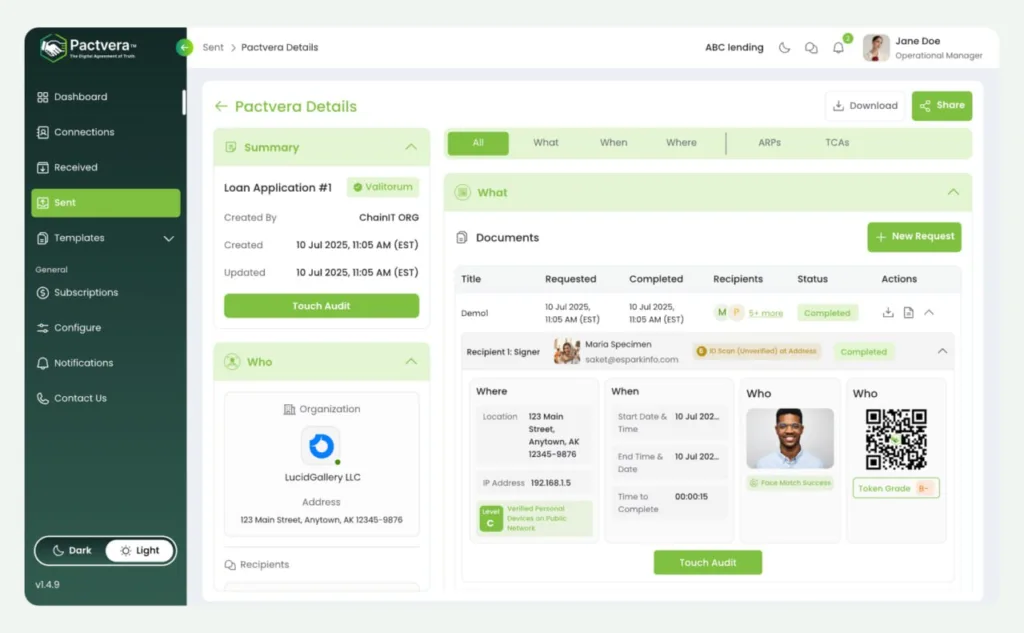
Pactvera produces a Validated Data Token (VDT) that captures evidence signals (who/what/when/where/device/identity strength), including token grading for evidentiary strength.

We also generate Touch Audit™, a privacy-preserving interaction trail designed as rebuttable proof of the signing journey (what was shown, what was affirmed, and how the user interacted), aligned with modern privacy expectations.

Finally, we seal the final artifact as Valitorum: an immutable, timestamped, jurisdiction-tagged, audit-ready record positioned as court-ready evidence for URPERA/UETA/ESIGN-aligned workflows.

The Practical Result

If your organization needs zero trust not only for access, but for agreements that must hold up under audit, dispute, or enforcement, Pactvera turns zero-trust identity verification into a verifiable artifact, not a policy statement.


Common Mistakes That Break Zero-Trust Identity Verification Programs

  • Treating zero trust as a product purchase instead of an operating model
  • MFA everywhere, but not phishing-resistant where it matters most
  • Tool sprawl that creates inconsistent policy enforcement (a common stall point)
  • Over-privilege normalization (standing admin, excessive SaaS rights)
  • No kill switch: inability to instantly revoke access when risk spikes
  • Logs without integrity: audit trails that don’t survive disputes
  • Ignoring human-led risk paths like insider threats
Best Contract Signing Solution for Enterprises in 2026

Conclusion

Zero-trust identity verification in 2026 is the discipline of proving, enforcing, and continuously re-evaluating trust for every identity and every action.

Done well, it reduces breach impact, limits lateral movement, and makes access decisions defensible under real scrutiny.

If you want zero trust to extend into the agreements and approvals that carry real legal and financial consequences, we built Pactvera to make identity, intent, authority, and integrity verifiable end-to-end.

Book a demo with Pactvera to see what evidence-grade zero-trust identity verification looks like in a real signing workflow.

Read Next:


FAQs:

1. What Is Zero-Trust Identity Verification?

Zero-trust identity verification is an approach where no user, device, or session is trusted by default. Every access request is authenticated and authorized continuously using identity, context, and risk signals.

2. How Is Zero Trust Different From Traditional MFA?

Traditional MFA confirms you are likely the right user at login. Zero trust uses MFA as one signal, then continues to evaluate device posture, context, and behavior throughout the session to decide whether access should persist.

3. What Does Identity As The Perimeter Mean In 2026?

It means access decisions are enforced primarily through identity and policy, not network location. In cloud-first environments, the identity layer becomes the control plane for applications, data, and workflows.

4. Why Do Zero Trust Programs Stall After Initial Deployment?

A common reason is inconsistent enforcement across too many tools and systems. Organizations may deploy controls but fail to unify policy, which creates gaps and operational complexity.

5. What Is The Fastest Starting Point For Zero-Trust Identity Verification?

For many enterprises, the fastest operational win is modernizing remote access by moving from VPN to per-application ZTNA and enforcing conditional access policies consistently.
    Best Zero-Trust Identity Verification Software for Legal Agreements

    In 2026, trust is the wrong default for digital agreements. Fraud is automated, devices are shared, inboxes are compromised, and counterparties can be remote, unknown, or operating through layered entities.

    That reality is pushing legal, compliance, and procurement teams toward zero-trust identity verification software, systems that assume nothing, verify everything, and produce evidence-grade proof that holds up under audit and dispute.

    Pactvera is built for this exact problem: transforming “a click happened” into “a verified human with verified authority intentionally agreed, under enforceable rules, captured in a court-ready record.”

    Key Takeaways

    • Zero-trust for agreements means continuous verification of identity, authority, and intent, not one-time checks.
    • The best systems enforce policy at signing time (age, jurisdiction, authority, deadlines) instead of relying on “process docs.”
    • Identity proof without liveness + device linkage + integrity sealing is still dispute-prone.
    • Evidence quality matters: you need a package that supports non-repudiation and clean chain-of-custody.
    • Pactvera combines verified identity, embedded rules, and immutable evidence artifacts designed for legal enforceability.

    Best Contract Signing Software in 2026

    What Is Zero-Trust Identity Verification For Legal Agreements?

    Zero-trust identity verification for legal agreements is a model where no participant, device, channel, or claim is trusted by default, and every critical assertion required for contract formation is explicitly validated.

    For agreements, the assertions courts and regulators care about tend to cluster into five buckets:

    1. Identity: Who is the person?
    2. Authority: Are they authorized to bind themselves or an organization?
    3. Intent and consent: Did they knowingly agree to the terms?
    4. Integrity: Was the document altered? Were logs manipulated?
    5. Chain-of-custody: Can you prove the full lifecycle of the agreement and interactions?

    Zero-trust identity verification software is the layer that verifies and records those assertions in a structured, defensible way, so your contract is not only signed, but provable.


    The Zero-Trust Threat Model In Legal Agreements (Deepfakes, ATO, And Impersonation)

    Zero-trust matters in legal workflows because modern fraud is no longer one-step forgery. It’s multi-stage: credential compromise, session hijack, synthetic identity assembly, deepfake-assisted liveness bypass attempts, and then signature capture.

    Recent benchmarks show why legal teams are tightening controls:

    • U.S. consumers reported more than $12.5B in fraud losses in 2024, a 25% increase year-over-year, and the share of reports involving financial loss rose to 38% (from 27%).
    • Entrust reported digital document forgeries up 244% year-over-year and that deepfakes account for 40% of biometric fraud.
    • The World Economic Forum highlighted a shift where payment method fraud can outpace document fraud as criminals move downstream into monetizable transaction flows.

    Why this changes legal agreements: if your evidence relies on email possession or a thin audit log, you’re exposed to the exact failure mode modern fraud prefers, compromise the channel, then produce an apparently legitimate signature event.


    Market Momentum: Why Zero-Trust Identity Verification Is Accelerating In 2026

    Zero-trust identity verification isn’t niche anymore, it’s riding multiple fast-growing markets at once (identity verification, ZTNA, and broader zero-trust adoption).

    Four growth signals relevant to legal and regulated workflows:

    • The identity verification market is projected to grow from $14.1B (2026) to $42.8B (2036) at 13.1% CAGR.
    • Zero-trust network access (ZTNA) is expected to reach $11.03B (2033) at 24.2% CAGR (2026–2033).
    • The zero-trust market is forecasted to expand to $148.68B by 2034 at 14.76% CAGR.
    • The U.S. identity verification market is projected to grow to $8.16B (2030) at 13.5% CAGR.

    The practical takeaway for buyers is simple: vendors are improving liveness detection, device intelligence, and policy-driven decisioning quickly because regulated workflows are now a primary demand driver.

    How Zero-Trust Identity Verification Works

    A zero-trust flow is not a single KYC step. It’s a sequence of checks that map to contract risk and evidentiary needs.

    1) Strong Identity Proofing (Not Just An Email)

    A credible system starts by binding a real human to the signing act. High-quality approaches typically include:

    • Biometric liveness verification (to prevent spoofing)
    • Identity strength scoring (so you know how strong the proof is)
    • Optional correlation to government ID where appropriate

    2) Device And Session Binding

    Zero-trust assumes credentials and inboxes can be compromised. So it also verifies:

    • Device fingerprinting / device linkage
    • Step-up confirmation for high-risk actions
    • Session-level evidence (time, IP/geo signals, risk indicators)

    3) Authority Resolution (For Organizational Signers)

    This is where most e-sign flows fail in disputes: “That person signed, but could they bind the company?”
    A zero-trust system should support:

    • Organizational identity verification
    • Role and authority checks (who can approve what)
    • Delegation chains and approval provenance

    4) Policy Enforcement At The Moment Of Agreement

    For legal agreements, policy can’t live in a PDF or internal SOP. Zero-trust software enforces rules such as:

    • Age and eligibility constraints
    • Jurisdiction rules and choice-of-law requirements
    • Required approvals, countersignature sequencing
    • Deadlines, revocation windows, and conditional execution logic

    5) Evidence Packaging And Integrity Sealing

    Finally, the system must produce a tamper-resistant, explainable record:

    • A complete audit trail of interactions and consent steps
    • Timestamping and integrity proofs
    • A structured evidence artifact that’s easy to present, not just raw logs

    Best Contract Signing Solution for Enterprises in 2026

    Compliance Reality: How Zero-Trust Identity Verification Supports KYC, AML, GDPR, And HIPAA

    Legal agreements frequently intersect with regulated obligations, even when the document itself isn’t regulated. That’s because the workflow touches identity, sensitive personal data, and access control.

    Zero-trust identity verification software commonly supports compliance by:

    • KYC / AML alignment: risk-based identity proofing, repeatable verification, and auditable decisioning (especially for client onboarding and high-value transactions).
    • GDPR posture: privacy-by-design logging, minimization, and controlled access to evidence artifacts.
    • HIPAA-adjacent use cases: for firms handling healthcare-related matters or protected health information, verified identity plus strict access controls reduce unauthorized access risk.


    Why Zero-Trust Matters More For Legal Agreements Than For Logins

    Many vendors apply zero-trust to workforce access. Legal agreements add another layer: the burden of proof.

    A login can fail and you reset credentials. A disputed contract can trigger:

    • litigation risk and settlement pressure
    • regulatory scrutiny
    • revenue recognition issues
    • procurement breakdowns and vendor disputes
    • employment and contractor misclassification problems

    So the bar is higher: you need evidence-grade identity, enforceable workflow controls, and non-repudiation, by design.


    Benefits Of Zero-Trust Identity Verification Software

    1. Reduced Fraud And Impersonation Risk

    Liveness + step-up checks + device binding reduces the odds that the signer was a bot, a replay, or a hijacked inbox.

    2. Lower Dispute Exposure

    When counterparties contest agreements, your outcome depends on evidence quality. Zero-trust systems produce cleaner, stronger evidence.

    3. Stronger Compliance Posture

    Zero-trust enables consistent enforcement for regulated workflows: eligibility gating, auditability, privacy-aware logging, and controlled access to evidence.

    4. Faster Deal Cycles With Less Manual Review

    When rules are embedded and enforcement is automated, legal and compliance teams spend less time chasing screenshots, emails, and backchannel approvals.

    5. Higher Reliability In Cross-Border Agreements

    Jurisdiction and identity standards vary. Zero-trust workflows help normalize evidence and reduce ambiguity across regions.


    What Does The Best Identity Verification Look Like In A Legal Zero-Trust Stack

    A practical way to evaluate systems is to think in layers:

    1. Identity Proofing Layer
      Liveness + identity strength + (optional) government ID correlation
    2. Assurance Layer
      Device linkage + session risk signals + step-up confirmation
    3. Authorization Layer
      Policy engine enforcing who can do what, when, under which conditions
    4. Authority Layer (Org Binding)
      Organizational identity + role/authority resolution + delegated approvals
    5. Evidence Layer
      Tamper-evident audit trail + integrity sealing + court-presentable artifact

    The gap most tools leave: they do (1) and (2), sometimes partial (3), but rarely deliver (4) and (5) in an evidence-grade way.

    Best Zero-Trust Identity Verification Software

    The Access-Control Controls That Make Zero-Trust Real For Legal Workflows

    This is where zero-trust becomes operational, not theoretical: continuous monitoring of risk signals, least privilege access to sensitive agreement data, and microsegmentation between systems handling evidence, client files, and administrative functions to reduce blast radius from insider threats, ransomware, and other cyber threats, especially when remote signing and collaboration are standard.

    In practice, this is why legal teams increasingly pair agreement-grade verification with modern cybersecurity solutions, including zero trust network access, to ensure user authentication remains high-assurance under changing conditions, while still preserving least privilege for staff, counterparties, and third parties who only need limited exposure to case materials and agreement artifacts.


    The Three Product Categories Buyers Confuse (And How To Compare Correctly)

    When teams search for identity verification, they often compare products that solve different problems:

    Category A: E-Sign-Adjacent Identity Proofing

    Designed to raise assurance inside signing flows (stronger ID checks tied to signatures).

    Category B: Enterprise IAM / ZTNA Platforms

    Excellent for workforce access control, conditional access, and enterprise policy, but not always built to output evidence-grade agreement formation artifacts.

    Category C: Dedicated IDV / Fraud Engines

    Great at liveness, document verification, and fraud detection for onboarding, often needs an agreement/evidence layer for contract enforceability.

    Pactvera is positioned as zero-trust identity verification for agreements, meaning authority resolution, enforced rules, and evidence packaging are first-class outcomes, not add-ons.

    Buying Criteria: What To Look For In Zero-Trust Identity Verification Software

    If your goal is legal enforceability, not just user onboarding, evaluate vendors on these criteria:

    1. Liveness-based identity verification with clear identity strength outputs
    2. Multi-factor authentication support and robust session assurance
    3. Authority resolution for organizations (not “trust the email domain”)
    4. Enforceable workflow rules (policy engine, not just templates)
    5. Tamper-evident audit trails and integrity sealing
    6. Evidence artifact quality: can it be presented cleanly to counsel, auditors, and courts?
    7. Privacy-aware logging: you need proof without over-collecting sensitive data
    8. Cross-jurisdiction support: timestamps, intent capture, and record structures aligned to common e-sign legal frameworks


    Identity Fraud Statistics That Matter In Legal Contexts

    Identity fraud becomes a legal risk when it undermines enforceability (forged signatures, impersonation) or compromises confidentiality (unauthorized access to privileged data).

    Two data points that help quantify the risk environment:

    • Identity fraud costs in the U.S. have been measured at scale, with account takeover and new-account fraud remaining material contributors to total losses.
    • Tens of millions of U.S. residents have reported identity theft experiences in national surveys, reinforcing that counterparties operate in a high-compromise environment.

    The operational takeaway is straightforward: email-based assurance is structurally fragile in the face of modern fraud.

    Best Contract Signing Software

    Why Pactvera Is The Best Zero-Trust Identity Verification Software For Legal Agreements In 2026

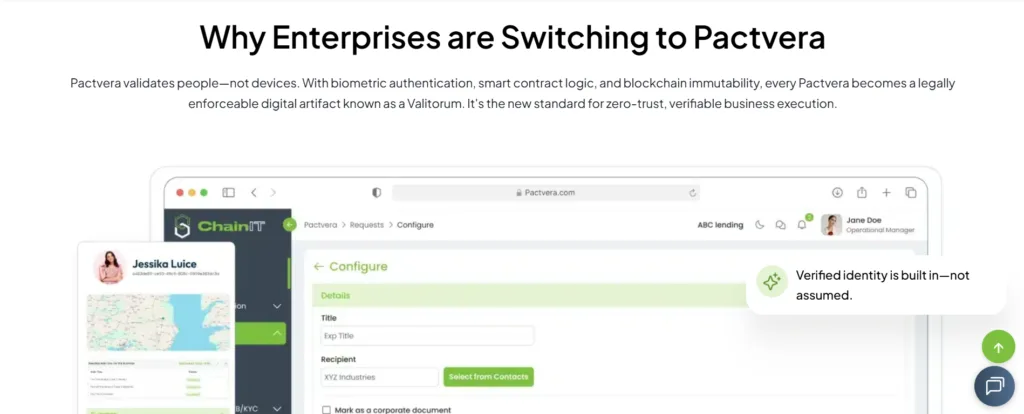
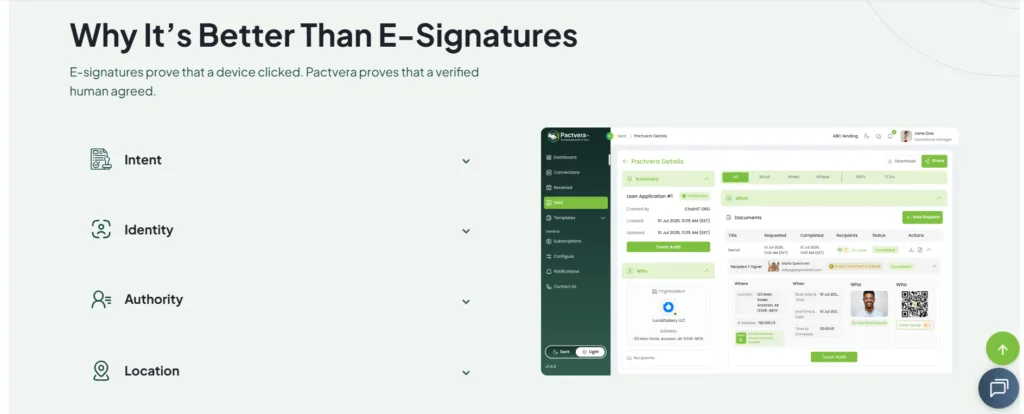
    Pactvera is designed around a simple premise: e-signature tools prove a device click. High-stakes agreements need proof of verified human intent, verified identity, verified authority, and enforced rules, packaged as evidence.

    Here’s how Pactvera implements zero-trust for agreements:

    1. ChainIT ID + Step-Up Confirmation: Verified Human Identity, Not Just Credentials

    Pactvera uses ChainIT ID to verify a real person through liveness-verified biometrics, with device linkage and step-up confirmation. That reduces reliance on fragile identifiers like emails, shared links, or forwardable signing requests, common failure points in disputes.

    2. Business Rules Engine: Enforced Conditions Before A Contract Can Finalize

    Zero-trust isn’t only about identity; it’s also about eligibility and policy enforcement. Pactvera embeds a Business Rules Engine that can enforce age, jurisdiction, role, authority requirements, and deadline logic. If conditions fail, the agreement simply cannot finalize, turning policy from “documentation” into “execution.”

    3. Validated Data Token: Evidence-Grade “Who/What/When/Where/How Strong”

    Pactvera generates a Validated Data Token (VDT) that captures the core evidentiary signals: identity assertions, device/session context, timestamps, and a token grade that reflects identity strength. This is how you move from vague logs to a structured, explainable evidence layer.

    4. Touch Audit: Privacy-Preserving Interaction Proof

    Touch Audit creates a rebuttable-proof interaction trail, capturing intent signals and user actions while remaining privacy-aware. For legal agreements, this is critical: you want strong proof without turning your contract workflow into a data liability.

    5. Authority Resolution Pactvera: Proving Organizational Authority

    Where many disputes focus on “they weren’t authorized,” Pactvera’s organizational identity layer (ChainIT Org ID + authority resolution) is built to prove that the signer had the right role and approval chain to bind the organization, especially important in procurement, enterprise sales, and delegated signing environments.

    6. Valitorum: Immutable, Court-Ready Agreement Artifact

    Pactvera seals the final agreement artifact (Valitorum) as an immutable, timestamped, jurisdiction-tagged record with the embedded evidence package.

    The practical value is simple, when something is challenged months later, you can produce a coherent record of identity, intent, authority, and integrity, without reconstructing it from scattered systems.

    Net result: Pactvera operationalizes zero-trust from end to end, verify the human, verify the authority, enforce the rules, and seal the evidence.


    A Simple Implementation Roadmap For Legal Teams (30/60/90 Days)

    First 30 Days: Scope The Risk

    • Identify the agreement types where disputes are most costly
    • Map signer types (individual vs. organizational) and authority complexity
    • Define evidence requirements (internal audit, regulator, litigation readiness)

    Next 60 Days: Deploy Controls Where Evidence Matters

    • Turn on liveness + step-up confirmation + device binding for high-risk agreements
    • Enforce workflow rules for eligibility, jurisdiction, deadlines, approvals
    • Standardize your evidence artifact output and retention

    By 90 Days: Operationalize And Measure

    • Reduce exceptions and manual review queues
    • Track fraud attempts blocked, disputes reduced, cycle time improved
    • Expand the same zero-trust workflow to adjacent processes (onboarding, renewals, amendments)


    When Pactvera Is The Right Fit

    Pactvera is strongest when:

    • Agreement value is material or dispute likelihood is high
    • Counterparties are external, remote, or unknown
    • You operate in regulated or audit-heavy industries
    • You need enforceable authority chains and approvals
    • You want non-repudiation and court-ready evidence by default

    If you’re mostly signing low-risk internal acknowledgments, basic tools may be sufficient. If you need evidence-grade signing under zero-trust assumptions, Pactvera is built for that.

    Best Electronic Signature Software in 2026

    Conclusion

    Zero-trust identity verification is becoming the default expectation for serious digital agreements in 2026 because the threat model has changed, and the burden of proof hasn’t.

    The right zero-trust identity verification software verifies the human, verifies authority, enforces policy at execution, and produces tamper-evident evidence you can stand behind.

    If you want to upgrade your agreements from signed to provable, book a demo with Pactvera and we’ll walk you through a zero-trust workflow tailored to your specific contract risk.

    Read Next:


    FAQs:

    1. What is zero-trust identity verification for legal agreements?

    Zero-trust identity verification for legal agreements is a model that treats every signer, device, and claim as untrusted until verified, and records evidence of identity, authority, intent, integrity, and chain-of-custody.

    2. How is zero-trust different from standard e-signature verification?

    Standard e-signature verification often relies on email access and basic logs, while zero-trust validates identity and authority more strongly, enforces workflow rules, and produces higher-quality evidence artifacts.

    3. Do I need biometric verification for zero-trust agreements?

    Not always, but biometric liveness is one of the strongest ways to prove a real human was present, which is why it’s commonly used for high-risk, high-value, or dispute-prone agreements.

    4. What should the evidence package include for a dispute?

    The evidence package should at minimum include the signer identity proof, session/device signals, timestamps, document integrity proofs, audit trail of intent/consent steps, and authority evidence when signing on behalf of an organization.

    5. Why does authority matter as much as identity?

    Because many contract disputes are not about who clicked, they’re about whether the signer could legally bind the organization, which requires role and approval-chain proof.