High-risk agreements are where ordinary e-signature workflows tend to break, because the stakes are high, the counterparties are motivated, and the dispute playbook is predictable (deny intent, deny authority, challenge identity, challenge timing, challenge jurisdiction).
In 2026, secure can’t just mean encrypted PDFs and an IP address in an audit log, it has to mean provable human intent, provable organizational authority, and provable rule compliance at the moment an agreement becomes enforceable.
That’s exactly why we built Pactvera, to move beyond click-to-sign and toward court-ready, logic-enforced agreements designed for the deals you can’t afford to lose.
Key Takeaways
- High-risk agreements fail in disputes for five reasons: identity, intent, authority, rule compliance, and evidence integrity.
- The strongest systems don’t just capture signatures, they enforce conditions (age, jurisdiction, approvals, deadlines) before finalization.
- Audit trails matter, but interaction evidence matters more: what the signer actually did, when, and under what controls.
- If you need non-repudiation, you need stronger identity assurance than email links and SMS alone.
- Pactvera is built for high-stakes enforceability: biometric ChainIT ID + MFA, embedded rules, graded evidence tokens, and an immutable final artifact.
What Makes a Contract High-Risk in 2026
A high-risk agreement is any contract where (1) the downside is material, (2) the counterparties may later contest enforceability, or (3) regulators, auditors, or courts will scrutinize the workflow.
Typical examples include:
- Treasury and digital-asset mandates (custody, issuance, settlement, liquidity facilities)
- Enterprise procurement and strategic partnerships
- Cross-border contractor and executive agreements
- IP transfers, licensing, and commercialization deals
- Security, data processing, and incident-response addenda
- Credit, guarantees, and revenue-share structures
- DAO or Web3 governance agreements with off-chain legal teeth
In these deals, having an e-signature is rarely the end of the story.
The real question is: can you prove who agreed, that they had authority, that they understood what they agreed to, and that your process followed the rules you claim it followed?
The 2026 Evaluation Criteria for Secure Contract Platforms
When we assess secure contract platforms for high-risk agreements, we look at eight enforceability-driven capabilities:
- Identity assurance: how strongly the system binds a real human to the act of signing.
- Intent evidence: whether the workflow captures more than a final click (e.g., step-by-step interaction).
- Authority verification: proving the signer had the organizational right to commit.
- Embedded rules: preventing finalization if conditions fail (approvals, roles, jurisdiction, timing).
- Evidence integrity: tamper-resistant artifacts, strong timestamps, and defensible audit design.
- Dispute readiness: court-ready exportability and clarity of evidence.
- Privacy and compliance: strong controls without collecting unnecessary sensitive data.
- Operational fit: integrations, templates, workflow control, and scalability.
This is why, in practice, the best secure systems look less like e-signature tools and more like contract management software that treats enforceability as the product.
1) Pactvera: Best Secure Contract Platform for High-Risk Agreements in 2026
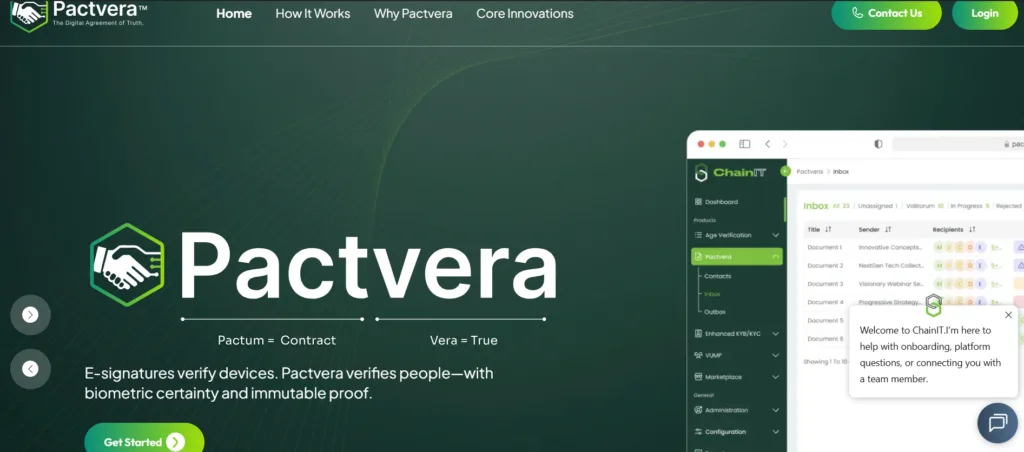
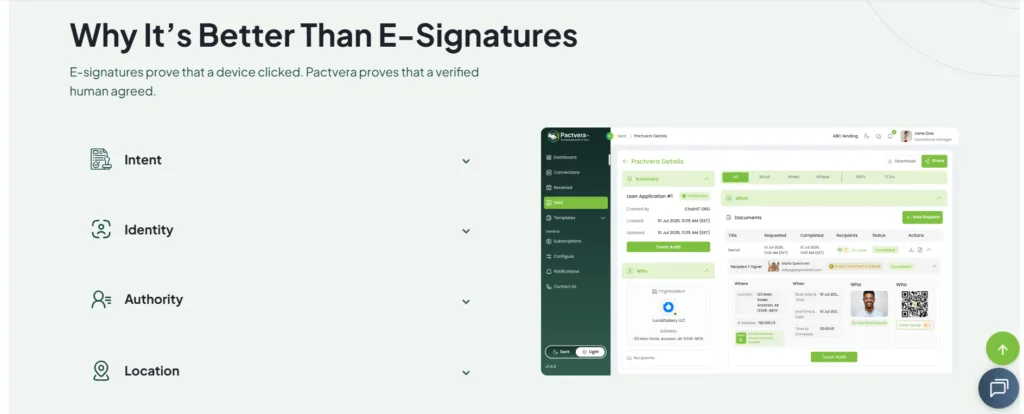
Pactvera is purpose-built for agreements that get challenged: where you need to prove identity, intent, authority, and rule compliance with evidence that holds up under pressure.
Why Pactvera wins in high-risk agreements
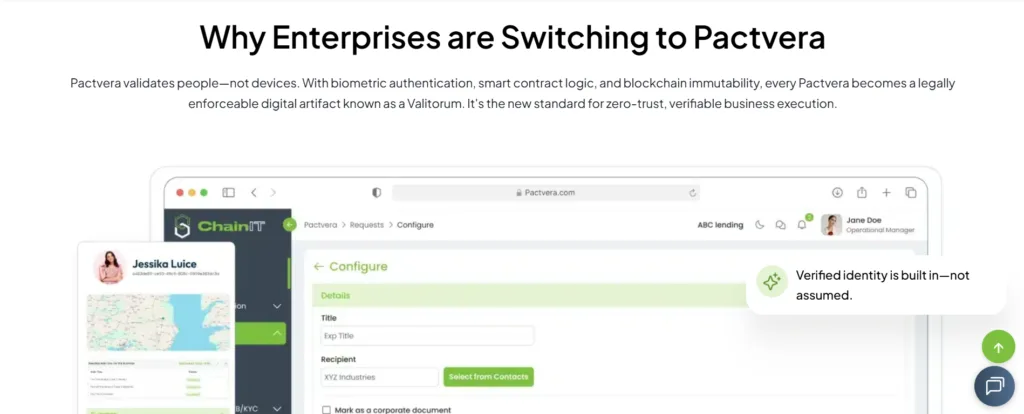
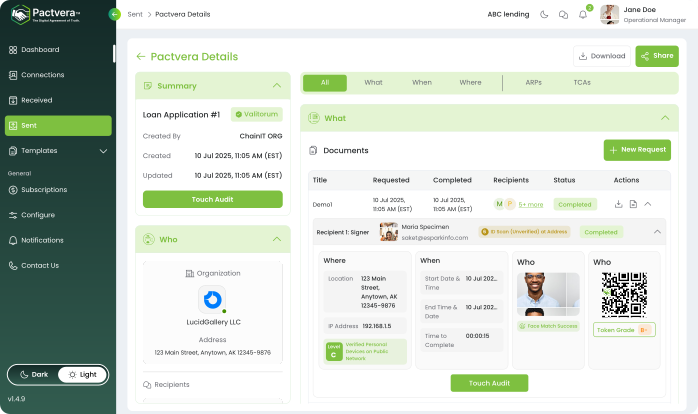
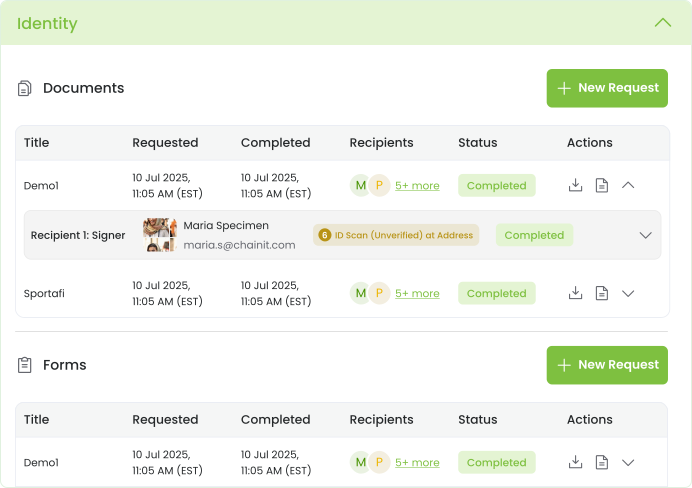
- ChainIT ID + MFA: We bind a real human to the act of agreement using liveness-verified biometrics and multi-factor controls, not just email possession.
- Business Rules Engine: We embed enforceability requirements directly into the agreement flow, age gates, jurisdiction constraints, role-based approvals, deadlines, and conditional obligations. If conditions fail, the agreement cannot finalize.
- Validated Data Token: We generate a cryptographically anchored evidence package capturing who/what/when/where/device plus identity strength, then grade that evidence so teams can set internal thresholds for “high-risk” vs “standard” deals.
- Touch Audit: We preserve a privacy-aware interaction trail that’s rebuttable-proof oriented (designed for disputes, not dashboards).
- ARP authority resolution: For organizations, we can prove that the person signing had the right authority, reducing “they weren’t authorized” disputes.
- Valitorum final artifact: The final agreement is sealed as an immutable, timestamped, jurisdiction-tagged artifact, positioned to be court-ready.
Best for
- Enterprise and regulated workflows
- Cross-border agreements
- Web3/DAO agreements needing real-world enforceability
- Any scenario where non-repudiation actually matters
Pros
- Strong identity and intent evidence designed for disputes
- Rules-based finalization reduces process defects
- Authority proof for organizational signers
- Court-ready immutable artifact with defensible provenance
Cons
- More rigorous than lightweight e-sign tools (by design)
- Requires thoughtful configuration of rules and risk thresholds (we help you set this up quickly)
2) DocuSign: For Basic Enterprise Controls
DocuSign remains a default choice for many enterprises because it’s familiar, widely accepted, and integrates into a large ecosystem. For high-risk agreements, it typically works best when combined with advanced identity options, strong internal policies, and strict template governance.
Where it fits well
- High-volume commercial contracting with standardized workflows
- Organizations with mature admin governance and CLM processes
- Use cases where “accepted standard practice” is a major requirement
Pros
- Strong enterprise feature set and integrations
- Mature admin controls, templates, and workflow tooling
- Broad market familiarity among counterparties
Cons
- In disputes, many workflows still boil down to link-based access + audit logs
- Proving intent and authority can require external process controls
- Stronger assurance often depends on add-ons and configuration
- Execution evidence is often still link-based and log-driven; Pactvera strengthens enforceability with biometric ChainIT ID + MFA and graded VDT evidence designed for disputes.
Why Pactvera is stronger for high-risk deals: we’re not optimizing for signature completion rates; we’re optimizing for evidence quality, biometric identity binding, authority resolution, and rules that prevent defective execution in the first place.
3) Adobe Acrobat Sign: For Adobe-Centric Enterprises
Adobe Acrobat Sign is a natural fit for organizations already standardized on Adobe Document Cloud and PDF workflows. It can be a practical choice for controlled internal processes and procurement-driven standardization.
Pros
- Seamless experience for PDF-heavy document environments
- Enterprise governance options in larger Adobe stacks
- Familiar UX for many business users
Cons
- Identity and authority proof often relies on surrounding process rather than native enforceability primitives
- Security can be interpreted as document security, not dispute-grade evidence
- High-risk edge cases still require stricter verification and policy enforcement
- Security can skew toward document handling and PDF controls; Pactvera focuses on the signing act itself with identity binding, intent evidence, and rules-based finalization.
Why Pactvera is stronger for high-risk deals: we treat identity, intent, and authority as first-class evidence objects (not optional workflow settings), and we embed enforceability rules that block finalization when conditions aren’t met.
4) OneSpan Sign: For Regulated Signature Workflows
OneSpan is frequently positioned for regulated industries and scenarios where stronger authentication and transaction security are expected. For high-risk use cases, it can be compelling when the requirement is more verified transaction signing than full contract management.
Pros
- Strong orientation toward secure transaction signing
- Well-suited for regulated use cases requiring tighter controls
- Often favored in environments that prioritize security posture
Cons
- May feel heavier for general contracting and CLM workflows
- Authority verification and conditional business rules can still sit outside the signing act
- Evidence quality depends heavily on how flows are designed and governed
- Strong transaction security doesn’t automatically prove organizational authority or enforce business conditions; Pactvera adds ARP authority resolution plus a Business Rules Engine that blocks non-compliant finalization.
Why Pactvera is stronger for high-risk deals: we combine strong verification with enforceability automation, so it’s not just a secure signing event, but a rules-compliant agreement that produces a graded evidence package and immutable final artifact.
5) Ironclad: For Legal Team Workflow and Negotiation Control
Ironclad is primarily valued for legal operations and contract workflow orchestration, intake, playbooks, approvals, and process discipline. For high-risk agreements, this process rigor is useful, especially when paired with stronger identity and finalization controls.
Pros
- Excellent for legal intake, playbooks, and approval routing
- Strong operational control for negotiating and managing complex contracts
- Good fit for legal teams driving standardization
Cons
- High-risk enforceability hinges on how the final signing and identity steps are implemented
- Proving signer authority and intent may require external systems and policies
- Dispute-grade evidence quality is not always the default outcome
- Great workflow discipline, but dispute resilience depends on external signing/verification choices; Pactvera natively generates dispute-grade evidence and an immutable final artifact at execution time.
Why Pactvera is stronger for high-risk deals: we complement legal workflow discipline with enforceability mechanics: authority resolution, biometric identity binding, rules-based finalization, and an immutable artifact engineered for disputes.
6) Icertis: For Enterprise Contract Lifecycle Management
Icertis is a CLM heavyweight, ideal for global enterprises managing complex obligations, supplier ecosystems, and large-scale contract repositories. For high-risk agreements, CLM strength helps, but enforceability still comes down to execution controls and evidence.
Pros
- Deep CLM capabilities for large organizations
- Strong obligation management and enterprise governance
- Good fit for complex procurement and supplier networks
Cons
- Execution evidence often depends on integrated signature tools and policies
- Identity/authority proofs can be fragmented across systems
- Implementations can be substantial, especially if you need faster time-to-value
- CLM strength can mask execution-layer evidence gaps across integrated tools; Pactvera closes the enforceability loop with rules-gated completion and court-ready Valitorum artifacts.
Why Pactvera is stronger for high-risk deals: we focus on the moment of enforceability with embedded rules and court-ready evidence, so your CLM isn’t managing contracts that later get attacked on execution defects.
7) Agiloft: For Configurable CLM and Workflow Flexibility
Agiloft is known for configurability, teams that want tailored workflows, data models, and process automation often shortlist it. In high-risk agreements, flexibility helps, but you still need hard guarantees on identity, authority, and evidence integrity.
Pros
- Highly configurable workflows and data structures
- Strong automation potential for operations-heavy teams
- Useful for organizations with unique contracting processes
Cons
- Configurability increases the risk of inconsistent execution without strict governance
- High-risk evidence requirements may not be native defaults
- Authority verification and non-repudiation often remain process-dependent
- High configurability can create inconsistent execution and uneven evidence quality; Pactvera standardizes high-risk execution with enforceability rules, identity assurance, and graded evidence outputs.
Why Pactvera is stronger for high-risk deals: we reduce reliance on process discipline alone by adding enforceability into the execution layer: rules gate finalization, and evidence is generated and graded automatically.
8) Notarization Platforms: For Human-Verified Notarial Acts
In certain high-risk scenarios like real estate, specific cross-border documents, or regulated attestations, remote online notarization (RON) can be the right approach. It’s not always a substitute for a secure contract platform, but it can be an important layer when required.
Pros
- Strong third-party attestation model (where applicable)
- Useful for regulated document types and jurisdiction-specific requirements
- Can reduce specific categories of identity disputes
Cons
- Not always available or valid for every jurisdiction and contract type
- Adds operational friction and scheduling constraints
- Does not automatically solve business-rule enforcement or organizational authority across broader workflows
- Notarization adds friction and isn’t universally applicable across contract types/jurisdictions; Pactvera provides scalable, high-assurance execution with strong identity and tamper-resistant evidence without forcing a notarial workflow.
Why Pactvera is stronger for high-risk deals: when notarization isn’t strictly required, we provide a scalable, rules-driven alternative that strengthens identity, intent, authority, and evidence integrity without forcing every agreement into a notarial workflow.
Secure Contract Platforms Comparison Table (High-Risk Focus)
| Platform | Identity assurance | Authority proof | Rules-based finalization | Evidence artifact strength | Best for |
|---|---|---|---|---|---|
| Pactvera | Liveness biometrics + MFA | ARP authority resolution | Yes (BRE gates completion) | Valitorum + graded VDT + Touch Audit | High-stakes, dispute-prone, regulated execution |
| DocuSign | Configurable, often link-based | Process-driven | Limited (workflow-dependent) | Strong logs, varies by setup | Broad enterprise adoption + integrations |
| Adobe Acrobat Sign | Workflow-dependent | Process-driven | Limited | Document-centric evidence | Adobe-standardized PDF signing |
| OneSpan Sign | Strong transaction controls | Mixed (process + configuration) | Limited to flow design | Security-oriented evidence | Regulated transaction signing |
| Ironclad | Depends on integrated signing | Process-driven | Strong workflow routing | CLM-centric evidence | Legal ops workflow + negotiation governance |
| Icertis | Depends on integrated signing | Process-driven | Strong CLM controls | CLM-centric evidence | Enterprise CLM at scale |
| Agiloft | Depends on integrated signing | Process-driven | Highly configurable | Varies by configuration | Custom workflows and data models |
| Notarization platforms | Strong human attestation | Notarial model | Not applicable | Notarial record | Jurisdiction-specific notarized acts |
How To Choose the Right Platform for High-Risk Agreements
Use this practical checklist:
- If your biggest risk is identity denial → prioritize strong identity assurance (not just email/SMS).
- If your biggest risk is authority challenges → prioritize organizational authority resolution, not just signer names.
- If your biggest risk is process defects (missing approvals, wrong jurisdiction, wrong version) → prioritize rules-based finalization.
- If your biggest risk is litigation → prioritize dispute-grade evidence and immutable artifacts.
- If your biggest risk is operational scale → prioritize workflow controls, templates, and integrations.
The best platform for high-risk contracting is the one that prevents invalid execution and produces evidence that survives scrutiny.
High-Risk Agreement Checklist
Use this checklist to sanity-check your execution posture before you send a high-stakes agreement:
- Signer identity is verified at a level appropriate to risk (not just email link possession)
- Signer intent is captured beyond a single click (clear interaction evidence exists)
- Organizational authority is provable (role, delegation, or approval chain is evidenced)
- Version control is enforced (final doc is locked; no last-minute drift)
- Approvals and role gates are enforced before completion (no bypass paths)
- Jurisdiction and timing are captured consistently (time source + jurisdiction tags)
- Evidence export is tested (you can produce a court-ready packet quickly)
- Data minimization is respected (only collect what is necessary and defensible)
Real-World Dispute Scenarios (And How Secure Platforms Hold Up)
These are the exact scenarios that tend to surface in high-risk disputes, and the platform capabilities that determine outcomes:
Scenario 1: The signer denies they agreed
If the evidence is an email link + audit log, the dispute often becomes an argument about access, forwarding, or shared inboxes.
High-risk execution benefits from strong identity assurance and interaction-level intent evidence, the area where we designed Pactvera to be materially stronger.
Scenario 2: The company claims the signer wasn’t authorized
Many disputes are won or lost on authority, not signatures. If your platform can’t prove authority, you’re relying on internal testimony and policy documents.
Pactvera’s ARP authority resolution is designed specifically to reduce “not authorized” challenges.
Scenario 3: The counterparty argues the process was defective
Missing approvals, wrong jurisdiction routing, or missed deadlines can invalidate execution or create settlement leverage.
Rules-based systems that block completion when conditions fail are structurally harder to attack than workflows that log the problem after the fact.
Pactvera Implementation Path (High-Risk Rollout)
For teams adopting Pactvera specifically for high-risk agreements, the rollout is usually straightforward:
- Identify your high-risk contract categories (by dollar value, regulatory exposure, or dispute history)
- Define identity and evidence thresholds for each category (what must be verified, and at what assurance level)
- Configure Business Rules Engine gates (role approvals, jurisdiction constraints, deadline logic, conditional obligations)
- Map authority logic (who can sign what, and what evidence proves authority)
- Pilot with one high-risk workflow, then expand templates and rules across categories
- Standardize evidence export playbooks for legal/compliance teams
- Operationalize governance (template control, rule change management, audit readiness)
Conclusion
In 2026, secure contracting is shifting from a signed PDF with an audit log to verifiable agreement infrastructure that includes strong identity, provable intent, provable authority, enforceable business rules, and tamper-resistant evidence.
That’s why Pactvera leads this category. We’re engineered for high-risk agreements where the cost of a dispute is massive, and where you need to prove, not merely claim, that the right person agreed under the right controls at the right time.
If you’re handling high-stakes contracts and want enforceability you can defend, schedule a demo with Pactvera and we’ll map your risk profile to the exact controls, rules, and evidence thresholds you need.
Read Next:
- Know Your Agent (KYA): Can an AI Agent Legally Sign a Contract?
- Best Legal and Compliance Softwares for AI Startups in 2026
- Best e-Signature Platforms for Small Businesses in 2026
FAQs:
1. What are secure contract platforms?
Secure contract platforms are tools that help execute agreements with stronger controls for identity, intent, authority, and evidence integrity, especially for high-risk or dispute-prone contracts.
2. What makes a contract high-risk in 2026?
A contract is high-risk when the downside is material, the counterparty may dispute enforceability, or regulators/auditors will scrutinize execution, common in enterprise, cross-border, and regulated workflows.
3. Are e-signatures enough for high-risk agreements?
Sometimes, but high-risk agreements often fail on weak identity verification, unclear signer authority, missing approvals, or thin audit evidence that is difficult to defend in disputes.
4. What is the most important feature in a secure contract platform?
For high-risk agreements, the most important feature is dispute-grade evidence: proof of identity, proof of intent, proof of authority, and tamper-resistant records that demonstrate rules were followed.
5. How does Pactvera secure high-risk agreements?
Pactvera secures high-risk agreements through ChainIT ID + MFA for verified human signing, a Business Rules Engine that prevents invalid finalization, VDT evidence packaging with grading, Touch Audit interaction trails, ARP authority resolution, and an immutable Valitorum artifact.
6. When should a team choose Pactvera over a traditional e-sign tool?
Choose Pactvera when agreements are high-stakes, cross-border, authority-sensitive, audit-heavy, or likely to be disputed, when you need to prove identity/intent/authority, not just capture a signature.