Zero-trust identity verification is no longer a niche cybersecurity idea. In 2026, it is the practical response to hybrid work, cloud sprawl, contractor access, and AI-driven impersonation attempts that make perimeter assumptions unreliable.
The core shift is simple: identity becomes the control plane, and every access decision is continuously evaluated, not approved once and forgotten.
NIST’s Zero Trust Architecture formalizes this posture: no implicit trust based on network location or device ownership, and access is evaluated per session and context.
Key Takeaways
- Zero trust treats identity as the perimeter, not the network.
- The gap is execution: 82% say universal ZTNA is essential, but only 17% have fully implemented it.
- Over-privilege remains a leading internal risk: 56% cite employee over-privilege as a key contributor to unauthorized access.
- 2026 zero trust must cover humans, devices, APIs, and AI agents (non-human identities).
- Pactvera applies zero-trust identity verification to digital agreements, producing evidence-grade proof of identity, intent, authority, and integrity.

What Is Zero-Trust Identity Verification?
Zero-trust identity verification is the set of controls and verification steps that ensure every user (and increasingly, every machine identity) is authenticated, authorized, and re-validated continuously based on risk, including modern zero trust authentication patterns.
It extends never trust, always verify beyond login to the entire lifecycle of access:
- Before access: strong identity proofing + passkeys + device and session checks
- During access: continuous evaluation (behavioral signals, session risk, context drift)
- After access: auditing, evidence, and rapid revocation (kill-switch capability)
Zero Trust vs Traditional IAM
Traditional IAM often answers: Did you log in correctly?
Zero trust identity verification answers: Should you still have access right now, to this resource, from this device, under these conditions?
That distinction matters in 2026 because credentials alone are not a reliable signal of legitimate intent.
Why Zero-Trust Identity Verification Matters More In 2026
1) The enterprise perimeter is functionally gone
Cloud apps, partner access, contractors, and remote users make inside vs outside meaningless in practice.
2) Execution gaps create real exposure
A 2026 report found 82% of organizations view universal ZTNA as essential, but only 17% have fully implemented it, producing a large strategy-to-reality gap.
3) Over-privilege and SaaS sprawl are persistent internal weaknesses
Authorization risk compounds:
- 56% cite employee over-privilege as a key factor in unauthorized access
- SaaS/cloud app access and legacy broad permissions remain major contributors
4) AI agents expand identity beyond humans
Widespread adoption of AI agents inside large enterprises increases the urgency of governing and protecting non-human identities with the same rigor as human users.
5) Data trust becomes part of zero trust
By 2028, 50% of organizations are expected to adopt a zero-trust posture for data governance due to the growth of unverified AI-generated data, raising new expectations around compliance and verification rigor.
Core Principles Of Zero-Trust Identity Verification
1. Always Verify
Every access attempt requires explicit authentication and re-authorization based on risk. Practically, this means layered signals such as:
- passkeys and phishing-resistant login
- biometrics (with liveness where appropriate)
- device posture and session integrity
- contextual scoring and anomaly detection
2. Least Privilege Access
Grant only the minimum permissions necessary, ideally enforced with:
- role-based and attribute-based access control (RBAC/ABAC)
- time-bound access (JIT/JEA)
- privilege reviews and automated entitlement cleanup
- context-driven risk assessment for privilege elevation decisions
Over-privilege is not theoretical; it’s repeatedly cited as a primary internal contributor to unauthorized access in enterprise environments.
3. Assume Breach
Design as if attackers are already inside:
- segmentation and per-resource policy enforcement
- continuous monitoring for abnormal session behavior
- rapid isolation and instant revocation paths to contain security incidents
4. Context-Aware Decisions
Access is granted and maintained based on live signals, not static assumptions:
- geo velocity and travel anomalies
- device health (EDR, patch level, jailbreak/root)
- session risk changes over time (new IP, automation signals)
- behavior drift (impossible usage patterns)
The goal is to reduce friction without degrading user experience.
5. Identity As The Perimeter
In cloud-first environments, the identity layer becomes the enforcement plane for applications, data, and workflows. This is why zero trust programs typically start with access modernization and ZTNA.
What Zero-Trust Identity Verification Looks Like In Practice
A useful way to operationalize this is to map your verification to three checkpoints:
1) Proof (Establish who/what it is)
- identity proofing and recovery hardening
- phishing-resistant authentication
- biometric binding where appropriate
- verified device binding (managed or trusted device enrollment)
2) Policy (Decide what it can do)
- least privilege roles + attributes
- dynamic authorization (risk-based, time-based, resource-based)
- step-up prompts for sensitive actions
- reduce overall attack surface by eliminating broad standing access
3) Proof-of-Action (Record what happened)
- audit logs that are actually dispute-resilient
- integrity controls (tamper evidence)
- authority proof (did this person have the right to commit the org?)
- jurisdiction-aware evidence packaging
Most organizations do (1) and part of (2). In 2026, the differentiator is consistent enforcement of (2) and evidence-grade (3).
Key Technologies Powering Zero-Trust Identity Verification In 2026
1. Identity And Access Management (IAM)
IAM remains the backbone: central auth, federated identity, SSO, lifecycle provisioning, and policy enforcement.
2. Phishing-Resistant MFA And Passkeys
In 2026, MFA-enabled is not enough. Zero trust increasingly expects phishing-resistant methods (passkeys/FIDO2) and step-up flows for sensitive actions using multi-factor authentication when risk warrants it.
3. Behavioral Analytics And Risk Scoring
Continuous authentication relies on anomaly detection (impossible travel, bot-like patterns, session hijacking indicators). The goal is to detect compromised sessions even after successful login.
4. ZTNA And Per-Application Access
ZTNA replaces network access with app access, enforcing identity-based, policy-driven connectivity for each resource. A common starting point is VPN replacement, which remains a practical on-ramp because it delivers measurable risk reduction quickly.
5. Segmentation
Segmentation limits blast radius. In identity-centric designs, segmentation policies often tie directly to identity attributes and session risk, and can be enforced through micro-segmentation for high-value resources.
6. Verifiable Credentials And Digital Identity Wallets
Reusable, privacy-preserving identity is maturing, pushing more regulated workflows toward stronger, standardized identity rails.
Adoption Trends And What The Data Says
Zero trust is widely accepted in principle, but uneven in implementation:
- 82% view universal ZTNA as essential, yet only 17% have fully implemented it.
- Organizations rate their zero trust effectiveness at 6/10 in the same report, reflecting maturity plateaus and fragmentation.
- 41% of businesses report using zero-trust architecture (a commonly cited baseline adoption figure).
The operational takeaway: most programs stall at tool deployment instead of reaching policy consistency, and organizations struggle with consistent visibility across identity signals.
Common Zero-Trust Identity Verification Use Cases Across The Funnel
1. Awareness And Baseline Controls
Use Case: Remote workforce access
- enforce phishing-resistant login
- require managed or posture-checked devices
- replace VPN with ZTNA per application
Use Case: SaaS sprawl and shadow IT containment
- consolidate identity providers
- enforce conditional access policies everywhere
- detect risky sessions and enforce re-authentication
2. Risk-Reduction And Operationalization
Use Case: Contractor and partner access
- time-bound, least privilege access
- per-app access with step-up for admin actions
- fast revocation (kill switch)
Use Case: Privileged access governance
- JIT admin elevation
- strong re-auth for privilege escalation
- continuous monitoring of privileged sessions
Use Case: High-risk actions (payments, data export, contract execution)
- step-up auth + device verification
- contextual rules (location, timing, role)
- tamper-resistant event trail
3. Evidence-Grade Trust For High-Stakes Workflows
This is where identity verification stops being an IT control and becomes proof in disputes, audits, and regulated workflows:
- onboarding with defendable identity and consent evidence
- enforceable approvals (procurement, HR, finance)
- cross-border workflows with jurisdiction-aware controls
- non-repudiation requirements for executive actions
Implementation Roadmap: How To Build Zero-Trust Identity Verification In 2026
Step 1: Inventory identities and flows
- Humans: employees, admins, contractors, vendors
- Machines: service accounts, APIs, workloads
- AI identities: agent accounts, tool tokens, delegated actions
- Assets: devices, applications, and critical endpoints
Step 2: Standardize strong authentication
- prioritize phishing-resistant auth for privileged and remote access
- eliminate legacy MFA gaps
- harden recovery and helpdesk reset workflows
Step 3: Enforce least privilege by default
- role and attribute mapping
- entitlement reviews (quarterly minimum, automated ideally)
- remove standing admin; move to JIT/JEA
Step 4: Move access to per-resource policy enforcement
- replace VPN with ZTNA where possible
- enforce device posture and session conditions per application
Step 5: Add continuous evaluation
- baseline behavior and detect drift
- automate step-up prompts and access revocation
- integrate identity telemetry into SOC workflows with clear escalation security protocols
Step 6: Make proof and audit dispute-ready
For high-stakes workflows, generic logs aren’t enough. You need:
- consistent event capture (who/what/when/where/how)
- integrity controls (tamper evidence)
- authority proof (did this person have the right to commit the org?)
- jurisdiction-aware evidence packaging
- cryptographic integrity protections such as encryption
That last layer is where Pactvera is built to operate.
How Pactvera Solves Zero-Trust Identity Verification For Digital Agreements
Most zero trust programs focus on access to systems.
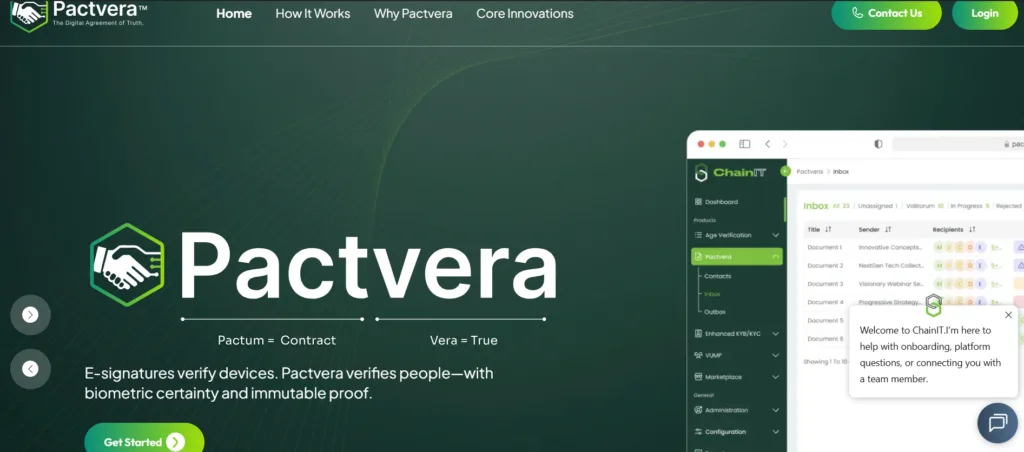
Pactvera focuses on access to commitment: the moment a person binds themselves (or an organization) to terms.
When agreements are remote, high-value, or dispute-prone, login + click is not evidence-grade. Pactvera is designed to produce a defensible trust package that maps directly to zero-trust identity verification principles:
1. Identity As The Perimeter For Agreement Formation
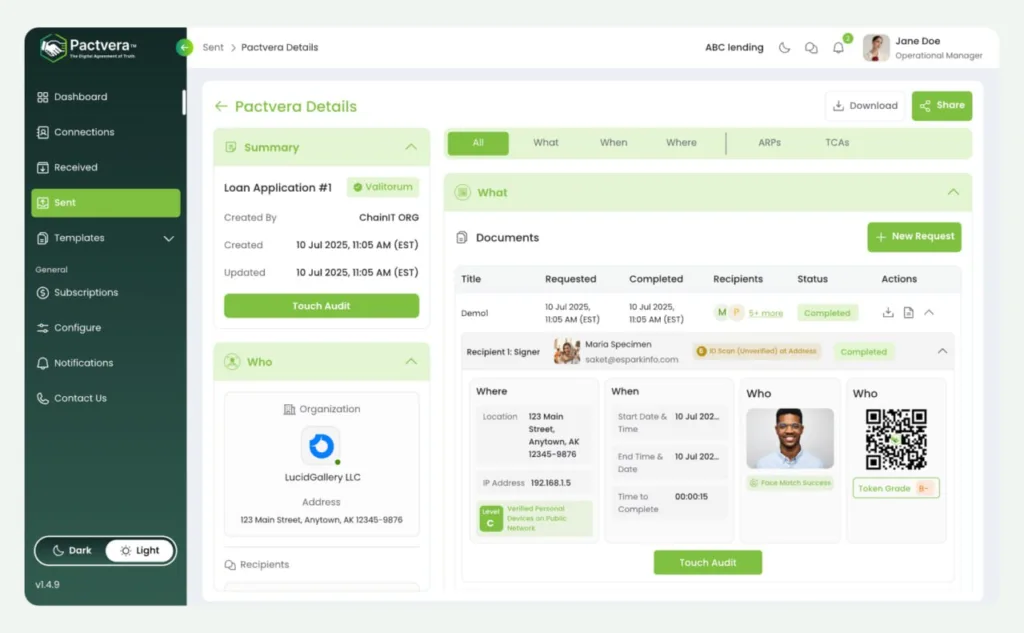
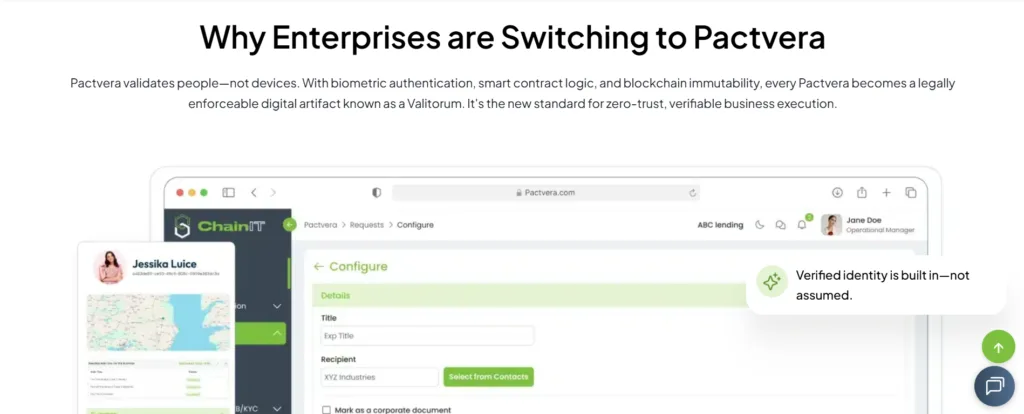
Pactvera ChainIT ID creates a liveness-verified, biometric-linked identity with MFA and device linkage. Instead of trusting an email address or a shared device, we treat identity as the control plane for signing and approval actions.
2. Always Verify With Context And Rules
Our Business Rules Engine (BRE) enforces conditions before an agreement can finalize (age, jurisdiction, role/authority, deadlines, and other workflow constraints). If conditions fail, the agreement cannot complete, which is exactly how zero trust expects policy enforcement to behave.
3. Least Privilege, Applied To Authority
In agreements, least privilege isn’t just system permissions. It is organizational authority: who is allowed to sign, approve, or commit the entity.
ChainIT Org ID + Authority Resolution (ARP) is built to prove authority pathways (who can bind the company, under what policy), reducing a common enterprise contracting failure mode: unauthorized signers.
4. Assume Breach With Evidence-Grade Auditability
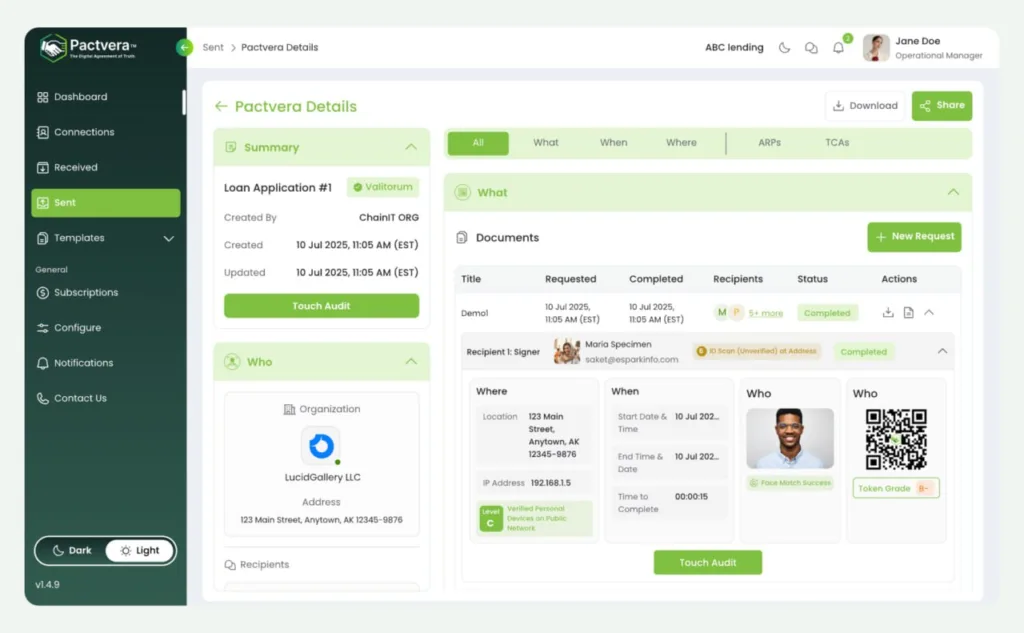
Pactvera produces a Validated Data Token (VDT) that captures evidence signals (who/what/when/where/device/identity strength), including token grading for evidentiary strength.
We also generate Touch Audit™, a privacy-preserving interaction trail designed as rebuttable proof of the signing journey (what was shown, what was affirmed, and how the user interacted), aligned with modern privacy expectations.
Finally, we seal the final artifact as Valitorum: an immutable, timestamped, jurisdiction-tagged, audit-ready record positioned as court-ready evidence for URPERA/UETA/ESIGN-aligned workflows.
The Practical Result
If your organization needs zero trust not only for access, but for agreements that must hold up under audit, dispute, or enforcement, Pactvera turns zero-trust identity verification into a verifiable artifact, not a policy statement.
Common Mistakes That Break Zero-Trust Identity Verification Programs
- Treating zero trust as a product purchase instead of an operating model
- MFA everywhere, but not phishing-resistant where it matters most
- Tool sprawl that creates inconsistent policy enforcement (a common stall point)
- Over-privilege normalization (standing admin, excessive SaaS rights)
- No kill switch: inability to instantly revoke access when risk spikes
- Logs without integrity: audit trails that don’t survive disputes
- Ignoring human-led risk paths like insider threats
Conclusion
Zero-trust identity verification in 2026 is the discipline of proving, enforcing, and continuously re-evaluating trust for every identity and every action.
Done well, it reduces breach impact, limits lateral movement, and makes access decisions defensible under real scrutiny.
If you want zero trust to extend into the agreements and approvals that carry real legal and financial consequences, we built Pactvera to make identity, intent, authority, and integrity verifiable end-to-end.
Book a demo with Pactvera to see what evidence-grade zero-trust identity verification looks like in a real signing workflow.
Read Next:
- How to Stop Deepfake Signature Fraud in Remote Onboarding
- Top Legal Compliance Risks for Blockchain Companies in 2026 (New Data)
- Best Zero-Trust Identity Verification Software for Legal Agreements
FAQs:
1. What Is Zero-Trust Identity Verification?
Zero-trust identity verification is an approach where no user, device, or session is trusted by default. Every access request is authenticated and authorized continuously using identity, context, and risk signals.
2. How Is Zero Trust Different From Traditional MFA?
Traditional MFA confirms you are likely the right user at login. Zero trust uses MFA as one signal, then continues to evaluate device posture, context, and behavior throughout the session to decide whether access should persist.
3. What Does Identity As The Perimeter Mean In 2026?
It means access decisions are enforced primarily through identity and policy, not network location. In cloud-first environments, the identity layer becomes the control plane for applications, data, and workflows.
4. Why Do Zero Trust Programs Stall After Initial Deployment?
A common reason is inconsistent enforcement across too many tools and systems. Organizations may deploy controls but fail to unify policy, which creates gaps and operational complexity.
5. What Is The Fastest Starting Point For Zero-Trust Identity Verification?
For many enterprises, the fastest operational win is modernizing remote access by moving from VPN to per-application ZTNA and enforcing conditional access policies consistently.