Best Platforms for Immutable Audit Trails in 2026

Immutable audit trails are no longer just a checkbox. In 2026, they are a business requirement for regulated operations, high-value agreements, remote onboarding, and any workflow that can end up in an audit, arbitration, or court.

The problem is that most platforms can log events or lock retention, but far fewer can produce an evidence-grade package that proves identity, intent, authority, and integrity end-to-end.

That is the gap Pactvera is designed to close.

Instead of treating audit trails as system logs, Pactvera treats them as verifiable proof artifacts, built for disputes, reviews, and high-stakes approvals, while still integrating cleanly with modern governance stacks to support accountability across every binding action.

Key Takeaways

  • Immutable audit trails require tamper resistance plus verification, not just a timestamped log.
  • Locked retention is strong for preservation, but weak for proving human intent and organizational authority.
  • Cloud audit logs are ideal for infrastructure governance, not agreement-grade consent proof.
  • Traditional e-sign tools provide audit records, but can still be challenged on identity/authority in higher-stakes disputes.
  • Pactvera is engineered for evidence-grade outcomes through rule enforcement, authority proof, and immutable final artifacts.
Best Contract Signing Software in 2026

What Immutable Audit Trails Mean In 2026

An immutable audit trail is a chronological record of actions that is tamper-resistant, preserved under enforceable retention, and verifiable. Most 2026 implementations use a mix of:

  • Provider audit logging (admin activity, API calls, access records)
  • WORM-style retention controls (objects cannot be overwritten or deleted before retention ends)
  • Legal holds (preservation under investigation or regulatory requirement)
  • Integrity verification (hashing/signing/anchoring so changes become detectable)

The operational definition reviewers care about is broader than can you store logs. In practice, the strongest audit trails prove:

  • Identity: a real human did the action (not a shared mailbox or compromised account)
  • Authority: the actor had the power to approve/sign for the organization
  • Intent + context: what they reviewed and what they accepted
  • Integrity + chain-of-custody: the record is complete, consistent, and tamper-evident

This matters because audits and disputes are rarely about whether an entry exists, they’re about whether the record is complete, reliable, and defensible.


How To Evaluate Platforms For Immutable Audit Trails

Use this lens to keep your selection objective and aligned with how audits actually play out.

1. Immutability and retention enforcement:
Can you enforce WORM retention or equivalent controls, reduce privileged deletion risk, and preserve records under legal hold without exceptions?

2. Identity assurance:
Does the platform bind actions to a person strongly enough for your threat model, especially for high-stakes approvals?

3. Authority resolution:
Can you prove someone was authorized to bind an entity, not just if they had access?

4. Intent and context capture:
Can you reconstruct what was presented and accepted, not just whether a click happened?

5. Evidence packaging and exportability:
Can you export a coherent evidence bundle that a third party can review without needing your internal dashboards?

If you are buying audit management software, prioritize products that minimize manual stitching of exports, because every extra join in your evidence chain increases review friction during internal audits and escalations.
Best Contract Signing Software

Best Platforms for Immutable Audit Trails in 2026

1) Pactvera (Best Overall Platform For Evidence-Grade Immutable Audit Trails)

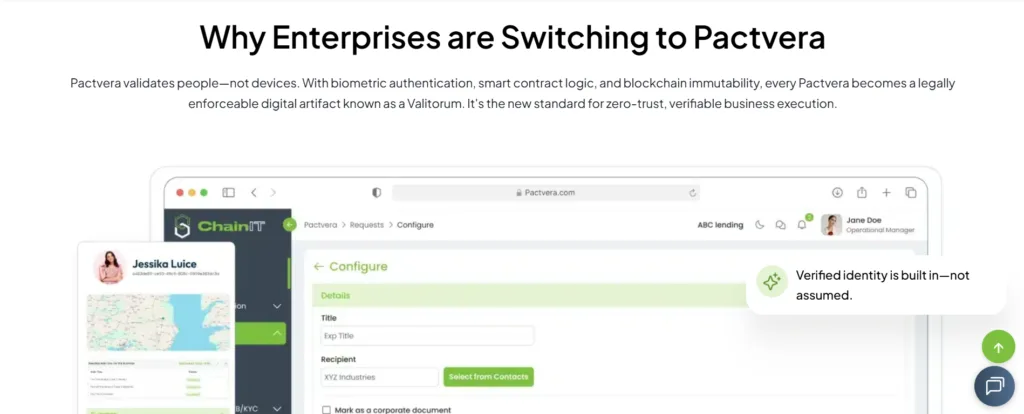
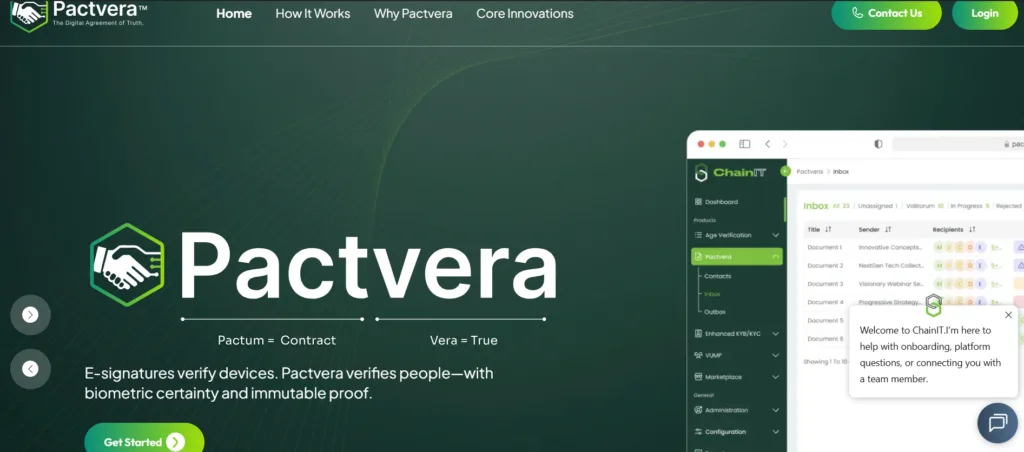
Pactvera is a digital agreement and proof system that replaces basic click-based e-sign flows with verified human identity, rule enforcement, and evidence-grade audit artifacts.

Most tools in 2026 focus on either (a) infrastructure logs or (b) document signing records. Pactvera is designed to unify the full proof chain for high-stakes workflows using blockchain technology in the final sealing step:

  • ChainIT ID + MFA to bind actions to verified humans
  • Business Rules Engine (BRE) that blocks finalization if conditions fail (age, jurisdiction, role, deadlines)
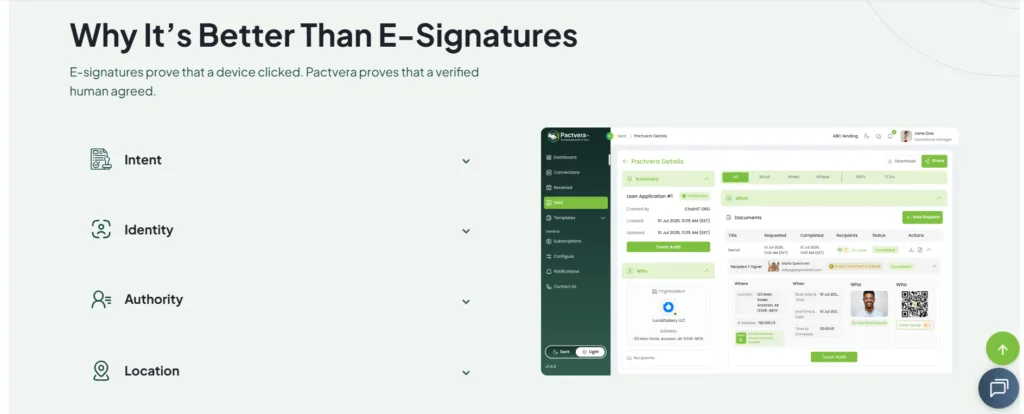
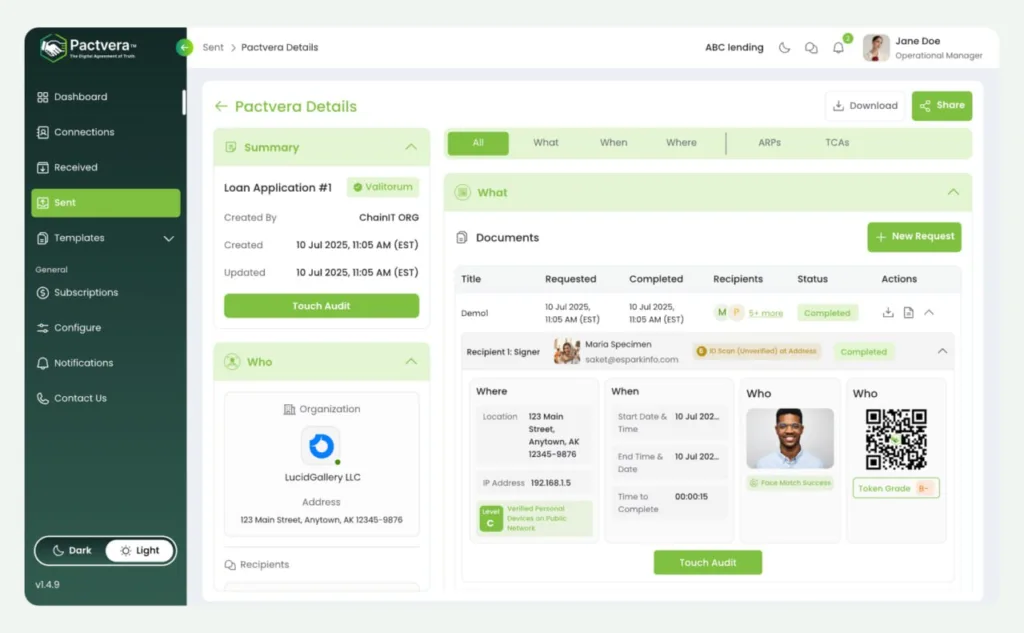
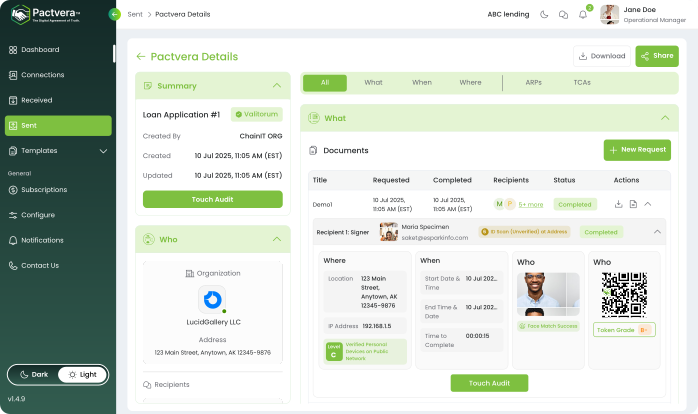
  • Validated Data Token (VDT) capturing who/what/when/where/device/identity strength with token grading
  • Touch Audit interaction trail built for privacy-preserving, dispute-ready reconstruction
  • Authority Resolution Pactvera (ARP) to prove organizational authority, not just email possession
  • Valitorum final sealed artifact that is immutable, timestamped, and jurisdiction-tagged

Pactvera is best for regulated onboarding, high-value procurement, enterprise approvals, cross-border contracting, and any workflow where logs won’t survive adversarial scrutiny.

If you only need infrastructure activity history, Pactvera may be more than you need. Pactvera is optimized for evidence quality, not commodity event collection.

2) AWS CloudTrail + Amazon S3 Object Lock (Strong Option For AWS-Native Governance + WORM Retention)

AWS CloudTrail records AWS account activity and API events so teams can reconstruct changes across identities, services, and regions. To harden retention, Amazon S3 Object Lock supports WORM-style retention modes that can prevent deletion/overwrite during a defined retention window.

Where it shines

  • Cloud governance and forensic readiness for AWS environments
  • Strong retention hardening for archived logs and evidence stores
  • Good foundation when your requirement is to prove what changed in AWS

Cons

  • CloudTrail plus locked retention preserves when an AWS principal took an action, but it does not inherently prove verified human intent for a binding agreement or approval.
  • It also lacks built-in authority proof and consent context packaging, while Pactvera is purpose-built to produce a single exportable evidence artifact for disputes and regulated reviews.


3) Google Cloud Audit Logs + Retention Controls (Strong Option For GCP Audit Coverage)

Google Cloud Audit Logs provide audit streams that help teams reconstruct activity across cloud services, including administrative actions and access events. When paired with retention controls, this approach supports longer-term preservation and review.

Where it shines

  • Strong baseline visibility for GCP governance and access review
  • Helpful for investigations and standardized change tracking inside Google Cloud
  • Clean fit for cloud-first operating models

Cons

  • These logs are optimized for cloud activity reconstruction, not for proving human consent, what terms were accepted, or organizational signing authority.
  • Pactvera is designed to package identity strength, authority resolution, and acceptance context into a single evidence bundle with minimal ambiguity.

Best Zero-Trust Identity Verification Software

4) Microsoft Purview Audit + Azure Immutable Blob Storage (Strong Option For Microsoft 365 + Azure-Centric Organizations)

Microsoft Purview Audit supports configurable retention for audit logs across Microsoft workloads, and Azure immutable blob storage can preserve stored objects under time-based retention and legal hold configurations.

Where it shines

  • Microsoft-first organizations that need centralized audit retention governance
  • Preservation patterns that reduce tampering risk for stored records and archives
  • Strong enterprise governance plumbing when Microsoft is your backbone

Cons

  • This stack is strong for Microsoft workload auditability, but it does not inherently produce a single court-ready agreement artifact that proves identity strength, authority, and intent together.
  • Pactvera is designed to deliver that combined proof chain as one immutable output, rather than spreading proof across multiple admin consoles and exports.


5) DocuSign eSignature (Common Choice For Standard E-Sign Audit Records)

DocuSign provides signing workflows and generates completion records that capture envelope activity, timestamps, and transaction events tied to the signing process.

Where it shines

  • Mature signing workflows and broad enterprise adoption
  • Practical audit records for routine agreements at scale
  • Helpful operational exports for contract operations teams

Cons

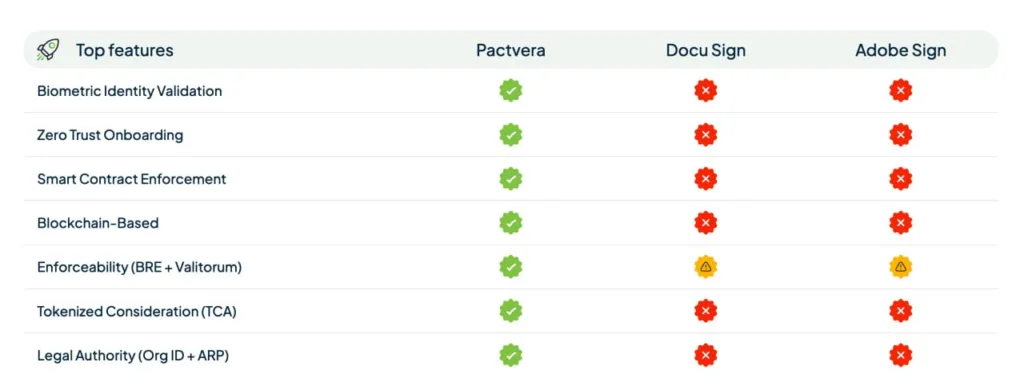
  • In higher-stakes disputes, challenges often focus on whether it was the right verified person and whether they were authorized to bind the entity; conventional e-sign records can become a pressure point.
  • Pactvera is engineered to raise the evidentiary ceiling with verified-human identity, authority resolution, and rule gating before finalization.


6) Adobe Acrobat Sign (Document-Centric Option With Downloadable Audit Reports)

Adobe Acrobat Sign provides downloadable audit reports that track agreement milestones and completion history, making it straightforward to share a transaction record across business teams.

Where it shines

  • Strong fit for organizations standardized on Adobe document workflows
  • Clear audit reports for signing status and transaction milestones
  • Useful for routine agreements where document flow is the primary concern

Cons

  • Audit reports capture signing milestones, but do not inherently enforce eligibility rules or prove organizational authority at an evidence-grade bar before completion.
  • Pactvera is designed to enforce execution rules and authority constraints in-line, then produce an immutable artifact that supports dispute defense.
Best Contract Signing Software for Enterprises

7) HashiCorp Vault Audit Devices (Security-Focused Option For Secrets Access Evidence)

HashiCorp Vault audit devices record API requests and responses to create a high-signal record of secrets-related activity, which is valuable for privileged access review and operational investigations.

Where it shines

  • Strong trace logs for secrets access and privileged operations
  • Useful for SIEM ingestion and forensic reconstruction of access patterns
  • Designed to support reliable event capture in sensitive paths

Cons

  • Vault is not an agreement/consent evidence platform; it does not capture what terms were presented, what a signer accepted, or who had corporate authority to approve.
  • Pactvera is purpose-built for immutable audit trails where human intent, organizational authority, and executed context must be provable and exportable.


8) Datadog Audit Trail + Export/Archives (Operations Option For Platform Governance)

Datadog Audit Trail tracks user activity and platform changes within Datadog, and supports exporting events for review and archiving, which is useful for operational governance and change oversight.

Where it shines

  • Operational governance: who changed what inside the observability platform
  • Helpful oversight for admin activity and configuration changes over time
  • Practical exports for review workflows and incident follow-ups

Cons

  • Operational audit events are not the same as dispute-ready evidence of consent and authority for binding approvals.
  • Pactvera produces purpose-built proof artifacts for contracting and approvals, rather than operational telemetry, which improves traceability across legal and business outcomes.

Comparison Table: Best Platforms For Immutable Audit Trails in 2026

PlatformBest Use CaseImmutability StrengthIdentity AssuranceAuthority ProofIntent + Context CaptureEvidence Package QualityWhy Pactvera Is Better (Key Gap)
PactveraEvidence-grade immutable audit trails for agreements, approvals, onboarding5/55/55/55/55/5None — purpose-built for end-to-end proof (identity + authority + rules + sealed artifact).
AWS CloudTrail + S3 Object LockAWS governance + WORM retention5/53/52/52/52/5Preserves cloud actions, but doesn’t prove verified human intent or bind authority + consent into a single artifact like Pactvera.
Google Cloud Audit LogsGCP governance + event reconstruction4/53/52/52/52/5Strong cloud audit coverage, weak on agreement-grade intent + authority proof and portable evidence packaging.
Microsoft Purview Audit + Azure Immutable BlobMicrosoft audit retention + WORM archives5/53/52/52/53/5Excellent retention and preservation, but not built to generate a court-ready consent + authority artifact like Pactvera.
DocuSign eSignatureHigh-volume signing workflows3/53/52/53/53/5Signing audit trails can be challenged on identity/authority; Pactvera is engineered to raise evidentiary strength.
Adobe Acrobat SignDocument-centric signing + audit reports3/53/52/53/53/5Strong audit reports for signatures, but lacks Pactvera-level policy enforcement and authority resolution.
HashiCorp Vault Audit DevicesSecrets access evidence2/53/51/51/52/5Access logging is not consent proof; Pactvera is purpose-built for intent + authority + immutable agreement evidence.
Datadog Audit TrailOps governance and admin oversight2/53/51/51/52/5Great operational auditability, not agreement-grade evidence packaging like Pactvera.
Best Contract Signing Solution for Enterprises in 2026

Conclusion

If you define immutable audit trails as logs that can’t be deleted, cloud audit logging plus locked retention is a strong and proven pattern. If your requirement is signing records with downloadable audit reports, traditional e-sign tools can work well for routine agreements.

But in 2026, the highest-stakes workflows increasingly require something stricter: evidence-grade immutable audit trails that prove identity strength, organizational authority, policy alignment, and consent context, not just that an event occurred.

That is why Pactvera is the best platform for immutable audit trails in 2026: it’s built to generate dispute-ready proof artifacts, sealed as an immutable record, with rule enforcement and authority resolution embedded in the execution flow.

If you want to see what evidence-grade immutable audit trails look like in practice, book a demo with Pactvera and we’ll walk through how Valitorum-sealed artifacts, Touch Audit, VDT grading, and authority resolution work end-to-end for your workflow.

Read Next:


FAQs:

1. What Is An Immutable Audit Trail In 2026?

An immutable audit trail is a tamper-resistant, verifiable record of actions preserved under enforceable retention rules. In 2026, the strongest audit trails also prove identity, authority, intent, and provide exportable evidence bundles.

2. Are WORM Retention Controls Enough On Their Own?

Locked retention is a strong preservation layer, but it usually does not prove who consented, what they accepted, or whether the actor had authority, especially when the workflow is dispute-prone.

3. What Is The Difference Between Cloud Audit Logs And Agreement Audit Trails?

Cloud audit logs focus on infrastructure and administrative activity. Agreement audit trails must also prove consent context, authority, and the binding validity of the transaction.

4. Why Do Disputes Focus On Identity And Authority So Often?

Because even a perfectly preserved log can be challenged if the opposing side claims the account was compromised, the signer lacked authority, or the signer did not knowingly accept the terms.

5. What Makes Pactvera Different From Traditional E-Sign Audit Trails?

Pactvera combines verified human identity, authority resolution, rule enforcement (BRE), and an immutable sealed artifact so the audit trail is designed as proof, not just a record of signing events.
Audit Trails for Digital Contracts: What Courts and Regulators Expect in 2026

Audit trails in 2026 are the evidentiary backbone that turns a signed file into something defensible when a deal is disputed, a regulator asks questions, or an internal investigation starts.

As AI automation and cyber risk rise, courts and regulators expect lifecycle-grade logs that prove intent, identity, authority, and integrity.

Pactvera solves this by combining ChainIT ID + MFA, rules-based controls, and court-ready evidence packaging so digital contracts remain defensible under dispute and audit.

Key Takeaways

  • Audit trails are the evidence layer for digital contracting: who did what, when, from where, using what identity and device.
  • In 2026, courts focus heavily on demonstrable assent and clean attribution, not just the presence of an e-signature.
  • Regulators increasingly expect auditability as a compliance control, especially in finance and other regulated workflows.
  • Expectations are risk-based: low-stakes agreements can use basic logs; high-stakes agreements need tamper-evidence and stronger identity proofing.
  • Pactvera’s approach treats audit trails as a first-class contract output: identity strength + rule execution + authority proof + immutable sealing, designed for disputes and audits.

Best Contract Signing Solution for Enterprises in 2026

What Audit Trails Are In Digital Contracting

An audit trail is a sequential, time-stamped record of events across the contract lifecycle. In practical terms, it documents the story of the contract from creation through execution, including:

  • Creation and version history (who drafted, who edited, what changed)
  • Workflow actions (reviews, approvals, delegations, access events)
  • Signature events (viewed terms, scrolled, clicked, signed, declined)
  • Identity and authentication (how the signer was verified, what factors were used)
  • Technical context (timestamps, IP addresses, device and browser signals)
  • Integrity evidence (proof the document did not change after signing)

In regulated contexts, this is not an abstract best practice, some rules explicitly require secure, time-stamped audit trails that preserve history and prevent changes from obscuring prior records. (ecfr.gov)

The Purpose Of An Audit Trail

Audit trails serve three purposes that matter in real disputes and audits:

  1. Prove attribution: connect the action to a person or authorized actor.
  2. Prove intent and assent: show that the signer actually agreed, under fair notice conditions, at the stated time.
  3. Prove integrity: demonstrate the contract content is the same content that was agreed to, no silent edits, no swapped PDFs, no post-sign tampering.

When a contract’s legal validity is challenged, those are the three pillars you must defend, and they are what creates accountability, transparency, and non-repudiation in digital contracts.


Why Audit Trails Matter More In 2026 Than Previous Years

Digital contracting is not new. What is new is the threat model and the scrutiny level.

1) Courts Are Narrowing In On Assent Mechanics

Courts increasingly analyze how a user was presented terms and how assent was captured, especially for multi-layer agreements (terms of service + promotions + add-on rules).

The U.S. Supreme Court’s decision in Coinbase, Inc. v. Suski (2024) is a reminder that digital contracting often involves multiple documents and competing clauses, and the record of how the user agreed matters.

Similarly, the Ninth Circuit’s Patrick v. Running Warehouse (2024) centered on whether notice and assent were sufficiently clear in an online flow. It reinforces a basic point: enforceability depends on whether the signing process provides defensible evidence of agreement, not merely that a checkbox existed.

2) Regulators Are Treating Auditability As A Control, Not A Report

In financial services, regulators are explicit that records must be preserved and producible in usable form, often with access to the record’s audit trail where applicable.

For example, SEC amendments to broker-dealer recordkeeping rules emphasize furnishing the record and its audit trail when requested.

In other regulated environments, rules demand secure, computer-generated, time-stamped audit trails that retain prior history and remain available for agency review.

3) AI-Assisted Workflows Increase The Need For Provenance

As AI tools assist with drafting, redlining, clause extraction, approvals, and even decisioning, courts and regulators become less tolerant of black box contract outcomes.

The baseline expectation shifts toward traceability: what data was used, what changes were made, who approved them, and what controls prevented unauthorized behavior.

The compliance conversation becomes less about “did we use AI” and more about “can we prove governance and oversight.”

4) Cyber Risk Turns Weak Logs Into A Litigation Liability

If identity can be spoofed, emails can be compromised, devices can be hijacked, and PDFs can be altered, then “a signature event occurred” is not enough.

Strong audit trails reduce fraud exposure by providing multiple independent evidence points that are harder to counterfeit in combination.

Best E-Signature Software in 2026

What Courts Expect From Audit Trails In 2026

Courts are generally technology-neutral, but they are evidence-driven. In 2026, the practical court checklist for audit trails looks like this:

1. Clear Assent And Notice

Courts want to see:

  • The user saw the terms (or a conspicuous link)
  • The user performed an affirmative action to agree (click, signature gesture, etc.)
  • The flow was not misleading or buried

This is why event-level logging matters: opened doc, scrolled, clicked sign, confirmed, plus timestamps and UI context, especially for consumer-facing agreements.

2. Strong Attribution Of The Signer

Attribution is where many basic systems fail. In court, the opposing side often argues:

  • Someone else used the email
  • The device was shared
  • The IP was a VPN
  • The signature image was copied
  • The account was compromised

So courts value layered evidence: identity verification method, authentication logs, device linkage, and a consistent chain of events tied to the same actor.

3. Integrity And Post-Sign Tamper Evidence

Courts want proof that the signed content was not altered.

This is where cryptographic integrity evidence becomes high value: hashing, sealing, and verifiable change detection.

4. A Complete, Coherent Timeline

Audit trails must read like a narrative. If timestamps are inconsistent, missing, or out of order, it creates reasonable doubt.

A good trail is sequential, internally consistent, and explains anomalies (timeouts, retries, re-sends, delegation events).

5. Admissibility-Friendly Packaging

Even a strong audit dataset can fail if it is not producible and explainable.

Courts and arbitrators prefer evidence packets that are:

  • Easy to understand (human-readable summary)
  • Verifiable (tamper-evident proofs included)
  • Exportable (does not depend on vendor dashboards to interpret)

What Regulators Expect In 2026

Regulators approach audit trails differently than courts.

  • Courts ask: “Is this enforceable?”
  • Regulators ask: “Is this controlled, retained, and reviewable?”

1. Record Retention And Accessibility

In finance, the ability to produce records promptly in usable format, including the audit trail where applicable, is a recurring theme. (sec.gov)

2. Immutability Or Equivalent Auditability

Certain regulatory regimes historically emphasized immutable storage; newer frameworks also accept audit-trail-based approaches that reliably show who changed what and when, and prevent undetected deletion.

3. Identity, Consent, And Disclosure Controls

In the U.S., ESIGN’s enforceability foundation includes consent and disclosure mechanics for electronic records and signatures, particularly in consumer contexts.

For digital contracts, meeting the e-sign act baseline is table stakes, but the audit trail is what proves you actually met it. (law.cornell.edu)

A regulator evaluating your digital contracting process will look for evidence that consent was obtained properly, that disclosures were provided, and that the process can be reproduced for audit.

4. Sector Rules That Explicitly Require Audit Trails

Some compliance frameworks are blunt: they require secure, time-stamped audit trails that do not obscure prior information and are retained as long as the underlying records.

If you operate in or sell into regulated industries, your audit trail must meet the strictest requirement that applies, not the minimum requirement you prefer.


The 2026 Standard Is Risk-Based, Not One-Size-Fits-All

A key shift in 2026 is that expectations scale with risk:

A) Low-Risk Digital Contracts

Examples: basic NDAs, low-value vendor terms, internal acknowledgements.

Typically acceptable audit trail elements:

  • Basic timestamps
  • Signer email / account ID
  • IP and device signals
  • Document version hash at signing
  • A certificate of completion that summarizes the execution steps and key metadata

B) High-Risk Digital Contracts

Examples: employment agreements, regulated financial agreements, high-value procurement, cross-border deals, anything dispute-prone.

Expected enhancements:

  • Strong identity verification (not just email access)
  • MFA logs and device binding
  • Role/authority proof for organizational signers
  • Tamper-evident sealing (hash + independent anchoring)
  • Full lifecycle logs (creation → approvals → signature → post-sign access)
  • Policy-driven controls (jurisdiction, age, required approvals, deadlines)

This is where Pactvera is designed to operate by default.

Best Electronic Signature Software in 2026

Smart Contracts And On-Chain Agreement Evidence

If you use blockchain-based execution, you do get one advantage: many events are inherently logged immutably. But courts and regulators still need:

  • Human-readable terms (what did parties actually agree to?)
  • Assent evidence (who consented, under what UI/process?)
  • Authority evidence (did the actor have power to bind an org/DAO/treasury?)
  • Linkage evidence (how does the on-chain transaction map to the legal agreement?)

On-chain logs help, but they do not replace the off-chain identity and assent layer.

The strongest pattern is a hybrid dossier: legal agreement + identity proof + workflow history + on-chain transaction references, all bound together with integrity proofs.


AI-Assisted Digital Contracts: What Must Be Logged

If AI is used anywhere in the contracting pipeline, 2026 expectations trend toward provable governance. The audit trail should capture:

  • What the AI did (drafted, extracted, recommended, auto-approved)
  • What inputs influenced the output (data sources, prompts, policies)
  • Who approved or overrode the AI output
  • What controls prevented unreviewed high-risk actions
  • Versioning for both the contract and the AI-produced artifacts

This is not just a theoretical standard. As EU enforcement timelines mature and AI governance becomes operational, the inability to show logging and oversight becomes a compliance exposure, especially when penalties can be material. (European Commision)


The Practical Checklist: What Your Audit Trail Must Contain

If you want a defensible audit trail for digital contracts in 2026, use this checklist as a baseline:

1. Identity And Authentication

  • Signer identity method (KYC, biometric liveness, ID correlation, etc.)
  • MFA events (challenge type, success/failure, timestamps)
  • Device fingerprint / device binding and session continuity

2. Assent And Intent

  • Proof of notice (how terms were displayed, conspicuous links)
  • Explicit action to agree (click/sign/confirm)
  • Step-by-step event log (viewed → reviewed → signed)

3. Authority And Delegation

  • Role and authorization state at time of signing
  • Delegation events and approval routing
  • Org-level authority proof for business signers

4. Integrity And Tamper Evidence

  • Hashing at key stages (pre-sign, sign, post-sign storage)
  • Change detection and document history with version lineage you can reproduce
  • Independent sealing/anchoring for high-risk workflows

5. Retention And Production

  • Retention policy aligned to regulatory needs
  • Exportable evidence packet (human-readable + verifiable proofs)
  • Access controls and access logs for the evidence itself


How Pactvera Solves the Problem of Audit Trails for Digital Contracts in 2026

Most e-signature tools treat audit trails as a compliance add-on. Pactvera treats audit trails as the contract’s evidentiary core.

ChainIT ID + MFA For Human Attribution

Instead of relying on email ownership equaling identity, we use liveness-verified biometrics (ChainIT ID) and device linkage with MFA, producing stronger attribution signals that stand up better under impersonation and account-takeover arguments.

Business Rules Engine For Enforceable Process Controls

Our embedded Business Rules Engine enforces rules like jurisdiction constraints, age/role requirements, required approvers, and deadline logic, so the agreement cannot finalize if conditions fail.

That means your audit trail is not merely descriptive; it proves policy execution and control effectiveness.

VDT For Structured Evidence Quality

The Validated Data Token (VDT) captures who/what/when/where/device/identity strength, plus a token grade that expresses evidence quality.

This gives you a consistent way to show how strong the proof is, not just that proof exists.

Touch Audit™ For Privacy-Preserving, Rebuttable Proof

Touch Audit™ logs interactions in a way designed to be dispute-ready while remaining privacy-aware.

In practice, this is how you preserve defensibility without dumping unnecessary personal data into a generic log file.

ARP For Organizational Authority Resolution

A major gap in many systems is proving that the person signing had authority to bind the organization.

Pactvera’s ChainIT Org ID and Authority Resolution Pactvera (ARP) are designed to close that gap with explicit authority evidence.

Valitorum For Immutable, Court-Ready Final Artifacts

Finally, Pactvera seals the finalized artifact as Valitorum: immutable, timestamped, jurisdiction-tagged, and packaged for production.

This is how you move from having logs to having a court-ready evidence set.

Best Contract Signing Software

Conclusion

In 2026, audit trails are the deciding factor between a digital contract that is merely executed and one that is defensible under scrutiny.

Courts want provable assent, attribution, and integrity, while regulators want retention, auditability, and controls that scale with risk and efficiency.

If you need a platform that operationalizes audit trails across e-signature and electronic signature workflows and still meets EIDAS-grade integrity expectations for high-stakes agreements, book a demo with Pactvera and we will map your contract management workflow to a 2026-ready evidence standard.

Read Next:


FAQs:

1. What is an audit trail in Digital Contracts?

An audit trail in digital contracts is a time-ordered record of every key event, creation, edits, approvals, signing, and access, captured with metadata like timestamps, identity signals, and integrity proofs.

2. Why do courts care so much about audit trails in 2026?

Courts rely on audit trails to confirm assent, attribute actions to the correct signer, and verify that the signed content was not altered, especially in online flows where disputes often involve notice and identity challenges.

3. What do regulators expect from audit trails?

Regulators expect controlled retention, timely production, and reliable auditability, and in some regimes they explicitly require secure, computer-generated, time-stamped audit trails that preserve prior history.

4. Are basic e-signature logs enough for enforceability?

Basic logs may be sufficient for low-risk agreements, but high-stakes agreements increasingly require stronger identity proofing and tamper-evident integrity controls to reduce fraud and evidentiary doubt.

5. What makes an audit trail tamper-evident?

A tamper-evident audit trail uses integrity mechanisms, such as hashing, sealed versions, and immutable storage or anchoring, so any post-sign change is detectable and the original state remains provable.

Best Platform for Non-Repudiation in Digital Contracts

Non-repudiation is the difference between a contract that looks signed and a contract that is provably enforceable under scrutiny.

In 2026, disputes are less about whether a document exists and more about whether the right human signed it, with clear intent, proper authority, and defensible evidence integrity.

Traditional e-signature workflows often stop at click-to-sign, email access, or basic audit logs. That is not enough when the counterparty denies involvement, claims coercion, disputes authority, or challenges the integrity of the signing record.

Pactvera solves this by turning digital contract execution into a controlled, verifiable process that produces stronger proof by default.

We verify real human signers with biometric ChainIT ID and MFA, enforce policy with rules-based execution, and seal a complete evidence record into a final artifact designed to stand up in disputes.

Key Takeaways

  • Non-repudiation means a signer cannot credibly deny identity, intent, authority, or the integrity of the signed record.
  • Click-based electronic signatures are easy to execute but often weak in contested scenarios.
  • Strong non-repudiation requires identity assurance, liveness, authority checks, tamper-evident evidence, and rules-based gating.
  • Pactvera enforces these controls at signing time, then seals verifiable evidence into a final artifact designed for disputes.
  • For high-stakes legal agreements, Pactvera is the best platform for non-repudiation in digital contracts because we prove the full chain of human intent and organizational authority, not just a signature event.

Best E-Signature Software in 2026

What Non-Repudiation Means In Digital Contracts

Non-repudiation is the ability to prove, with defensible evidence, that a specific party performed a specific contractual act and cannot later deny it without contradicting the evidence.

In practical legal and operational terms, non-repudiation answers four dispute questions:

  1. Identity: Who was the signer, and what was the strength of that identity proof?
  2. Intent: Did a real human knowingly approve these terms at that time?
  3. Authority: Did the signer have the right role or delegated authority to bind the party?
  4. Integrity: Has the document, audit trail, or evidence been altered after execution?

Most signature disputes exploit gaps in one of these four areas. Non-repudiation is not a single feature. It is a system design that ties together verification, policy enforcement, evidence capture, and tamper resistance across digital transactions.


Why Non-Repudiation Is Harder In 2026

Digital contracts now live in environments that amplify repudiation risk:

  • Remote-first execution increases impersonation and delegation abuse.
  • AI-enabled fraud makes identity spoofing, synthetic documents, and social engineering more effective.
  • Cross-border agreements introduce jurisdictional complexity and uneven evidentiary expectations.
  • Complex org structures make authority disputes common (who could sign, under what policy, at what threshold).
  • Audit and compliance pressure demands repeatable, explainable proof instead of informal logs.

If your workflow cannot prove identity, intent, authority, and integrity with strong evidence, repudiation is no longer an edge case. It becomes a predictable failure mode.


The Limits Of Traditional E-Signature Non-Repudiation

Many e-signature vendors describe their audit logs as non-repudiation. In contested scenarios, those logs often reduce to:

  • An email address received a link
  • A device clicked a button
  • An IP address was captured
  • A timestamp was recorded

That is helpful metadata, but it is not strong proof of a verified human. Email access is not identity. A click is not intent. An IP address is not authority. A PDF audit trail is not necessarily tamper-evident in the way courts and regulators increasingly expect for high-risk workflows.

When repudiation happens, the platform that recorded an event is not the same as the platform that can prove the actor.

What A Real Non-Repudiation Stack Requires

To consistently achieve non-repudiation in digital contracts, a platform must deliver these controls as a cohesive system:

1. Identity Assurance With Liveness

You need proof that a real human was present, not a forwarded link or a replayed credential. Liveness-verified biometrics materially reduces impersonation and credential sharing risk.

2. Strong Authentication And Step-Up

Multi-factor authentication and step-up flows reduce account takeover and session hijacking. The platform must be able to increase friction when risk is higher and protect the authenticity of the signing session.

3. Policy Enforcement At Execution Time

Rules must gate finalization. If conditions fail, the agreement should not complete. That prevents weak evidence from being produced in the first place.

4. Authority And Role Verification

For B2B contracts, the question who signed is incomplete without were they authorized. Authority resolution must be provable, not assumed.

5. Tamper-Evident Evidence Package

Evidence must be captured, structured, and sealed so it cannot be silently altered. Courts and auditors care about integrity and provenance.

6. Privacy-Aware Auditability

You need enough evidence to prove, but not so much that you create unnecessary privacy or data retention exposure. A privacy-preserving approach is crucial for regulated environments.

This is the standard Pactvera is designed to meet, even when counterparties expect PKI-style assurances.

Best Contract Signing Software

Why Pactvera is the Best Platform for Non-Repudiation in Digital Contracts

Pactvera replaces fragile signature events with a verifiable execution record that is difficult to credibly dispute. We do this by treating every agreement as a controlled transaction with embedded rules and a sealed evidence artifact.

1) ChainIT ID Proves A Verified Human, Not A Mailbox

Pactvera uses ChainIT ID, which is designed around liveness-verified biometrics, device linkage, and optional government ID correlation.

The objective is straightforward: reduce repudiation by proving a real human participated in the signing event, with measurable identity strength.

Instead of relying on who had access to an email, we anchor the agreement to who passed liveness and identity verification. That changes the burden in a dispute.

The counterparty now has to explain how biometric verification, device linkage, and MFA were wrong, not merely claim that a link was forwarded.

2) MFA And Step-Up Controls Reduce Takeover And Delegation Risk

Non-repudiation fails when signing sessions can be hijacked.

Pactvera pairs identity verification with multi-factor authentication so the execution event is not a single-point failure.

This is particularly important for executive signers and high-value agreements where attackers target accounts and approvals.

3) Business Rules Engine Enforces Conditions Before The Contract Can Finalize

Non-repudiation is strongest when the platform prevents weak execution paths from producing a completed contract.

Pactvera includes an embedded Business Rules Engine (BRE) that can enforce controls such as:

  • Age or eligibility requirements
  • Jurisdiction constraints and geo-policy
  • Role-based signing rules and approval prerequisites
  • Deadline windows and conditional execution
  • Required identity strength thresholds

If the rules fail, the agreement does not finalize. This is how you avoid generating disputable contracts that later become legal liabilities.

4) Validated Data Token Captures Structured Evidence With Token Grading

Pactvera produces a Validated Data Token (VDT) that captures the evidence context of the agreement: who, what, when, where, device characteristics, identity strength, and execution metadata.

We also support token grading so evidence strength can be evaluated consistently across workflows.

This matters because non-repudiation is not binary in the real world. Evidence quality varies. Pactvera makes that variance explicit and controllable.

5) Touch Audit Provides A Privacy-Preserving Interaction Trail

In many disputes, it is not enough to show that a signature occurred. You need to show interaction and process: what the signer saw, what steps were taken, and that the workflow followed policy.

Pactvera’s Touch Audit creates a rebuttable-proof interaction trail designed to be GDPR/CCPA-aware while still defensible.

This is particularly valuable in regulated industries where you need auditability without turning every agreement into a privacy risk.

6) ARP Resolves Organizational Authority, Not Just Individual Identity

Enterprise repudiation often looks like this: the signer was real, but they did not have authority.

Pactvera includes organizational identity and authority resolution (ChainIT Org ID + ARP) so the agreement can prove not only the signer’s identity, but the signer’s authority to bind the organization.

This is a core gap in most consumer-grade signature tooling.

7) Valitorum Seals The Final Artifact For Integrity And Court Readiness

Pactvera’s final output is a blockchain-sealed artifact called Valitorum.

It is immutable, timestamped, jurisdiction-tagged, and tied to the evidence record. The goal is to make post-execution tampering and ambiguity materially harder.

In a dispute, you are no longer defending a PDF plus a vendor log. You are presenting an integrity-sealed artifact designed for enforcement.

Best Contract Signing Solution for Enterprises in 2026

Where Pactvera Fits Best

Pactvera is designed for high-stakes and dispute-prone digital contracting, including:

  • Enterprise procurement and vendor agreements
  • Cross-border service contracts and MSAs
  • IP assignments, invention agreements, and sensitive NDAs
  • Employment, contractor, and executive agreements
  • Regulated financial workflows and audit-heavy approvals
  • Web3 and DAO governance where signer identity and authority are frequently contested

If repudiation risk is material, the signing layer must do more than capture a signature. It must produce proof.

How To Implement Non-Repudiation With Pactvera

A practical implementation follows a clear model: define the risk, enforce rules, capture evidence, and seal integrity.

  1. Define your repudiation risk profile: Identify which agreements are high-value, regulated, cross-border, or historically disputed.
  2. Set identity assurance requirements: Configure ChainIT ID verification strength and determine when government ID correlation is required.
  3. Configure authentication and step-up: Apply MFA standards and step-up triggers for higher-risk executions.
  4. Encode execution policy in the BRE: Add rules for jurisdiction, role, deadlines, conditional approvals, and identity thresholds.
  5. Enable evidence capture and grading: Ensure VDT metadata is captured consistently and graded for your internal audit standards.
  6. Activate authority resolution where applicable: Use org identity and ARP for agreements where authority disputes are likely.
  7. Finalize with Valitorum sealing: Ensure the final artifact is sealed, timestamped, and jurisdiction-tagged for integrity.

This approach reduces repudiation risk at the point of execution, not after a dispute begins, and it improves reliability across repeatable workflows.

Best Electronic Signature Software in 2026

Conclusion

Non-repudiation in 2026 requires more than digital signatures. It requires verified human identity, clear intent, provable authority, rules-based execution controls, and tamper-evident evidence integrity.

Pactvera is built around that full stack: ChainIT ID biometric verification with MFA, BRE policy gating, VDT evidence capture with grading, Touch Audit trails, authority resolution, and a blockchain-sealed final artifact.

For teams evaluating non-repudiation tools, we also bridge the operational gap between identity-first execution and the classic public key infrastructure model used for digital certificates, without reducing signing to certificate possession alone.

If you want a digital contract workflow that is designed to hold up in disputes, audits, and enforcement with accountability and transparency, you can book a demo to see Pactvera in action.

Read Next:


FAQs:

1. What is non-repudiation in digital contracts?

Non-repudiation is the ability to prove that a specific party executed a contract and cannot credibly deny identity, intent, authority, or evidence integrity after the fact.

2. Why are traditional e-signatures weak for non-repudiation?

Traditional e-signatures often rely on email access and click events, which can be forwarded, compromised, or disputed, especially when identity and authority are not strongly verified.

3. How does Pactvera prove signer identity for non-repudiation?

Pactvera uses ChainIT ID with liveness-verified biometrics, device linkage, and optional government ID correlation, paired with MFA, to prove a real human signer with measurable identity strength.

4. What role does a rules engine play in non-repudiation?

A rules engine enforces execution policy before finalization, so agreements cannot complete unless identity, jurisdiction, role, timing, and other conditions are satisfied, preventing weak evidence outcomes.

5. What is Pactvera’s evidence package and why does it matter?

Pactvera generates a Validated Data Token that captures structured execution evidence and can be graded for strength, making audits and disputes more consistent and defensible.