A wallet address is a routing identifier for assets and messages on a blockchain.
Courts, regulators, and enterprise risk teams care about something different: whether you can tie an action to a real, legally accountable human or authorized organization with defensible evidence.
That gap is why wallet addresses routinely fail as identity proof in disputes, investigations, employment contexts, procurement, and any contract workflow where enforceability and attribution matter.
In 2026, the standard is moving toward evidence-grade identity and intent records: who acted, what they approved, when and where it happened, what device they used, how strong the identity proofing was, and whether organizational authority was verified.
A wallet address alone cannot reliably answer those questions, especially in decentralized environments where identity is optional by design, and that’s exactly why we built Pactvera.
Key Takeaways
- A wallet address is not a person, and it is not stable legal identity evidence.
- Attribution breaks fast with custody, shared wallets, delegation, malware, and key rotation.
- Legal identity requires verified human intent, context, and authority, not just cryptographic control.
- Evidence needs workflow enforcement and audit integrity, not screenshots and explorer links.
- Pactvera closes the gap by binding verified identity, authority, and consent to a court-ready artifact.

5 Reasons Why Wallet Addresses Don’t Prove Legal Identity
1) Wallet Addresses Prove Control of Keys, Not Who Controlled Them
A wallet address can indicate that someone with the private key signed a transaction. It does not prove which natural person (or which officer of a company) actually performed the act.
In legal identity analysis, control is not the same as identity.
Why this fails in practice:
- Custodial vs non-custodial ambiguity: If assets sit on an exchange, the address may represent a platform’s omnibus wallet, not the user.
- Shared control: Multi-sig, team wallets, and shared devices mean multiple individuals may be able to initiate actions.
- Delegation: A signer can be a delegate, operator, or employee acting under unclear authority.
- Compromised keys: Malware and social engineering can result in actions signed by attackers, still valid on-chain.
Pactvera solves this by binding the signing event to a verified human, not just a key.
ChainIT ID (liveness biometrics + device linkage + MFA) produces signer-level attribution, and the VDT records the identity strength and execution context so attribution can be evaluated in a dispute.
2) Addresses Are Pseudonymous and Not Uniquely Linked to Legal Names
Blockchain addresses are designed to be pseudonymous. Even if an address is publicly associated with a name on social media, a website, or a block explorer label, that linkage is not standardized, verified, or stable.
Why pseudonymity breaks legal identity:
- No native identity binding: Blockchains do not require legal name, date of birth, residency, or corporate capacity to generate an address.
- Unverifiable assertions: Anyone can claim an address without evidence-grade proof.
- Labeling is not identity: Explorer labels, naming services, and third-party tags are not legal proofing and can be wrong or spoofed.
- Jurisdictional requirements: Many workflows require jurisdiction-specific eligibility checks and records.
Pactvera solves this by tying agreements to verified identity evidence rather than public claims.
ChainIT ID can include optional government ID correlation where needed, and the Validated Data Token packages identity attributes and verification strength into a structured record that is designed to be reviewed as legal evidence.
3) Wallet Infrastructure Obscures the Human Actor
Even in non-custodial settings, modern wallet stacks make who signed hard to prove without supporting evidence.
Where attribution gets distorted:
- Smart contract wallets & account abstraction: A wallet may be a contract executing logic, sponsored by paymasters, or triggered by bundled operations.
- RPC and relayers: The signature may be broadcast by a third party, and network metadata can be incomplete.
- Bots and automation: Treasury automation and scripted signers can execute actions no human reviewed in the moment.
- Enterprise key management: MPC/HSM policy signing can involve committees and systems, not one identifiable signer.
Pactvera solves this by capturing and sealing the consent journey, not only the final cryptographic event. Touch Audit preserves the interaction trail (review steps, acknowledgements, approvals), while the BRE enforces required steps so the evidence includes what happened and what was prevented from happening.
4) Addresses Are Cheap to Create, Easy to Rotate, and Hard to Treat as Persistent Identity
Wallet addresses are not stable identifiers in the way legal identity expects.
Why persistence matters:
- Unlimited creation: Anyone can generate thousands of addresses instantly.
- Key rotation and operational changes: Individuals and companies rotate wallets for security, treasury ops, and privacy.
- Privacy strategies: New deposit addresses and routing intentionally reduce linkability.
- Reassignment risk: A company’s signing address can change with custody providers, treasury policies, or M&A.
Pactvera solves this by anchoring identity to the verified signer and the agreement artifact, not a specific wallet. Pactvera’s Valitorum preserves an immutable, timestamped record of who agreed and under what conditions, so later wallet rotation does not degrade the evidentiary chain.
5) On-Chain Evidence Alone Often Fails Evidentiary Standards for Contracts
Blockchain data is excellent at proving that an event occurred. Contracts require more: offer, acceptance, intent, capacity, authority, and integrity of the record.
Wallet addresses rarely prove the contract formation elements.
Common evidentiary gaps:
- Intent and understanding: A transaction does not show what terms were reviewed or disclosed.
- Authority: A wallet does not prove someone had authority to bind a company.
- Process integrity: Screenshots and off-chain logs are easy to dispute without controlled audit integrity.
- Context: Courts want timestamps, authentication context, and chain of custody for records.
- Non-repudiation: It came from my address is not the same as I knowingly agreed to these terms.
Pactvera is built around enforceable contract formation: ARP resolves organizational authority, the BRE enforces conditions before finalization, and Valitorum seals the complete evidence package so the agreement is defensible as a legally formed commitment.

Judge’s Checklist: What Courts Typically Request (Mapped to the 5 Reasons)
When wallet-address evidence is challenged, reviewers usually ask for five categories of proof.
Here is how each of the five reasons maps to what courts typically want to see.
1. Control of keys ≠ human identity:
Courts typically request: Identity (who exactly), chain of custody (how identity was established), integrity (tamper-resistance of proof)
2. Pseudonymity and unstable name linkage:
Courts typically request: Identity (verified legal identity), integrity (reliable binding between identity and act), chain of custody (who collected/verified it and how)
3. Infrastructure obscures the actor:
Courts typically request: Intent (review + acceptance trail), integrity (audit trail that cannot be edited), authority (who was permitted to act)
4. Address rotation and non-persistence:
Courts typically request: Chain of custody (continuity of records over time), identity (persistent signer identity), integrity (records survive operational changes)
5. On-chain event ≠ contract formation:
Courts typically request: Intent (offer/acceptance signals), authority (capacity to bind), integrity (complete record), chain of custody (how evidence is preserved)
Wallet Address Evidence vs Evidence-Grade Legal Identity Package (Pactvera)
| Dimension | Wallet Address Evidence | Evidence-Grade Legal Identity Package (Pactvera) |
|---|---|---|
| What it proves | A valid signature/transaction from a key | A verified signer’s intent + identity + context tied to an agreement |
| Identity | Pseudonymous by default; attribution often inferential | ChainIT ID with liveness biometrics, device linkage, MFA; identity strength recorded in VDT |
| Authority to bind an org | Not proven | ARP + Org authority resolution recorded in the evidence trail |
| Intent to contract | Not shown by default | Touch Audit captures review/consent steps; BRE enforces required workflow conditions |
| Integrity of records | On-chain event integrity only; off-chain context is easy to dispute | Valitorum seals an immutable, timestamped, jurisdiction-tagged artifact including the evidence package |
| Chain of custody | Often fragmented across tools and teams | Consolidated, replayable evidence trail with who/what/when/where/device + provenance |
| Persistence over time | Address rotation breaks linkability | Evidence anchored to signer identity and artifact, not a single address |
| Dispute readiness | Requires extensive additional proof | Designed as court-ready, rebuttable-proof evidence package |
How Pactvera Proves Legal Identity in 2026
Pactvera treats legal identity as an evidence package, not a single identifier, and it can complement compliance workflows that also need KYC, proof of address, and other checks when a use case triggers anti-money laundering obligations.
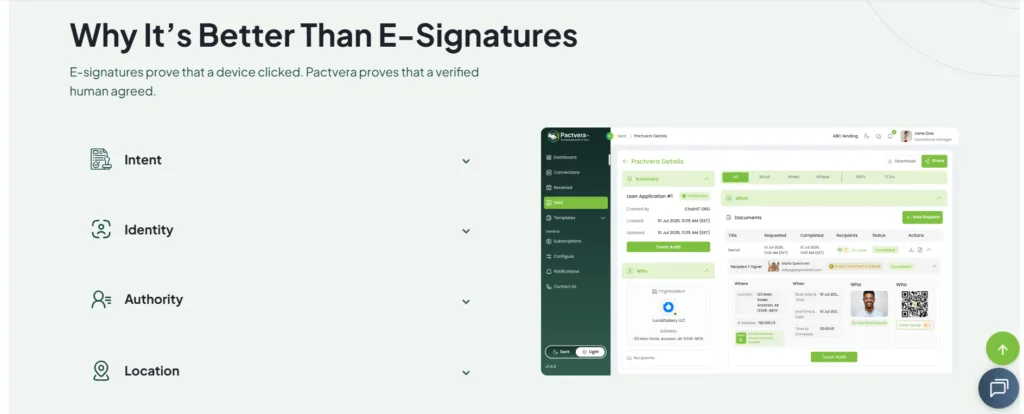
- Verified Human Identity (ChainIT ID): Liveness-verified biometrics + device linkage + MFA to tie actions to a real person.
- Policy-Enforced Eligibility (BRE): Rules for jurisdiction, role, age, deadlines, and prerequisite approvals, agreement cannot finalize if conditions fail.
- Evidence Tokenization (VDT): A structured proof record of who/what/when/where/device and the strength of identity verification, with token grading.
- Interaction Integrity (Touch Audit™): Privacy-preserving, rebuttable-proof audit trail of user actions and consent steps.
- Organizational Authority (ARP): Authority resolution to show the signer was entitled to bind the org.
- Final Court-Ready Artifact (Valitorum): Immutable, timestamped, jurisdiction-tagged agreement artifact sealed with the full evidence trail.
Conclusion
Wallet addresses are powerful cryptographic identifiers, but they are not legal identity. They do not reliably prove who acted, whether they were authorized, whether the required legal and process conditions were met, or whether a contract was formed with defensible intent.
They also do not establish the real-world evidentiary inputs that many regulated workflows still require, such as a bank statement or cash source documentation tied to specific transactions and a documented control trail.
In 2026, evidence-grade agreements require identity, authority, context, and audit integrity that hold up under scrutiny, and Pactvera is built to produce that standard in a single, dispute-ready artifact.
If you want to see how Pactvera packages digital identity proof and authority evidence into a court-ready record with verifiable security controls, book a demo and we will walk you through the evidence trail end to end.
Read Next:
- What Makes a Digital Agreement Legally Binding? (2026 Criteria)
- How Judges Evaluate Digital Contract Evidence in 2026
- Best Digital Contract Software for Immutable Audit Trails
FAQs:
1. Why don’t wallet addresses prove legal identity?
Wallet addresses don’t prove legal identity because they show key control, not a verified human signer, verified authority, or a defensible intent trail.
2. Can a wallet address be used as evidence in court?
Yes, but a wallet address is usually treated as partial technical evidence that an event occurred, not as complete proof of identity, authority, and contract formation.
3. What is the difference between on-chain attribution and legal attribution?
The difference is that on-chain attribution ties actions to keys and addresses, while legal attribution ties actions to verified people or authorized organizations with provable intent and capacity.
4. How does Pactvera link a signer to a real person?
Pactvera links a signer to a real person by using ChainIT ID with liveness verification, device linkage, and MFA, then recording identity strength and context in the VDT and Touch Audit trail.
5. How does Pactvera prove someone had authority to sign for a company?
Pactvera proves authority by resolving organizational signing capacity through ARP and sealing that proof into the agreement’s evidence package.