Online contracts are faster than paper, but speed creates a new problem: proving who actually signed, with what authority, and with what intent, especially when money, IP, regulated workflows, or cross-border counterparties are involved.
Traditional e-signatures mainly prove a click on a device. If a dispute happens, you often end up arguing over emails and IP addresses.
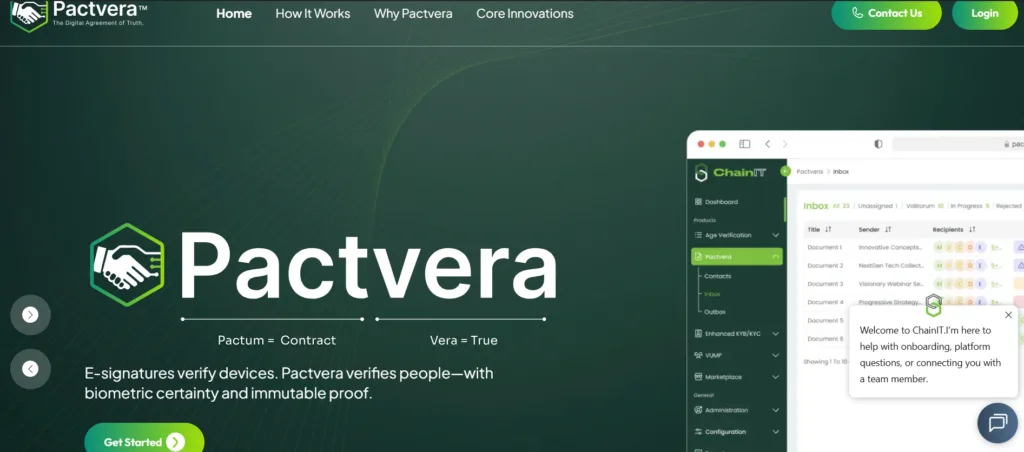
That’s exactly why we built Pactvera: to replace device-click evidence with verified human intent.
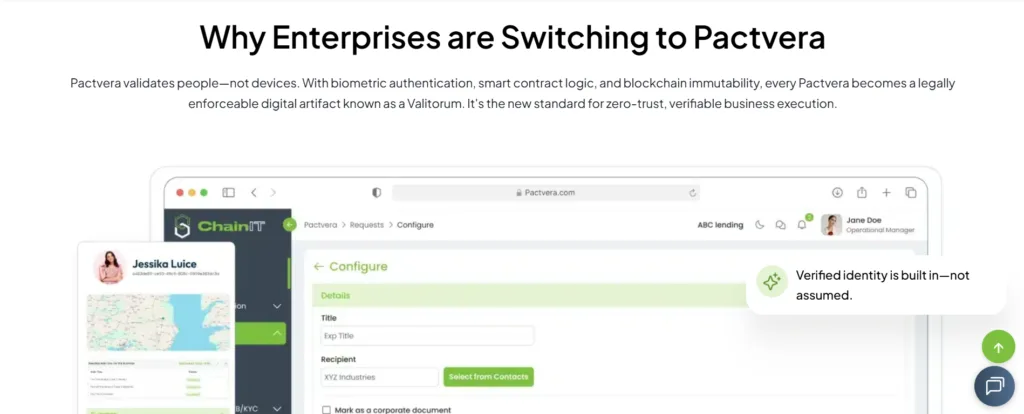
By combining ChainIT’s liveness-verified biometric identity, step-up MFA, and rules that prevent an agreement from finalizing when key conditions fail, Pactvera helps teams execute online contracts with stronger assurance, clearer authority proof, and audit-ready evidence.
Biometric verification changes the evidence model. Instead of relying on a checkbox, you bind the agreement to a liveness-verified human, a specific device session, and a cryptographically sealed record of execution context. That’s what courts, auditors, and enterprise risk teams actually want when the downside is real.
Key takeaways
- Biometric verification strengthens enforceability by proving signer identity, liveness, and intent, not just device access.
- The best workflows also verify organizational role and signing rights, not only the person’s identity.
- Build verification into the contract flow with rules: block finalization if required checks fail.
- Preserve evidence as a tamper-resistant artifact that’s easy to produce in disputes or audits.
- Use privacy-by-design: collect only what you need, minimize retention, and control access to logs.
What is Biometric Contract Verification
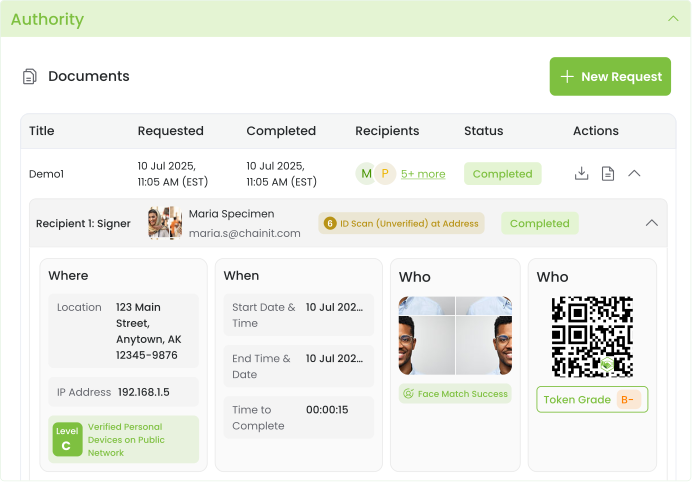
Biometric contract verification is the process of confirming a signer’s presence using biometric signals (commonly facial recognition) with liveness detection, then binding that verified session to the execution event.
A strong biometric verification flow typically proves:
- Identity: the signer is who they claim to be, with liveness-backed assurance.
- Liveness: a real person is present (not a replay or spoof).
- Intent: the signer took affirmative steps to execute the agreement during that session.
- Session integrity: device/session context is captured to support forensic review.
- Authority: the signer had the right role to sign for themselves or their organization.
That last point (role and authority), matters more than many teams realize. A contract can be signed by the right person but still disputed if they weren’t permitted to bind the company.
The Core Components of a Biometric Contract Verification Stack in 2026
To implement biometric verification correctly, think in layers:
1) Identity proofing and liveness
This is where the signer’s biometrics are used to confirm they’re the same real person at signing time.
Minimum bar:
- Liveness detection (active or passive)
- Anti-spoofing protections
- Device binding signals (to reduce session hijacking)
2) Step-up factors (when risk increases)
Biometrics are strong, but pairing them with an additional factor increases resilience.
Choose a second factor that matches your risk model (passkeys, authenticator apps, etc.) and step it up for amendments or high-liability clauses.
3) Rules that prevent invalid execution
This is the “contract cannot finalize if controls fail” layer. Rules should enforce:
- Required assurance level (by contract type)
- Jurisdiction gating (where relevant)
- Role requirements for corporate signers
- Deadline/expiry logic
- Required counterparty approvals
4) Evidence capture and grading
You want a structured evidence record of:
- Who signed, when, where (jurisdiction-aware), and on what device
- Assurance strength and method used
- What version of the agreement was signed (hashing/version control)
5) Tamper-resistant final artifact
A court-ready output should be immutable (or immutability-proven), timestamped, and easy to produce and interpret in disputes.
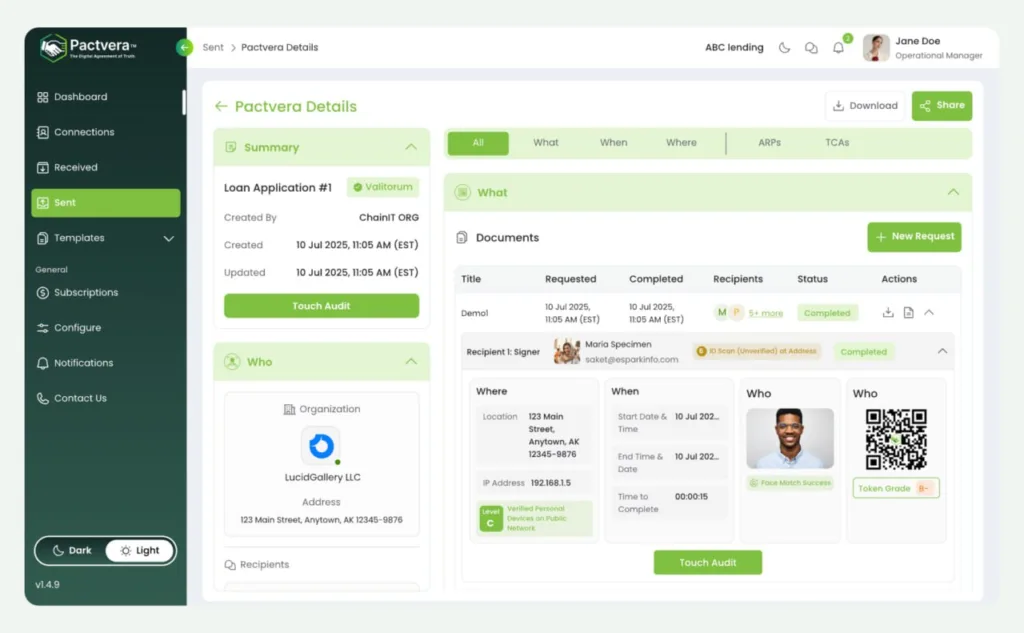
At Pactvera, we design this end-to-end: ChainIT ID + MFA for verified signer assurance, an embedded Business Rules Engine (BRE) so agreements can’t finalize when conditions fail, a Validated Data Token (VDT) that captures execution context and identity strength, Touch Audit™ for a privacy-preserving interaction trail, Authority Resolution (ARP) for organizational signing power, and a final blockchain-sealed artifact (Valitorum) positioned as court-ready evidence.
How to Biometrically Verify Your Online Contracts in 2026
Step 1: Define what must be verified for your contract type
Start with a simple risk matrix:
- Low-risk (internal acknowledgements): basic controls may be enough
- Medium-risk (standard vendor agreements): biometrics + step-up factor + audit trail
- High-risk (regulated, high dollar, cross-border): biometrics + step-up + authority proof + jurisdiction gating + immutable evidence artifact
Decide what minimum controls are non-negotiable before signing can complete.
Step 2: Bind the signer to the signing session (before the final action)
In the signing workflow, require the signer to complete liveness-backed checks before the final acceptance step.
The flow should:
- Verify the signer is present
- Bind the verified session to the signer
- Record the assurance strength for later evidentiary review
In Pactvera terms, this is where ChainIT ID establishes a liveness-verified identity bound to the execution event.
Step 3: Add step-up checks at the right moment
Place the second factor at the point of maximum leverage, typically right before the final “accept” action, or immediately before executing a high-impact clause change.
This reduces risk from compromised devices or intercepted links.
Step 4: Prove organizational signing rights (don’t skip this)
If a signer is executing on behalf of an organization, verify:
- They are an approved role (e.g., GC, CFO, authorized procurement)
- The organization’s identity is proven (Org ID / registry correlation where appropriate)
- The authority record is stored as evidence
Pactvera’s ARP is designed to make this defensible, proving the signer can bind the entity, not just that they are a real person.
Step 5: Enforce rules so the agreement cannot finalize when conditions fail
This is where many contract signing tools fall short, they log what happened, but they don’t prevent the wrong outcome.
Use rule gating so the agreement cannot finalize unless:
- Required identity checks pass
- Step-up factor passes (when required)
- Role/authority requirements are satisfied
- Jurisdiction/age conditions (if applicable) are satisfied
- Required approvals are complete
This creates a clean compliance posture: you’re not hoping people follow process; the system enforces it.
Step 6: Produce a single, dispute-ready evidence package
Your evidence should be coherent, exportable, and consistent, especially when disputes or auditors show up.
A strong package includes:
- Liveness/assurance result
- Step-up completion record
- Timestamp and jurisdiction tag
- Document hash/version identifiers
- Key interaction trail (viewed, consented, accepted), captured responsibly
Pactvera’s VDT + Touch Audit™ are built for this: capturing the “who/what/when/where/how strong” details while keeping evidence privacy-aware.
Step 7: Seal the final artifact for long-term integrity
For high-stakes agreements, preserve the final artifact so it remains verifiable years later, even if systems change.
Pactvera’s Valitorum artifact is designed for long-term integrity with immutability proofs and jurisdiction tagging.
Common Mistakes That Weaken Biometric Verification
- No liveness detection: face match alone is vulnerable to spoofing.
- Verification happens after execution: identity must be bound before the final accept action.
- No role/authority check: the person is real, but may not be permitted to bind the company.
- Rules aren’t enforced: controls exist, but the agreement can still finalize anyway.
- Evidence is scattered: logs across tools, no single dispute-ready package.
Fixing these is often the difference between having logs and having proof.
Why Pactvera is Best Platform for Biometric Contract Verification in 2026
Most platforms optimize for convenience.
Pactvera optimizes for enforceability and dispute resilience:
- Verified human identity via ChainIT ID (liveness + device linkage)
- Step-up MFA embedded in the flow
- BRE logic that blocks finalization when required conditions fail
- VDT evidence capturing execution context and identity strength
- Touch Audit™ interaction trail with privacy-preserving design
- ARP to prove organizational authority
- Valitorum as the immutable, timestamped, jurisdiction-tagged final artifact
If you work wit high-risk agreements, this is the difference between a signed PDF and a defensible execution record.
Conclusion
Biometric verification is how online contracting catches up to real-world risk: it ties your agreement to a liveness-verified human, enforces your rules before execution, and preserves evidence that stands up in disputes and audits.
If you’re evaluating biometric verification for high-stakes agreements, book a demo with Pactvera, and we will walk you through our workflow (identity + authority + BRE gating + court-ready artifact) mapped to your exact contract types.
Read Next:
- Tokenized Consideration Assets: Everything You Need to Know in 2026
- Best Secure Contract Platforms for High-Risk Agreements in 2026
- Know Your Agent (KYA): Can an AI Agent Legally Sign a Contract?
FAQs:
1. What does it mean to biometrically verify an online contract?
To biometrically verify an online contract means confirming a real, present signer via liveness-backed biometrics, then binding that verified session and evidence record to the agreement execution event.
2. Is biometric verification legally enforceable for contracts?
Yes. Biometric verification can materially strengthen enforceability because it improves proof of identity, intent, and execution context, especially when combined with step-up factors, authority proof, and tamper-resistant evidence.
3. What’s the difference between e-signature and biometric contract verification?
The difference between e-signature and biometric contract verification is that e-signatures mainly prove a signing action occurred on a device while biometric verification links the action to a verified, live human signer with stronger evidentiary quality.
4. Do I need biometric verification for every contract?
No. Biometric verification is most useful for high-stakes, regulated, cross-border, or dispute-prone agreements where identity and authority materially matter.
5. How do you prove a signer had authority to sign for a company?
You can prove a signer had authority by verifying their role and binding power, link them to the organization, and store that authority record as part of the evidence package.
6. What evidence should be stored for biometric verification?
Evidence that should be stored for biometric verification is: liveness result, step-up completion record, timestamp and jurisdiction tag, document hash/version identifiers, and a coherent interaction trail, stored in a tamper-evident format.