
In Web3, smart contracts run on decentralized blockchain networks like Ethereum, and most participants interact pseudonymously through wallet addresses.
That design is powerful for composability and open access, but it creates a problem when you need to prove a real person’s identity or eligibility for Web3 contracts that carry legal, financial, or regulatory consequences.
The practical goal is not to doxx users. The goal is to verify specific attributes (real human presence, age threshold, residency, organizational authority, sanctions screening status, accredited status, or credential validity) in a way that preserves decentralization, privacy, and security while still producing evidence that holds up under audit or dispute.
That’s exactly where Pactvera comes in.
Key Takeaways
- Wallet signatures prove key control, not legal identity, authority, or intent.
- The most reliable identity proofing stacks cryptographic proofs with privacy-preserving disclosure and tamper-resistant records.
- A strong identity solution balances off-chain sensitive data with on-chain verification and integrity anchoring.
- For enforceable Web3 contracts, you must prove five things together: identity, intent, authority, integrity, and chain of custody.
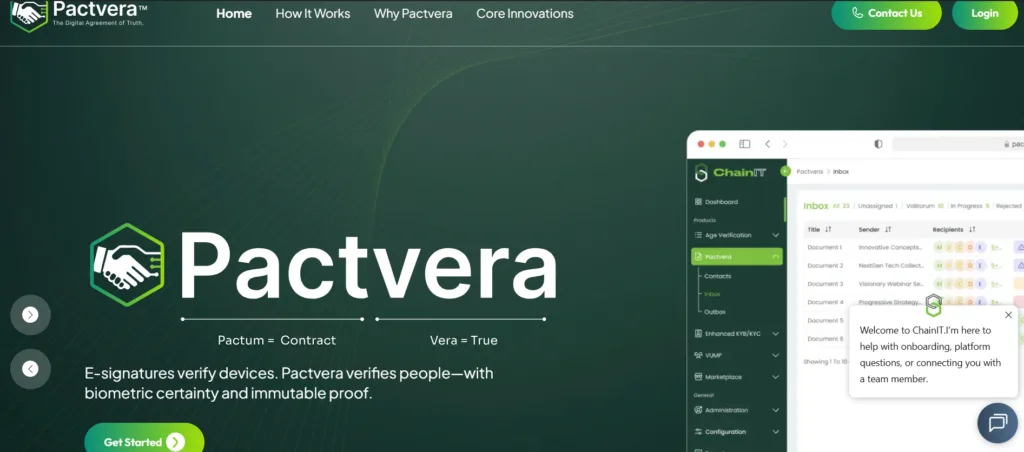
- Pactvera focuses on evidence-grade identity for Web3 contracts by enforcing identity conditions at signing time and sealing the final record for defensible production.
How To Prove Identity In Web3 Contracts: What Actually Works
Key Principles For Effective Identity Proofing
Before methods, the foundations matter more than the tools:
- Cryptographic proofs are non-negotiable: Reliable identity proofing uses signatures, hashes, and verifiable attestations to prevent tampering.
- Privacy preservation is a design requirement: Selective disclosure and zero-knowledge approaches reduce data exposure and breach risk.
- On-chain vs off-chain balance is how systems scale: Keep sensitive data off-chain; put proofs, attestations, and integrity anchors on-chain.
- Standards drive interoperability: W3C Decentralized Identifiers (DIDs) and Verifiable Credentials (VCs) are widely used for portable identity claims.
Effective Methods And How They Work In Smart Contracts
Below are the most practical patterns used across DeFi, DAOs, NFTs, and enterprise Web3 integrations.
1) Wallet Signatures And Address Control
- Description: The user signs a message with a private key to prove they control a wallet address.
- How it works in contracts: The contract (or app) generates a challenge (nonce). The user signs it. The verification step can be handled inside a contract instance written in Solidity, where interface inheritance patterns are commonly used to standardize signature checks across modules.
- Why it’s effective: Simple, native, and cheap. It is the baseline for most Web3 authentication.
- Limitations: It does not prove a real-world person, legal identity, age, nationality, or authority. It is also vulnerable to key theft and delegated signing.
- Best use: Low-stakes gating, basic logins, and as a component inside stronger multi-layer proofing.
2) Decentralized Identifiers (DIDs) With Verifiable Credentials (VCs)
- Description: DIDs act as user-controlled identifiers. VCs are cryptographically signed claims such as over 18, licensed attorney, or verified employee.
- How it works in contracts: Credentials are issued off-chain, often stored in an identity wallet. The user presents a VC proof to the contract (or verifier), which checks issuer signatures and DID control. Hashes or registries may be anchored on-chain to support revocation and auditability.
- Why it’s effective: Supports self-sovereign identity. Users can selectively disclose attributes and rotate keys while preserving continuity.
- Limitations: You still need trusted issuers and a revocation model. Full on-chain verification can be expensive or slow without good architecture.
- Best use: Eligibility checks for compliant DeFi, permissioned DAOs, credential-based access, and enterprise onboarding.
3) Zero-Knowledge Proofs (ZKPs)
- Description: ZKPs prove a statement is true without revealing the underlying data.
Example: proving you are over 18 without revealing date of birth. - How it works in contracts: Proofs are generated off-chain and submitted to verifier contracts that validate the proof and accept or deny an action.
- Why it’s effective: It is the strongest privacy model for compliance-like assertions without exposing PII on-chain.
- Limitations: Circuit design, setup complexity, and compute costs. Engineering maturity matters, and operational tooling can be non-trivial.
- Best use: Privacy-sensitive proofs, anti-sybil gating, eligibility proofs in DAOs, and regulated access where data minimization is critical.
4) Oracles And On-Chain Attestations
- Description: Oracles bridge off-chain identity checks (like document verification or sanctions screening) into on-chain attestations such as pass/fail or risk tier.
- How it works in contracts: A contract queries an oracle or reads an attestation registry. The oracle posts an attestation that the contract treats as a gating input, and many stacks also standardize which state snapshot is referenced through a defaultblock setting to avoid ambiguity in reads.
- Why it’s effective: It connects Web2-grade checks to Web3 execution while keeping raw data off-chain.
- Limitations: Oracle dependency and trust assumptions. Decentralization level and attestation governance become part of your threat model.
- Best use: KYC/AML gating, risk scoring, and integrations with traditional compliance systems.
5) Soulbound Tokens (SBTs) Or Non-Transferable NFTs
- Description: Non-transferable tokens represent credentials or reputation bound to a wallet.
- How it works in contracts: An issuer mints an SBT to a wallet. Contracts check for token ownership before allowing actions.
- Why it’s effective: Easy integration and strong composability. It creates an on-chain reputation layer.
- Limitations: Not private by default. If a wallet is compromised, the credential association is compromised. Also, tokens represent claims, but the evidentiary link to a legal identity may still be weak unless issuance is rigorous.
- Best use: Reputation, participation proofs, credential signaling, and sybil resistance where privacy is not the primary requirement.
Comparison Of Methods For Identity In Web3 Contracts
| Method | Privacy Level | Ease Of Integration | Cost (Gas/Compute) | Best For | Core Drawback |
|---|---|---|---|---|---|
| Wallet Signatures | Low | High | Low | Basic auth, logins | Proves key control only |
| DIDs + VCs | Medium–High | Medium | Medium | Credentials, compliant access | Issuer trust and revocation design |
| ZKPs | High | Medium | High | Privacy-preserving eligibility | Complexity and tooling maturity |
| Oracles / Attestations | Medium | Medium | Medium | Bridging Web2 checks | Oracle trust and governance |
| SBTs / Non-Transferable NFTs | Low–Medium | High | Low | Reputation, achievements | Wallet compromise and low privacy |
What Actually Works: Best Practices And Considerations
1) Use Hybrid Stacks For Real-World Robustness
Most production systems combine methods. A common pattern is VCs for credential issuance, ZKPs for selective disclosure, and on-chain attestations for gating. Wallet signatures remain the session-level glue, not the identity itself.
2) Treat Security As Part Of Identity, Not A Separate Topic
Identity collapses if account takeover is easy. Hardware wallets, passkeys, enforced MFA, and device binding materially improve defensibility, especially when the signer later disputes involvement.
3) Avoid Putting PII On-Chain
The strongest implementations keep sensitive data off-chain and put only proofs, hashes, revocation anchors, and attestations on-chain.
4) For Enforceable Agreements, Prove More Than Identity
If your contract has legal or financial consequences, you must also prove:
- Intent (clear consent to specific terms)
- Authority (ability to bind an organization)
- Integrity (record cannot be altered post-signing)
- Chain of custody (how evidence is preserved and produced)
This is where identity tools often fall short because they focus on authentication, not evidentiary readiness.
How Pactvera Proves Identity In Web3 Contracts
Most Web3 identity stacks are designed for access control. Pactvera is designed for enforceability and dispute readiness, where identity must be packaged as evidence, not inferred from a wallet address.
1. ChainIT ID + MFA For Verified Human Presence
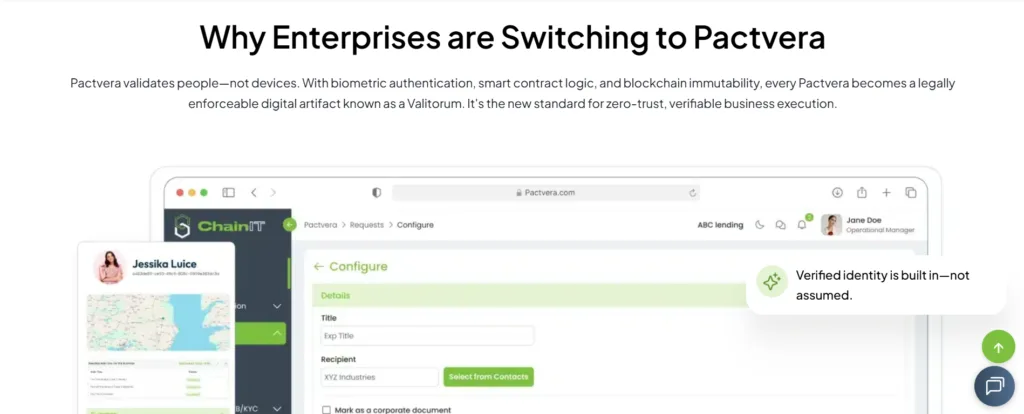
Pactvera uses ChainIT ID to verify a real human with liveness-verified biometrics and device linkage, then applies MFA to harden the signing event against takeover and replay risk.
The identity event is tied to the agreement execution, not stored as a detached verification record.
2. Business Rules Engine That Enforces Identity Conditions
Our embedded Business Rules Engine (BRE) can require identity strength thresholds, jurisdiction or age gating, role-based constraints, and deadline logic. If conditions fail, the agreement cannot finalize.
Enforced controls create consistent, reviewable evidence.
3. Validated Data Token For Evidence Packaging
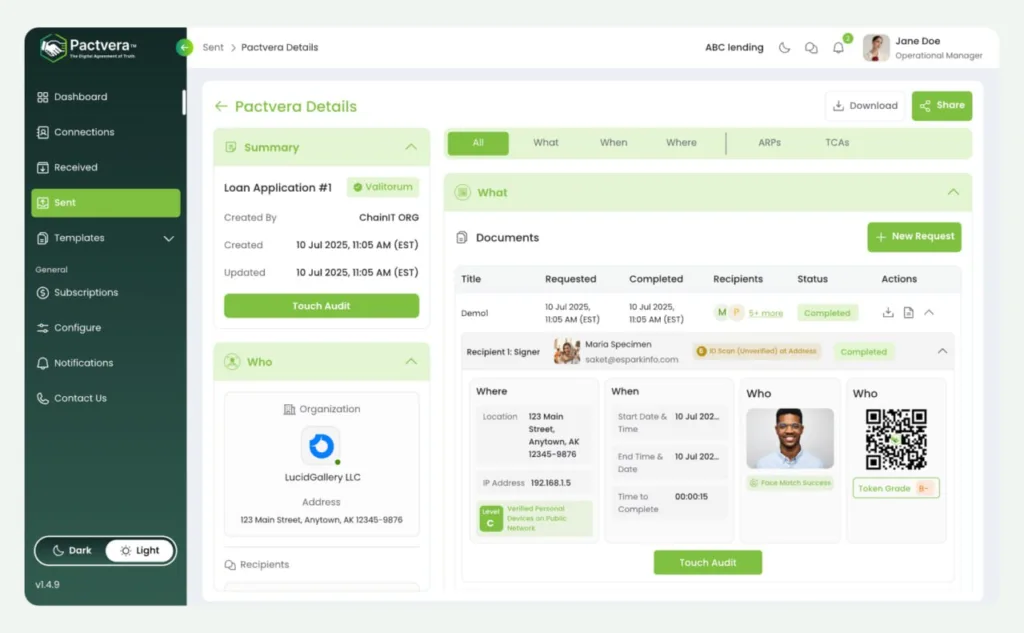
Pactvera generates a Validated Data Token (VDT) capturing who, what, when, where, device context, and identity strength, plus token grading to express evidence quality. This turns identity into a structured artifact a reviewer can evaluate.
4. Touch Audit For Consent And Interaction Proof
Touch Audit creates a privacy-preserving, rebuttable-proof interaction trail that shows the steps taken, the agreement version presented, and the order of consent events. This strengthens intent and reduces ambiguity.
5. Authority Resolution For Organizations
With ChainIT Org ID and Authority Resolution Pactvera (ARP), Pactvera can prove that a signer had authority to bind an organization, not just that a wallet signed something.
6. Valitorum Sealing For Court-Ready Integrity
The finalized agreement is sealed as Valitorum: immutable, timestamped, jurisdiction-tagged, and audit-linked. This supports integrity and chain of custody when the digital contracts record must be produced as evidence.
Conclusion
In Web3, proving identity is not about adding a single KYC step.
What works is a defensible stack: cryptographic verification, privacy-preserving disclosure, enforced authentication, authority proof, and tamper-resistant evidence packaging.
If you want identity proofing for Web3 contracts that is built to survive audits and disputes, book a demo with Pactvera and we will map your current flow to an evidence-grade standard for identity, intent, authority, integrity, and chain of custody.
Read Next:
- 5 Reasons Why Wallet Addresses Don’t Prove Legal Identity
- What Makes a Digital Agreement Legally Binding? (2026 Criteria)
- How Judges Evaluate Digital Contract Evidence in 2026
FAQs:
1. What is the simplest way to prove identity in Web3 contracts?
The simplest method is a wallet signature, but it only proves address control, not a real-world legal identity.
2. Do DIDs and verifiable credentials work for compliant Web3 contracting?
Yes. DIDs and VCs work well for compliant flows because they support issuer-signed claims, revocation models, and selective disclosure.
3. Why are zero-knowledge proofs important for Web3 identity?
Zero-knowledge proofs are important because they let users prove eligibility without revealing sensitive personal data on-chain.
4. Are soulbound tokens enough to prove legal identity?
No. Soulbound tokens can represent credentials or reputation, but they usually do not provide evidence-grade linkage to a legal identity without rigorous issuance and audit trails.
5. What is missing from most Web3 identity solutions when contracts are disputed?
Most solutions miss intent, authority, integrity, and chain of custody evidence, which are required when agreements must be enforced.